
Mastering Air Quality Governance: A Strategic Blueprint for Sustainable Urban Ecosystems
Lessons from Iran and Global Urban Systems
Air Quality Governance as a Strategic Policy Challenge
Air pollution has evolved from a localized environmental concern into a systemic challenge that threatens public health, economic productivity, and urban resilience. Despite decades of investment in monitoring technologies and emission control measures, many cities—including those with established legal frameworks—continue to experience chronic air quality degradation.
This paradox is particularly evident in countries such as Iran, where national air quality laws, monitoring networks, and technical expertise exist, yet outcomes remain limited. The underlying issue is not a lack of data or technology, but a governance gap—characterized by fragmented responsibilities, weak accountability, limited enforcement, and declining public trust.

Air quality governance must therefore be understood as a complex, non-linear regulatory ecosystem, integrating legal, economic, technological, and socio-institutional mechanisms to sustain atmospheric order from local to global scales.
From Air Quality Management to Governance
Traditional air quality management relies heavily on top-down administrative controls, sectoral regulations, and reactive interventions. While such approaches are necessary, they are insufficient in isolation—particularly in complex urban and institutional environments.
Governance, by contrast, encompasses the full range of interactions among public institutions, private actors, civil society, and communities. In the context of Iran, where centralized decision-making structures coexist with diverse pollution sources and social expectations, governance-oriented approaches are essential.
Air pollution is inherently non-linear: changes in traffic flows, energy subsidies, or industrial production can trigger disproportionate and cross-boundary impacts. Governance frameworks allow policymakers to move beyond end-of-pipe solutions toward integrated, preventive, and adaptive strategies.
The Eight Principles of Good Governance in Environmental Policy
Sustainable air quality strategies must be grounded in the principles of good governance, which provide legitimacy, effectiveness, and durability.
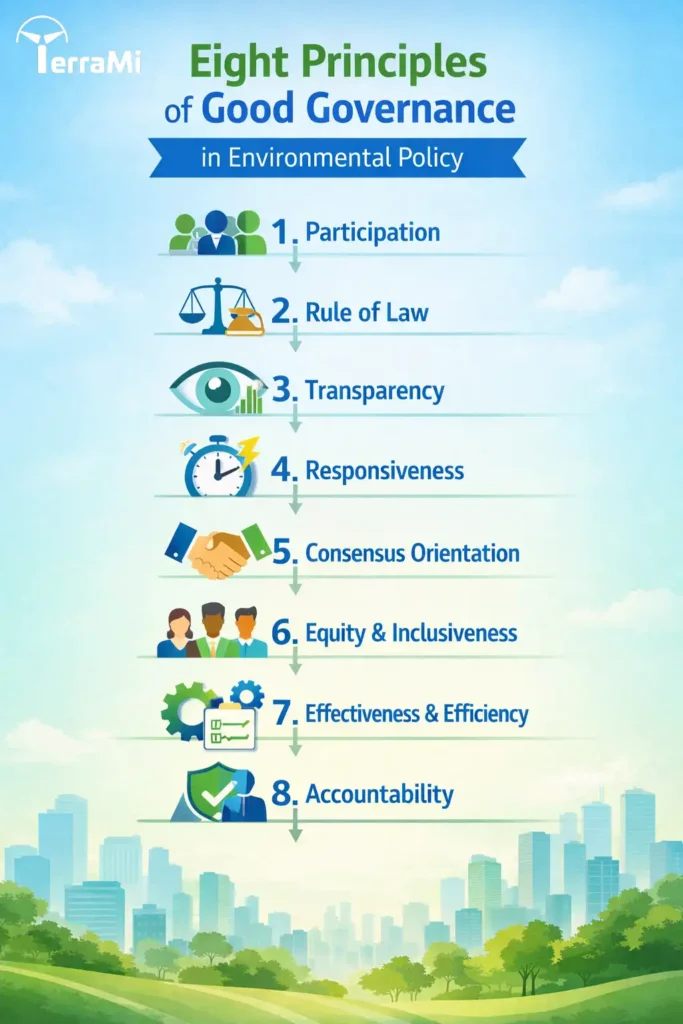
- Participation
Meaningful citizen engagement and stakeholder dialogue are essential, particularly in contexts where public trust in environmental institutions is fragile. - Rule of Law
Clear legal mandates, independent oversight, and consistent enforcement are critical for translating policy into measurable outcomes. - Transparency
Public access to air quality data, regulatory decisions, and environmental budgets strengthens accountability and institutional credibility. - Responsiveness
Governance systems must be capable of timely action during pollution episodes and environmental emergencies. - Consensus Orientation
Balancing economic, social, and environmental priorities requires mediation and inclusive decision-making. - Equity and Inclusiveness
Access to clean air is a matter of environmental justice. Governance systems must address disproportionate exposure and protect vulnerable populations. - Effectiveness and Efficiency
Institutions must deliver tangible improvements while optimizing financial, human, and technological resources. - Accountability
Governments, industries, and civil society organizations must be answerable for their environmental performance.
Governance Models for Complex Airshed Systems
Different governance models produce different outcomes depending on institutional and political contexts.
Bureaucratic and State-Centered Governance
In countries like Iran, centralized governance structures play a key role in setting national standards and policies. However, rigid hierarchies often limit flexibility and local responsiveness.
Network and Collaborative Governance
Collaborative models—bringing together government agencies, municipalities, industries, NGOs, and communities—help overcome institutional silos and improve policy coherence.
Smart and Digital Governance
Digital platforms, real-time monitoring, and data integration enhance transparency and decision-making, particularly in large metropolitan regions.
Adaptive Governance
Environmental, economic, and social conditions are constantly evolving. Adaptive governance emphasizes learning-based regulation and policy adjustment—an essential feature in cities where pollution levels fluctuate daily.
Polycentric Governance
Air pollution transcends administrative boundaries. Polycentric governance distributes authority across local, regional, and national levels, enabling context-specific solutions while maintaining strategic coordination.
Resilience and Adaptive Co-Management
Resilient governance systems can absorb shocks—such as extreme pollution events—without institutional breakdown. Shared management responsibilities enhance legitimacy and long-term sustainability.
Global Benchmarks: Governance in Action
Cities worldwide demonstrate how governance-driven strategies can deliver measurable air quality improvements.
| City | Governance Approach | Key Strategy | Outcome |
| London | Adaptive + Polycentric | Ultra Low Emission Zone | Significant NO₂ reduction |
| Beijing | Polycentric + Resilience | Clean Air Action Plan | 35% PM2.5 reduction |
| Los Angeles | Collaborative | Multi-agency coordination | Historic smog reduction |
| Stockholm | Adaptive Co-Management | Congestion pricing | Lower traffic emissions |
| Delhi | Network + Adaptive | Citizen monitoring & traffic rules | Measurable PM2.5 decline |
These cases reinforce a central lesson: technology succeeds only when governance works.
Hybrid governance models:
Given the complex and multidimensional nature of air quality governance, none of the mentioned methods alone can adequately address improvements in urban air quality governance. Therefore, the only practical and operational approach is to employ an integrated or hybrid system. To this end, by combining one or more governance models, it is possible to strengthen capabilities and address the weaknesses of the system. In Iranian cities and many developing countries, the integrated application of the adaptive co-management model and the network model can achieve sustainable desirable air quality.
Bridging Governance Theory and Practice: The TerraMi Approach
At TerraMi Solutions Inc., air quality governance is not treated as a conceptual framework alone, but as an operational and implementation-ready system.
Building on governance frameworks such as adaptive, networking, and hybrid models, TerraMi focuses on translating policy principles into executable strategies that align regulatory compliance with long-term sustainability and ESG objectives.
Through the integration of digital platforms, environmental intelligence software, and decision-support systems, TerraMi enables the alignment of air quality governance with global environmental targets, smart infrastructure development, and future-ready urban projects.
With demonstrated expertise in system integration, regulatory alignment, and data-driven governance, TerraMi is prepared to support the operational phase of air quality initiatives—bridging governance design with real-world implementation across complex infrastructure environments.
Conclusion: Governance as the Foundation of Clean Air
Air quality governance is one of the defining challenges of contemporary urban development—particularly in countries where institutional complexity, economic constraints, and public trust intersect.
The experience of Iran underscores a broader global truth: clean air is not achieved through technology alone, but through governance systems capable of coordination, adaptation, and accountability. By embracing good governance principles and adopting adaptive, networking, and hybrid models, cities can transform policy ambition into breathable reality.
At TerraMi, this governance-first perspective guides the transition from environmental insight to lasting impact.
🔹 From Policy Insight to Practical Action
While governance frameworks provide the strategic foundation for cleaner air, their success ultimately depends on effective implementation. Cities and institutions seeking to translate air quality policy into measurable outcomes must navigate regulatory complexity, institutional coordination, and evolving environmental risks.
Engaging with multidisciplinary expertise—spanning environmental governance, digital systems, regulatory alignment, and implementation planning—can significantly enhance the effectiveness of air quality initiatives. Expert-led assessments, governance diagnostics, and decision-support tools help identify institutional gaps, align stakeholders, and prioritise interventions with the highest impact.
As urban environments face increasing environmental pressures, informed governance design and implementation readiness become critical enablers of sustainable and resilient cities.