The Digital Core of Infrastructure: Orchestrating ESG and Circularity via the TerraMi Platform
Executive Summary: The Intelligence Gap in Infrastructure
In the multi-billion dollar world of global infrastructure, the most expensive commodity is not steel or concrete—it is verified data. Traditionally, large-scale projects suffer from “Data Silos,” where environmental metrics, social impact data, and circularity performance are scattered across disconnected spreadsheets. To bridge these gaps, the industry is increasingly turning to Infrastructure ESG Management Software, which integrates these fragmented data points into a unified, transparent platform to ensure long-term sustainability and compliance.
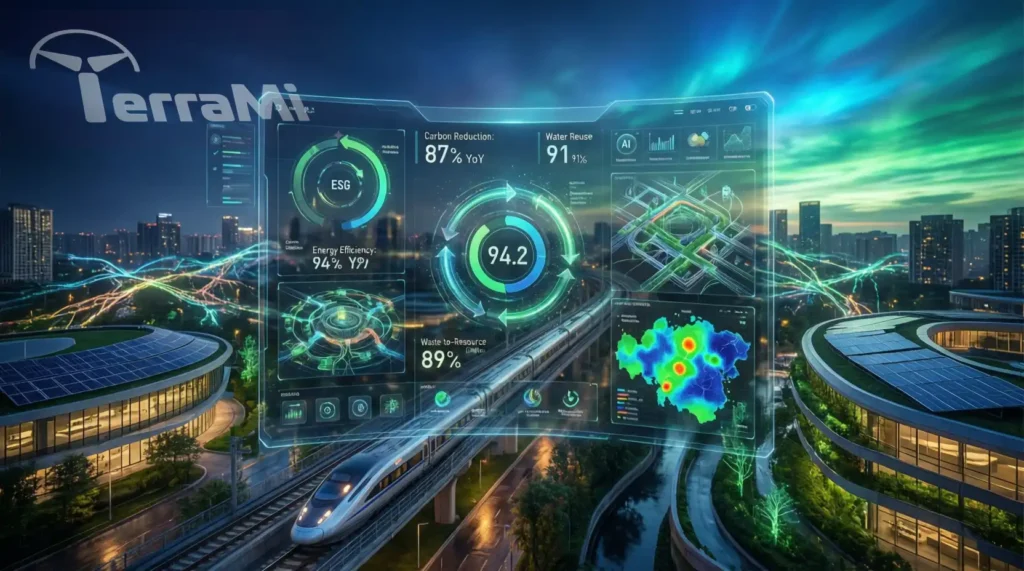
This fragmentation creates a “Compliance Risk” for investors and a “Management Blind-spot” for operators. TerraMi has engineered a specialized software ecosystem to serve as the single source of truth. This article provides a comprehensive deep-dive into how the TerraMi platform orchestrates the complex lifecycle of ESG and Circular Economy (CE) monitoring, from initial framework design to strategic Gap Analysis.
1. The Foundations: Bridging the Knowledge Gap for Leaders
Before diving into the technical architecture, it is essential to understand the core concepts that are reshaping the global infrastructure landscape. For decision-makers and policy-makers, these aren’t just technical terms—they are the language of modern economic resilience.
What is ESG and Why Does it Matter?
ESG (Environmental, Social, and Governance) is a framework used to assess a project’s impact beyond just financial profit.
- Environmental: How does the project affect the planet? (Carbon footprint, water usage).
- Social: How does it treat people and communities? (Safety, labor rights, local impact).
- Governance: How is it managed? (Transparency, anti-corruption, ethical leadership).
- For a Nation: High ESG scores attract foreign direct investment and satisfy international climate treaties.
What is a KPI?
A KPI (Key Performance Indicator) is a vital sign for a project. Just as a doctor checks a pulse to gauge health, a manager checks a KPI to gauge project success. In the TerraMi platform, KPIs are the specific data points—such as “liters of fuel saved” or “tons of recycled steel used”—that prove a project is meeting its promises.
What is the Circular Economy (CE)?
The Circular Economy is a model of production and consumption that involves sharing, leasing, reusing, and recycling existing materials for as long as possible. In infrastructure, it means building today’s roads and bridges in a way that their materials can be “harvested” and reused 50 years from now, rather than becoming waste.
2. Architectural Philosophy: Why “Framework-First” Matters
Most generic ESG tools are essentially “empty boxes”—they provide a database but no direction. TerraMi’s architecture is built on a Framework-First Philosophy. This means the software understands the logic of infrastructure before you even enter your first data point.
2.1 Standardized vs. Bespoke Frameworks
The platform allows users to choose between two primary paths:
- TerraMi Predefined Frameworks: Based on global standards (GRI, SASB, EU Taxonomy), these allow projects to start monitoring immediately without reinventing the wheel.
- Custom Framework Design: For unique projects (e.g., a cross-border rail network or a coastal resilience project), the platform provides the tools to build a bespoke hierarchy of metrics.
2.2 The Hierarchy of Intelligence
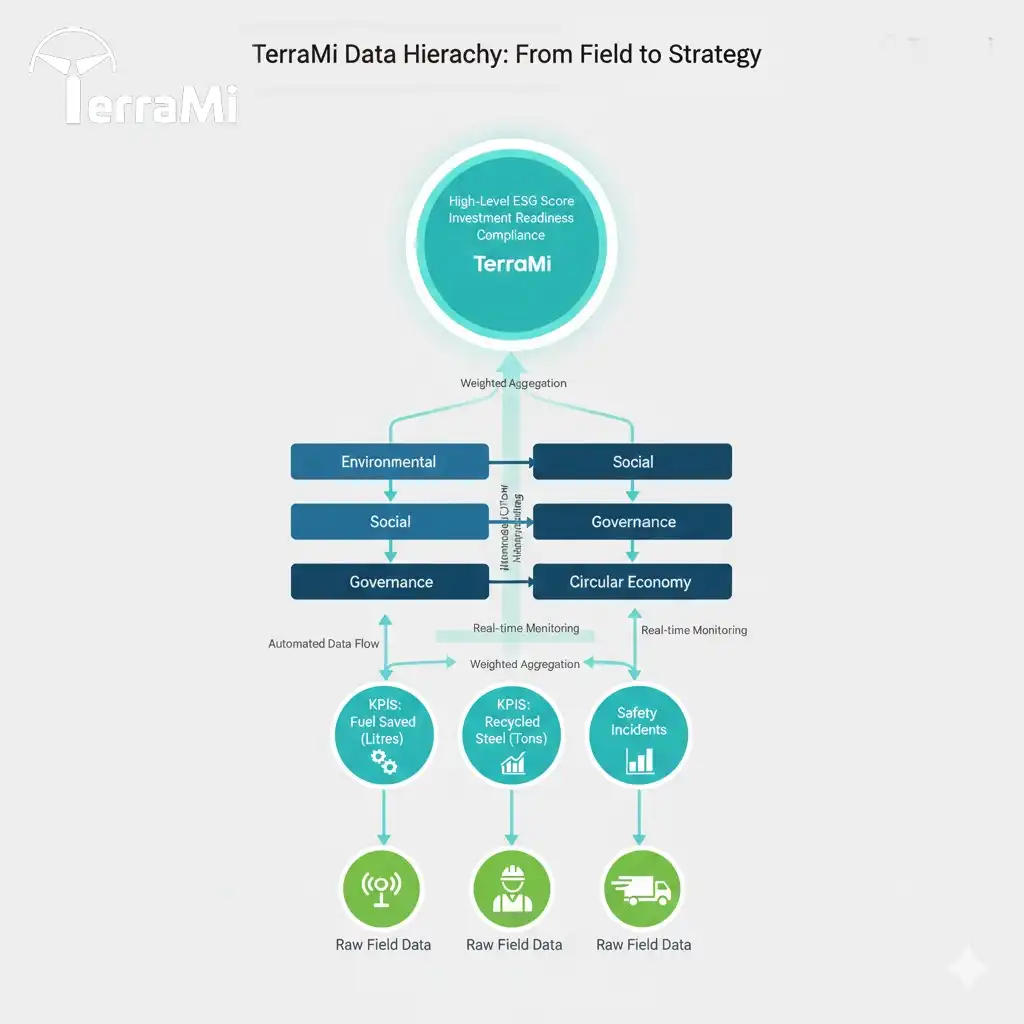
The system organizes data into a logical tree:
- Business Lines: Strategic groupings (e.g., Renewables, Transport, Urban Housing).
- Framework Levels: The broad categories (Environmental, Social, Governance, Circular Economy).
- Parent-Child Relationships: Ensuring that every sub-KPI rolls up into a major strategic objective.
3. The KPI Engine: The Anatomy of a Metric
At TerraMi, we don’t just track numbers; we track Context. A “Metric” in our platform is a rich data object with several layers of intelligence.
3.1 Granular KPI Configuration
When a project manager defines a KPI in TerraMi, they specify:
- Acceptance Value: The minimum threshold for comp
- Weighting: Not all KPIs are equal. A carbon reduction metric may carry more weight than a paper usage metric. TerraMi allows for precise weight distribution to reflect the project’s actual priorities.
3.2 Advanced Calculation Types
The platform supports two types of KPI calculations:
- Single Calculation: Direct data entry (e.g., Total Cubic Meters of recycled concrete).
- Multiple/Formula-Based: Complex KPIs derived from multiple parameters. For example:
- Carbon Intensity = (Total Fuel Consumption * Emission Factor) / Total Square Meters Built. The platform includes a Formula Builder where users can define these parameters, ensuring that the software does the heavy lifting, not the user.
4. Operations: The “Setup Wizard” and Data Orchestration
4.1 The XLSX Integration (Bulk-Mapping)
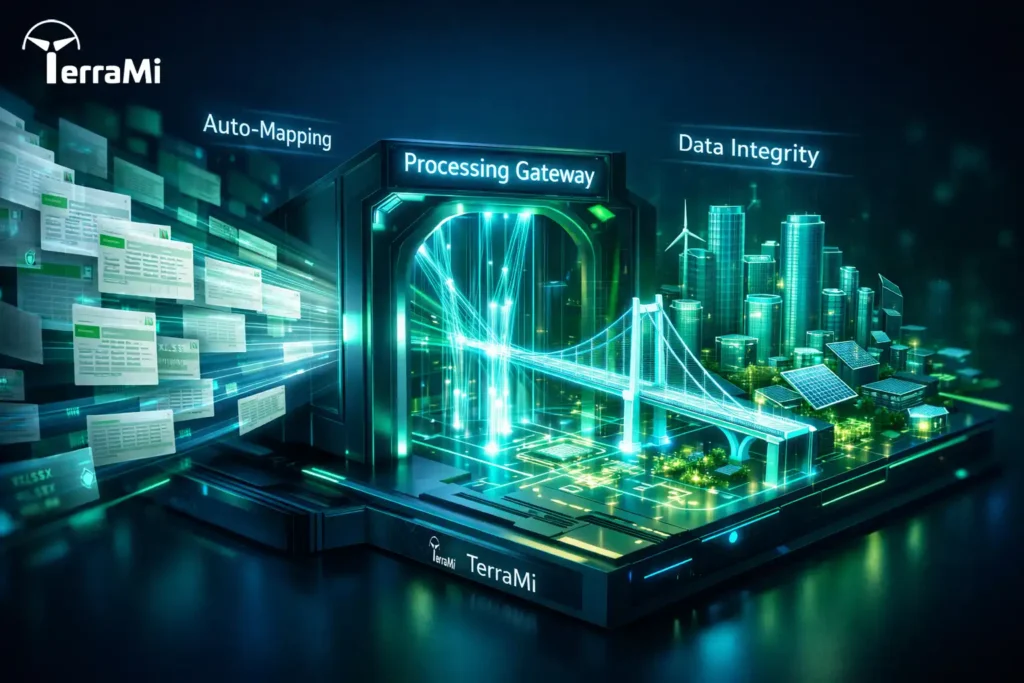
For projects with thousands of data points, manual entry is an invitation for error. The TerraMi Framework Template (XLSX) allows managers to:
- Map their entire existing project structure in Excel.
- Upload it in one click.
- The system automatically builds the digital architecture, defines the KPIs, and sets the permissions.
4.2 Role-Based Data Integrity
Infrastructure projects involve hundreds of stakeholders. TerraMi’s Authentication Module ensures that:
- Field Staff: Can only enter data for their specific section.
- Project Managers: Can approve or edit entries.
- Auditors/Investors: Have read-only access to high-level reports, ensuring transparency without compromising data security.
5. Turning Data into Strategy: The Reporting Suite
Monitoring is useless without Actionable Insights. The TerraMi platform provides two distinct reporting paths.
5.1 The KPI Performance Report (The Operational View)
This report visualizes the “health” of the project in real-time.
- Dynamic Graphs: Visualizing trends over daily, monthly, or yearly periods.
- Weighted Aggregation: Showing how individual KPI performance is impacting the overall ESG score.
5.2 The Gap Analysis Report (The Strategic View)
This is TerraMi’s most powerful feature. It is designed for board-level decision-making.
| Feature | Description | Strategic Benefit |
| Missing Score Calculation | Calculates exactly how far you are from your target. | Identifies underperforming sectors instantly. |
| Prioritized Sorting | Sorts issues from highest “Missing Score” to lowest. | Focuses resources on the biggest risks first. |
| Trend Projection | Predicts if the gap will widen or close based on current data. | Enables proactive rather than reactive management. |
6. Circular Economy (CE) Monitoring: A Specialized Edge
While many platforms handle ESG, TerraMi is a pioneer in Circular Economy (CE) monitoring for infrastructure.
The platform allows for specific tracking of:
- Material Loop Retention: Measuring the percentage of materials diverted from landfills.
- Recycled Content Tracking: Identifying the provenance of “Green Materials” like recycled steel or timber.
- Modular Asset Lifecycle: Tracking the “Digital Passport” status of components to ensure they can be reused at the end of the project’s life.
7. Financing and Compliance: Winning the Green Capital Race
In today’s market, infrastructure projects that cannot prove their ESG credentials face higher interest rates and restricted capital.
7.1 Audit-Ready Documentation
The TerraMi platform generates reports that are directly compatible with the requirements of:
- Equator Principles: For large project finance.
- EU Taxonomy: For European-based or European-funded projects.
- SFDR (Sustainable Finance Disclosure Regulation): Providing the underlying data for financial disclosures.
7.2 Investor Transparency
By providing investors with a dedicated “Dashboard View,” TerraMi builds Data Trust. When an investor can see the real-time Gap Analysis and the corrective actions being taken, the perceived risk of the project drops significantly.
8. The Future: AI and Predictive Infrastructure
As we move toward 2030, TerraMi is integrating AI to move from “Monitoring” to “Prediction.”
- Anomaly Detection: AI identifies data entries that look suspicious or erroneous before they impact the reports.
- Predictive Gap Analysis: Using historical data to warn project managers that they are likely to miss a target 3 months before it happens.
Conclusion: Designing the Resource Banks of Tomorrow
Infrastructure is the skeleton of our society. For this skeleton to be sustainable, it must be intelligent. The TerraMi Software Ecosystem is not just an administrative tool; it is a strategic necessity for the modern infrastructure leader. By transforming raw data into verified KPIs and actionable Gap Analysis, we provide the digital foundation required to build a net-zero, circular future.
Ready to Modernize Your Infrastructure Monitoring?
The TerraMi platform is ready to scale with your project, no matter the complexity.
- Request a Platform Demo
- Download the Full 2025 Product Catalog
- Explore Our Sustainability Frameworks
© 2025 TerraMi. Leading the Convergence of Infrastructure, Intelligence, and Sustainability