The Economics of Circularity: Scaling Infrastructure Through Data-Driven Material Flows
Executive Summary
“The integration of the Digital Construction Material Passport (DCMP) is fundamentally reshaping the global infrastructure sector, marking a transformative era where resource efficiency and financial performance are becoming inextricably linked. As international ESG mandates evolve, the transition from traditional linear models to Circularity Models has emerged as a premier strategic advantage for resilient infrastructure developments. At TerraMi, we redefine the circular economy as a sophisticated re-engineering of material flows, powered by AI-driven insights and integrated logistics. This article explores how forward-thinking leaders are leveraging the Digital Construction Material Passport (DCMP) and Urban Mining to decouple economic growth from resource volatility, effectively turning lifecycle orchestration into a high-yield operational asset.”
1. Unlocking Residual Value: Moving Toward Asset-Centric Supply Chains
For decades, the standard construction trajectory followed a path of production, utilization, and eventual disposal. However, in today’s high-complexity global market, this model is being replaced by an “Asset-Centric” approach. Instead of viewing materials as temporary site inputs, we now recognize them as long-term capital bankable assets.
By transitioning to a circular framework, infrastructure projects can significantly reduce Total Cost of Ownership (TCO). This shift is not merely about environmental stewardship; it is about mitigating the risks of material price volatility and supply chain disruptions. When we design for longevity and recovery, we are essentially “hedging” our bets against future resource scarcity.
The Strategic Shift from Waste to Resource Banks
The term “waste” is becoming obsolete in the vocabulary of modern infrastructure. By viewing every structure as a “Resource Bank,” companies can track the embedded value of steel, concrete, and rare minerals throughout their lifecycle. This proactive management ensures that at the end of an asset’s primary life, its components retain maximum economic utility for future projects.
2. Technological Enablers: Engineering Transparency with AI and DCMP
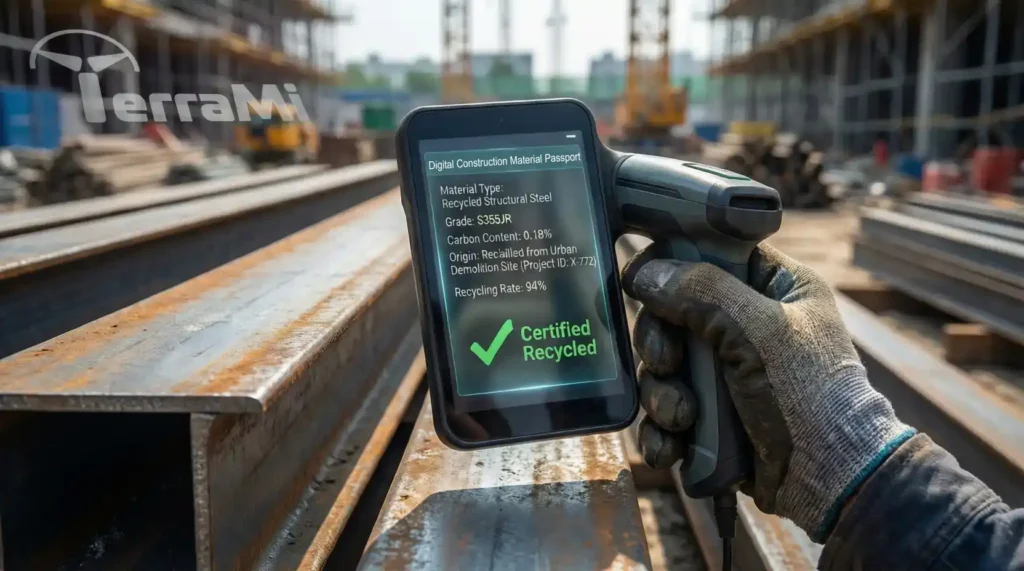
The scalability of circularity depends entirely on the “Digital Core.” Without precise data, circularity remains a manual, non-scalable process. TerraMi’s approach integrates several key technological pillars to ensure that material flows are transparent, predictable, and profitable.
Digital Construction Material Passports (DCMP): The Ledger of Value
Digital Constraution Material Passports (DCMP) are the cornerstone of modern circular supply chains. A DMP acts as a comprehensive digital identity for every material used in a project, recording its origin, chemical composition, maintenance history, and technical specifications.
- Operational Transparency: DMPs allow facility managers to know exactly what is inside their walls, facilitating safe and efficient material recovery decades later.
- Investor Confidence: High-quality data through DMPs increases asset valuation and sustainability by providing a clear audit trail for ESG reporting and compliance.
AI-Driven Lifecycle Orchestration
Artificial Intelligence plays a critical role in predicting the optimal time for material recovery. By analyzing data from Digital Twins and IoT sensors, AI can determine when a component has reached its “secondary life” potential, allowing for seamless handoffs between deconstruction and new construction phases.
3. Scaling Impact: Reducing GHG’s Emissions through Urban Mining
One of the most significant challenges for global infrastructure firms is Reducing GHG’s Emissions. Since a vast majority of a project’s carbon footprint lies within its supply chain, circularity provides a direct pathway to decarbonization.
The Rise of Urban Mining in Infrastructure
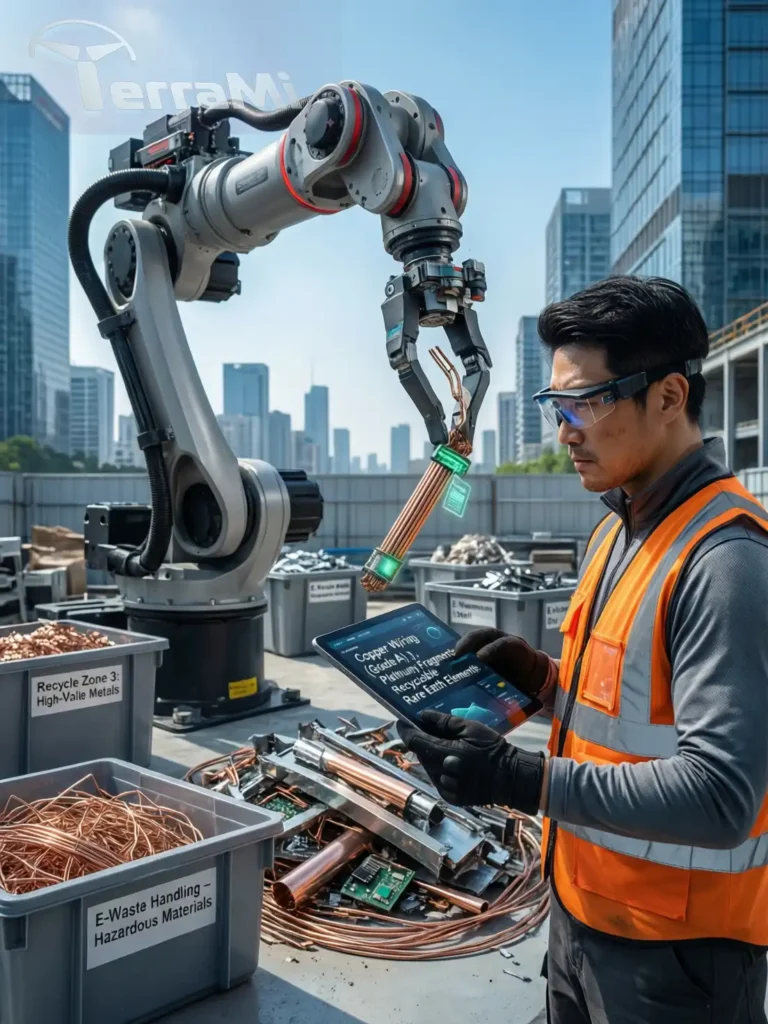
Urban Mining—the process of reclaiming raw materials from existing structures—is no longer a niche concept; it is a multi-billion dollar opportunity. By sourcing materials locally from the “urban mine,” projects can:
- Lower Logistics Costs: Reducing the distance materials travel decreases fuel consumption and transportation emissions.
- Ensure Regulatory Compliance: Meeting increasingly strict circular economy regulations in markets like Canada, the EU, and the Middle East.
- Enhance Community Resilience: Creating local jobs in material processing and specialized deconstruction.
4. The Global Imperative: Navigating International ESG Mandates
From North America to the Asia-Pacific region, the regulatory landscape is shifting toward mandatory circularity. Investors and sovereign wealth funds are increasingly prioritizing projects that demonstrate a clear “Closed-Loop” strategy.
- Financial Resilience: Assets designed with circular principles often enjoy lower insurance premiums and better financing terms due to their reduced risk profile.
- Market Leadership: Companies that adopt these frameworks early are setting the standards for international infrastructure, positioning themselves as the partners of choice for large-scale, sustainability-focused developments.
5. Conclusion: Lifecycle Orchestration as a Competitive Edge
Redefining material flow requires a fundamental shift in mindset from “Project Completion” to “Lifecycle Orchestration.” For global infrastructure leaders, the circular supply chain offers more than just a path to sustainability—it offers a blueprint for long-term economic resilience.
At TerraMi, we believe the assets we build today must be engineered as the resource banks of tomorrow. By leveraging AI-driven data and ESG-centric frameworks, we are not just building infrastructure; we are engineering a regenerative future where “waste” is transformed into a relic of the past, and every material flow is an opportunity for value creation.
Ready to Optimize Your Material Lifecycle?
The transition to a circular supply chain is a strategic journey that requires precision, data integrity, and expert orchestration. Whether you are looking to integrate Digital Construction Material Passport into your next project or seeking advanced strategies to reduce GHG emissions, our team at TerraMi is here to help you navigate the complexities of modern infrastructure.
Contact our consultants today to discuss how we can tailor our AI-driven insights and ESG-centric frameworks to your specific operational needs. Let’s engineer the future of resilient infrastructure together.