
Strategic Mastery of Green Procurement in Infrastructure: An ESG Blueprint
How Infrastructure Leaders Can Turn Procurement into a Strategic ESG Lever
What Is Green Procurement in Infrastructure?
Green procurement is the systematic integration of environmental and social criteria into purchasing decisions, alongside price and quality. In high-stakes infrastructure, this includes:
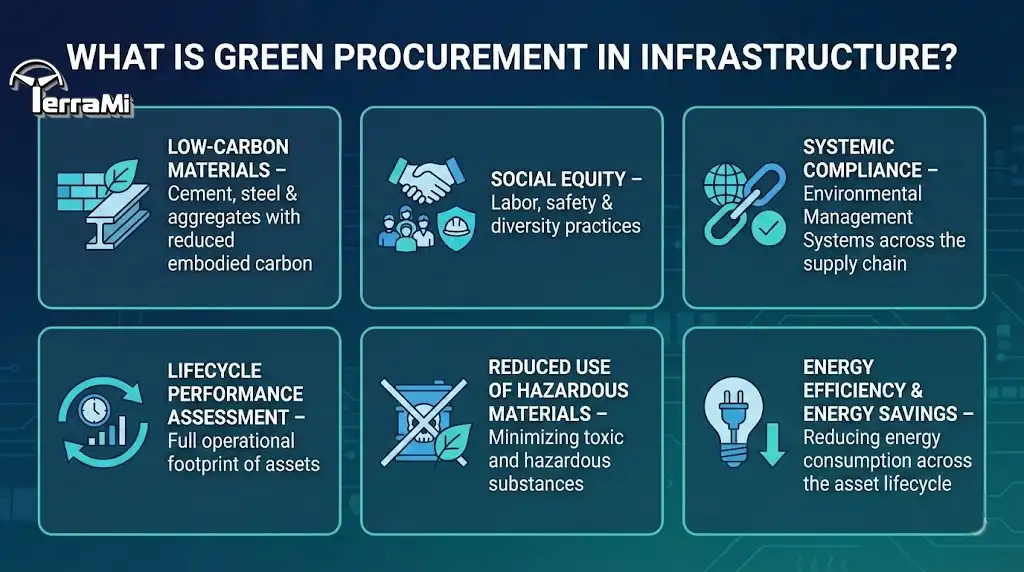
- Low-carbon materials: Selection of cement, steel, and aggregates with reduced embodied carbon.
- Social Equity: Evaluation of contractors’ labor, safety, and diversity practices.
- Systemic Compliance: Requirements for Environmental Management Systems (EMS) across the supply chain.
- Lifecycle Performance: Assessing the full operational footprint of equipment and technologies.
- Reduced use of hazardous materials: Minimizing toxic and hazardous substances across materials, equipment, and construction processes.
- Energy efficiency and energy savings: Reducing energy consumption across the full asset lifecycle through efficient technologies and operational practices.
In practice, Green Procurement in Infrastructure operationalizes ESG commitments by hardwiring environmental and social performance into sourcing decisions, supplier governance, and lifecycle cost accountability.
Common Pitfalls to Avoid in Strategic Implementation
Implementing a transition toward sustainable supply chains is rarely a linear process. To ensure that Green Procurement in Infrastructure moves beyond a corporate slogan and into operational reality, leaders must navigate the following structural traps:
Neglecting the “S” in ESG (Social Tunnel Vision): Often, procurement focuses so heavily on “Green” (Environmental) that it ignores the “Social.” Pitfalls include failing to audit deep-tier suppliers for fair labor practices or missing opportunities for local community wealth building. A holistic framework must ensure that ethical sourcing is as rigorous as carbon accounting.
The Checklist Trap (Process vs. Impact): Many organizations fall into the “compliance-only” mindset, treating ESG requirements as a static set of boxes to tick during the pre-qualification phase. This superficial approach fails to incentivize true innovation. Instead, procurement teams must embed ESG performance directly into core Procurement KPIs, treating carbon intensity and social equity as equal in weight to traditional delivery milestones.
The Upfront Price Overweighting: A persistent barrier to Green Procurement in Infrastructure is the obsession with lowest-bid-wins models. By focusing exclusively on initial CapEx, decision-makers often ignore the “Green Premium” that delivers massive OpEx savings over the asset’s 30-to-50-year life. Failure to account for carbon taxes, rising energy costs, and climate-risk insurance premiums leads to a “false economy” that undermines long-term project viability.
Data Silos and The “Auditability Gap”: Without an integrated digital ecosystem, ESG data often sits in disconnected spreadsheets, far from the reach of procurement officers. This lack of transparency leads to “Greenwashing” risks. Real-time, auditable data collection is not a luxury; it is the only way to prove to investors and regulators that your material choices—such as recycled steel or low-alkali cement—actually meet the promised environmental benchmarks.
As ESG frameworks mature, procurement teams are being repositioned from transactional buyers to strategic enablers. Green procurement is no longer niche; it is a core competency for organizations seeking resilience and regulatory alignment.
The TerraMi Advantage: Traditional vs. Green Procurement
To understand the strategic shift, we must look at how green procurement redefines the “value” of a contract:
| Feature | Traditional Procurement | TerraMi’s Green Procurement Approach |
| Primary Metric | Lowest Upfront Cost | Total Cost of Ownership (TCO) & ESG Risks |
| Supplier Scope | Direct Tier-1 Vendors | Multi-tier Traceability |
| Risk Assessment | Financial & Technical Only | Environmental, Social, and Regulatory Resilience |
| Data Usage | Static Compliance Checklists | Real-time AI Dashboards & Comparable KPIs |
Why Green Procurement Creates Strategic Value
For infrastructure developers, this approach delivers value across four dimensions:
- Risk Management: Screening suppliers against ESG Risks reduces exposure to regulatory penalties, schedule disruptions, and reputational damage.
- Lifecycle Cost Optimization: Using Lifecycle Costing (LCC) enables teams to reduce maintenance cycles and improve long-term asset reliability.
- Investor Confidence: Demonstrating credible procurement practices signals operational discipline to financiers and public-sector clients.
- Regulatory Future-Proofing: Organizations with embedded ESG processes are structurally better positioned for evolving global standards.
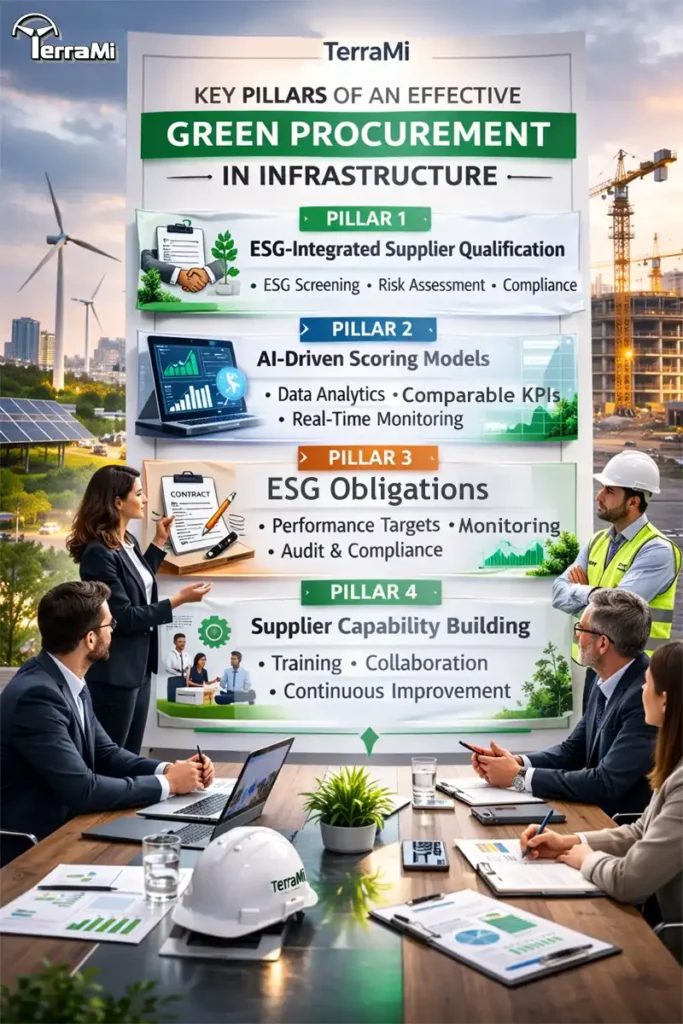
Key Pillars of an Effective Green Procurement Framework
Pillar 1: ESG-Integrated Supplier Qualification
Beyond financial stability, qualification must now include ESG indicators such as carbon footprint reporting capabilities and anti-corruption frameworks. At TerraMi, this transforms onboarding into a governance control point.
Pillar 2: AI-Driven Scoring Models
ESG metrics should have formal weighting in tender evaluation. By leveraging AI and data analytics, we can move beyond manual scoring to predictive models that assess a supplier’s long-term climate resilience and alignment with Net-Zero goals.
Pillar 3: ESG Obligations
Commitments must be translated into enforceable contracts, including:
- Mandatory reporting on environmental and social performance.
- Monitors all KPIs related to ESG
- Audit rights and compliance verification mechanisms.
- Corrective action protocols for non-compliance.
Pillar 4: Supplier Capability Building
Leading organizations invest in their ecosystem through ESG training and standardized reporting templates. This is especially vital for SMEs within the global supply chain to reduce systemic risk.
Implementation Roadmap
- Policy Alignment: Define clear sustainability objectives.
- Standardization: Create ESG metrics and reporting requirements for all vendors.
- Integration: Update RFPs and evaluation templates.
- Training: Build internal capacity to assess ESG performance consistently.
- Monitoring: Use digital dashboards to track and audit performance continuously.
The Strategic Takeaway
Green procurement is not a peripheral initiative—it is a strategic operating model. By embedding ESG into the commercial backbone of projects, infrastructure leaders can future-proof operations against scrutiny while driving real-world impact. For TerraMi, this means sustainability is part of how projects are bought and built, not just an afterthought in a year-end report.
Without Green Procurement in Infrastructure, ESG strategies remain disconnected from commercial reality, leaving organizations exposed to regulatory risk, lifecycle cost overruns, and supply-chain fragility.
Frequently Asked Questions (FAQ)
1. How does Green Procurement differ from traditional cost-saving strategies? Traditional procurement prioritizes the lowest upfront price, often ignoring long-term liabilities. Green Procurement at TerraMi utilizes Lifecycle Costing (LCC), which accounts for carbon taxes, energy efficiency, and waste management costs over the asset’s entire life, often proving more economical in the long run.
2. Can Small and Medium Enterprises (SMEs) comply with these rigorous ESG standards? Yes. While standards are high, the framework includes Supplier Capability Building. We provide standardized reporting templates and technical guidance to help smaller vendors align with global ESG requirements without being excluded from the supply chain.
3. How is “Greenwashing” prevented in supplier contracts? Prevention is built into Pillar 3: Contractual ESG Obligations. We move beyond “intent” by embedding mandatory reporting, audit rights, and clear corrective action protocols directly into the legal language of the contract.
4. What role does technology play in monitoring supply chain sustainability? Technology is the backbone of transparency. We use ESG Performance Dashboards and digital tools to collect and validate real-time data from multiple tiers of the supply chain, ensuring that sustainability isn’t just a claim, but a measurable fact.
5. Does Green Procurement impact project timelines? Initially, the integration phase requires careful planning. However, by identifying high-risk or non-compliant suppliers early through ESG-Integrated Qualification, we prevent mid-project disruptions and regulatory bottlenecks that typically cause major delays