
From Policy to Projects: How Governments and Infrastructure Leaders Enable ESG at Scale
Future-Ready Infrastructure cannot be delivered by policy alone, nor can it be scaled by corporate execution in the absence of enabling national frameworks. As climate volatility intensifies, capital constraints tighten, and ESG regulation matures, infrastructure leaders are confronting a structural truth: the transition from sustainability commitments to operational impact requires a coordinated model in which governments define the enabling environment while companies operationalize delivery at asset and portfolio levels. In practice, Future-Ready Infrastructure emerges only when policy, finance, standards, data, and execution models are aligned across public and private actors.
This article examines why ESG at scale depends on this two-level operating model—and how leading countries and infrastructure leaders are making it work in practice.
The Policy–Execution Gap: Why ESG Stalls at Scale
Many national strategies articulate ambitious goals for decarbonization, resilience, and digital transformation. Yet execution frequently lags. The reasons are structural:
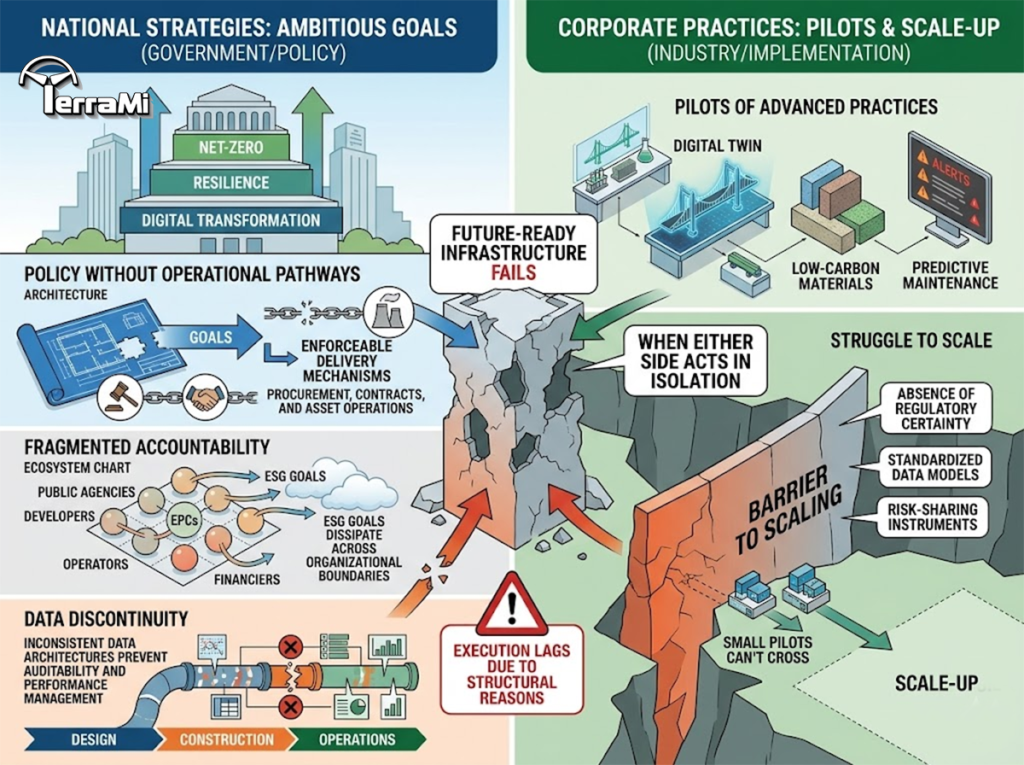
- Policy without operational pathways: National strategies often define outcomes (net-zero, resilience) without embedding enforceable delivery mechanisms in procurement, contracts, and asset operations.
- Fragmented accountability: Infrastructure portfolios are delivered by ecosystems of public agencies, developers, EPCs, operators, and financiers. Without integrated governance, ESG goals dissipate across organizational boundaries.
- Data discontinuity: Even when standards exist, inconsistent data architectures prevent auditability and performance management across design, construction, and operations.
Conversely, corporate leaders may pilot advanced practices—digital twins, low-carbon materials, predictive maintenance—yet struggle to scale them in the absence of regulatory certainty, standardized data models, and risk-sharing instruments. Future-Ready Infrastructure therefore fails when either side acts in isolation.
A Two-Level Operating Model for ESG at Scale
To institutionalize Future-Ready Infrastructure, roles must be explicit and complementary:
Governments (Enablers of Scale)
- Set standards and codes for carbon, resilience, safety, and data interoperability.
- Provide risk-reducing finance and blended instruments to crowd in private capital.
- Establish national data architectures to support audit-grade ESG reporting and digital twins at city/portfolio scale.
- Anchor long-term certainty so investors and operators can commit capital to multi-decade assets.
Infrastructure Leaders (Operators of Impact)
- Translate policy into operational controls: ESG KPIs embedded in contracts, procurement, and O&M.
- Deploy digital twins and AI-native planning to manage performance across asset lifecycles.
- Build capability across the supply chain to meet carbon, resilience, and data standards.
- Institutionalize continuous assurance to prevent greenwashing risk and protect asset value.
When these roles are aligned, Future-Ready Infrastructure becomes a repeatable operating model rather than a one-off pilot.

Global Case Snapshots: How Alignment Unlocks Scale
Germany — Policy Certainty + Industrial Execution
Germany’s long-term energy transition frameworks provide regulatory certainty around grid modernization, renewable integration, and building performance. This certainty has enabled utilities, contractors, and city operators to invest in digital substations, grid-edge intelligence, and low-carbon construction methods. The lesson for Future-Ready Infrastructure is not that policy replaces execution—but that stable codes and incentives de-risk corporate investment in digital operations and resilience engineering.
Transferable insight: Long-horizon policy signals enable companies to embed AI-enabled planning and lifecycle carbon management into capital programs without fear of regulatory whiplash.
Netherlands — National Risk Frameworks + Engineering Innovation
The Netherlands’ national flood-risk governance sets non-negotiable resilience baselines. Within that framework, engineering firms and operators deploy digital twins to simulate hydrological scenarios and optimize asset reinforcement strategies. Future-Ready Infrastructure here is the product of policy-defined risk thresholds combined with corporate-led digital execution.
Transferable insight: Governments should define resilience thresholds; companies should operationalize them through data-driven asset management.
Singapore — Data Standards + Operational Digital Twins
Singapore’s national digital and urban planning standards enable city-scale data interoperability. Operators leverage this foundation to run portfolio-level digital twins for transport, water, and energy assets—enabling predictive maintenance, carbon operations, and resilience testing. This coupling of standards with operational technology is a hallmark of Future-Ready Infrastructure.
Transferable insight: National data standards are prerequisites for scaling digital twins beyond pilots into operating systems of infrastructure portfolios.
United Arab Emirates — Capital Mobilization + Delivery Velocity
Large-scale public investment programs in the UAE have catalyzed private-sector execution of smart grids, clean mobility, and low-carbon construction. The state reduces capital risk; infrastructure leaders deliver at speed. Future-Ready Infrastructure in this context is accelerated by public capital aligned with corporate execution capability.
Transferable insight: Blended finance accelerates adoption of net-zero operations and digital asset management when paired with strong delivery partners.
Japan — Codes for Resilience + Predictive Operations
Japan’s seismic codes define stringent resilience requirements. Operators and technology partners extend these standards through predictive maintenance and sensor-driven monitoring to minimize downtime after shocks. Future-Ready Infrastructure emerges from legally enforced resilience combined with corporate innovation in operations.
Transferable insight: Mandatory resilience codes create the floor; predictive operations create performance differentiation.
Why Policy Alone Fails
Relying exclusively on government action produces predictable failure modes:
- Implementation drag: Regulatory cycles lag technological change, delaying adoption of AI-native planning and digital twins.
- Underutilized data: Standards without operational integration result in reporting artifacts rather than performance management.
- Weak incentives: Without performance-linked contracts, ESG remains aspirational.
Implication for Future-Ready Infrastructure: Policy must be designed with operationalization in mind—procurement rules, contract structures, and data interoperability baked in from the outset.
Why Corporate Action Alone Doesn’t Scale
Corporate pilots struggle to scale without national enablers:
- Regulatory uncertainty increases cost of capital for multi-decade assets.
- Data fragmentation prevents portfolio-level optimization and audit-grade assurance.
- Systemic risk exposure persists without national resilience thresholds and insurance frameworks.
Implication for Future-Ready Infrastructure: Corporate excellence requires enabling policy to move from pilot projects to portfolio transformation.
An Action Framework to Institutionalize ESG at Scale
For Governments
- Codify resilience and carbon thresholds in building and infrastructure codes.
- Standardize ESG data models to enable auditability and digital twins at scale.
- Deploy blended finance instruments to de-risk net-zero and adaptation investments.
- Align procurement rules with lifecycle performance and circularity objectives.
For Infrastructure Leaders
- Embed ESG KPIs into contracts with enforceable incentives and penalties.
- Operationalize digital twins as portfolio management systems.
- Adopt AI-native planning for scenario optimization and capital allocation.
- Build supplier capability to meet data, carbon, and resilience standards.
- Institutionalize continuous assurance to prevent greenwashing risk.
This framework converts Future-Ready Infrastructure from strategy into an operating discipline.

Financing the Transition: ESG as a Cost-of-Capital Lever
Capital markets increasingly price transition risk. Portfolios aligned with national standards and operated with audit-grade ESG controls attract preferential financing terms. The practical effect is that Future-Ready Infrastructure lowers weighted average cost of capital by reducing regulatory, operational, and reputational risk. This financial signal is the missing link that aligns policy intent with corporate execution incentives.
Workforce and Governance: The Hidden Enablers
Scaling Future-Ready Infrastructure requires governance and talent transformation:
- Hybrid skill sets: Systems engineering, data science, climate risk, and commercial governance embedded in PMOs.
- Operating governance: Executive dashboards with real-time ESG KPIs tied to accountability.
- Ecosystem alignment: Supplier upskilling to meet digital and ESG thresholds.
Without these enablers, even aligned policy and finance will underperform.
The Strategic Takeaway

Future-Ready Infrastructure is not delivered by governments or companies alone. It is institutionalized through a two-level operating model in which policy defines the enabling environment and infrastructure leaders convert that environment into measurable performance at asset and portfolio levels. Countries that align standards, finance, and data architectures with corporate execution will scale ESG outcomes faster—while infrastructure leaders that operationalize digital twins, AI-native planning, and enforceable ESG KPIs will outperform on resilience, lifecycle cost, and investor confidence.