
ESG Metrics That Shape On-Site Behavior: Linking Measurement Systems to Operational Reality in Infrastructure Projects
The evolution of Environmental, Social, and Governance (ESG) frameworks in infrastructure projects has reached a critical juncture. ESG metrics in infrastructure projects are no longer limited to compliance reporting; they are increasingly being used as operational tools that directly influence decision-making and on-site behavior. This shift marks the transition from static disclosure models to what is often described as “ESG 2.0”—a more dynamic approach where sustainability metrics are embedded into daily execution and governance processes.
At the core of this transformation is the selection of Key Performance Indicators (KPIs) that do more than measure outcomes. They actively shape workforce behavior, operational priorities, and risk perception on construction sites. Poorly designed ESG metrics can obscure real operational risks, while well-calibrated indicators can surface inefficiencies and improve governance performance.
At TerraMi, this perspective aligns closely with the importance of ESG governance in infrastructure operations, where measurement systems are treated not as reporting tools, but as mechanisms that influence real-world project execution.
The Strategic Role of ESG Metrics in Infrastructure Projects: Analyzing the Observer Effect
In physics, the observer effect describes how the act of measurement inevitably influences the system being measured. A similar dynamic applies to ESG metrics in infrastructure projects, where measurement frameworks do not simply record performance but actively shape it.
When a specific ESG indicator is elevated to a primary performance KPI, organizational behavior tends to align directly with its optimization. For example, if “carbon intensity per cubic meter of concrete” becomes the dominant metric, procurement and engineering teams will naturally prioritize solutions that reduce this value, often driving material innovation and efficiency improvements.
However, without a holistic ESG framework, this optimization can introduce unintended consequences. Cost-driven substitutions, extended supply chains, or untested material alternatives may reduce carbon metrics while increasing social risk exposure or long-term asset maintenance costs.
This effect emerges because ESG metrics effectively define the operational “rules of the game” for site managers and subcontractors. In high-pressure construction environments—where schedules are compressed and margins are constrained—teams will rationally optimize toward what is measured and reported at the corporate level.
For this reason, ESG governance frameworks in infrastructure operations must be designed with behavioral responses in mind, ensuring that performance measurement does not distort project-wide risk distribution, as discussed in Operational ESG in Infrastructure Projects.
Obscuring Risk: The Danger of Lagging Indicators

One of the most significant risks in contemporary infrastructure is the over-reliance on lagging indicators—metrics that record what has already happened. In the “Social” pillar of ESG, the most common lagging indicator is the Lost Time Injury Frequency Rate (LTIFR). While essential, LTIFR only measures failure. If a site reports an LTIFR of zero, it does not necessarily mean the site is safe; it could mean the site is lucky, or worse, that a culture of under-reporting has developed to protect bonuses tied to safety performance.
When metrics are used as a cudgel rather than a diagnostic tool, they obscure the very risks they are meant to manage. An obsession with “green” checklists can lead to a culture of “checkbox sustainability,” where the paperwork is flawless but the actual environmental impact on-site remains unaddressed. This creates a “blind spot” in project governance, where management believes the project is meeting ESG commitments while the operational reality is diverging toward a catastrophic failure or a significant ESG breach.
Revealing Risk: The Power of Integrated ESG Data
To address the limitations of lagging KPIs, ESG 2.0 frameworks increasingly emphasize the use of leading indicators and integrated data systems. A leading indicator is a predictive metric that signals future performance outcomes rather than documenting historical results. In the context of ESG metrics in infrastructure projects, this shift enables organizations to detect operational and environmental risks before they materialize.
For example, instead of solely tracking waste volume, modern ESG systems may measure indicators such as “percentage of materials reused in real time” or “engagement levels in environmental risk assessments.” These metrics provide early signals about the operational health of a project and the maturity of its sustainability culture.
This transition is strongly aligned with global trends in data-driven sustainability and digital infrastructure monitoring, as highlighted by initiatives such as the World Economic Forum’s work on digital transformation in infrastructure and industrial IoT adoption frameworks promoted by organizations like ISO (International Organization for Standardization).
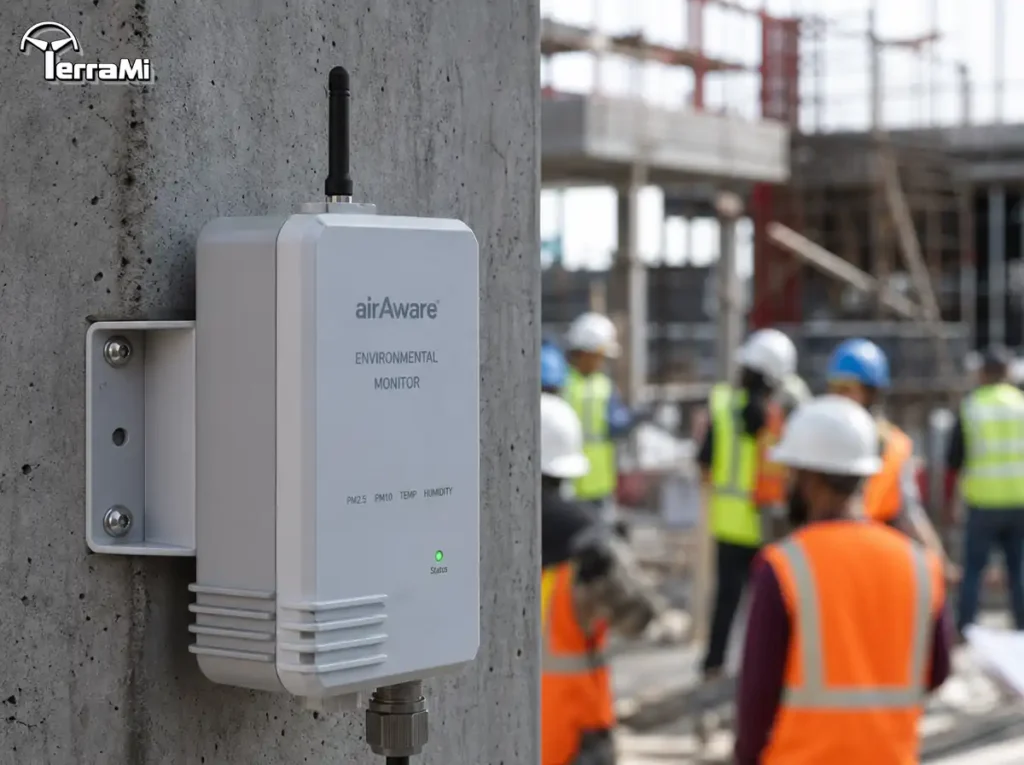
By integrating Artificial Intelligence (AI) and Internet of Things (IoT) sensors into infrastructure operations, platforms such as TerraMi enable a more transparent and continuous view of project performance. When operational data—such as machinery energy consumption or water discharge quality—is captured automatically, reliance on manual reporting is significantly reduced, thereby minimizing reporting bias.
This enables a shift toward “predictive governance,” where infrastructure managers can identify behavioral and operational patterns associated with emerging risks. For instance, abnormal spikes in energy consumption during night shifts may indicate inefficient equipment usage or deviations from standard operating procedures driven by schedule pressure.
The Role of KPIs in Workforce Stability and Resilience
In infrastructure governance, KPIs play a decisive role in shaping workforce stability and operational resilience. As ESG metrics in infrastructure projects become more embedded in day-to-day execution, they increasingly influence not only reporting outcomes but also employee engagement, productivity, and organizational trust.
When ESG metrics are perceived as bureaucratic overhead with no operational benefit, workforce engagement tends to decline. However, when metrics are transparently linked to tangible workplace conditions—such as real-time air quality monitoring in tunneling operations or noise reduction thresholds on active construction sites—they shift from being compliance tools to becoming enablers of workforce well-being and safety.
This alignment is closely connected to broader occupational health and safety standards promoted by organizations such as the World Health Organization (WHO) Occupational Health framework, which emphasizes the importance of environmental conditions in workforce performance and long-term resilience.
Within ESG governance, the role of metrics must therefore extend beyond boardroom reporting and directly bridge operational realities on-site. This requires designing indicators that are both scientifically robust and operationally feasible in high-pressure construction environments.
At TerraMi, this principle aligns with the concept of Double Materiality in ESG reporting, which emphasizes identifying metrics that are material not only to environmental and social outcomes, but also to the financial performance and operational stability of infrastructure assets.
Designing the Future: ESG 2.0 Metric Architecture
Building a resilient infrastructure project requires a metric architecture that is balanced, dynamic, and fundamentally data-driven. In modern ESG frameworks, particularly in ESG metrics in infrastructure projects, the design of measurement systems is shifting from static reporting structures toward adaptive operational intelligence.
This architecture typically consists of four interconnected layers:
Direct Functional Constraints: Metrics that establish hard environmental limits—such as maximum water usage or emissions thresholds—while still allowing engineering teams flexibility to innovate within defined boundaries.
Social Connectivity Metrics: Indicators that measure the depth of community engagement, workforce inclusion, and local skill development, moving beyond simple employment headcounts toward long-term social value creation.
Circular Economy Benchmarks: Metrics that track material lifecycle performance, including the use of digital material passports for major components. This aligns with global circular economy principles promoted by institutions such as the Ellen MacArthur Foundation.
Real-Time Governance Loops: AI-enabled systems that continuously evaluate the gap between planned ESG performance and actual site behavior, enabling immediate corrective action at the project level. This approach is consistent with emerging digital infrastructure governance models discussed by the World Economic Forum on AI in industry.
By shifting focus from reporting for compliance to measuring for performance, ESG transitions from a cost center into a value-generating system. In this sense, ESG metrics become not just indicators of progress, but structural inputs that define how infrastructure is designed, executed, and optimized over its entire lifecycle.
This is the essence of advanced infrastructure thought leadership: recognizing that the metrics we choose to track ultimately function as the blueprint for the physical and social systems we build.

TerraMi: Your Partner in Operational ESG Excellence
As a specialized consultancy operating at the intersection of infrastructure systems, artificial intelligence, and ESG governance, TerraMi provides the technical expertise and strategic foresight required to navigate the increasing complexity of modern infrastructure project delivery.
Rather than simply analyzing ESG metrics in infrastructure projects, TerraMi focuses on designing and enabling the systems that generate, structure, and operationalize these metrics in real time. This systems-level approach ensures that ESG is not treated as a reporting obligation, but as an integrated component of project performance and decision-making.
Our methodology is grounded in the principle that infrastructure should function as a long-term value system—combining engineering precision with measurable Environmental, Social, and Governance outcomes. This aligns with global best practices in operational ESG frameworks in infrastructure, where sustainability is embedded directly into asset lifecycle management rather than treated as a parallel reporting stream.
Whether developing urban transit systems, scaling energy infrastructure, or modernizing national utility networks, TerraMi provides the analytical tools and governance frameworks necessary to ensure projects are data-driven, resilient, and aligned with long-term sustainability objectives.
To explore how integrated ESG systems can transform your project delivery and convert operational data into strategic advantage, engagement with specialized infrastructure intelligence partners becomes a critical next step.