
The Digital Twin Imperative: Engineering Resilience in Modern Infrastructure
The global infrastructure sector is undergoing a structural transformation driven by two converging forces: the accelerating demand for decarbonization and the increasing operational complexity of urban and interurban asset systems. Traditional models of design, construction, and maintenance are no longer sufficient to manage assets exposed to climate volatility, aging materials, and escalating performance expectations.
In this context, Digital Twin Infrastructure has emerged as a foundational paradigm shift. A digital twin is not a static representation of an asset; it is a continuously evolving, high-fidelity digital counterpart that integrates real-time sensor data, predictive analytics, and engineering models to mirror and optimize the physical system throughout its entire lifecycle.
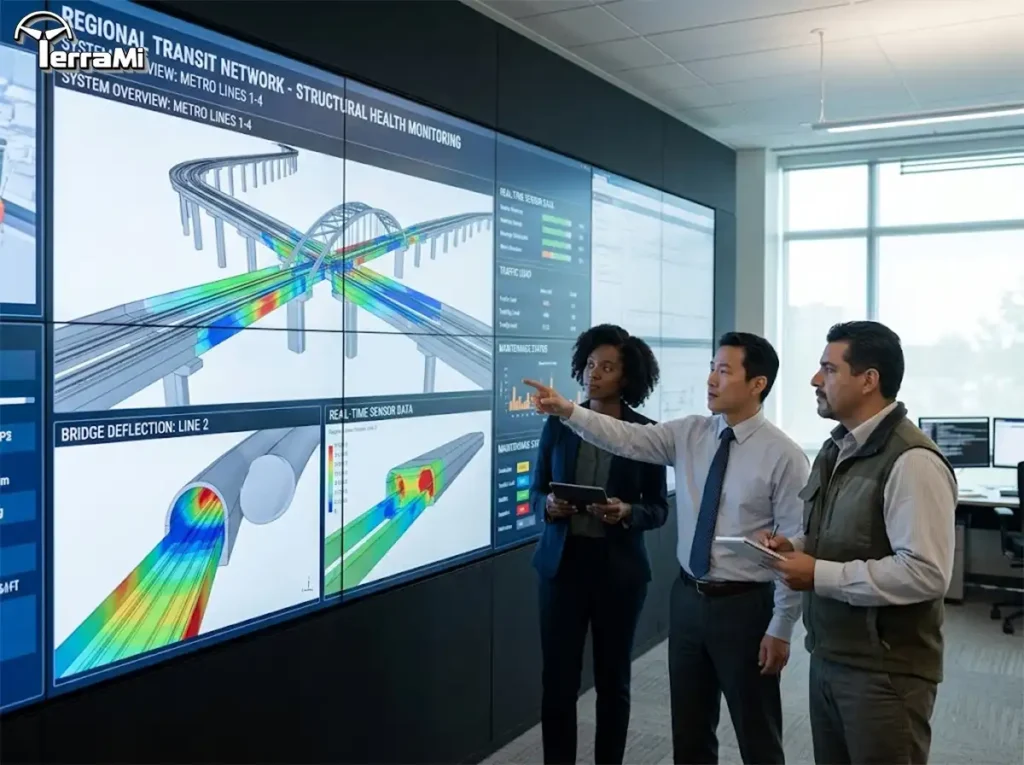
At TerraMi, Digital Twin Infrastructure is positioned as a core enabler of ESG 2.0—where artificial intelligence, structural engineering, and lifecycle intelligence converge to enable a circular and adaptive built environment. This transition marks a shift from reactive maintenance toward continuous, data-driven infrastructure orchestration.
From BIM to Digital Twin Infrastructure: Extending Intelligence Across the Asset Lifecycle
While Building Information Modeling (BIM) fundamentally transformed infrastructure design and coordination workflows, its functional scope has traditionally remained concentrated within the design and construction phases. Digital Twin Infrastructure extends this paradigm into the operational lifecycle of assets, enabling a continuously evolving digital environment synchronized with real-world infrastructure conditions. According to Autodesk’s overview of digital twins, digital twin ecosystems enable infrastructure operators to integrate real-time operational intelligence with predictive analytics, creating more adaptive and resilient asset management systems.
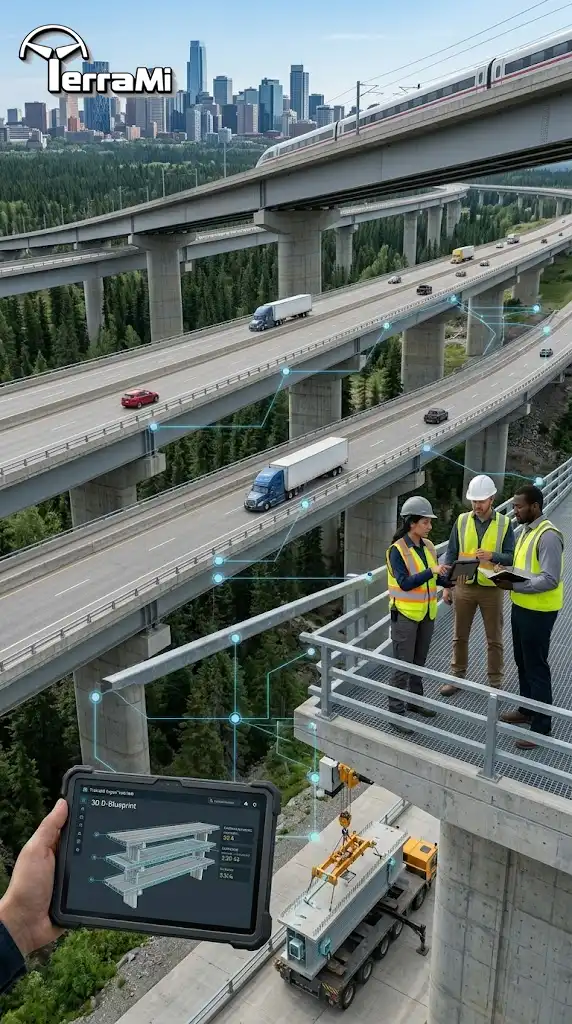
The defining characteristic of Digital Twin Infrastructure is its bidirectional data architecture. Embedded IoT-enabled systems within structural components—including reinforced concrete systems, bridge decks, and steel assemblies—continuously transmit operational performance data such as thermal stress behavior, vibration response, moisture infiltration, and dynamic load variability. This enables predictive maintenance and Structural Health Monitoring (SHM) capabilities at a level of precision that conventional infrastructure management systems cannot achieve. Recent industry implementations highlighted by IBM’s infrastructure digital twin analysis further demonstrate how AI-driven digital twin platforms are being used to reduce downtime, optimize maintenance cycles, and improve long-term infrastructure resilience under increasingly complex environmental conditions.
ESG Integration and the Circular Infrastructure Economy
One of the most significant contributions of Digital Twin Infrastructure lies in its impact on the environmental dimension of ESG.
Through Digital Construction Material Passports (DCMPs), every structural component is digitally documented across its lifecycle. These passports contain granular data on:
- embodied carbon
- material composition
- recyclability potential
- maintenance history
- structural performance degradation
This level of traceability enables urban mining at the end-of-life phase of infrastructure assets. When a bridge, tunnel, or utility hub is decommissioned, the digital twin provides a complete, machine-readable inventory of reusable and recyclable components.
This transforms demolition from a linear waste-generating process into a circular resource recovery operation, aligning directly with circular economy infrastructure strategies and net-zero carbon objectives.
Additionally, operational optimization enabled by Digital Twin Infrastructure reduces energy consumption in maintenance logistics, minimizes emergency repair interventions, and improves asset utilization efficiency across entire infrastructure networks.
AI-Driven Infrastructure: Digital Twin Infrastructure
The scalability of Digital Twin Infrastructure depends on advanced artificial intelligence systems capable of processing continuous, high-volume IoT data streams.
AI models are applied across multiple domains:
- predictive asset failure modeling using time-series anomaly detection
- traffic load optimization for bridges and transport corridors
- energy flow balancing in decentralized smart grids
- environmental impact forecasting for infrastructure operations
However, the effectiveness of these systems depends heavily on robust data governance frameworks. Without structured governance, the value of real-time infrastructure data cannot be fully realized.
TerraMi’s approach prioritizes Safety-First AI architecture, ensuring that decision-making systems are:
- auditable
- explainable
- secure
- aligned with engineering safety thresholds
This is critical in high-risk infrastructure environments where AI recommendations directly influence public safety outcomes.
Social Impact: Infrastructure Equity Through Data Democratization
Beyond technical optimization, Digital Twin Infrastructure plays a significant role in advancing social equity in urban development.
By democratizing access to infrastructure performance data, cities and governing bodies can make more informed decisions about where to allocate capital investment. This is particularly relevant for underserved or rapidly urbanizing communities where infrastructure gaps are most pronounced.
Importantly, the development and deployment of digital twin systems is inherently multidisciplinary and global. It requires collaboration between:
- civil and structural engineers
- data scientists and AI specialists
- environmental analysts
- urban planners
- public policy stakeholders
This cross-functional integration ensures that infrastructure systems are not only technologically advanced but also socially responsive and context-aware.
In practical terms, this means infrastructure investments can be prioritized based on real-world performance degradation, usage intensity, and community vulnerability metrics—rather than solely on historical planning assumptions.
Conclusion: From Static Assets to Living Infrastructure Systems
The transition toward Digital Twin Infrastructure represents a fundamental redefinition of how infrastructure is conceived, operated, and sustained.
It replaces static lifecycle assumptions with continuous operational intelligence, enabling infrastructure systems to behave as adaptive, data-driven entities rather than passive physical assets.
As climate pressures intensify and urban systems become more interconnected, the ability to simulate, predict, and optimize infrastructure behavior in real time is no longer optional—it is an operational necessity.
The future of infrastructure lies not in building more, but in building systems that think, adapt, and evolve.
Conclusion (with Engagement Layer)
The transition toward Digital Twin Infrastructure represents a fundamental redefinition of how infrastructure is conceived, operated, and sustained.
It replaces static lifecycle assumptions with continuous operational intelligence, enabling infrastructure systems to behave as adaptive, data-driven entities rather than passive physical assets.
As climate pressures intensify and urban systems become more interconnected, the ability to simulate, predict, and optimize infrastructure behavior in real time is no longer optional—it is an operational necessity.
The future of infrastructure lies not in building more, but in building systems that think, adapt, and evolve.
For organizations seeking to accelerate this transition, the challenge is no longer conceptual—it is implementation. TerraMi works with infrastructure stakeholders to translate Digital Twin Infrastructure from strategic vision into operational reality across complex, large-scale assets. To explore collaboration opportunities or discuss application within your infrastructure portfolio, engaging with our team is the next step toward building resilient, data-driven systems for the future.