
From Connected Assets to Intelligent Infrastructure
AI IoT digital twins are beginning to change the way infrastructure systems are understood and operated. Yet the significance of their convergence is easy to miss when each technology is viewed separately. IoT connects physical assets and environments to digital systems. Digital Twins create dynamic representations of those assets and the systems around them. AI can interpret the resulting data, identify patterns, predict conditions, and support decisions. The real shift occurs when these capabilities work together as parts of one operational system.
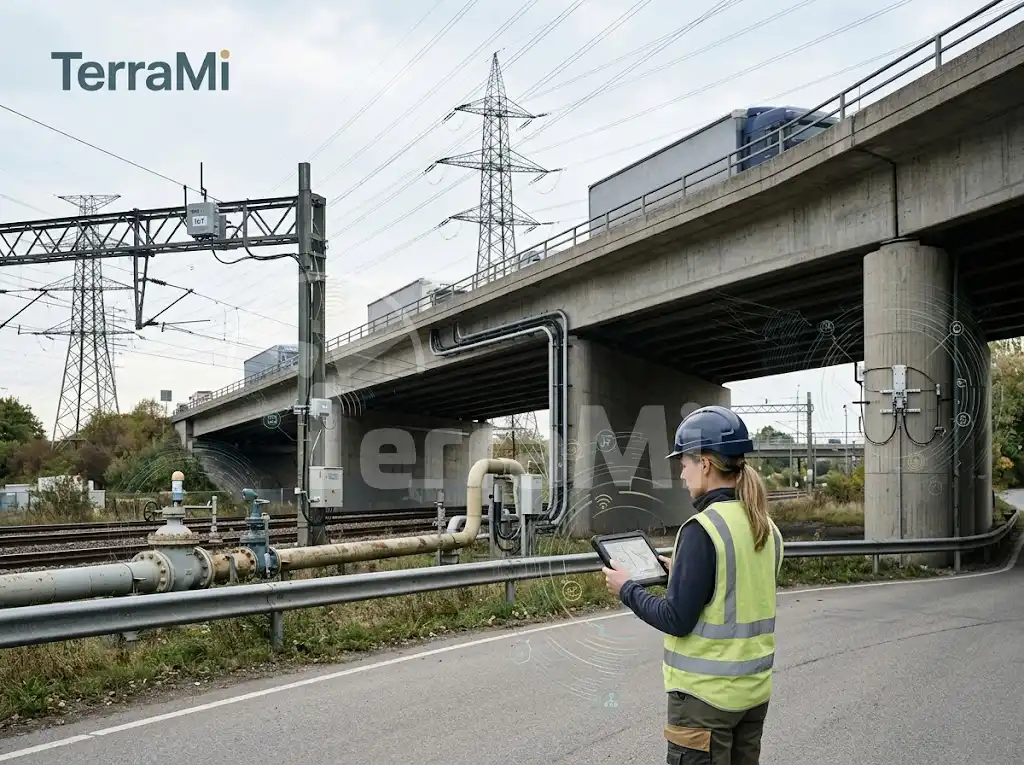
For years, infrastructure digitalization largely focused on making individual assets more visible. Sensors could measure temperature, vibration, pressure, flow, energy consumption, traffic conditions, or equipment performance. Data platforms could collect and display those measurements. Digital models could represent physical assets in increasingly detailed ways. These developments improved visibility, but visibility alone does not create intelligence. A system becomes more capable when information from the physical environment can be interpreted in context and translated into decisions.
The next stage of infrastructure digitalization is not simply connecting more assets. It is connecting sensing, understanding, prediction, and action.
This distinction matters because infrastructure does not operate as a collection of isolated objects. A bridge is part of a transportation network. A pumping station depends on electricity and communications. A building interacts with energy systems, transportation patterns, water services, and surrounding development. A disruption in one system can create consequences elsewhere. As infrastructure becomes more interconnected, the value of digital intelligence increasingly depends on understanding these relationships rather than monitoring assets one by one.
Three Technologies, Three Different Roles
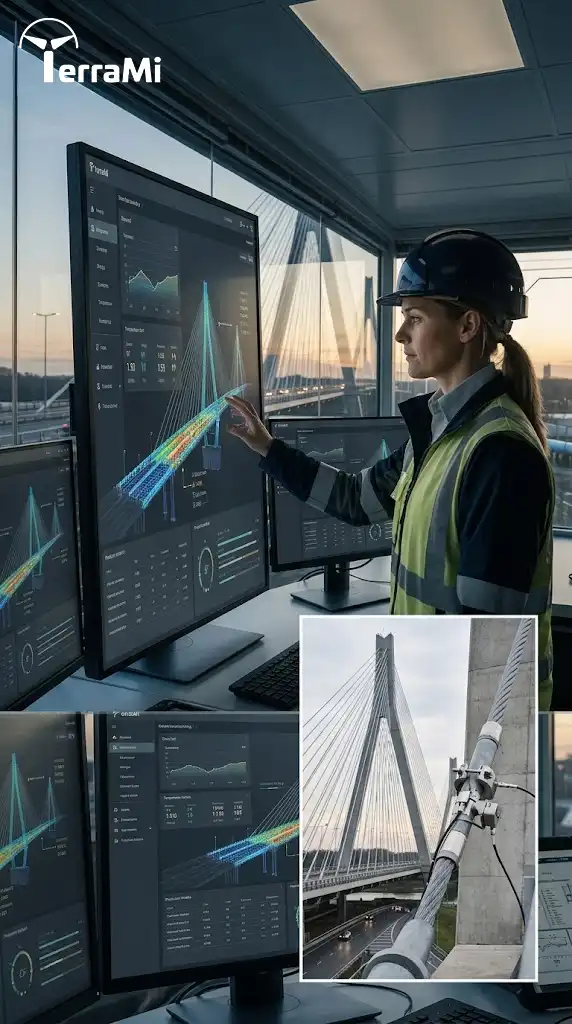
IoT provides the physical connection between infrastructure and digital systems. Sensors and connected devices continuously generate information about conditions in the real world. Edge computing can process some of that information closer to where it is produced, reducing latency and allowing certain responses to occur without sending every data point to a central platform.
But IoT does not explain what the information means across an infrastructure system. A stream of sensor readings can reveal that a component is changing, but it does not automatically establish why the change matters, what might happen next, or how it could affect connected assets.
This is where the Digital Twin becomes important. A Digital Twin is more than a three-dimensional model or a digital record of an asset. Its value comes from maintaining a meaningful digital representation that can be connected to the condition, behaviour, relationships, and operational context of the physical system. When continuously updated with relevant data, the twin can provide a working representation of infrastructure that changes as the real system changes.
AI adds another layer of capability. It can examine large and changing datasets, detect patterns that may be difficult to identify manually, estimate future conditions, classify events, identify anomalies, and help evaluate possible responses. In infrastructure applications, this can support activities ranging from predictive maintenance to network optimization and operational planning.
The three technologies therefore perform different functions, but their boundaries increasingly overlap. IoT provides observations from the physical world. The Digital Twin provides context and representation. AI helps interpret information and reason about what it may mean.
Their value grows when these functions form a continuous loop rather than operate as separate technology projects.
From Data Collection to an Intelligence Loop
Consider a transportation network as an example. Connected sensors can report traffic conditions, pavement performance, weather, vehicle movements, and the status of critical equipment. On their own, these data streams provide fragments of information.
A Digital Twin can place those observations into a representation of the transportation system. It can connect current conditions with the physical configuration of roads, bridges, intersections, transit infrastructure, and other relevant assets. This creates a richer operational context than a dashboard showing independent sensor readings.
AI can then examine the combined information. It might identify an emerging pattern of congestion, detect an unusual change in asset behaviour, estimate how a disruption could propagate through the network, or compare possible operational responses.
The result is not simply a more sophisticated dashboard. It is a different relationship between infrastructure and decision-making.
Instead of asking only, “What is happening now?”, an integrated system can begin to support questions such as:
- What is changing?
- Why might it be changing?
- What could happen next?
- Which connected systems could be affected?
- What responses are available?
- What are the likely consequences of each response?
That progression—from observation toward interpretation and prediction—is central to the emerging infrastructure intelligence model.
Why Integration Matters More Than Individual Technology
The practical challenge is that infrastructure organizations rarely start with a clean digital environment. They operate across decades of engineering projects, legacy control systems, different data formats, proprietary platforms, asset-management databases, operational technologies, and organizational boundaries.
As a result, adding another technology does not automatically solve the integration problem. An organization can have IoT sensors without a useful Digital Twin. It can have a Digital Twin that is not updated reliably. It can have sophisticated AI models that lack sufficient operational context. Each component can appear advanced while the overall system remains fragmented.
This is why interoperability becomes a central issue in the convergence of AI, IoT, and Digital Twins. The challenge is not only whether systems can exchange data, but whether they can exchange information in ways that preserve meaning, context, timing, identity, and relationships.
A sensor reading, for example, is not equally useful simply because it can be transferred from one platform to another. The receiving system must understand what was measured, where it was measured, when it was measured, what asset it relates to, how reliable the measurement is, and how it should be interpreted within the wider infrastructure system.
That is the difference between data connectivity and infrastructure intelligence.
The emerging AIoT model reflects this broader direction by bringing AI capabilities closer to connected devices, edge environments, and cloud platforms. At the same time, new Digital Twin architectures are formalizing how digital representations can be structured and connected. Together, these developments point toward an infrastructure environment in which data does not simply move between systems; it becomes part of a continuously evolving operational model.
The implications extend beyond individual assets. Once infrastructure data, digital representations, and analytical capabilities are connected, organizations can begin to manage infrastructure according to relationships and system behaviour rather than isolated component performance.
That shift sets up the next question: what does an integrated intelligence loop actually look like when it operates across real infrastructure systems?
How AI, IoT, and Digital Twins Form an Intelligence Loop
The convergence of AI, IoT, and Digital Twins becomes meaningful when information can move continuously between the physical infrastructure system and the decisions made about it. This is more than a technical connection. It is an operating model in which observations from the real world update a digital representation, analytical tools interpret changing conditions, and the resulting insights inform decisions that affect the physical system. Subsequent observations then help determine whether those decisions achieved their intended results.
This process can be understood as an intelligence loop: sense, connect, represent, analyse, predict, decide, act, and learn. Not every infrastructure application needs to automate every stage, and not every decision should be made by an algorithm. The value lies in creating a reliable relationship between physical conditions, digital information, analytical insight, and operational action.
From Observation to Context
The loop begins with sensing. IoT devices, monitoring equipment, operational systems, inspections, and other data sources provide information about the condition and performance of infrastructure. Depending on the application, these inputs may include vibration, temperature, pressure, water flow, equipment status, energy demand, traffic movement, weather, or structural measurements. The frequency and reliability of the data matter because an integrated system is only as useful as its understanding of current conditions.
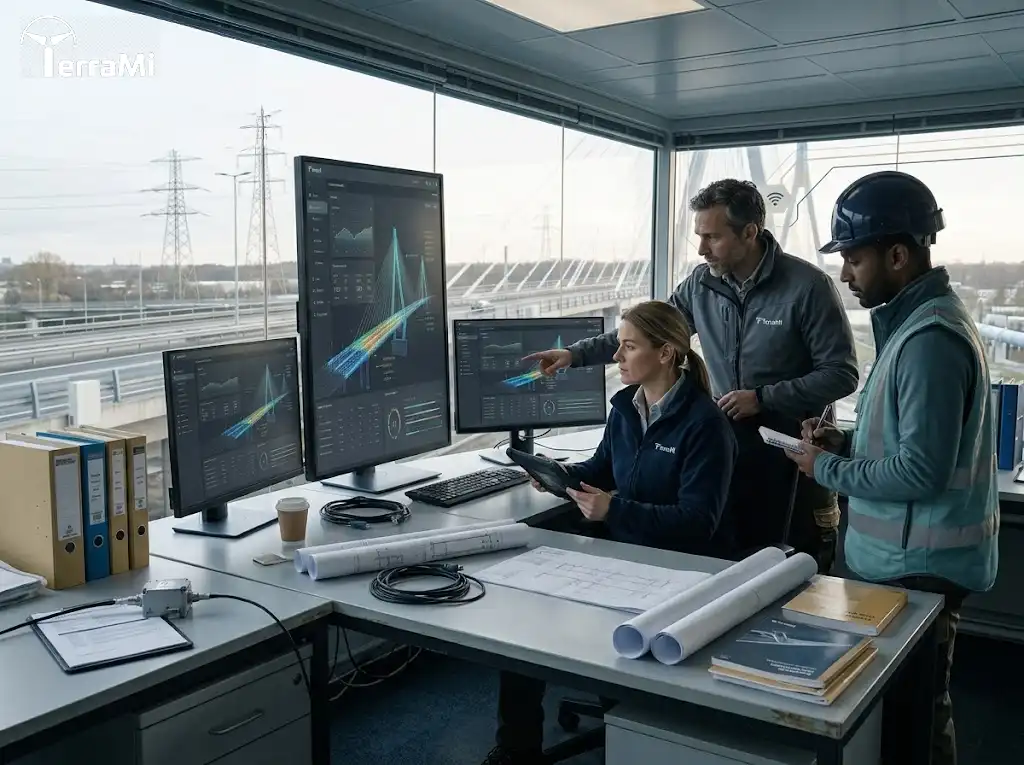
Yet observations become more useful when they are connected to context. A vibration reading from a bridge component, for example, cannot be interpreted properly without knowing which component produced it, its normal operating range, its maintenance history, the conditions under which the measurement was taken, and whether other evidence supports the same interpretation. A Digital Twin can bring these relationships together by associating incoming information with the relevant asset, its configuration, its operating conditions, and its place within a wider network.
The twin is not simply a visual replica. Its operational value depends on the quality of its underlying data, the accuracy of its representation, and how well it reflects changes in the physical system. Some twins update frequently and support near-real-time operations; others are designed for periodic analysis, engineering decisions, or scenario planning. The appropriate level of detail and update frequency depends on the decisions the twin is expected to support.
From Context to Prediction
Once data is associated with a meaningful representation of the infrastructure system, AI can help identify patterns, detect anomalies, estimate future conditions, and compare possible responses. The type of analysis should match the operational question. A model that identifies unusual equipment behaviour serves a different purpose from one that forecasts demand, estimates deterioration, or evaluates the likely effects of a network disruption.
Consider a water utility monitoring pumps, treatment equipment, storage facilities, and distribution networks. IoT devices may report flow rates, pressure, energy consumption, vibration, and equipment temperature. A Digital Twin can relate these measurements to the configuration and operating conditions of the water system. AI may then identify patterns consistent with declining pump performance, unusual demand, or a developing fault.
The benefit is not that AI can always predict a failure with certainty. It cannot. Rather, the combination can help operators identify conditions that warrant attention earlier, understand the possible implications, and prioritize investigation or maintenance. Engineers and operators can assess the evidence, consider the consequences of acting or waiting, and decide what intervention is appropriate.
Prediction becomes operationally valuable when it changes a decision—not simply when it produces a forecast.
That distinction is important for infrastructure leaders evaluating digital investments. A highly accurate model may have limited practical value if its output arrives too late, cannot be interpreted by the people responsible for the asset, or does not connect to an available maintenance or operating process. Conversely, a less complex model may deliver meaningful value when it provides timely, understandable information that supports a clearly defined decision.
From Prediction to Action
The next stage connects analytical insight to an operational response. Depending on the risk and application, that response may be a maintenance work order, an engineer’s inspection, a revised operating schedule, an adjustment to system settings, or a recommendation to investigate a potential problem. In some well-defined and appropriately controlled applications, a system may execute an action automatically. In others, a qualified human must review the recommendation and authorize the response.
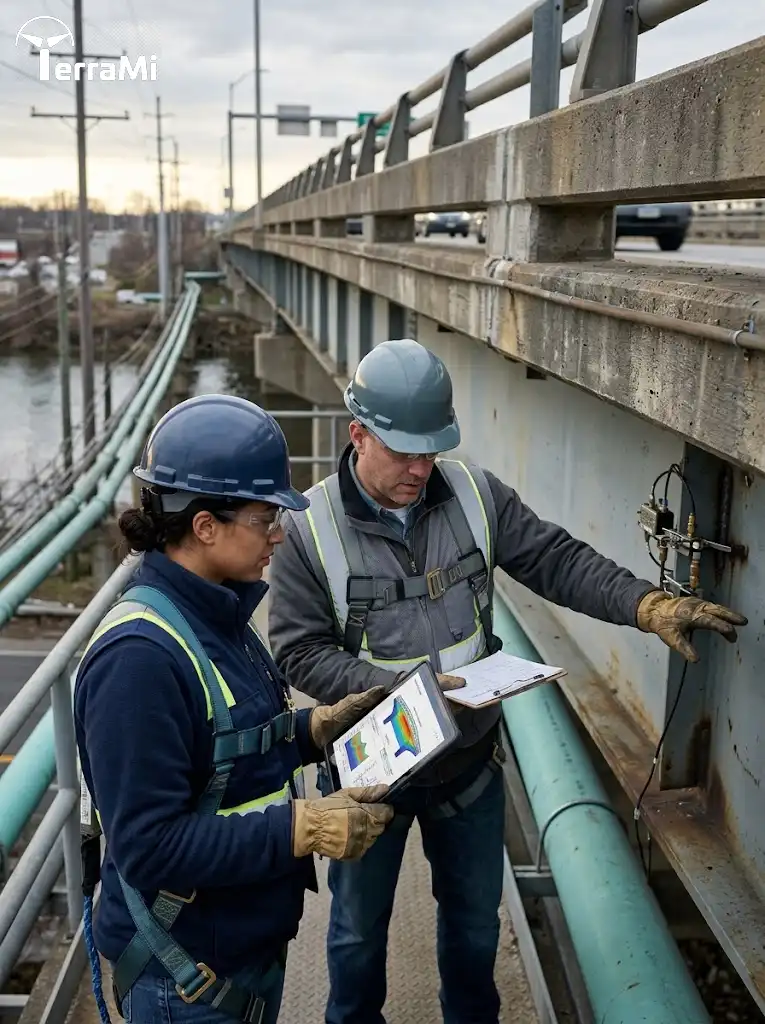
The distinction between decision support and autonomous control should remain explicit. Infrastructure systems can affect public safety, essential services, environmental conditions, and substantial financial assets. The more consequential or difficult to reverse an action becomes, the stronger the need for validation, oversight, clear operating limits, and a way to intervene when system behaviour falls outside expectations.
A transportation network illustrates how these stages can work together. Connected traffic sensors and roadside systems provide observations about vehicle movement, incidents, weather, and congestion. A network-level Digital Twin relates those observations to road geometry, signal configurations, transit routes, and other relevant infrastructure. AI can estimate how a lane closure or major incident may affect nearby routes and help compare possible responses. Traffic operators can then adjust signal timing, communicate route information, or coordinate with transit services, depending on the tools available and the authority of the operating team.
After the response, new observations show whether traffic conditions improved, whether congestion shifted elsewhere, and whether unexpected consequences emerged. That feedback can inform the next decision and improve future planning. The loop is therefore not complete when a recommendation is issued or an action is taken. It is complete only when the outcome is observed and assessed.
Why Infrastructure Needs a System-Level View
Many infrastructure problems cross organizational and technical boundaries. A power disruption can affect water pumping, transport operations, telecommunications, and buildings. Severe weather can change electricity demand, restrict road access, increase drainage loads, and disrupt emergency response at the same time. A Digital Twin of one asset may help its operator understand local conditions, but it cannot by itself explain all the consequences of a disruption across connected systems.
This is where integration between Digital Twins becomes important. Different organizations may maintain separate twins for power networks, transport corridors, water infrastructure, buildings, or individual facilities. Connecting them does not necessarily mean combining everything into one enormous model. It may be more practical to link independently managed twins through agreed data interfaces, shared definitions, relevant dependencies, and clear rules governing what information can be exchanged.
The work underway around federated Digital Twins for electricity systems illustrates this direction. The challenge is not merely to build a detailed digital representation of each network, but to enable separate systems to exchange information and support analysis across boundaries while respecting their different responsibilities and operating environments. Similar questions arise wherever infrastructure networks depend on one another.
Such coordination requires more than compatible software. Organizations need to agree on data meaning, update requirements, access rights, responsibilities, and the decisions that shared information is intended to support. Without these agreements, technical connections can create the appearance of integration while leaving critical gaps in operational understanding.
Learning Without Losing Control
An intelligence loop also creates a need for ongoing verification. Infrastructure conditions change, equipment ages, operating patterns shift, sensors drift, and analytical models can become less reliable when the environment differs from the one in which they were developed. A model that performed well under ordinary conditions may behave differently during an extreme event or after a major system modification.
Organizations therefore need to monitor not only physical assets but also the performance of their digital and analytical components. That includes checking sensor quality, validating model outputs, documenting changes, investigating unexpected recommendations, and establishing procedures for reverting to safe operating modes. Human operators need to understand the limits of the tools they use and know when an output requires further investigation rather than immediate action.
The result should not be an infrastructure system that blindly follows its own predictions. It should be a system that uses data and analysis to improve the timing, quality, and consistency of decisions while retaining appropriate engineering judgement and operational accountability.
An intelligent infrastructure system is not one that never needs human intervention. It is one that makes changing conditions easier to understand, decisions easier to evaluate, and outcomes easier to verify.
The practical question is how to build this capability without creating new dependencies that are difficult to govern or maintain. That requires attention to interoperability, cybersecurity, data quality, organizational responsibilities, and long-term operational costs—not just the performance of individual technologies.
The Integration Challenge: Data, Interoperability, Governance, and Trust
The value of AI IoT digital twins depends not only on how well each technology performs, but on whether the technologies can operate together within a dependable infrastructure system. A sensor may collect accurate readings, an AI model may identify a developing problem, and a digital twin may represent an asset in considerable detail. Yet if these components use incompatible data formats, operate on different update cycles, or sit within disconnected organizational systems, the information may never become a useful operational decision.
This is one of the central challenges facing intelligent infrastructure: integration is not simply a technical exercise. It requires shared definitions, reliable data, clear responsibilities, cybersecurity controls, and a realistic understanding of how infrastructure is operated over time. The challenge becomes more demanding as digital systems cross asset boundaries, organizational jurisdictions, and infrastructure sectors.
Interoperability Begins With Meaning, Not Connectivity
Infrastructure operators have spent years connecting sensors, platforms, databases, and control systems. However, a connection does not automatically make information understandable or usable. Two systems may exchange a data stream while interpreting asset identifiers, units of measurement, timestamps, operating states, or risk classifications differently. The information has moved, but its meaning may not have survived the journey.
Consider a water utility and an electricity provider that need to coordinate during a period of high demand. The water utility may track pumping capacity, reservoir levels, and treatment requirements, while the electricity provider monitors grid conditions, generation availability, and demand forecasts. Each organization may have reliable internal systems. Coordinating their responses, however, requires an agreed understanding of which assets are involved, how operational conditions are described, when information was recorded, and what restrictions govern its use.
The same problem appears within a single infrastructure organization. Maintenance records may use one asset identifier, sensor platforms another, and engineering models a third. If those references cannot be reconciled, the digital twin may not accurately associate a new observation with the relevant equipment or its history. AI may then analyse incomplete or incorrectly matched information, producing outputs that appear precise but are poorly grounded in the physical system.
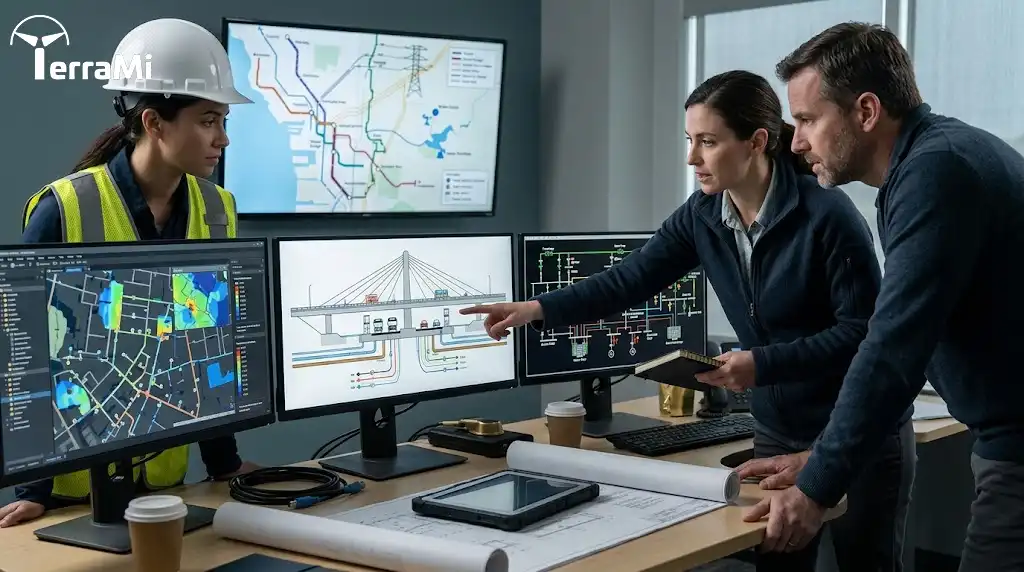
Interoperability must consequently address several connected layers: technical communication, data structure, semantic meaning, identity management, and operational procedures. Shared interfaces and data standards can reduce friction, but organizations also need to agree on how those standards apply to their assets and workflows. The AIoT reference model published by the International Telecommunication Union in 2026 is part of the wider standards landscape addressing the relationship between artificial intelligence and connected things. Its significance lies in treating AI and connected devices as parts of an architecture that must be considered together, rather than as unrelated technology purchases.
Interoperability also needs to be proportionate. Not every infrastructure operator requires one universal platform or a single data model for every asset. In many cases, a more practical approach is to establish a small set of shared definitions and interfaces for the information that must cross system boundaries, while allowing individual organizations to retain specialized tools. The objective is not uniformity for its own sake. It is dependable exchange of information where coordination creates operational value.
Data Quality Is an Operational Responsibility
An integrated digital environment can make poor data more influential, not less. When observations from several systems feed a digital twin and then inform AI-assisted decisions, errors can travel across the entire chain. A sensor that drifts out of calibration, a missing maintenance record, an incorrect asset classification, or an outdated engineering assumption can affect the conclusions drawn downstream.
Data quality is often discussed as a preparation task: clean the dataset, validate the inputs, and proceed with analysis. Infrastructure requires a more sustained approach. Data quality changes with physical conditions, equipment deterioration, sensor replacement, software updates, and modifications to the asset itself. A dataset that was reliable during commissioning may become misleading years later if its assumptions are not maintained.
Digital twins should therefore make the status and limitations of their information visible. Operators need to know which observations are current, which values are estimated, which systems have not reported, and which assumptions remain unverified. The required level of detail depends on the decision. A strategic planning model may tolerate periodic updates and broader uncertainty ranges; a system supporting time-sensitive operational decisions may require stricter controls and more frequent validation.
AI outputs also need to be interpreted in the context of input quality. A model may identify an unusual pattern without being able to determine whether it reflects a developing fault, a sensor problem, or an operating condition absent from its training data. The system should support investigation rather than disguise uncertainty behind a confident-looking score. In higher-consequence settings, a recommendation may need corroborating measurements, an engineering review, or an inspection before action is authorized.
This is where predictive maintenance in infrastructure becomes a useful example of the relationship between data quality and operational value. Detecting a pattern associated with equipment deterioration matters only if the organization can verify the signal, connect it to the correct asset, determine the urgency, and arrange a suitable response. The objective is not simply to generate more alerts. It is to improve the quality and timing of maintenance decisions without overwhelming the people responsible for acting on them.
Data governance should also address ownership and accountability. Who is responsible for correcting an inaccurate record? Who approves changes to asset information? How are data gaps documented? Who can challenge an AI-generated recommendation? These questions are not administrative details to resolve after deployment. They influence whether an integrated system can be trusted throughout its operating life.
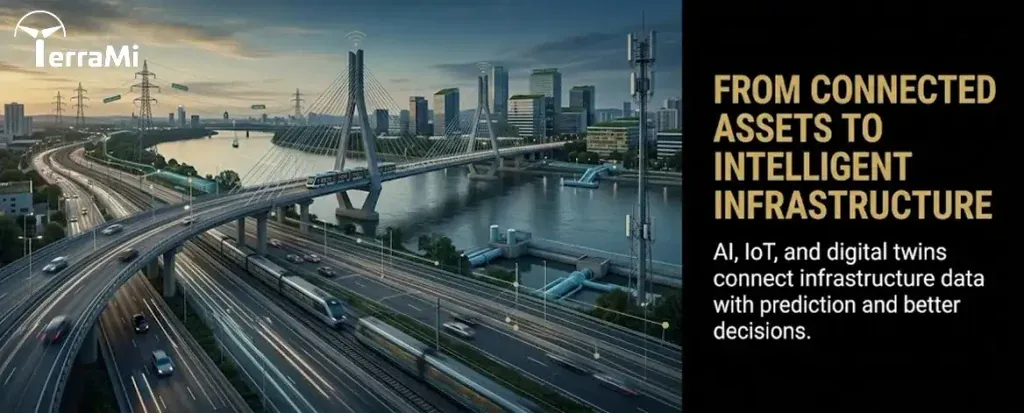
Cybersecurity Must Follow the Connections
Connecting infrastructure systems can expand their operational capabilities, but it can also expand the number of pathways through which a system may be disrupted. Sensors, gateways, cloud platforms, remote access tools, application programming interfaces, digital-twin environments, and AI services may each introduce dependencies that require protection. The risk is not limited to unauthorized access to data. In some settings, compromised information or disrupted communications could affect physical operations.
The architecture should therefore be designed around the consequences of failure, not just the convenience of connectivity. Operators need to identify which components are critical, which connections are necessary, what access each user or service requires, and how the system should behave when a component becomes unavailable or untrustworthy. Network segmentation, strong authentication, controlled privileges, secure updates, monitoring, and tested recovery procedures can help limit the impact of a compromise. Their implementation should reflect the infrastructure’s operating context and established security requirements.
Digital twins and AI services deserve particular attention because they may combine information from systems that were previously isolated. A twin may expose relationships between assets, operating constraints, and vulnerabilities. An AI service may rely on external infrastructure, third-party software, or data pipelines whose failure affects the reliability of its recommendations. Integrating these capabilities without examining their dependencies can create a system that is more connected but less resilient.
A sound design distinguishes between the ability to observe a system and the authority to control it. An analytical platform may be permitted to examine operational data without receiving permission to change equipment settings. Automated actions, where justified, should operate within defined limits, with appropriate authorization, logging, monitoring, and mechanisms for safe intervention. Critical infrastructure should not become dependent on an AI service whose loss would leave operators unable to maintain essential functions.
Cybersecurity also needs to be treated as a continuing operational responsibility. Threats, software components, access arrangements, and system configurations change over time. Periodic assessments, incident exercises, supplier oversight, and recovery testing are needed alongside the original security design. Integration is successful only when the resulting system can continue to operate—or fail safely—under adverse conditions.
Governance Determines Where Automation Should Stop
As AI, IoT, and digital twins become more closely connected, the distinction between information, recommendation, and action becomes increasingly important. A system that reports a condition is not performing the same role as one that recommends a response. Neither is equivalent to a system authorized to alter physical operations without prior human approval.
These distinctions should be explicit in the system’s governance model. Organizations need to determine which decisions can be supported by automated analysis, which require professional review, and which must remain under direct operational control. The appropriate boundary depends on the potential consequences of error, the reversibility of the action, the reliability of the available evidence, and the ability to detect and correct an unwanted outcome.
For example, an AI-enabled twin might recommend changing a maintenance schedule after identifying a developing equipment problem. That recommendation can be reviewed against safety requirements, resource availability, asset criticality, and other planned work. A different system that automatically changes the operating parameters of a water-treatment process or electrical network would require a more demanding level of validation, authority, and protection. The technical ability to automate a decision does not, by itself, establish that doing so is appropriate.
Governance also needs to define responsibility across suppliers and operators. Technology vendors may maintain models or software components, while asset owners remain accountable for the infrastructure and the services it provides. Engineers, operations teams, data specialists, cybersecurity professionals, and executives each hold different parts of the knowledge needed to assess a system. Clear decision rights help prevent responsibility from becoming fragmented when an AI-assisted recommendation contributes to an operational outcome.
Documentation is central to that accountability. Organizations should be able to establish which data informed a decision, which model or system version produced the recommendation, what limitations were known, who authorized the action, and whether the expected result occurred. The required recordkeeping will vary by application, but the underlying principle is consistent: decisions affecting infrastructure should remain open to review.
The Economics of Integration Extend Beyond Deployment
The business case for AI, IoT, and digital twins is often framed around improved prediction, reduced downtime, more efficient resource use, or better asset performance. These benefits can be meaningful, but they need to be evaluated against the full cost of building and sustaining the integrated capability.
Initial expenditure may include sensors, communications infrastructure, software licences, data integration, modelling, cybersecurity, and specialist expertise. Ongoing costs may include sensor calibration, platform maintenance, model monitoring, data stewardship, system upgrades, staff training, supplier management, and the migration or replacement of legacy technologies. If these recurring obligations are underestimated, an apparently successful pilot may prove difficult to sustain at scale.
Organizations should evaluate benefits at the level of the operational problem rather than assuming that integration is valuable in itself. Does the system reduce the time required to identify a fault? Does it improve maintenance prioritization? Does it help operators understand dependencies that were previously difficult to see? Can the improvement be measured against a credible baseline, and does it persist under normal operating conditions?
The assessment should also consider the cost of false alarms, missed warnings, unnecessary interventions, and dependence on systems that may be difficult to replace. A sophisticated digital twin may provide little additional value if the organization lacks the processes or authority to act on its findings. Conversely, a relatively focused integration can deliver substantial benefits when it addresses a clearly defined operational need and fits existing responsibilities.
A staged approach can help organizations establish evidence before expanding the scope. Begin with a defined use case, identify the data and interfaces required, agree on decision rights, and establish measurable outcomes. Test how the system behaves when data are missing, communications fail, or conditions differ from expectations. Expand only when the benefits, operating requirements, and governance arrangements are sufficiently understood.
Building an Ecosystem Without Creating a Single Point of Failure
The long-term direction of intelligent infrastructure is unlikely to be one universal platform controlling every asset. Infrastructure networks differ in ownership, purpose, regulatory context, operating life, and tolerance for risk. A more adaptable model is an ecosystem of systems that can exchange selected information, coordinate where necessary, and preserve appropriate local control.
This approach places greater emphasis on interoperability, clear interfaces, federated information models, and agreed governance. Individual digital twins can continue to serve their respective assets or organizations while sharing the information needed to understand wider dependencies. AI can support analysis across these connections without requiring every dataset or operational function to be centralized.
The benefits depend on maintaining boundaries as carefully as connections. Shared information does not always require shared control. Coordination does not require identical software. And system-level intelligence should not eliminate the ability of an individual operator to understand and manage its own assets when external services are unavailable.
The emerging standards landscape, including work on digital-twin architectures and connected AI systems, reflects the need to address these relationships systematically. Yet standards alone cannot settle every question of authority, liability, investment, or acceptable risk. Those decisions must be grounded in the operational realities of each infrastructure system and the public or economic functions it supports.
The convergence of AI, IoT, and digital twins is therefore best understood as an ongoing institutional and engineering challenge as much as a technological one. The strongest systems will not necessarily be those with the greatest number of sensors, the most elaborate models, or the highest degree of automation. They will be those that combine useful information with dependable interfaces, accountable decisions, appropriate security, and the capacity to adapt over time.
Intelligent infrastructure becomes valuable when its digital capabilities improve real-world decisions—and when the organizations responsible for those decisions can explain, verify, and govern the results.
TerraMi Perspective: Integration Is the Real Infrastructure Challenge
The convergence of AI, IoT, and digital twins marks an important stage in the evolution of infrastructure systems. Yet the central opportunity is not the adoption of three technologies at once. It is the ability to connect observations from the physical world with a meaningful representation of infrastructure, use that information to anticipate changing conditions, and translate the resulting insight into decisions that improve real-world performance.
This shift requires a broader view of infrastructure intelligence. Technical integration must be accompanied by interoperable data, cybersecurity, clear accountability, and operating models that recognize the limits of automation. Without these foundations, connected systems can produce more information without improving decisions. With them, organizations can begin to understand infrastructure not only as a collection of individual assets, but as an interconnected system whose performance depends on relationships, dependencies, and timely responses.
For infrastructure leaders, the practical starting point is a defined operational challenge—not a technology purchase. Identify where better information could change a decision, establish the data and governance needed to support that decision, and measure whether the integrated approach delivers a meaningful improvement. Expand from evidence rather than expectation. The long-term objective is infrastructure that can learn from changing conditions while remaining secure, maintainable, and accountable to the people and communities it serves.
TerraMi explores the systems thinking, digital capabilities, and sustainability principles that can help organizations make this transition. If your organization is assessing how connected intelligence could support infrastructure planning, operations, or resilience, Contact Us to discuss the challenges and opportunities relevant to your context.
Questions and Answers
1. What does the convergence of AI, IoT, and digital twins mean for infrastructure?
It means connecting physical-world observations, digital representations of infrastructure, and analytical capabilities within a coordinated operating model. IoT devices and connected systems provide data, digital twins organize that information in relation to assets and operating conditions, and AI helps identify patterns, estimate future conditions, and support decisions.
2. How is an infrastructure digital twin different from a conventional 3D model?
A 3D model primarily represents physical form and geometry. An infrastructure digital twin can also connect asset information, operating data, condition monitoring, and analytical models. Depending on its purpose and design, it may be updated continuously, periodically, or when new information becomes available. Its usefulness depends on the quality, context, and currency of the information it represents.
3. Can AI, IoT, and digital twins operate effectively without full integration?
Yes. Each technology can provide value independently. IoT can improve monitoring, AI can support analysis, and a digital twin can improve asset understanding. Integration becomes particularly valuable when decisions depend on information from multiple sources or when operators need to understand how changes in one asset may affect a wider infrastructure network.
4. What are the main barriers to integrating these technologies?
Common barriers include incompatible data formats, inconsistent asset identifiers, poor data quality, legacy systems, cybersecurity risks, unclear responsibilities, and the cost of maintaining digital capabilities over time. Organizational coordination can be as important as the technical architecture, particularly when infrastructure systems cross ownership or sector boundaries.
5. Does intelligent infrastructure require autonomous operation?
No. Intelligence and autonomy are different capabilities. An integrated system may improve monitoring, forecasting, and decision support while keeping operational decisions under human control. Automated actions may be appropriate for specific, well-tested tasks, but the degree of automation should reflect the consequences of error, the reliability of the information, and the ability to intervene safely.
6. How should an organization begin integrating AI, IoT, and digital twins?
Start with a clearly defined operational problem and a decision that better information could improve. Identify the required data, system interfaces, responsibilities, security controls, and measurable outcomes. Test the approach under realistic conditions, including missing data and system failures, before expanding it. The objective is to demonstrate operational value and establish a sustainable governance model before scaling.