
Decarbonizing Infrastructure: Practical Steps Toward Net-Zero Projects
The global construction and infrastructure sector stands at a critical crossroads. Currently accounting for nearly 40% of energy-related carbon emissions, the industry is no longer just a participant in the climate conversation—it is the primary battlefield. Decarbonizing Infrastructure has transcended its origins as a corporate social responsibility (CSR) checklist item to become the most significant driver of asset valuation, regulatory compliance, and technological innovation in the 21st century. As institutional investors pivot toward high-ESG-performance portfolios and global frameworks like the Paris Agreement dictate national policies, the mandate for infrastructure leaders is clear: evolve or face obsolescence. At TerraMi, we view this challenge through the lens of “Carbon Intelligence,” where the fusion of engineering excellence and Artificial Intelligence (AI) creates a scalable roadmap for a Net-Zero future.
The Architecture of Carbon: Understanding the Scope 1-3 Paradigm
To embark on the journey of Decarbonizing Infrastructure, one must first achieve total transparency in carbon accounting. The industry has long struggled with “fragmented data,” where emissions are hidden within complex supply chains. To solve this, we must categorize emissions into three distinct scopes, as defined by the Greenhouse Gas (GHG) Protocol, but viewed through an infrastructure-specific lens.
Scope 1 and 2: The Immediate Operational Frontier
Scope 1 emissions represent the direct output of a project—the diesel burned by excavators, the gas consumed by onsite power generators, and the leakage of fluorinated gases from cooling systems. While these are the most “visible” emissions, they often represent only the tip of the iceberg. Scope 2 emissions, involving purchased electricity and heat, are increasingly being mitigated through the “electrification of everything.” However, the transition to electric heavy machinery and onsite renewable microgrids requires significant capital expenditure and a fundamental redesign of construction site logistics.
Scope 3: The Hidden Giant of Embodied Carbon
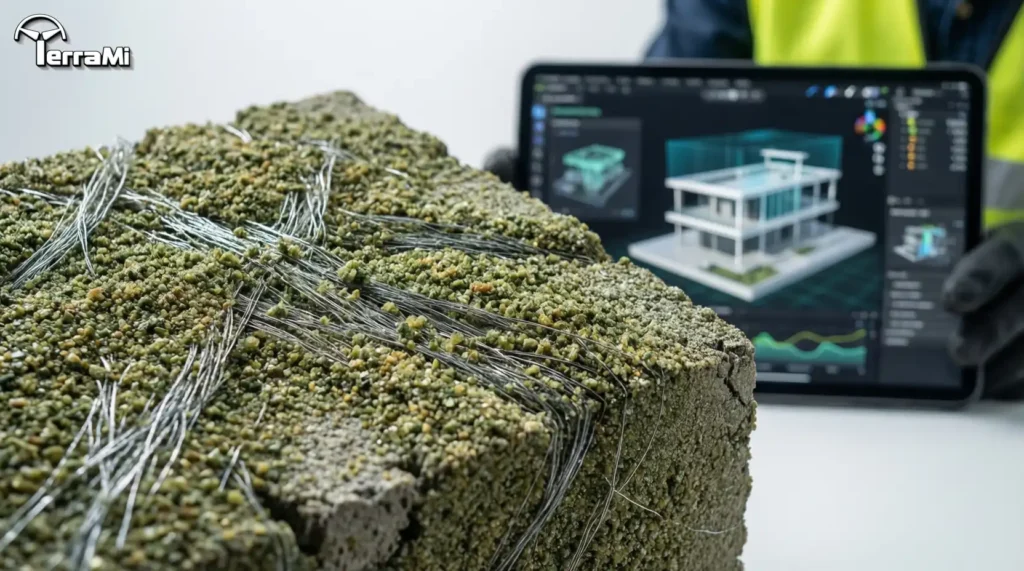
The true challenge of Decarbonizing Infrastructure lies in Scope 3. This category encompasses the “embodied carbon” within materials like steel, cement, and glass. For a typical bridge or skyscraper project, Scope 3 can account for up to 80% of the total lifetime emissions. Tracking these requires a level of supply chain integration that was historically impossible. Today, however, blockchain-enabled ledger systems and AI-driven procurement platforms allow TerraMi to trace the carbon intensity of a single ton of steel from the furnace to the site.
The Decarbonization Roadmap: From Strategy to Execution
A theoretical commitment to Net-Zero is worthless without a tactical roadmap. Decarbonizing Infrastructure requires a multi-layered approach that begins at the conceptual design phase and extends through the entire 50-to-100-year lifecycle of the asset.
Integrated Digital Design and “Carbon-First” Engineering
The most effective way to reduce carbon is to never generate it in the first place. This is known as “dematerialization.” By using Generative Design—a process where AI explores thousands of structural permutations—engineers can design assets that use 30% less concrete while maintaining the same structural integrity
The Power of Digital Twins in Predictive Mitigation
A Digital Twin is not just a 3D model; it is a living, breathing data entity. During the design phase of Decarbonizing Infrastructure, Digital Twins allow us to simulate the “carbon ROI” of different materials. For instance, we can simulate the thermal performance of a building using cross-laminated timber (CLT) versus traditional reinforced concrete, providing investors with data-backed energy savings projections over a 30-year period.
Material Revolution: Beyond the Cement Era
Cement production alone is responsible for approximately 8% of global CO2 emissions. Therefore, Decarbonizing Infrastructure is impossible without a revolution in material science.
- Green Cement and Geopolymers: We are seeing a shift toward limestone calcined clay cement (LC3) and the use of industrial by-products like fly ash to reduce clinker content.
- Carbon-Negative Materials: Innovative startups are now mineralizing CO2 into aggregates, effectively turning infrastructure into a carbon sink.
- High-Recycled-Content Steel: Shifting procurement toward Electric Arc Furnace (EAF) steel produced with green hydrogen is a cornerstone of the TerraMi procurement strategy.
AI and Data: The Central Nervous System of Net-Zero
In the past, carbon reporting was a retrospective exercise—looking back at what was burned. Today, Decarbonizing Infrastructure relies on real-time carbon telemetry.
Real-Time Carbon Tracking on the Job Site
Using IoT sensors and computer vision, we can now monitor the idle time of heavy machinery. An excavator left idling for four hours a day is not just a fuel cost; it is a Scope 1 surge. AI algorithms can optimize vehicle routing and duty cycles on-site to reduce fuel consumption by up to 15%. This granular level of control is essential for hitting the mid-term targets of any reduction roadmap.
Automating ESG Compliance and Reporting
Regulatory frameworks such as the Corporate Sustainability Reporting Directive (CSRD) in Europe and the SEC’s climate disclosure rules in the US are making carbon data as critical as financial data. AI-driven ESG dashboards can aggregate data from thousands of sensors and invoices, automatically generating audit-ready reports. This reduces the “compliance burden” and allows leadership to focus on actual reduction rather than just documentation.
The Economic Imperative: Why Net-Zero is Profitable
There is a lingering myth that Decarbonizing Infrastructure is a “green tax” that erodes margins. On the contrary, the economic data suggests that carbon-efficient assets are more resilient and yield higher returns.
Access to Green Finance and Lower Cost of Capital
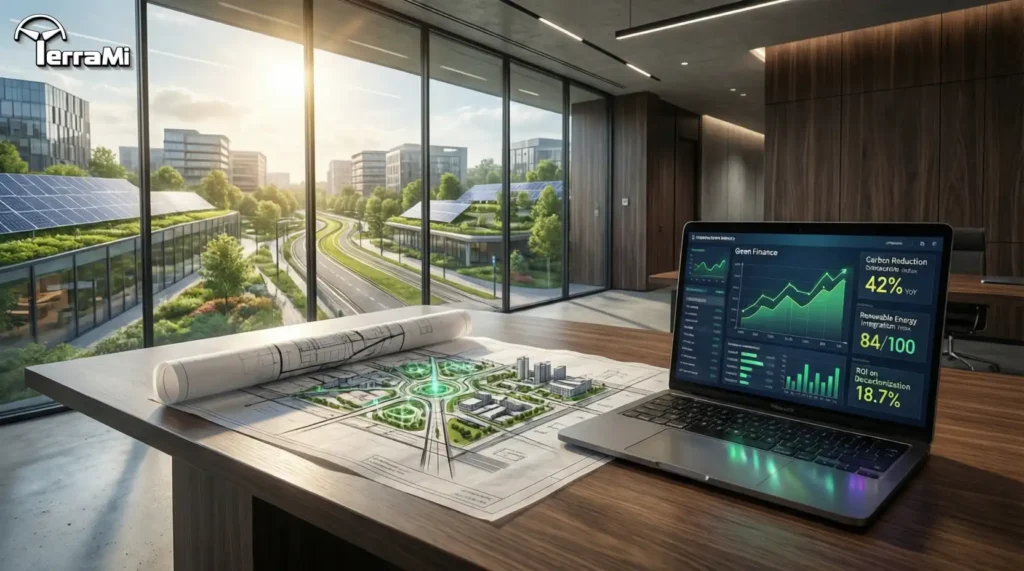
The global pool of ESG-linked capital is now measured in the trillions. Banks and institutional investors are offering “Sustainability-Linked Loans” (SLLs) where interest rates are tied to the achievement of specific carbon reduction targets. By Decarbonizing Infrastructure, developers can significantly lower their debt servicing costs, providing a direct boost to the project’s Internal Rate of Return (IRR).
Future-Proofing Against Carbon Pricing
As governments implement carbon taxes and systems like the EU’s Carbon Border Adjustment Mechanism (CBAM), the cost of “high-carbon” materials will skyrocket. Early movers in Decarbonizing Infrastructure are effectively hedging against future inflation in material costs. An asset designed for Net-Zero today is protected against the “stranded asset” risk of tomorrow, where carbon-intensive buildings may become un-leasable or subject to heavy fines.
Attracting High-Value Tenants
Corporate tenants, driven by their own Net-Zero targets, are increasingly seeking “Grade A” green office space. Infrastructure that prioritizes decarbonization commands a “green premium” in rental rates, often 10% to 20% higher than traditional assets in the same geography.
Overcoming the Barriers to a Decarbonized Future
While the path is clear, it is not without obstacles. Decarbonizing Infrastructure faces cultural, technical, and systemic challenges that require collective action.
Bridging the “Green Premium” Gap
Currently, low-carbon materials often cost more than their traditional counterparts. To overcome this, we must move toward “Lifecycle Costing” (LCC) rather than “Initial Capital Expenditure” (CapEx). While green concrete might be 5% more expensive upfront, the energy savings and carbon tax avoidances over 20 years make it the cheaper option in total.
Solving the Data Fragmentation Issue
The construction industry is notoriously siloed. Subcontractors often lack the digital infrastructure to report their emissions accurately. TerraMi is leading the charge in creating “Data Standard Exchanges” where stakeholders can share carbon data in a unified format, ensuring that Decarbonizing Infrastructure is a collaborative effort rather than a series of isolated attempts.
Policy and Regulatory Support
Governments must play a role by updating building codes that currently favor traditional materials. “Buy Clean” acts and public procurement requirements that mandate a maximum carbon footprint for public works are essential catalysts for scaling the green material market.
Conclusion: The Era of Responsible Infrastructure
The goal of Decarbonizing Infrastructure is not merely to “do less harm,” but to redefine the relationship between the built environment and the natural world. As we look toward 2030 and 2050, the leaders of the infrastructure sector will be those who treated carbon as a core engineering constraint, not an afterthought. By integrating AI-driven insights, Scope 1-3 transparency, and material innovation, we can transform infrastructure from a climate liability into a climate solution. At TerraMi, our commitment is to provide the intelligence and the tools necessary to navigate this transition. Decarbonizing Infrastructure is the great engineering challenge of our time, and it is a challenge we are ready to meet.