
The Future of Decarbonization in Asset Management: A Strategic Imperative
Main Focus Keyword: Asset Management Decarbonization
The global transition toward net-zero infrastructure is reshaping the economics of long-term capital investment. Today, Asset Management Decarbonization is no longer treated as a peripheral sustainability initiative; it has become a central determinant of asset resilience, regulatory readiness, and long-term enterprise value. Across the infrastructure sector, the financial viability of assets is increasingly tied to their carbon efficiency, operational adaptability, and lifecycle intelligence.

At TerraMi, we view decarbonization not as a reporting exercise, but as a transformation of how infrastructure assets are designed, maintained, upgraded, and ultimately retired. The challenge facing asset owners is no longer whether carbon reduction targets should exist, but whether current governance systems, maintenance strategies, and operational models are structurally capable of achieving them.
Most decarbonization programs fail for a simple reason: organizations continue rewarding short-term operational throughput while expecting long-term environmental resilience. This contradiction sits at the heart of modern infrastructure strategy. True Asset Management Decarbonization requires aligning engineering decisions, executive incentives, procurement systems, and capital allocation with lifecycle carbon performance rather than quarterly operational outputs.
The Lifecycle Approach to Carbon Mitigation
Effective Asset Management Decarbonization demands a full lifecycle perspective. Historically, infrastructure operators focused primarily on operational emissions—energy consumption, fuel usage, and utility efficiency. While these remain critical, the industry now recognizes that a substantial portion of carbon exposure is embedded within construction materials, maintenance cycles, logistics networks, and asset replacement strategies.
This shift is accelerating the adoption of circular infrastructure models, where asset longevity becomes a core sustainability metric. Organizations that prioritize adaptive reuse, predictive maintenance, and low-carbon retrofits are increasingly outperforming those dependent on continuous replacement cycles.
According to Arup’s research on circular infrastructure systems, resilient infrastructure depends on integrating circularity principles directly into long-term asset planning rather than treating sustainability as an isolated compliance function.
At TerraMi, this philosophy informs our approach to lifecycle optimization, ESG integration, and infrastructure resilience modeling. Through our work in sustainable infrastructure strategy and ESG transformation, we emphasize that mature decarbonization strategies are built on extending asset value while simultaneously reducing environmental exposure.
Data-Driven Decarbonization: The Rise of Digital Twins
The next frontier of Asset Management Decarbonization is precision intelligence. Without reliable operational data, carbon management remains reactive, fragmented, and largely speculative.
Digital Twin ecosystems are changing this reality. By creating dynamic digital replicas of physical infrastructure assets, operators can model the carbon implications of operational decisions before they occur. This enables infrastructure leaders to optimize energy consumption, maintenance scheduling, thermal performance, and resource allocation in real time.
More importantly, Digital Twins shift decarbonization from estimation to measurable operational science.
Whether applied to transport corridors, industrial logistics hubs, or commercial building portfolios, these systems allow decision-makers to quantify how engineering interventions influence both emissions and financial performance simultaneously. At scale, this transforms sustainability from a reporting obligation into a continuously optimized operational capability.
Research published by McKinsey & Company on decarbonizing the built environment highlights that digital optimization and circular asset management will become defining competitive advantages for infrastructure organizations over the coming decade.
At TerraMi, we integrate Digital Twin intelligence with ESG reporting frameworks to ensure that every efficiency gain, carbon reduction, and resilience improvement is both measurable and auditable.
Financial Resilience and the Risk of Stranded Assets
Ignoring the trajectory of Asset Management Decarbonization now carries material financial consequences. As carbon pricing mechanisms tighten and institutional investors intensify climate-related disclosure requirements, carbon-intensive infrastructure faces growing stranded asset risk.
In practical terms, this means assets may lose economic relevance long before the end of their physical lifecycle.
Forward-looking asset managers are already restructuring portfolios around transition resilience. Capital is increasingly flowing toward adaptive infrastructure systems capable of operating under stricter environmental regulations, volatile energy markets, and evolving ESG standards.
The issue is no longer environmental branding. It is balance-sheet durability.
Organizations that delay decarbonization often underestimate the compounding financial impact of future retrofits, insurance exposure, regulatory penalties, and declining investor confidence. By contrast, proactive infrastructure decarbonization strengthens operational predictability while preserving long-term asset liquidity.
Case Study: Decarbonizing an Industrial Logistics Corridor in Southeast Asia
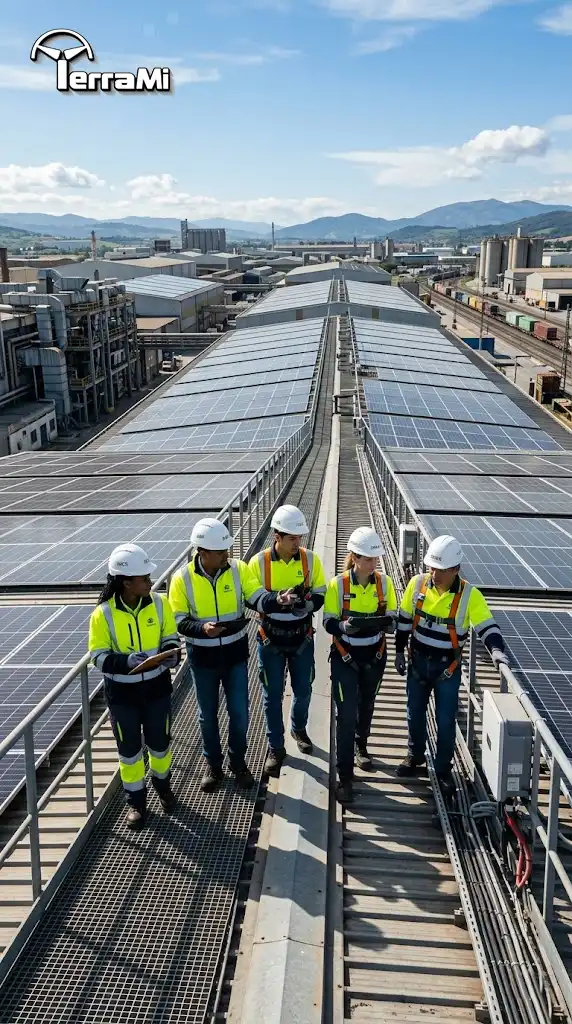
In a recent assessment involving a large industrial logistics corridor in Southeast Asia, TerraMi identified a major opportunity to accelerate Asset Management Decarbonization within remote infrastructure operations.
The project relied heavily on diesel-powered temporary energy systems to support distributed construction and logistics activities across multiple remote zones. While operationally effective in the short term, the system created significant fuel volatility exposure, elevated carbon intensity, and long-term operational inefficiencies.
Rather than focusing exclusively on carbon offsets, the project team redesigned the energy architecture itself.
By transitioning toward a hybrid solar-storage infrastructure model combined with AI-driven load balancing systems, the operation reduced its first-year operational carbon footprint by approximately 35% while simultaneously lowering long-term fuel dependency and improving energy reliability across the project network.
The significance of this transformation extended beyond emissions reduction. The project demonstrated that effective Asset Management Decarbonization is fundamentally an operational efficiency strategy—not merely an environmental initiative.
Governance, Workforce Transition, and ESG 2.0
Under the emerging ESG 2.0 framework, successful Asset Management Decarbonization depends as much on governance architecture as on engineering technology.
Many organizations invest heavily in sustainability systems while maintaining executive incentive structures that reward only short-term production metrics. This creates a structural contradiction: leadership teams are asked to deliver long-term resilience while being compensated for short-term throughput.
Sustainable decarbonization requires governance systems capable of aligning incentives with lifecycle performance, infrastructure reliability, workforce adaptation, and measurable carbon outcomes.
The social dimension is equally critical. Infrastructure decarbonization will inevitably reshape operational roles, maintenance processes, and technical workforce requirements. Organizations that fail to invest in workforce transition strategies risk operational disruption, institutional resistance, and long-term capability gaps.
At TerraMi, we believe the future of infrastructure leadership lies in integrating governance, operational psychology, and sustainability into a unified decision-making framework. When governance systems actively reinforce environmental objectives, decarbonization becomes operationally durable rather than politically temporary.
Strategic Priorities for Asset Managers
Organizations preparing for the next generation of infrastructure investment should prioritize the following:
- Embodied Carbon Audits — Measuring lifecycle carbon exposure across materials, maintenance cycles, and supply chains.
- Digital Twin Integration — Using real-time operational intelligence to optimize asset performance and reduce emissions continuously.
- Predictive Maintenance Systems — Extending infrastructure lifespan while minimizing carbon-intensive replacement cycles.
- Green Financing Mechanisms — Leveraging sustainability-linked financing structures to accelerate retrofit programs and low-carbon modernization.
- Governance Alignment — Linking executive incentives and operational KPIs directly to long-term decarbonization performance.
Conclusion: Decarbonization as Infrastructure Strategy
The future of infrastructure will not be defined solely by physical scale, but by carbon efficiency, operational intelligence, and lifecycle resilience.
Asset Management Decarbonization is rapidly becoming the defining framework through which infrastructure value is measured, protected, and expanded. The organizations that succeed in this transition will be those capable of integrating sustainability directly into governance systems, operational models, and capital planning strategies.
At TerraMi, we help infrastructure leaders move beyond symbolic sustainability commitments toward measurable, system-level transformation. In the coming decade, decarbonization will no longer represent a competitive advantage alone—it will define the minimum standard for resilient infrastructure ownership.