
TerraMi Special Series II
The Resource Future of Infrastructure
As infrastructure systems enter an era shaped by geopolitical instability, critical mineral competition, climate pressures, and increasingly fragile supply chains, engineering priorities are evolving beyond efficiency alone. This three-part TerraMi Special Series explores how resource security is becoming one of the defining challenges of twenty-first-century infrastructure.
Part I
The Coming Resource Century: Why Resource Security Is Becoming a Global Priority ✓
Part II
From Extraction to Intelligence: The Rise of Circular Economy as a New Discipline ✓
Part III
Why Developing Nations Cannot Afford Linear Growth
You are reading Part III of this special series.
Introduction
For more than two centuries, industrial development has largely followed a predictable pattern.
Nations extracted natural resources, transformed them into products, expanded infrastructure to support economic growth, and eventually managed the environmental and social consequences that emerged from decades of resource-intensive development. This linear model created extraordinary economic progress and transformed living standards across much of the industrialized world.
For many developing nations, however, the circumstances are fundamentally different.
The twenty-first century is being shaped by accelerating climate change, geopolitical competition, critical mineral dependency, resource constraints, and increasingly interconnected global supply chains. These realities mean that the development pathways available to emerging economies today are no longer the same as those followed by industrialized countries during the twentieth century.
Attempting to replicate yesterday’s model may therefore create tomorrow’s vulnerabilities.
As explored in the previous articles of this series, Resource Security has become a strategic priority for infrastructure planning, while the Circular Economy is rapidly evolving into a discipline centred on material intelligence, lifecycle thinking, and long-term resource productivity.
Developing nations now stand at a unique crossroads.

Rather than repeating decades of linear industrial expansion before attempting to correct its consequences, they have an opportunity to integrate circular principles into infrastructure systems from the very beginning. This approach allows emerging economies to build resilience while avoiding many of the inefficiencies, resource dependencies, and environmental costs that have challenged mature economies.
This is not simply an environmental argument.
It is an economic, engineering, and geopolitical opportunity.
Countries that successfully combine infrastructure investment with circular resource management can strengthen competitiveness, improve resource security, reduce future infrastructure costs, and position themselves within rapidly evolving global value chains.
The question facing developing nations is therefore no longer whether circular development is desirable.
It is whether they can afford to delay it.
The Development Model Is Changing
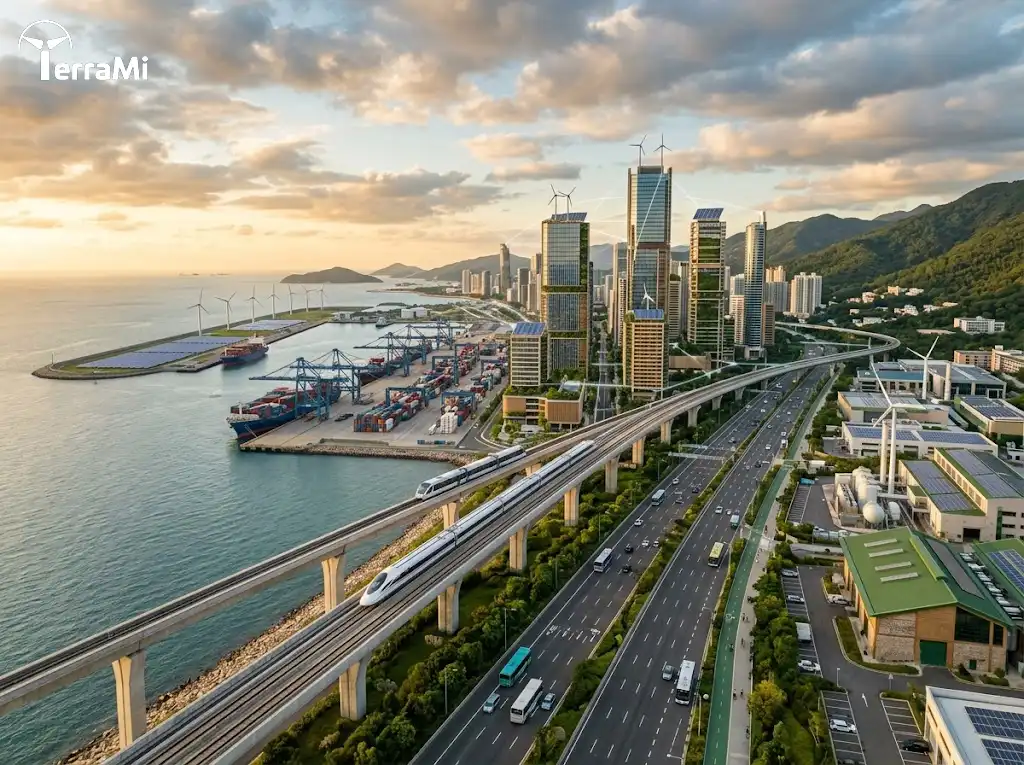
For decades, economic success was closely associated with increasing levels of industrial production, expanding infrastructure networks, and rising consumption of natural resources. Gross Domestic Product (GDP) growth often became the primary indicator of national progress, while resource availability was generally assumed to be sufficient to support continued expansion.
That assumption is becoming increasingly difficult to sustain.
Population growth continues to increase demand for transportation systems, housing, water infrastructure, renewable energy, digital connectivity, healthcare facilities, and industrial development. At the same time, competition for critical minerals, construction materials, freshwater resources, and agricultural land is intensifying across every region of the world.
Infrastructure development therefore faces a new reality.
Economic growth can no longer be measured solely by the quantity of infrastructure delivered. Increasingly, it must also be evaluated by how efficiently infrastructure preserves natural resources, adapts to future uncertainty, and generates long-term economic value.
This represents a profound shift in development philosophy.
Rather than separating economic growth from sustainability, future infrastructure must integrate resource productivity, resilience, digital intelligence, and circular design into the foundation of national development strategies.
Developing nations have an important advantage in this transition.
Many are still expanding critical infrastructure at unprecedented rates. Because large portions of their transportation systems, urban districts, industrial facilities, and energy networks remain under development, they possess greater flexibility to incorporate circular principles before conventional practices become permanently embedded.
Instead of retrofitting decades-old infrastructure systems, they can build future-ready infrastructure from the outset.
This opportunity may prove to be one of the greatest competitive advantages of the twenty-first century.
Leapfrogging Instead of Catching Up
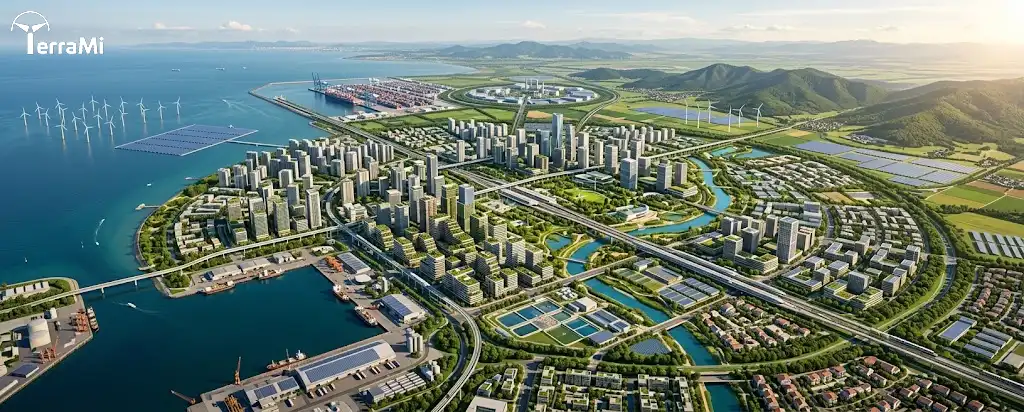
One of the most significant advantages available to developing nations is the ability to leapfrog outdated development models.
History offers numerous examples.
Many countries bypassed extensive landline telephone infrastructure by adopting mobile communications directly. Others expanded access to financial services through digital banking rather than conventional branch networks. Renewable energy is following a similar pattern, allowing communities to deploy decentralized power generation without replicating every stage of traditional energy infrastructure.
Infrastructure development can follow the same trajectory.
Rather than investing heavily in systems designed around linear resource consumption, emerging economies can adopt circular infrastructure principles that prioritize modular construction, material recovery, digital asset management, renewable energy integration, and lifecycle optimization from the beginning.
Doing so reduces the cost of future adaptation while improving long-term resilience.
It also enables governments and infrastructure owners to avoid locking themselves into resource-intensive systems that may become increasingly expensive to maintain as global resource competition accelerates.
The objective is not to imitate the historical development pathway of industrialized economies.
It is to build a more intelligent one.
Circular Development Is an Economic Strategy, Not an Environmental Luxury
One of the most persistent misconceptions surrounding the Circular Economy is that it represents an environmental ambition that developing nations should pursue only after achieving economic prosperity.
The opposite is becoming increasingly true.
For countries experiencing rapid urbanization and infrastructure expansion, circular development offers an opportunity to improve economic efficiency before inefficient resource systems become permanently embedded within national economies. Rather than delaying circularity until infrastructure matures, developing nations can integrate resource intelligence into roads, buildings, energy systems, water networks, industrial facilities, and transportation corridors from the earliest stages of development.
This distinction is critical.
Industrialized economies are now investing billions of dollars to retrofit infrastructure that was originally designed around linear resource consumption. Emerging economies have the opportunity to avoid many of these future costs by incorporating adaptability, recoverability, modularity, and lifecycle thinking into today’s infrastructure investments.
The economic implications extend far beyond environmental performance.
Infrastructure designed for longer service lives, easier maintenance, higher-quality material recovery, and future adaptability reduces operational costs while preserving valuable resources within domestic economies. Over time, these advantages improve national competitiveness and reduce dependence on volatile international commodity markets.
Circular development should therefore be viewed not as an additional cost, but as an investment in long-term economic resilience.
Infrastructure Is Becoming a National Resource Bank
For decades, infrastructure has been evaluated primarily according to its functional performance.
- Roads enabled transportation.
- Buildings provided occupied space.
- Bridges connected communities.
- Power networks delivered electricity.
While these functions remain essential, future infrastructure carries another form of value that is becoming increasingly significant.
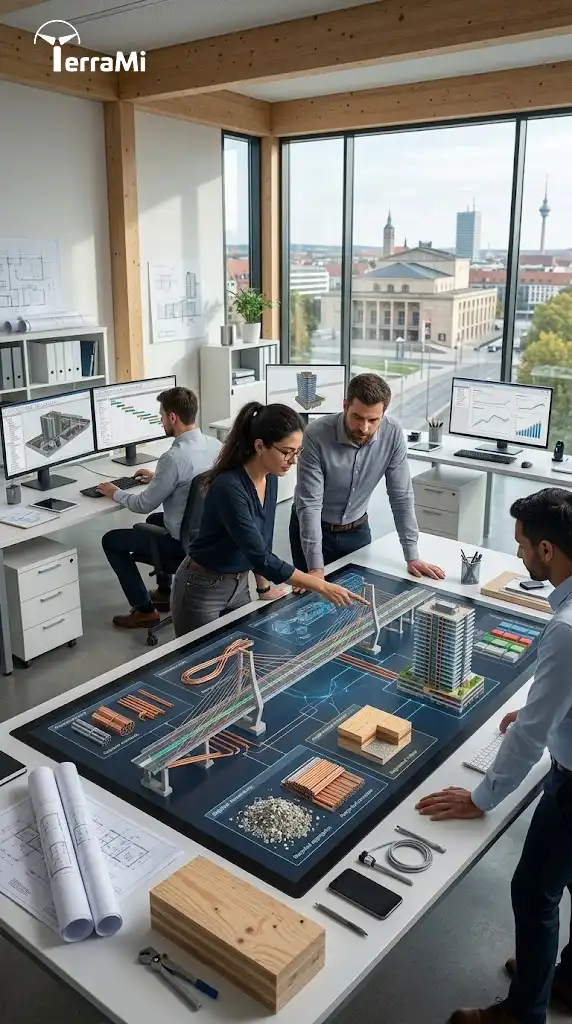
Every infrastructure asset also stores materials.
Steel, aluminium, copper, concrete, engineered timber, aggregates, rare earth elements, polymers, glass, and countless other materials remain embedded within infrastructure throughout its operational life. Collectively, these materials represent an enormous reserve of future economic value.
Instead of viewing infrastructure solely as a collection of physical assets, governments are beginning to recognise it as a national resource bank.
This perspective fundamentally changes long-term planning.
Every investment made today influences the quantity, quality, traceability, and recoverability of materials that will become available decades from now. Infrastructure therefore contributes not only to economic productivity but also to future resource security.
Countries that systematically document material inventories, improve lifecycle traceability, and design assets for future recovery will gradually accumulate strategic resource advantages that extend well beyond individual construction projects.
This is particularly important for developing nations, where much of tomorrow’s infrastructure has not yet been built.
The decisions made today will determine whether future generations inherit valuable material assets or costly demolition waste.
Digital Infrastructure Allows Emerging Economies to Leap Ahead
Many developing nations face infrastructure challenges that appear daunting.
Limited financial resources, ageing public services, growing urban populations, and increasing climate risks create substantial pressure on governments and infrastructure owners.
Yet these same conditions also create opportunities for innovation.
Without extensive legacy systems to constrain technological adoption, many emerging economies can implement digital infrastructure solutions more rapidly than countries burdened by decades of fragmented asset management practices.

Building Information Modelling (BIM), Digital Twins, Geographic Information Systems (GIS), Internet of Things (IoT) platforms, artificial intelligence, cloud-based asset management, and advanced data analytics enable governments to make better infrastructure decisions throughout entire asset lifecycles.
Rather than relying upon fragmented records, organisations can develop integrated digital ecosystems that improve planning, maintenance, investment prioritisation, and future material recovery.
Digital infrastructure therefore becomes more than a technology initiative.
It becomes an enabler of better governance, greater transparency, and more intelligent resource management.
Countries investing simultaneously in physical infrastructure and digital infrastructure are positioning themselves to make faster, better-informed decisions throughout the coming decades.
Financing the Future Instead of Correcting the Past
Infrastructure financing is also entering a period of significant transformation.
Historically, investment decisions concentrated primarily on construction costs, project delivery schedules, and immediate economic returns. Increasingly, however, investors recognise that infrastructure assets generate value throughout decades of operation.
Lifecycle performance has become a financial consideration.
Infrastructure that reduces maintenance requirements, extends material productivity, improves operational efficiency, and supports future resource recovery presents lower long-term investment risk.
For developing nations, this creates an important opportunity.
Rather than financing infrastructure that will require expensive retrofitting within a generation, governments can direct investment toward projects capable of preserving both economic value and resource productivity over multiple lifecycles.
This approach also aligns with evolving expectations from development banks, institutional investors, ESG-focused financing mechanisms, and international infrastructure partnerships.
Future investment will increasingly reward projects that demonstrate resilience alongside financial performance.
Circular development strengthens both.
Governance Determines Whether Opportunity Becomes Reality

Technology alone cannot transform infrastructure. Investment alone cannot guarantee resilience. Engineering alone cannot ensure sustainable development.
Ultimately, progress depends upon governance.
Policies that encourage circular procurement, lifecycle asset management, digital recordkeeping, transparent material tracking, and long-term infrastructure planning create the institutional foundation required for circular development.
Equally important is collaboration.
Governments, engineers, contractors, infrastructure owners, investors, technology providers, and academic institutions all contribute to the successful implementation of circular infrastructure strategies.
When these stakeholders operate within a shared strategic framework, infrastructure decisions become more consistent, investment becomes more effective, and national resource productivity improves over time.
Developing nations therefore possess an opportunity that extends beyond infrastructure itself.
They can build governance systems designed for the resource realities of the twenty-first century rather than adapting institutions created for the industrial economy of the last century.
The Opportunity Is Strategic, Not Incremental
The transition from linear growth to circular development should not be understood as a gradual environmental adjustment.
It represents a strategic shift in national development.
Countries that continue expanding infrastructure according to twentieth-century assumptions may become increasingly exposed to resource volatility, supply chain disruptions, rising material costs, and geopolitical uncertainty.
Those adopting circular principles today will gradually develop stronger domestic resource systems, better investment outcomes, more resilient infrastructure, and greater economic flexibility.
The gap between these two development models is likely to widen throughout the coming decades. For developing nations, the greatest competitive advantage may no longer be lower labour costs or abundant natural resources. It may be the ability to build infrastructure that preserves value instead of consuming it.
Conclusion
The future of infrastructure development will not be determined solely by the quantity of projects delivered, but by the quality of the systems that support them throughout their entire lifecycle.
For much of modern history, economic development has been closely linked to increasing levels of resource extraction and infrastructure expansion. That model generated remarkable progress, but it also created growing dependence on finite resources, increasingly complex global supply chains, and infrastructure systems that often struggle to adapt to changing economic and environmental conditions.
Developing nations now have an opportunity that previous generations did not.
Rather than replicating a development pathway built around linear resource consumption, they can integrate circular thinking, digital infrastructure, material intelligence, and lifecycle planning into national development strategies from the outset. Doing so enables countries to improve resource productivity while strengthening resilience, reducing long-term costs, and increasing economic competitiveness.

This transition is not about slowing development. It is about building smarter.
Countries that successfully combine infrastructure investment with resource intelligence will be better positioned to navigate uncertainty, respond to future resource challenges, and create infrastructure systems capable of delivering value for generations.
The question is therefore no longer whether developing nations should embrace circular development.
It is whether they can afford not to.
TerraMi Perspective
Economic growth has traditionally been measured by the speed at which nations extract resources, construct infrastructure, and expand industrial capacity. In the twenty-first century, however, long-term competitiveness will increasingly depend on how effectively countries preserve, recover, and regenerate the resources already embedded within their economies.
At TerraMi, we believe developing nations possess a unique strategic advantage. Because much of their future infrastructure has yet to be built, they are not constrained by many of the legacy systems that limit transformation in more mature economies. This creates an opportunity to embed circular thinking, digital intelligence, resilient governance, and lifecycle resource management into infrastructure from the very beginning rather than attempting costly corrections decades later.
The greatest opportunity is not to repeat the development model of the past more efficiently.
It is to create a fundamentally better one.
Infrastructure that preserves material value, supports intelligent decision-making, and strengthens resource security will become an increasingly important driver of national resilience and sustainable economic growth.
As governments, infrastructure owners, investors, and engineering organizations evaluate future development strategies, practical implementation becomes just as important as long-term vision.
If your organization is exploring circular infrastructure, resource intelligence, ESG integration, or digital transformation strategies, Contact Us to discuss how TerraMi can help translate these principles into practical infrastructure solutions.
Assess Your AI Readiness
Building intelligent infrastructure requires more than digital technologies—it requires organizational readiness.
Understanding your organization’s current level of AI maturity is an important first step toward implementing data-driven infrastructure management, resource intelligence, predictive analytics, and digital decision-making.
TerraMi’s AI Pre-Assessment helps organizations evaluate their preparedness for AI-enabled infrastructure transformation and identify opportunities for future capability development.
End of TerraMi Special Series II
The Resource Future of Infrastructure
Over the course of this three-part series, we have examined how the future of infrastructure is being reshaped by resource security, circular thinking, and intelligent resource management.
Part I explored why Resource Security has become a strategic priority as geopolitical uncertainty, critical mineral competition, climate pressures, and fragile supply chains redefine infrastructure planning.
Part II demonstrated how the Circular Economy has evolved beyond recycling into a multidisciplinary engineering framework centred on material intelligence, lifecycle optimisation, and digital resource management.
Part III concluded by showing why developing nations have a unique opportunity to bypass outdated linear development models and build infrastructure systems designed for resilience, resource productivity, and long-term competitiveness from the outset.
Together, these articles present a single message:
The future of infrastructure belongs to nations and organizations that treat resources not as consumables, but as strategic assets whose value can be preserved, regenerated, and intelligently managed throughout multiple generations.
Frequently Asked Questions (FAQ)
Why is linear growth becoming less sustainable for developing nations?
Linear growth depends heavily on continuous resource extraction and increasingly vulnerable global supply chains. As competition for critical materials intensifies, developing nations face growing economic and geopolitical risks if they rely solely on traditional development models.
How does the Circular Economy support national development?
The Circular Economy improves resource productivity by extending material lifecycles, promoting recovery and reuse, reducing waste, and strengthening long-term infrastructure resilience while supporting sustainable economic growth.
Why are developing nations well positioned for circular development?
Many developing nations are still expanding major infrastructure systems. This provides an opportunity to integrate circular design, digital technologies, and lifecycle planning before inefficient legacy systems become permanently established.
What role does digital infrastructure play in circular development?
Digital technologies such as BIM, Digital Twins, GIS, AI, and IoT improve visibility across infrastructure lifecycles, enabling better planning, maintenance, material recovery, and investment decision-making.
How can governments improve resource security through infrastructure planning?
Governments can strengthen resource security by designing infrastructure for durability, adaptability, material recovery, lifecycle management, and transparent resource tracking while supporting policies that encourage circular procurement and digital infrastructure management.