
Introduction
Building Intelligent Infrastructure has become one of the defining priorities of modern engineering, yet many organizations continue to equate digital transformation with the implementation of Building Information Modeling (BIM). Over the past two decades, BIM has fundamentally changed how infrastructure projects are designed, coordinated, and delivered. Three-dimensional models, shared project information, and improved collaboration have significantly reduced design conflicts and enhanced construction efficiency.
However, today’s infrastructure environment demands capabilities that extend well beyond digital design. Asset owners must manage infrastructure across decades of operation while responding to climate uncertainty, aging assets, workforce shortages, cybersecurity risks, and rapidly evolving regulatory expectations. These challenges require infrastructure systems that do more than store information—they must generate actionable intelligence.
At this point, many digital transformation initiatives begin to lose momentum. Organizations successfully implement BIM during design and construction but struggle to integrate operational data, maintenance records, sensor information, financial systems, and asset management platforms into a unified decision-making environment. The result is often a collection of disconnected digital tools rather than a genuinely intelligent infrastructure ecosystem.
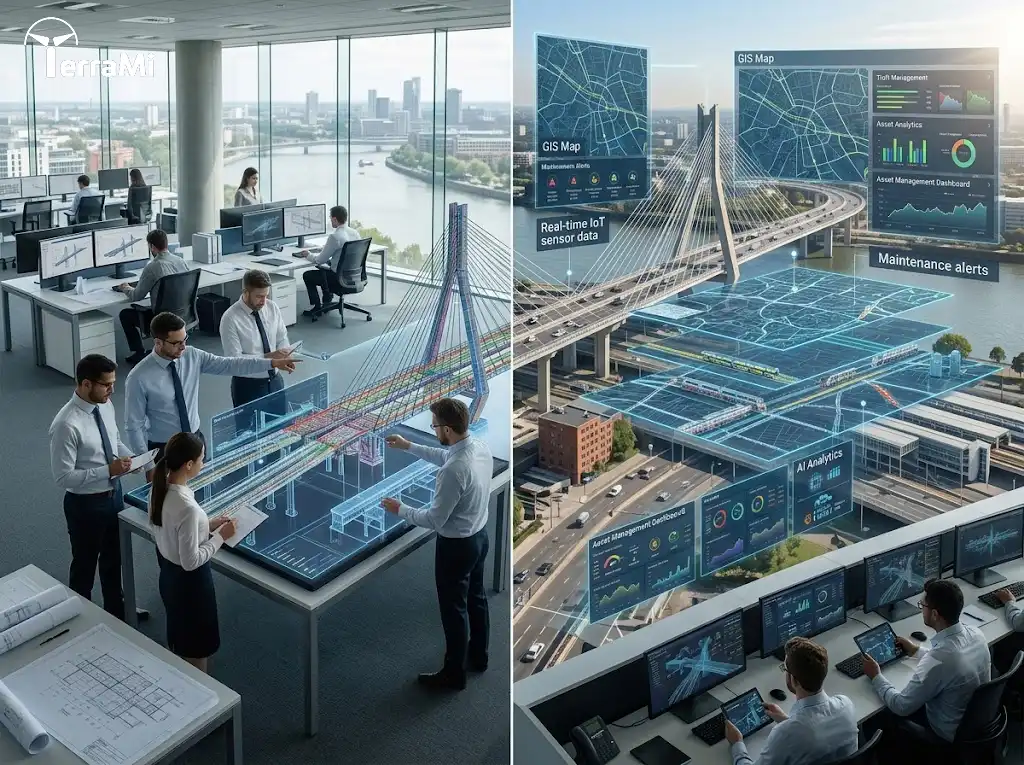
Rather than asking whether BIM remains valuable, infrastructure leaders should ask a different question: What comes after BIM? The future of digital infrastructure depends on connecting engineering information across the entire asset lifecycle, enabling data to flow continuously between planning, design, construction, operation, maintenance, renewal, and long-term investment decisions.
This shift represents a fundamental evolution in engineering philosophy. Instead of treating digital models as project deliverables, organizations are beginning to view infrastructure information as a strategic asset that continues to create value long after construction has been completed.
Why BIM Changed Infrastructure Engineering
Before BIM became widely adopted, infrastructure projects relied heavily on fragmented documentation. Design drawings, specifications, schedules, and engineering calculations often existed in separate systems managed by different disciplines. Information transfer between architects, engineers, contractors, and owners depended largely on manual coordination, creating opportunities for inconsistency and costly errors.
BIM transformed this process by introducing a shared digital representation of physical assets. Engineers could coordinate multiple disciplines within a common model, detect clashes before construction, improve visualization, and generate more reliable quantities. Project teams gained better visibility into design intent, while owners received richer digital documentation at project completion.
The impact extended beyond visualization. BIM encouraged greater collaboration, standardized information exchange, and established more structured engineering workflows. International standards such as ISO 19650 further strengthened information management practices by defining consistent approaches for creating, organizing, and sharing project information.
For many organizations, adopting BIM represented the first major step toward infrastructure digitalization. It demonstrated that engineering data could become a central component of project delivery rather than a collection of isolated documents.
Yet BIM was never intended to solve every challenge associated with infrastructure management.
Its primary strength lies in creating and coordinating engineering information during design and construction. Once infrastructure enters decades of operation, entirely different questions begin to dominate:
- Which assets are approaching failure?
- How should maintenance budgets be prioritized?
- What operational risks are emerging?
- How are climate conditions affecting long-term performance?
- Which investments deliver the highest lifecycle value?
Answering these questions requires information that extends far beyond a three-dimensional model.
Where BIM Reaches Its Limits
The misconception that BIM alone creates digital infrastructure has become increasingly common across both public and private sectors. While BIM provides an excellent representation of engineered assets, it is not designed to function as an enterprise-wide intelligence platform.
A completed BIM model describes what has been built. Intelligent infrastructure must also explain:
- what is happening now,
- why performance is changing,
- what is likely to happen next,
- and what actions should be taken.
These capabilities depend on integrating engineering models with operational technologies, asset management systems, geographic information systems (GIS), Internet of Things (IoT) sensors, maintenance histories, inspection records, financial data, environmental monitoring, and increasingly, artificial intelligence.
Without these connections, even the most detailed BIM model gradually becomes static documentation rather than a living source of operational knowledge.
This distinction is becoming more significant as infrastructure owners transition from project-centric thinking toward lifecycle-centric management. Success is no longer measured solely by delivering projects on time and within budget. Increasingly, it depends on how effectively infrastructure performs over the next thirty, fifty, or even one hundred years.
The organizations leading digital transformation are recognizing that BIM should be viewed not as the destination, but as the starting point for building a continuously connected infrastructure information ecosystem
From Information Modeling to Infrastructure Intelligence
The next phase of digital infrastructure is not defined by creating larger or more detailed models. It is defined by enabling information to move seamlessly across the entire lifecycle of an asset and supporting decisions long after construction has finished.
For decades, infrastructure projects have been organized around individual phases. Planning, design, procurement, construction, operation, and maintenance often function as separate domains, each producing its own datasets and documentation. Although BIM significantly improved collaboration during project delivery, many organizations still experience a sharp decline in information continuity once an asset becomes operational.
This fragmentation creates a persistent problem. Valuable engineering knowledge generated during design is rarely connected to the operational data collected over the following decades. Maintenance teams develop their own records, inspection reports are stored in separate systems, financial information resides in enterprise software, and sensor data is often managed independently from engineering models.
The consequence is not a lack of data—it is a lack of connected knowledge.
Intelligent infrastructure addresses this challenge by treating data as a continuous organizational asset rather than a project deliverable. Every stage of an infrastructure asset contributes information that enriches future decisions, creating a dynamic knowledge environment instead of isolated digital repositories.
In this context, BIM becomes one important component within a much broader digital ecosystem.
The Five Pillars of Intelligent Infrastructure
Organizations seeking to move beyond BIM should focus on developing five interconnected capabilities. Together, these capabilities transform digital information into operational intelligence.
1. Integrated Data Ecosystems
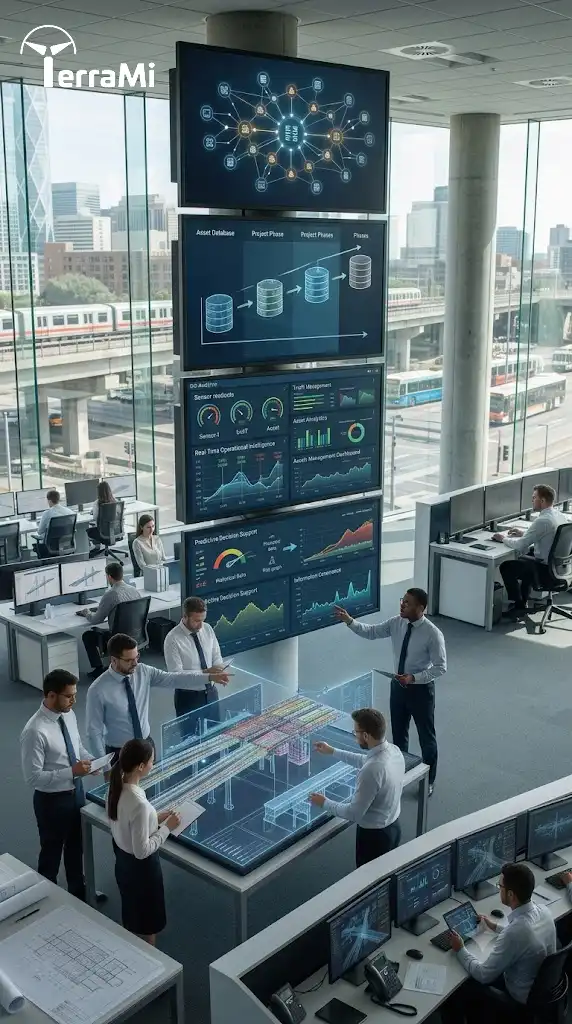
Infrastructure organizations typically manage information across dozens of software platforms. Engineering models, GIS databases, enterprise asset management systems, procurement platforms, financial software, maintenance applications, and operational monitoring tools often operate independently.
An intelligent infrastructure environment does not necessarily replace these systems. Instead, it connects them.
When information flows reliably between systems, decision-makers gain access to a comprehensive understanding of infrastructure performance instead of fragmented snapshots. Engineers can relate design assumptions to actual operational outcomes, while asset managers can evaluate maintenance strategies using engineering, financial, and environmental information simultaneously.
Integration reduces duplication, improves consistency, and supports more informed investment decisions throughout the infrastructure lifecycle.
2. Lifecycle Information Management
Infrastructure assets frequently remain in service for fifty years or more. During that period, information evolves continuously through inspections, repairs, upgrades, regulatory changes, and operational experience.
Traditional project documentation captures only a small portion of this journey.
Lifecycle information management ensures that digital information remains accurate, accessible, and valuable throughout the operational life of the asset. Rather than archiving project information after construction, organizations maintain living datasets that evolve alongside the infrastructure itself.
This continuity enables future engineers to understand not only how an asset was originally designed but also how it has performed under real operating conditions.
Such knowledge becomes increasingly valuable as infrastructure ages and maintenance decisions become more complex.
3. Real-Time Operational Intelligence
Static engineering information explains what infrastructure should do.
Operational intelligence explains what infrastructure is actually doing.
Modern infrastructure increasingly incorporates data from structural health monitoring systems, environmental sensors, traffic monitoring, energy management platforms, and remote inspection technologies. These continuous streams of operational information provide insights that cannot be obtained from design models alone.
When integrated with engineering information, operational data allows organizations to identify abnormal behavior earlier, prioritize inspections more effectively, and respond proactively before small issues develop into major failures.
The objective is not simply monitoring infrastructure.
It is improving engineering decisions through continuous feedback.
4. Predictive Decision Support
Perhaps the most significant shift beyond BIM is the movement from descriptive information toward predictive intelligence.
Instead of asking:
“What condition is this asset in today?”
Infrastructure owners increasingly ask:
“What is likely to happen over the next five, ten, or twenty years?”
Answering this question requires combining engineering knowledge with historical performance data, maintenance records, environmental conditions, and increasingly sophisticated analytical models.
Predictive decision support enables organizations to evaluate future risks before they become operational problems. Maintenance activities can be scheduled based on expected deterioration rather than fixed intervals. Investment priorities become more transparent, and limited financial resources can be directed toward assets facing the highest levels of risk.
While predictive analytics continues to evolve, its value depends entirely on the quality and integration of the underlying infrastructure information.
Without reliable data governance, even advanced analytical tools produce unreliable recommendations.
5. Information Governance
Technology often receives the greatest attention during digital transformation, yet governance frequently determines long-term success.
Infrastructure organizations generate enormous volumes of information every day. Without clear governance, data quality gradually deteriorates through inconsistent naming conventions, duplicated records, incomplete documentation, and incompatible information standards.
Information governance establishes common rules for creating, validating, maintaining, and sharing digital information throughout the organization.
It defines responsibilities, ensures accountability, supports regulatory compliance, and enables different departments to trust the information they use for decision-making.
In many respects, governance forms the foundation upon which every other component of intelligent infrastructure depends.
Without trusted information, there can be no trusted intelligence.
Why Data Integration Matters More Than 3D Models
Three-dimensional visualization remains one of BIM’s greatest strengths, but visualization alone rarely determines infrastructure performance.
Consider a bridge that has been operating for twenty years.
Its original BIM model accurately represents its geometry, materials, and construction details. However, decisions about future maintenance require a much broader perspective.
Engineers must also understand:
- inspection findings collected over many years,
- structural monitoring results,
- traffic loading patterns,
- environmental exposure,
- maintenance interventions,
- lifecycle costs,
- budget constraints,
- regulatory requirements,
- and projected deterioration.
None of these datasets exists exclusively within the BIM environment.
Only by integrating these diverse sources of information can organizations develop a comprehensive understanding of infrastructure condition and future risk.
This illustrates an important distinction between digital documentation and digital intelligence.
Documentation records what exists.
Intelligence explains what it means.
As infrastructure networks become larger, older, and more interconnected, this distinction will increasingly influence investment decisions, resilience planning, and long-term asset performance.
Case Study Perspective: Digital Rail Infrastructure
Many railway operators have invested heavily in BIM during major capital projects, improving design coordination and reducing construction conflicts. Yet the greatest operational gains have often emerged only after integrating BIM with asset management systems, GIS platforms, inspection databases, and condition monitoring technologies.
When these systems operate together, maintenance teams can trace defects directly to engineering models, compare current conditions with historical inspections, prioritize interventions based on risk, and allocate resources more efficiently across extensive rail networks.
The value is not created by the digital model itself. It is created by the continuous exchange of reliable information between engineering, operations, and maintenance.
This pattern is increasingly visible across airports, highways, water utilities, ports, and energy infrastructure. Organizations achieving the highest levels of digital maturity are those that view BIM as one layer within an integrated information architecture rather than as a standalone solution.
Building the Digital Infrastructure Stack
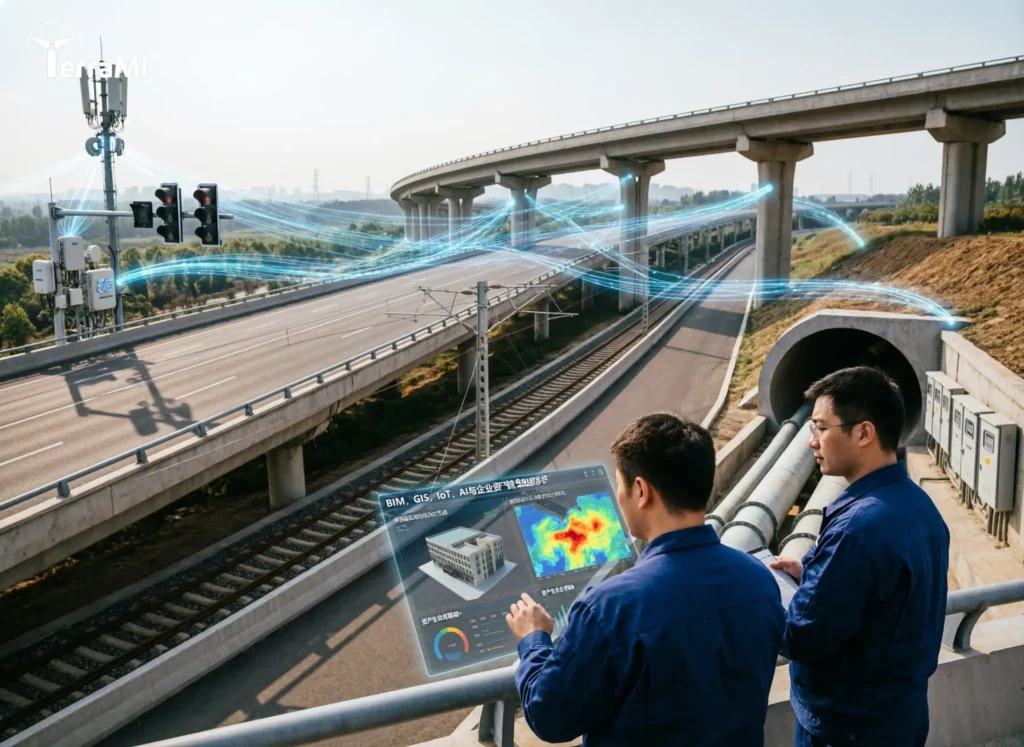
Moving beyond BIM does not require organizations to abandon existing digital investments. Instead, it requires a more mature digital architecture in which different technologies work together to support engineering, operations, and strategic decision-making.
This architecture can be viewed as a Digital Infrastructure Stack, where each layer contributes a distinct capability while sharing information across the entire infrastructure lifecycle.
The stack typically includes:
- Engineering Information Layer – BIM models, design documentation, specifications, and engineering calculations.
- Spatial Intelligence Layer – Geographic Information Systems (GIS) that provide geographic context and network-level visibility.
- Operational Data Layer – IoT sensors, SCADA systems, inspection records, and monitoring technologies that capture real-world asset performance.
- Enterprise Management Layer – Asset management, maintenance planning, financial systems, procurement platforms, and risk management applications.
- Analytics and Intelligence Layer – Artificial intelligence, machine learning, predictive analytics, and decision-support tools that transform data into actionable insights.
- Governance Layer – Policies, standards, cybersecurity, interoperability frameworks, and data governance practices that ensure information remains trustworthy and usable.
The strength of this architecture lies not in any individual technology but in the relationships between them. When information flows consistently across every layer, organizations gain a far more complete understanding of infrastructure performance than any single platform can provide.
Digital maturity is therefore measured less by the number of software systems an organization owns and more by the quality of information exchange between those systems.
Challenges on the Journey Beyond BIM
Although the vision of intelligent infrastructure is increasingly clear, implementation remains challenging. The barriers are rarely technological alone.
Many organizations continue to face fragmented digital environments that have evolved over decades. Different departments often adopt software independently, resulting in incompatible data structures, inconsistent terminology, and duplicated information.
Cultural challenges can be equally significant. Digital transformation requires engineers, operators, IT specialists, and executive leadership to collaborate in ways that traditional organizational structures have not always encouraged. Establishing common objectives and shared ownership of digital information often proves more difficult than deploying new technology.
Another persistent challenge is the quality of legacy data. Infrastructure owners frequently possess extensive historical records in paper archives, spreadsheets, disconnected databases, and outdated software platforms. Converting this information into structured, reliable digital assets demands sustained investment and careful governance.
Cybersecurity has also become a central consideration. As infrastructure systems become increasingly connected, organizations must protect not only operational technologies but also the integrity of engineering information that supports critical decisions. A secure digital environment is now an essential component of infrastructure resilience.
Finally, organizations must resist the temptation to pursue technology for its own sake. Successful digital transformation begins with clearly defined operational objectives and engineering challenges, followed by the careful selection of technologies that support those goals. Technology should enable better decisions rather than becoming an objective in itself.
Looking Ahead: From Digital Assets to Intelligent Infrastructure
The next decade is likely to redefine how infrastructure is planned, delivered, operated, and renewed.
Advances in artificial intelligence, digital twins, edge computing, cloud platforms, remote sensing, robotics, and autonomous inspection technologies will continue to expand the quantity and quality of infrastructure data. Yet the greatest competitive advantage will not come from collecting more information. It will come from connecting information in ways that improve decision-making.
Organizations capable of integrating engineering models, operational performance, environmental conditions, financial planning, and predictive analytics into a unified information environment will be better positioned to respond to increasingly complex infrastructure challenges.
This evolution also changes the role of engineers.
Engineering professionals will continue designing physical assets, but they will also become stewards of digital knowledge throughout the asset lifecycle. Their expertise will increasingly involve understanding how information moves between systems, how data quality affects engineering outcomes, and how digital intelligence can support more resilient and sustainable infrastructure.
In this environment, BIM remains indispensable.
It simply becomes one part of a much larger ecosystem dedicated to building infrastructure that is not only digitally represented but continuously informed.
TerraMi Perspective
For many organizations, the question is no longer whether BIM should be adopted. That conversation has largely been settled.
The more important question is whether digital transformation will stop at creating better project models or continue toward building intelligent infrastructure ecosystems.
At TerraMi, we believe digital maturity is achieved when infrastructure information remains valuable throughout the entire lifecycle of an asset—not only during design and construction. Intelligent infrastructure is built on connected data, disciplined information governance, interoperability, and the ability to convert engineering knowledge into better operational decisions.
Organizations that embrace this broader perspective will be better prepared to improve resilience, optimize lifecycle performance, strengthen sustainability outcomes, and make more confident investment decisions in an increasingly complex infrastructure landscape.
Frequently Asked Questions (FAQ)
Is BIM the same as intelligent infrastructure?
No. BIM is a methodology for creating and managing digital representations of physical assets, primarily during planning, design, and construction. Intelligent infrastructure extends beyond BIM by integrating operational data, asset management systems, analytics, governance, and lifecycle decision support.
Why isn’t BIM alone sufficient for long-term asset management?
A BIM model describes the engineered asset, but it does not automatically incorporate operational performance, maintenance history, environmental monitoring, financial planning, or predictive analytics. Long-term asset management depends on combining these information sources into a connected ecosystem.
What technologies complement BIM in intelligent infrastructure?
Common complementary technologies include Geographic Information Systems (GIS), Enterprise Asset Management (EAM) platforms, Internet of Things (IoT) sensors, digital twins, cloud-based data platforms, artificial intelligence, machine learning, and predictive analytics.
What is the biggest obstacle to building intelligent infrastructure?
In many cases, the greatest challenge is not technology but information governance. Poor data quality, disconnected systems, inconsistent standards, and organizational silos often prevent digital information from supporting reliable decision-making.
How does intelligent infrastructure improve sustainability?
Connected information enables organizations to optimize maintenance schedules, extend asset life, reduce unnecessary resource consumption, improve operational efficiency, prioritize investments based on risk, and support evidence-based sustainability strategies throughout the infrastructure lifecycle.