
How ESG Integration Is Changing Infrastructure Project Performance
For many years, ESG occupied a relatively narrow position within infrastructure organizations.
It was often associated with sustainability reporting, stakeholder communication, environmental disclosures, and compliance requirements. Project teams typically viewed ESG as something that existed alongside infrastructure delivery rather than something that actively shaped it.
That perception is changing.
Across transportation networks, energy systems, industrial facilities, water infrastructure, and large-scale capital projects, ESG is increasingly influencing how infrastructure projects are planned, financed, governed, executed, and operated.

This shift is not occurring because ESG has become fashionable.
It is occurring because infrastructure projects now operate in a world defined by uncertainty.
Climate-related disruptions are affecting asset performance. Supply chain volatility continues to influence project schedules and procurement strategies. Investors are paying closer attention to long-term operational risk. Regulators are demanding greater transparency. Communities expect infrastructure projects to deliver broader value beyond construction outputs.
Under these conditions, ESG is evolving from a reporting framework into a project decision framework.
The most forward-looking infrastructure organizations no longer ask whether ESG should be integrated into projects.
They ask how ESG can improve project outcomes.
Why ESG in Infrastructure Projects Is Moving Beyond Compliance
One of the most important developments in recent years has been the gradual shift away from compliance-driven ESG.
The early stages of ESG adoption often focused on disclosure requirements, sustainability reports, and external communications. While those activities remain important, they rarely determine whether infrastructure projects succeed or fail.
Project performance is ultimately shaped by decisions.
Infrastructure leaders increasingly recognize that ESG influences those decisions in meaningful ways.
A project that ignores workforce safety risks may experience productivity challenges.
A project that overlooks community concerns may face delays and reputational damage.
A project that underestimates climate exposure may encounter escalating operational costs long after construction is complete.
These realities explain why ESG is becoming embedded within project planning rather than remaining isolated within corporate reporting structures.
Recent discussions among investors and sustainability professionals also reflect a growing emphasis on measurable outcomes rather than symbolic commitments. Organizations are increasingly expected to demonstrate how ESG contributes to operational performance, resilience, and risk reduction rather than simply publishing sustainability targets. According to Reuters’ sustainability analysis, investors are increasingly focused on measurable ESG outcomes and long-term value creation rather than symbolic commitments alone.
As a result, ESG in infrastructure projects is becoming less about reporting activity and more about project effectiveness.
The Economic Case for ESG Integration in Infrastructure Projects
One of the most persistent misconceptions surrounding ESG is the belief that it primarily represents an additional cost.
In reality, many infrastructure organizations are discovering that ESG often functions as a mechanism for protecting long-term project value.

Infrastructure projects are uniquely exposed to long operational horizons.
Unlike many business initiatives, infrastructure assets may remain operational for decades.
Decisions made during planning and construction can influence asset performance long after project delivery.
This creates a direct economic connection between ESG and infrastructure outcomes.
Risk Reduction
Projects that proactively address environmental, social, and governance risks are often better positioned to avoid delays, disputes, regulatory complications, and operational disruptions.
Capital Access
Investors increasingly evaluate infrastructure opportunities through risk-adjusted perspectives that incorporate ESG considerations.
Organizations capable of demonstrating effective ESG integration may strengthen their attractiveness to capital providers.
Operational Efficiency
Resource optimization, workforce engagement, safety performance, and lifecycle planning frequently generate measurable operational benefits.
Asset Longevity
Infrastructure systems designed with resilience and adaptability in mind often maintain value more effectively under changing conditions.
The economic value of ESG therefore extends beyond compliance.
It increasingly influences infrastructure competitiveness.
How ESG in Infrastructure Projects Influences Decision-Making
The true significance of ESG emerges when it begins influencing decisions rather than reports.
Infrastructure projects involve thousands of decisions across their lifecycle.
Many of those decisions have direct ESG implications.
Investment Decisions
Investors are increasingly evaluating how infrastructure assets will perform under long-term environmental, operational, and governance pressures.
Questions that once appeared peripheral are becoming central:
- Can the asset adapt to future conditions?
- How resilient is the operational model?
- Are governance structures capable of supporting long-term performance?
- What risks remain hidden within the project ecosystem?
Organizations that can answer these questions effectively often gain strategic advantages.
Risk Allocation
Infrastructure risk management has traditionally focused on cost, schedule, and technical execution.
Modern projects require broader visibility.
Climate exposure, social acceptance, workforce challenges, cybersecurity risks, and governance weaknesses can all affect project outcomes.
ESG helps expand risk awareness beyond traditional project controls.
Governance Quality
Governance is frequently the least visible component of ESG, yet it often has the greatest influence on project performance.
Poor governance can undermine even technically successful projects.
Effective governance improves:
- accountability
- transparency
- decision quality
- stakeholder coordination
- strategic alignment
Strong governance creates the conditions required for resilient project execution.
Operational Performance
Infrastructure projects increasingly generate large volumes of operational data.
The challenge is not data availability.
The challenge is converting information into decisions.
This is where ESG begins intersecting with operational performance.
Organizations that integrate ESG into day-to-day operations gain greater visibility into the factors influencing long-term project success.
Operational ESG Is Reshaping Infrastructure Execution
One of the most significant developments in the infrastructure sector is the emergence of Operational ESG.
Traditional ESG models often focus on reporting outcomes after activities occur.
Operational ESG focuses on how infrastructure systems actually perform while projects are being executed and assets are being operated.
This distinction matters.
A project may publish excellent sustainability commitments while simultaneously struggling with operational visibility, governance fragmentation, workforce coordination, or infrastructure resilience.
Operational ESG attempts to close this gap.
Instead of asking:
“What should we report?”
Organizations increasingly ask:
“How do we improve performance?”
This shift creates opportunities to connect ESG with:
- project controls
- infrastructure intelligence
- risk monitoring
- asset management
- workforce safety
- operational resilience
- governance effectiveness
As infrastructure projects become more complex, ESG becomes most valuable when it supports execution rather than documentation.

Why Infrastructure Investors Are Paying Closer Attention to ESG
Infrastructure investors have always evaluated risk.
What has changed is the range of risks being considered.
Long-term infrastructure investments increasingly face uncertainty associated with climate impacts, regulatory change, resource availability, social acceptance, workforce dynamics, and operational resilience.
International organizations including the OECD’s Sustainable and Resilient Infrastructure framework emphasize that long-term infrastructure performance depends on integrating resilience, governance, and sustainability considerations throughout the asset lifecycle.
Investors understand that infrastructure value is rarely determined solely by construction quality.
Long-term value creation depends on how assets perform under changing conditions.
ESG provides a framework for evaluating those conditions.
This explains why ESG is becoming increasingly relevant within infrastructure finance, project evaluation, and strategic planning.
ESG as a Competitive Advantage Rather Than a Reporting Obligation
The organizations gaining the greatest value from ESG are often those that have stopped treating it as a reporting exercise.
Instead, they view ESG as a competitive capability.
When integrated effectively, ESG can improve:
- project resilience
- stakeholder trust
- operational visibility
- governance maturity
- investment readiness
- lifecycle performance
This does not mean every ESG initiative generates value automatically.
Poorly implemented ESG programs can become administrative burdens.
The difference lies in execution.
Organizations that connect ESG directly to project outcomes tend to achieve more meaningful results than those focused solely on compliance.
This is one reason why infrastructure leaders are increasingly exploring infrastructure intelligence approaches that connect governance, risk, operational visibility, and performance measurement.
The future of ESG in infrastructure projects will likely be defined by measurable operational value rather than reporting volume.
The Future of ESG in Infrastructure Projects
Infrastructure is entering an era where uncertainty is becoming a permanent operating condition.
The question facing project leaders is no longer whether disruption will occur.
The question is how infrastructure systems will respond when it does.
In that environment, ESG becomes increasingly relevant because it helps organizations evaluate resilience, governance quality, stakeholder relationships, operational performance, and long-term risk exposure.
The infrastructure projects most likely to succeed over the coming decades will not necessarily be those with the largest budgets or the most advanced technologies.
They will be the projects capable of adapting to changing conditions while maintaining operational effectiveness.
That capability sits at the heart of modern ESG integration.
ESG in Infrastructure Projects Is Becoming a Strategic Necessity
The evolution of ESG reflects a broader transformation occurring across the infrastructure sector.
Projects are becoming more interconnected.
Risks are becoming more complex.
Stakeholder expectations continue to rise.
Under these conditions, ESG is no longer simply a reporting framework.
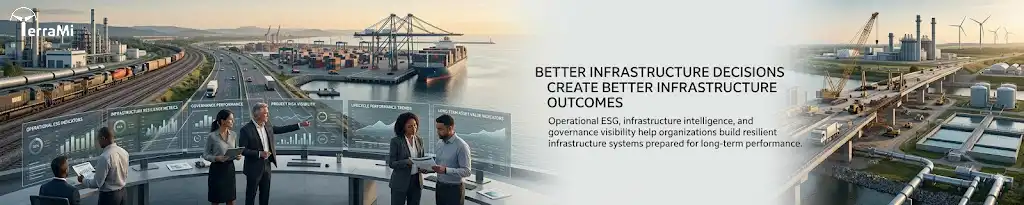
It is increasingly becoming a structural driver of infrastructure decision-making, risk management, governance, resilience, and long-term performance.
Organizations that integrate ESG effectively are often better positioned to navigate uncertainty while protecting infrastructure value throughout the asset lifecycle.
At TerraMi, we believe the future of infrastructure depends on moving beyond compliance and toward measurable execution capability. By connecting Operational ESG, infrastructure intelligence, governance, and resilience, organizations can build infrastructure systems that not only meet today’s requirements but remain effective under tomorrow’s challenges.