
The Foundations of Sustainable Infrastructure Systems
For decades, infrastructure development was primarily evaluated through a narrow set of delivery metrics.
Projects were considered successful when they were completed on time, delivered within budget, and aligned with technical specifications. Engineering performance was often measured through isolated operational milestones rather than long-term system behavior.
That approach shaped much of the modern built environment.
But infrastructure systems no longer operate in stable or isolated conditions.
Today, transportation networks, industrial facilities, energy systems, water infrastructure, logistics corridors, and urban development ecosystems exist within environments defined by operational uncertainty, climate pressure, supply chain volatility, cyber risk, regulatory evolution, and increasing expectations for measurable long-term performance.
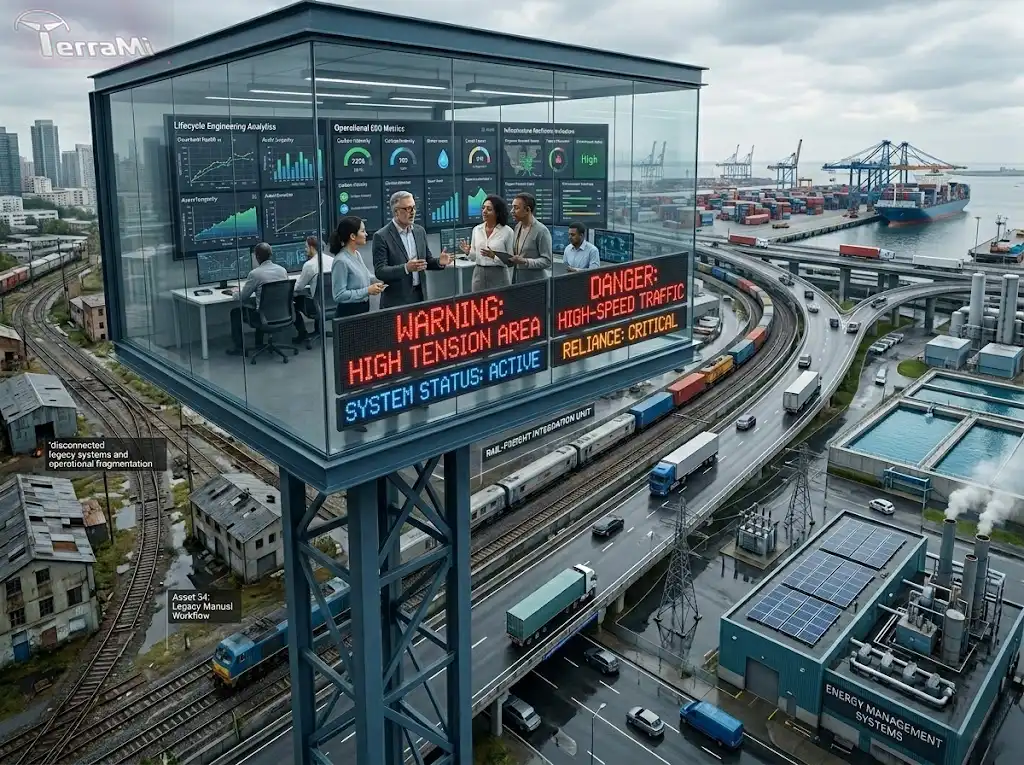
Under these conditions, infrastructure can no longer be understood as a collection of disconnected physical assets.
It must be understood as an interconnected operational system.
This shift is redefining the foundations of sustainable infrastructure systems.
The future of infrastructure will not be determined solely by construction capability. It will increasingly depend on whether infrastructure systems can adapt, integrate, recover, and continue generating operational value under changing conditions.
Sustainable Infrastructure Systems Are Built on Integration
One of the most common misconceptions surrounding sustainable infrastructure is the assumption that sustainability exists independently from operations.
In reality, sustainable infrastructure systems are fundamentally integration problems.
Infrastructure rarely fails because a single component stops functioning. Failure usually emerges from fragmentation between systems, teams, operational data, governance structures, and lifecycle decisions.
This fragmentation often appears in familiar forms:
- Engineering teams operating separately from operational teams
- ESG reporting disconnected from field execution
- Asset management systems lacking real-time visibility
- Procurement decisions isolated from lifecycle impacts
- Infrastructure data distributed across incompatible platforms
- Risk management frameworks reacting after disruption occurs
Traditional infrastructure models frequently optimize individual functions while weakening system-wide coordination.
Sustainable infrastructure systems require the opposite approach.
They require integration across planning, engineering, operations, governance, maintenance, risk analysis, and performance monitoring.
This is where sustainable infrastructure begins to evolve from a compliance concept into an operational capability.
Why Sustainable Infrastructure Systems Depend on Lifecycle Engineering
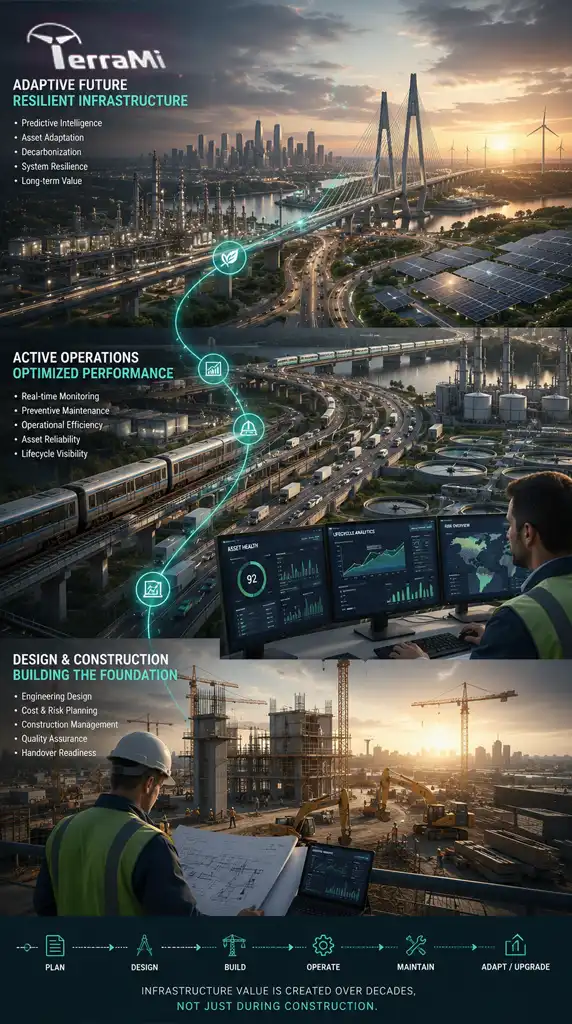
Infrastructure systems are often designed for delivery phases while operational realities extend for decades.
This disconnect creates one of the largest structural weaknesses in infrastructure planning.
Many assets perform adequately during commissioning but gradually lose efficiency, adaptability, and resilience over time because lifecycle conditions were not fully integrated into early-stage decisions.
Lifecycle engineering changes this perspective.
Instead of treating infrastructure delivery as a finite construction event, lifecycle engineering evaluates how infrastructure systems behave across long operational timelines.
This includes:
Long-Term Asset Performance
How infrastructure systems perform under evolving operational conditions.
Maintenance Adaptability
Whether systems can be efficiently monitored, repaired, upgraded, or reconfigured.
Resource Efficiency
How energy, materials, and operational resources are consumed across the asset lifecycle.
Operational Resilience
How infrastructure responds to disruption, environmental pressure, and changing demand patterns.
Data Continuity
Whether operational information remains accessible and actionable throughout system evolution.
Sustainable infrastructure systems depend on lifecycle visibility because long-term infrastructure value is increasingly determined after construction—not before it.
Operational ESG Is Becoming a Core Layer of Infrastructure Systems
For many organizations, ESG initially entered infrastructure through reporting obligations and stakeholder communication.
That model is changing rapidly.
Infrastructure leaders increasingly recognize that ESG cannot remain isolated inside annual reports or governance documents.
Operational ESG connects sustainability objectives directly to infrastructure performance.
This means sustainability becomes measurable through operational conditions rather than aspirational commitments.
In sustainable infrastructure systems, Operational ESG influences:
- Infrastructure decision-making
- Asset prioritization
- Risk visibility
- Resource optimization
- Workforce coordination
- Procurement strategy
- Operational resilience
- Lifecycle performance measurement
Organizations that operationalize ESG gain a clearer understanding of how infrastructure systems behave under pressure.
This transition also improves executive decision quality because governance becomes connected to real operational conditions.
As infrastructure ecosystems become more complex, the ability to measure operational performance continuously becomes increasingly valuable.
Organizations that still treat ESG as a reporting layer may struggle to adapt to infrastructure systems that now require operational intelligence.
Infrastructure Intelligence Is Reshaping Sustainable Infrastructure Systems
Infrastructure systems generate enormous amounts of operational information.
The challenge is rarely data availability.
The challenge is operational visibility.
Many organizations continue operating with fragmented infrastructure information spread across isolated software environments, disconnected reporting systems, and delayed communication structures.
Under conditions of uncertainty, fragmented visibility becomes a strategic liability.
Infrastructure intelligence addresses this problem by transforming infrastructure data into operational awareness.
This includes:
Real-Time Operational Monitoring
Continuous visibility across infrastructure systems and asset conditions.
Predictive Infrastructure Analytics
Identifying operational risks before disruptions escalate.
Integrated Infrastructure Decision-Making
Aligning engineering, governance, operations, and maintenance around shared operational context.
Adaptive Infrastructure Management
Allowing infrastructure systems to evolve alongside changing operational conditions.
Infrastructure intelligence does not replace engineering expertise.
It amplifies organizational awareness.
Sustainable infrastructure systems increasingly depend on the ability to transform operational complexity into measurable and actionable insight.
Sustainable Infrastructure Systems Require Resilience by Design
Infrastructure resilience is often misunderstood as post-disruption recovery.
Modern infrastructure resilience begins much earlier.
Resilience must be integrated directly into system architecture, governance structures, operational planning, and lifecycle engineering.
This concept is often described as resilience by design.
Resilience by design recognizes that disruption is no longer an exceptional condition. It is a persistent operational reality, and many global infrastructure resilience frameworks now emphasize adaptability, operational continuity, and long-term system visibility as foundational infrastructure requirements.
Sustainable infrastructure systems therefore require the ability to:
- Absorb operational stress
- Adapt to changing conditions
- Maintain continuity during disruption
- Recover efficiently from system instability
- Preserve long-term operational functionality
This applies across multiple infrastructure environments:
- Transportation systems
- Energy infrastructure
- Industrial facilities
- Water infrastructure
- Urban infrastructure networks
- Large-scale capital projects
Infrastructure systems that cannot adapt under pressure may remain operational temporarily, but they become increasingly vulnerable over time.
Resilience is no longer an optional enhancement layer.
It is becoming a structural requirement for sustainable infrastructure systems.
Why Fragmented Infrastructure Systems Create Long-Term Risk
One of the defining characteristics of legacy infrastructure models is fragmentation.
Fragmentation appears across:
- Operational data
- Governance systems
- Engineering workflows
- Contractor coordination
- Asset visibility
- Infrastructure technologies
- Lifecycle management processes
This fragmentation creates hidden operational risk.
Organizations may continue functioning while gradually losing adaptability, decision speed, and operational efficiency.
Over time, fragmented infrastructure systems create:

Slower Decision Cycles
Critical infrastructure information becomes delayed or inconsistent.
Higher Lifecycle Costs
Poor coordination increases inefficiency across operations and maintenance.
Reduced Infrastructure Visibility
Organizations struggle to identify emerging operational risks.
Governance Complexity
Strategic objectives become disconnected from execution realities.
Lower System Resilience
Infrastructure systems become less capable of adapting under pressure.
Sustainable infrastructure systems reduce these risks by improving integration, visibility, and operational coordination.
The Future of Sustainable Infrastructure Systems Is Adaptive
Infrastructure is entering an era where static operational assumptions are becoming increasingly ineffective.
Future infrastructure systems will likely be defined less by physical scale and more by adaptive capability.
The highest-performing infrastructure organizations are increasingly moving toward:
- Integrated operational ecosystems
- Data-driven infrastructure visibility
- Predictive infrastructure management
- Lifecycle-based governance models
- Infrastructure intelligence platforms
- Operational ESG frameworks
- Resilience-centered engineering systems
This transformation is not simply technological.
It is organizational.
Sustainable infrastructure systems require new ways of thinking about infrastructure performance, governance, operations, and long-term value creation.
The organizations that adapt early may gain significant advantages in resilience, operational efficiency, investment readiness, and infrastructure longevity.
Sustainable Infrastructure Systems Are Becoming Operational Necessities
Infrastructure systems now operate inside environments shaped by continuous change.
Under these conditions, sustainability can no longer be treated as a symbolic objective or isolated reporting exercise.
Sustainable infrastructure systems are increasingly becoming operational necessities for organizations seeking long-term infrastructure performance, resilience, and strategic adaptability.

The future belongs to infrastructure systems capable of integrating operational intelligence, lifecycle engineering, resilience, governance, and measurable execution capability into unified operational ecosystems.
Organizations that continue relying on fragmented infrastructure structures may still complete projects.
But long-term infrastructure leadership will increasingly belong to organizations capable of adapting faster, operating smarter, and maintaining visibility across complex infrastructure environments.
At TerraMi, we view sustainable infrastructure systems not simply as engineering outcomes, but as evolving operational ecosystems built on resilience, intelligence, integration, and long-term infrastructure performance.