
Infrastructure Resilience Series | Part II of III
This article is the second installment in a three-part thought leadership series exploring how infrastructure organizations can operate successfully in an era of increasing uncertainty, climate volatility, and systemic risk.
Part I: The End of Predictable Infrastructure: Why Historical Assumptions No Longer Work
Part II: Engineering for Uncertainty: The New Logic of Infrastructure Resilience
Part III: Why Infrastructure Resilience Fails Without Governance
From Predicting the Future to Designing for Uncertainty
The infrastructure sector has spent decades pursuing a worthy objective: predictability. Engineers sought predictable performance. Investors sought predictable returns. Governments sought predictable service delivery. Operators sought predictable operating conditions.
The logic was straightforward. If future conditions could be predicted with reasonable accuracy, infrastructure systems could be optimized to deliver maximum efficiency at minimum cost. For much of the modern era, that logic worked remarkably well.
Yet as discussed in the first article of this series, infrastructure organizations are increasingly operating in environments where historical assumptions no longer provide the same level of certainty. Climate volatility, geopolitical instability, supply chain disruption, labor shortages, cyber risks, regulatory evolution, and technological transformation are interacting in ways that make future operating conditions more difficult to anticipate.
This reality presents a critical challenge. Many organizations continue attempting to improve prediction. The more important question may be whether prediction itself remains the most valuable objective.
- What if the future cannot be forecast with the precision we once expected?
- What if the most resilient organizations are not those that predict the future most accurately, but those that remain effective across a range of possible futures?
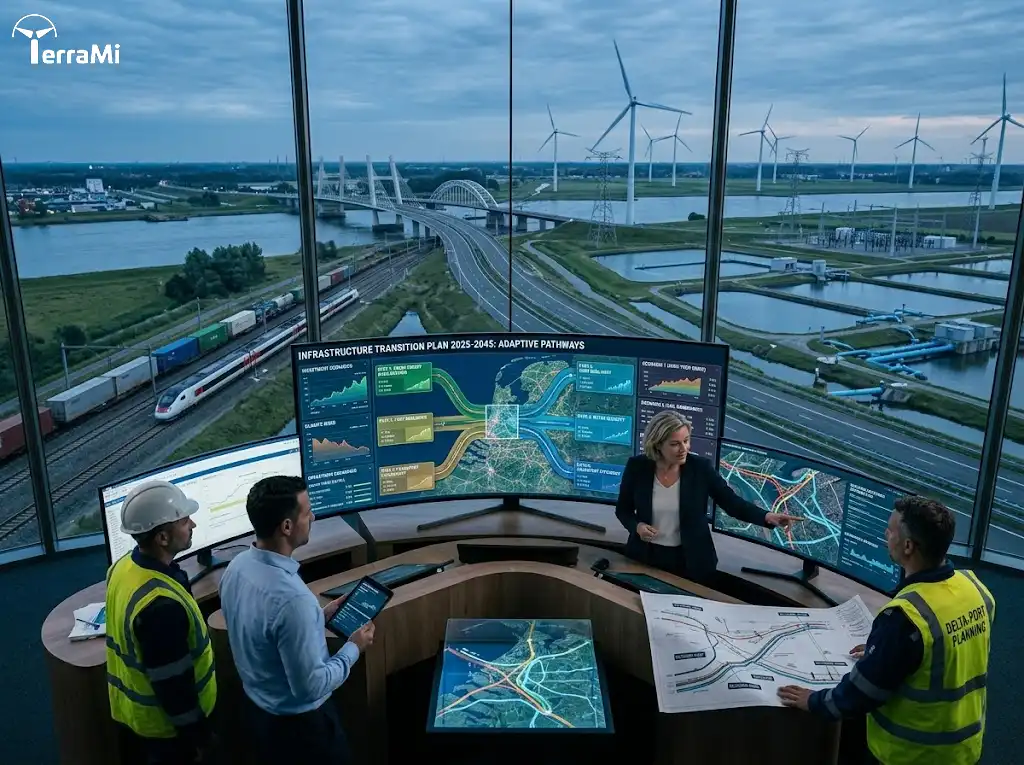
This question sits at the center of modern infrastructure resilience. The infrastructure leaders emerging as long-term winners are increasingly shifting their attention away from prediction and toward adaptation. Rather than asking how to forecast the future more precisely, they are asking how to perform successfully under conditions that remain uncertain. This represents one of the most important strategic transitions occurring across the infrastructure sector today.
Why Infrastructure Resilience Is Different from Traditional Risk Management
One of the most common misconceptions surrounding infrastructure resilience is that it is simply another form of risk management. While the two disciplines are closely related, they are not identical.
Traditional risk management generally begins with identifying specific threats. Organizations evaluate probability, estimate consequences, develop mitigation plans, and implement controls. The objective is to reduce the likelihood or impact of known risks. This approach remains essential.
However, modern infrastructure organizations increasingly face situations where not all risks are known in advance. Many of today’s most disruptive events emerge from the interaction of multiple factors rather than a single isolated threat:
- A supply chain disruption may coincide with labor shortages.
- Extreme weather may occur during periods of peak demand.
- Regulatory changes may alter project economics while market conditions shift simultaneously.
These situations create complexity that cannot always be addressed through conventional risk registers. Infrastructure resilience therefore expands the conversation. Instead of asking, “What risks do we know about?”, it asks, “How effectively can we operate when conditions change unexpectedly?”
This distinction may appear subtle, but in practice, it is transformational:
| Dimension | Traditional Risk Management | Infrastructure Resilience |
| Primary Focus | Reducing exposure | Maintaining performance |
| Core Objective | Seeking stability | Seeking adaptability |
| Preparation Target | Identified and specific threats | Uncertainty itself |
As infrastructure systems become increasingly interconnected, this distinction becomes more important. Organizations that focus exclusively on risk mitigation often discover that unforeseen events create challenges their plans never anticipated. Conversely, organizations that invest in resilience develop capabilities that remain valuable even when disruptions arrive from unexpected directions.
The Shift from Prediction to Adaptation
For generations, infrastructure planning revolved around forecasting. Traffic forecasts shaped transportation investments; demand projections influenced utility expansion; population growth estimates informed urban development strategies; and economic assumptions guided capital allocation decisions.
Forecasting remains important. No infrastructure organization can operate without planning assumptions. The challenge is that forecasts are becoming less reliable when operating environments change rapidly. This does not mean planning should stop; it means planning must evolve. The emerging objective is no longer identifying a single expected future, but preparing for multiple plausible futures. This shift fundamentally changes how infrastructure organizations think about resilience.
Historically, planning models often assumed a preferred scenario: future demand would increase by a certain percentage, population growth would follow expected trends, and climate conditions would remain within anticipated ranges. Today, infrastructure leaders increasingly recognize that multiple outcomes may be possible:
- Demand may rise faster than expected or completely stagnate.
- Resource constraints may suddenly emerge.
- Regulatory requirements and compliance standards may rapidly evolve.
- Technological disruption may completely alter baseline operating conditions.
The challenge is no longer selecting the most likely forecast. The challenge is ensuring infrastructure remains effective across a broad range of scenarios. This is where infrastructure resilience begins to create strategic value.
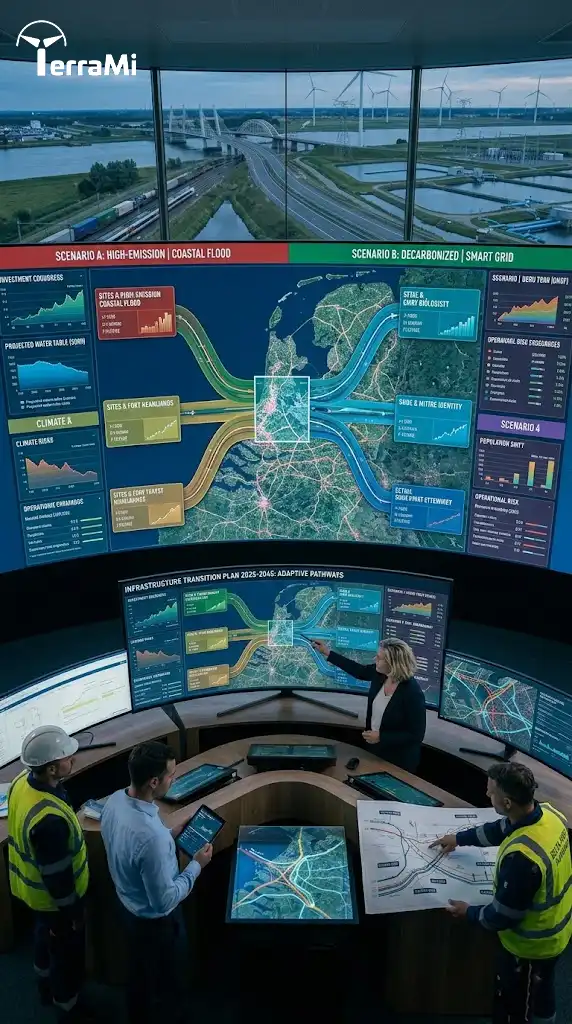
Designing Infrastructure Resilience for Multiple Futures
The concept of designing for multiple futures represents a major departure from traditional infrastructure thinking. Historically, infrastructure systems were optimized around expected conditions. Roads were designed for projected traffic volumes, utilities for forecasted demand, and facilities according to anticipated operating requirements.
Optimization remains important. However, optimization alone may create unintended vulnerabilities. A system optimized for one future may struggle under another. This reality is leading many organizations to embrace flexibility as a core design principle.
Adaptive infrastructure systems are not designed around a single prediction; they are designed around adaptability. They possess the ability to accommodate changing conditions without requiring a complete redesign. This approach increasingly influences infrastructure investment decisions across transportation, energy, water, and industrial sectors.
Infrastructure resilience therefore becomes less about predicting outcomes and more about preserving options. Organizations that preserve options can respond more effectively as circumstances evolve. Those that lock themselves into rigid assumptions often face higher adaptation costs later. This principle is becoming particularly important for long-life infrastructure assets expected to operate for decades, where future operating environments may differ significantly from those anticipated during project development. The ability to adapt may ultimately prove more valuable than the ability to optimize.
Why Scenario Planning Strengthens Infrastructure Resilience
One of the most powerful tools supporting modern infrastructure resilience is scenario planning. Unlike traditional forecasting, scenario planning does not attempt to predict a single future. Instead, it explores multiple possible futures. The objective is not accuracy; the objective is preparedness.
Scenario planning allows organizations to evaluate how infrastructure systems perform under different conditions. For example:
- What happens if energy demand accelerates unexpectedly?
- What happens if climate variability increases operational stress?
- What happens if supply chain disruptions become more frequent?
- What happens if workforce availability declines or technological adoption occurs faster than anticipated?
By exploring these possibilities before they occur, organizations gain valuable insight into vulnerabilities, dependencies, and adaptive opportunities. This approach is increasingly recommended by global institutions concerned with infrastructure resilience and long-term sustainability.
Global Perspectives:
The World Bank’s framework on resilient infrastructure emphasizes the vital importance of planning for uncertainty and strengthening adaptive capacity across infrastructure systems. For a deeper look at these global frameworks, exploreThe World Bank’s Infrastructure Initiatives.
Perhaps most importantly, scenario planning encourages a cultural shift. Organizations stop treating uncertainty as a planning failure. Instead, uncertainty becomes a condition that must be managed intelligently. That shift may represent one of the most important developments in the future of infrastructure leadership.
Infrastructure Resilience Requires New Engineering Thinking
Engineering has always been about solving problems. However, many traditional engineering approaches assume that the problem itself can be clearly defined. Increasingly, infrastructure leaders are discovering that future challenges may not always be fully visible during project development.
As a result, resilience-oriented engineering focuses not only on solving today’s problems but also on preparing for tomorrow’s unknowns. This does not reduce the importance of technical excellence; if anything, it increases it. Engineers must now consider how systems behave under conditions that extend beyond historical experience. They must evaluate flexibility, adaptability, recovery capability, and operational continuity.
The result is a broader engineering philosophy that integrates technical performance with resilience outcomes. Infrastructure systems are no longer judged solely by how efficiently they perform under expected conditions. They are increasingly judged by how effectively they perform when conditions change. That transition marks the beginning of a new logic for infrastructure resilience.
Infrastructure Intelligence and the Visibility Challenge
One of the most overlooked aspects of infrastructure resilience is visibility. Organizations cannot adapt to conditions they cannot see, they cannot respond effectively to risks they do not understand, and they cannot make informed decisions without accurate operational insight.
Historically, many infrastructure organizations relied on periodic reporting cycles to understand asset performance and operational conditions. Information moved through layers of management before reaching decision-makers. Under relatively stable operating conditions, this approach often proved sufficient. Today, the operating environment is changing far more rapidly:
- A disruption can emerge and escalate within hours.
- Supply chain constraints can affect project schedules unexpectedly.
- Demand patterns and environmental conditions can rapidly alter operational requirements.
- Cybersecurity threats evolve continuously, targeting interconnected networks.
In this environment, infrastructure resilience increasingly depends upon infrastructure intelligence. Infrastructure intelligence represents the ability to transform operational data into actionable decision-making insight. It enables organizations to identify emerging vulnerabilities earlier, improves situational awareness, strengthens risk evaluation, and accelerates decision-making. Most importantly, it provides leaders with the visibility necessary to adapt before disruptions become crises.
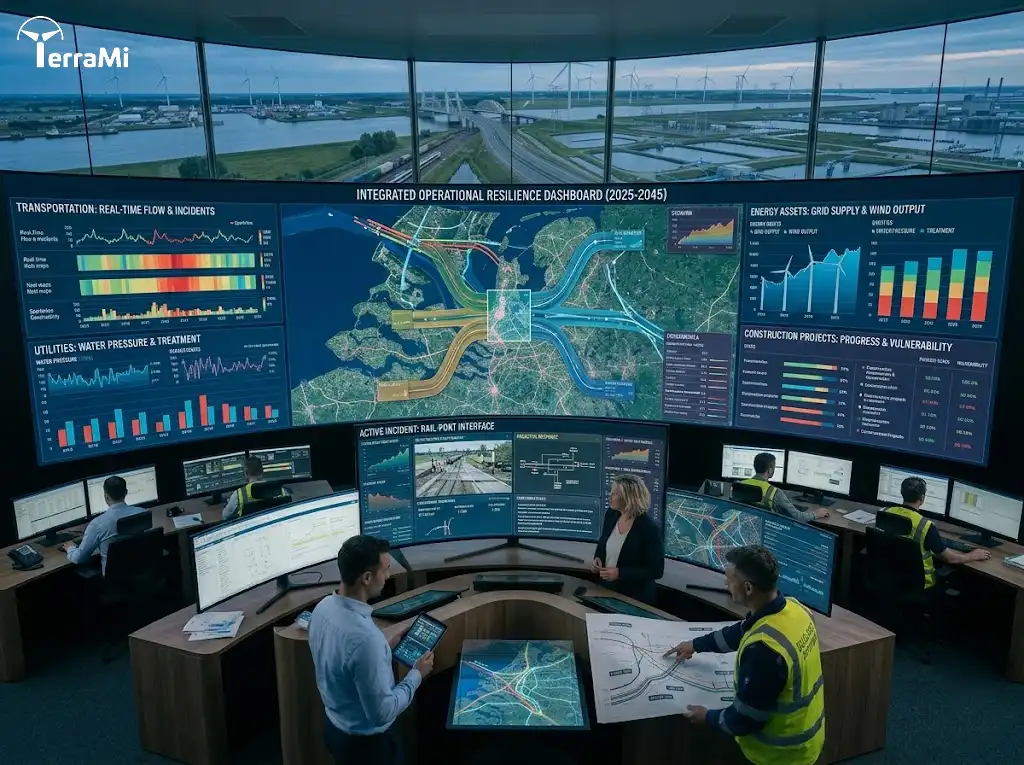
This is why many infrastructure organizations are investing heavily in digital twins, operational analytics, predictive maintenance systems, asset intelligence platforms, and integrated performance monitoring. The objective is not simply collecting more data; the objective is creating better decisions. Infrastructure resilience ultimately depends upon the quality of decisions made under conditions of uncertainty. Organizations with superior visibility generally make superior decisions, and superior decisions lead directly to stronger resilience.
Why Operational ESG Strengthens Infrastructure Resilience
For many years, ESG discussions focused primarily on reporting frameworks, disclosure requirements, and sustainability metrics. Those functions remain important. However, one of the most significant developments occurring today is the evolution of ESG from a reporting exercise into an operational management framework.
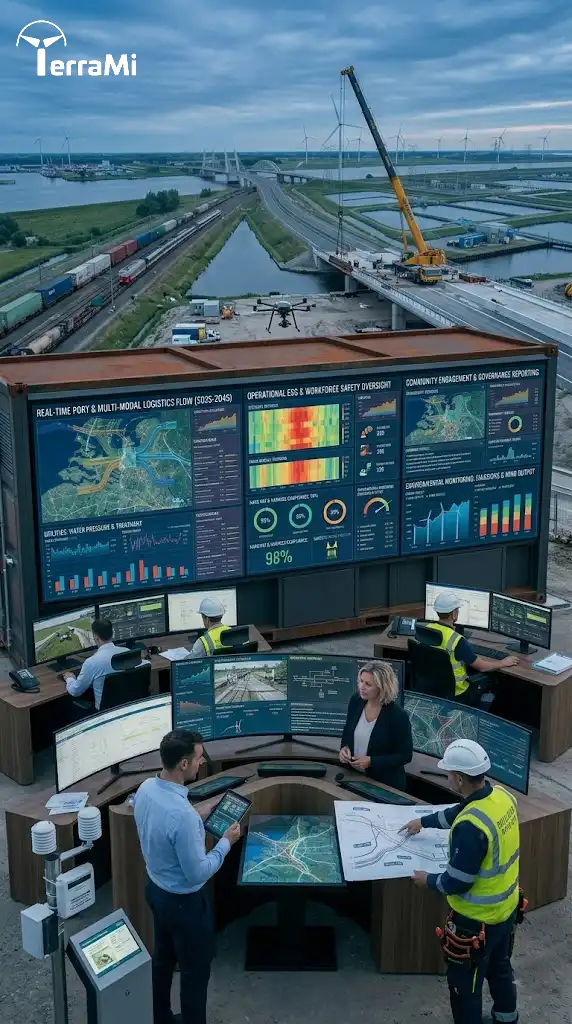
This evolution is particularly relevant to infrastructure resilience because many of the factors that influence resilience are already embedded within Operational ESG:
- Environmental: Considerations influence resource availability, climate exposure, emissions management, and long-term sustainability.
- Social: Considerations influence workforce resilience, community relationships, stakeholder trust, safety performance, and operational continuity.
- Governance: Considerations influence accountability, decision-making quality, transparency, risk management, and organizational agility.
When viewed through this lens, Operational ESG becomes far more than a compliance requirement; it becomes a core resilience capability. Organizations that strengthen governance often improve decision-making speed. Those that improve workforce engagement enhance operational continuity. And those that enhance environmental performance reduce long-term exposure to resource-related disruptions.
The connection between Operational ESG and infrastructure resilience is therefore becoming increasingly clear. Both disciplines seek long-term performance, emphasize adaptability, and encourage proactive management rather than reactive response. This alignment explains why resilience and Operational ESG are increasingly appearing together within infrastructure investment strategies.
(For a closer look at integrating these principles from the ground up, see our dedicated analysis on [ESG Integration in Infrastructure Projects].)
Adaptive Infrastructure Systems Create Long-Term Value
Historically, infrastructure organizations often focused on building assets designed to perform a specific function as efficiently as possible. The future may require a different mindset. Infrastructure systems increasingly need the ability to adapt as conditions evolve. This concept sits at the heart of adaptive infrastructure.
Adaptive infrastructure systems are designed with flexibility in mind. They recognize that future requirements may differ from current assumptions, and they incorporate mechanisms that allow organizations to respond effectively without requiring complete reconstruction or wholesale redesign.
The value of adaptability extends far beyond resilience alone. Adaptive infrastructure can significantly improve investment performance, reduce lifecycle costs, improve operational efficiency, enhance stakeholder confidence, and, most importantly, preserve strategic options.
Strategic options are becoming increasingly valuable in uncertain environments. Organizations rarely regret having flexibility; they frequently regret losing it. This is particularly important for infrastructure assets with long operational lifecycles. An asset built today may remain operational for fifty years or more, during which the surrounding world will almost certainly change. Adaptive infrastructure acknowledges this reality from the beginning. Rather than attempting to predict every future condition, it creates the capacity to respond as conditions evolve, defining the core value of resilient infrastructure systems.
Infrastructure Resilience as a Competitive Advantage
Many organizations continue viewing resilience primarily as a defensive capability—protection against disruption or insurance against uncertainty. While those perspectives are understandable, they underestimate the true value of resilience.
Increasingly, resilience is becoming a distinct competitive advantage. Organizations with stronger resilience capabilities often:
- Recover faster from operational disruptions.
- Maintain stakeholder and investor confidence more effectively.
- Preserve long-term operational continuity.
- Reduce structural risk exposure while making better capital investment decisions.
These advantages accumulate over time. As uncertainty increases, the performance gap between resilient and non-resilient organizations steadily widens. This reality is attracting growing attention from investors, infrastructure funds, lenders, insurers, regulators, and asset owners. Increasingly, resilience is being viewed not simply as risk mitigation, but as value creation. The organizations that thrive over the next decade may not necessarily be those with the largest assets, but those most capable of adapting to changing conditions. Infrastructure resilience therefore becomes a strategic differentiator.
The Next Evolution of Infrastructure Leadership
Leadership itself is changing. Traditional infrastructure leadership often emphasized control, efficiency, predictability, and optimization. Those priorities remain important, but modern infrastructure leaders increasingly require additional capabilities. They must navigate ambiguity, evaluate competing scenarios, balance short-term performance with long-term resilience, and make critical decisions despite incomplete information.
This represents a substantial shift. Infrastructure leadership is evolving from managing assets toward managing complexity. The leaders who succeed in this environment will likely be those who embrace uncertainty rather than attempting to eliminate it. They will understand that resilience is not achieved through perfect prediction, but through preparation, adaptability, governance, visibility, and informed decision-making. These capabilities increasingly define the next generation of infrastructure excellence.
Governance Frameworks:
The OECD’s guidelines on infrastructure governance highlight the growing importance of adaptive capacity, robust institutional frameworks, and long-term resilience in modern infrastructure systems. Learn more via theOECD Sustainable and Resilient Infrastructure Platform.
From Engineering Assets to Engineering Adaptability
The first article in this series argued that predictable infrastructure assumptions are becoming increasingly difficult to rely upon. This article has explored the logical next step: if uncertainty is becoming a permanent feature of the operating environment, infrastructure systems must be designed accordingly.
The objective is no longer creating assets optimized for a single expected future; the objective is creating systems capable of performing across multiple possible futures. This is the essence of infrastructure resilience. It does not eliminate uncertainty, but enables organizations to operate successfully despite it. It does not promise perfect forecasts, but provides the capability to adapt when forecasts prove incomplete. It expands engineering excellence into a broader framework capable of supporting long-term performance under changing conditions. This transition may ultimately become one of the defining infrastructure developments of the twenty-first century.
Continue Reading the Series
Infrastructure Resilience Series | Part III of III
Next Article:
Why Infrastructure Resilience Fails Without Governance
In the final article of this series, we explore why resilience ultimately becomes a governance issue. As uncertainty increases, infrastructure organizations must rethink accountability, decision-making structures, operational visibility, and leadership models capable of managing long-term complexity.
TerraMi Perspective
At TerraMi, we believe infrastructure resilience is no longer a specialized capability reserved for extreme events. It is becoming a foundational requirement for modern infrastructure organizations operating in environments defined by uncertainty, complexity, and accelerating change.
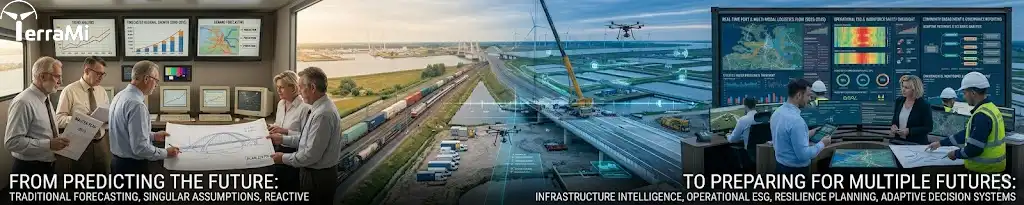
The future will not reward organizations that simply predict more accurately. It will reward organizations that build stronger governance, greater visibility, adaptive operating models, and resilience-oriented decision-making systems. Infrastructure intelligence, Operational ESG, and resilient infrastructure systems are increasingly becoming the mechanisms through which long-term value is created.
As infrastructure leaders prepare for a future that cannot be fully predicted, resilience is emerging not as a defensive strategy, but as a core driver of sustainable performance, strategic flexibility, and enduring competitive advantage.