Infrastructure Governance Series | Part III of III Before You Continue This article is the final installment of TerraMi’s three-part Infrastructure Resilience Series. The concepts explored here build directly upon ideas introduced in the first two articles. For the best reading experience, readers are strongly encouraged to begin with: Part I — The End of Predictable Infrastructure: Why Historical Assumptions No Longer Work Part II — Engineering for Uncertainty: The New Logic of Infrastructure Resilience Only after understanding why predictability is declining and why resilience has become essential does the governance challenge discussed in this article become fully visible.
Why Infrastructure Resilience Depends on Adaptive Governance
For many infrastructure organizations, resilience appears to be an engineering challenge. When disruptions occur, technical solutions often receive immediate attention. Organizations invest in stronger physical assets. They upgrade equipment. They enhance maintenance programs. They improve monitoring technologies. They strengthen emergency response capabilities.
These actions are important. In many cases they are essential. Yet history repeatedly demonstrates that technical capability alone does not guarantee resilience.
Some organizations possess sophisticated infrastructure assets but struggle during periods of disruption. Others operate aging systems yet continue delivering reliable performance under difficult conditions. The difference often lies somewhere beyond engineering. The difference often lies within infrastructure governance.
This reality is becoming increasingly important as infrastructure systems enter an era characterized by uncertainty, volatility, interconnected risks, and accelerating change. The challenge facing modern infrastructure leaders is no longer limited to building stronger assets. The challenge increasingly involves building stronger organizations. Because resilience is ultimately not a property of assets. Resilience is a property of systems. And systems are governed by people.
Why Technical Resilience Is Not Enough
For decades, infrastructure resilience was frequently associated with physical robustness. A resilient bridge could withstand extreme loading. A resilient power network could continue operating despite component failures. A resilient water system could maintain service during adverse conditions. These definitions remain valid. However, they are increasingly incomplete.
Modern infrastructure operates within a highly interconnected environment. Physical assets interact with multiple operational layers:
Physical assets interact with supply chains.
Supply chains interact with labor markets.
Labor markets interact with regulatory frameworks.
Regulatory frameworks interact with political priorities.
Political priorities influence investment decisions.
The result is a complex network of dependencies that extends far beyond physical infrastructure itself. This means resilience can no longer be evaluated solely through engineering performance.
An organization may possess technically resilient assets while simultaneously suffering from governance weaknesses that undermine long-term performance. For example, infrastructure systems may contain adequate redundancy while leadership structures remain fragmented. Operational data may exist while decision-making authority remains unclear. Risk information may be available while accountability mechanisms remain weak.
In these situations, technical resilience exists. Organizational resilience does not. And when uncertainty increases, organizational resilience often becomes the decisive factor. This distinction is becoming increasingly important as infrastructure organizations confront challenges that cannot be solved through engineering alone, such as climate volatility, cybersecurity threats, supply chain instability, workforce shortages, regulatory uncertainty, and geopolitical disruption. These issues rarely originate from a single asset failure; they emerge from interactions across systems. As a result, governance increasingly determines whether resilience succeeds in practice.
The Governance Gap in Modern Infrastructure
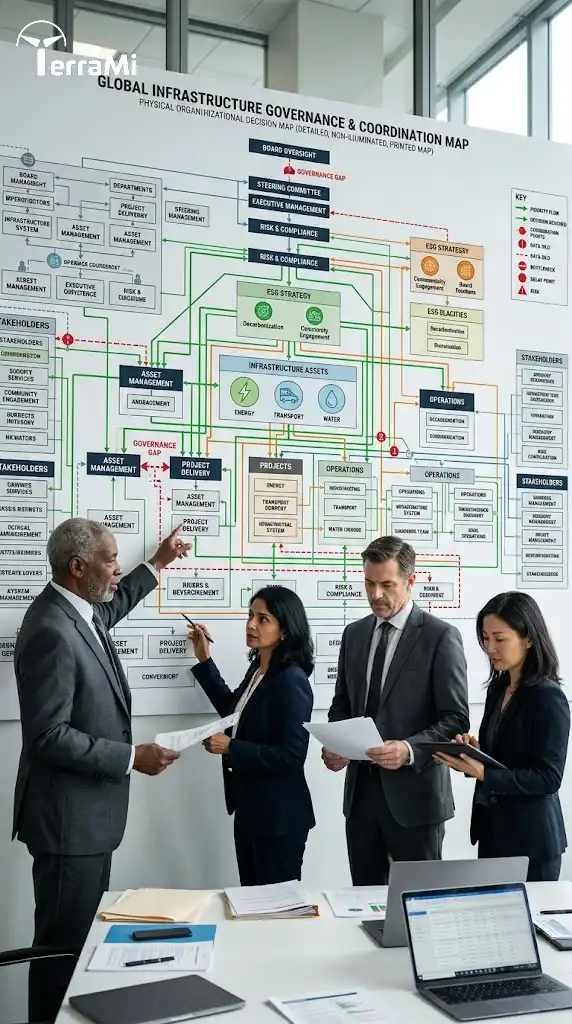
One of the most underestimated risks facing infrastructure organizations today is what might be called the governance gap. The governance gap emerges when organizational complexity evolves faster than decision-making structures.
Infrastructure systems become more interconnected. Data volumes increase. Stakeholder expectations expand. Operational risks multiply. Yet governance models often remain largely unchanged. Many organizations continue operating under frameworks originally designed for relatively stable environments. Those frameworks often perform adequately under normal conditions. Their limitations become visible during periods of disruption.
This is where governance gaps begin to appear:
Responsibilities become unclear.
Decision-making slows.
Information becomes fragmented.
Priorities become misaligned.
Accountability becomes difficult to establish.
Under stable conditions these weaknesses may remain largely invisible. Under uncertain conditions they become highly consequential.
An Aviation Analogy:
Modern aircraft contain extraordinary engineering sophistication. However, aviation safety does not depend solely upon aircraft design. It depends equally upon governance: clear procedures, defined responsibilities, standardized communication, decision protocols, and continuous learning systems. Without those governance structures, technical excellence alone would not be sufficient. Infrastructure organizations increasingly face a similar reality. Their ability to manage uncertainty depends not only upon infrastructure assets but also upon governance capability.
Why Many Infrastructure Resilience Programs Underperform
Across the infrastructure sector, resilience initiatives are becoming increasingly common. Organizations create resilience strategies, establish resilience committees, develop resilience metrics, and conduct resilience assessments. Yet many of these initiatives struggle to produce meaningful operational outcomes. The reason is not necessarily insufficient effort. The reason is often insufficient integration.
Resilience frequently becomes treated as a specialized function: a separate team, a separate department, a separate reporting process, or a separate compliance requirement. When this occurs, resilience remains isolated from core decision-making. The organization may discuss resilience extensively while continuing to make operational decisions through traditional structures. This creates a disconnect. Resilience becomes visible in presentations, but it becomes less visible in daily operations.
The most effective organizations take a different approach. Rather than treating resilience as a separate initiative, they embed resilience into governance itself. Resilience directly influences:
Investment decisions
Procurement decisions
Operational priorities
Performance management
Executive accountability
When resilience becomes integrated into governance structures, it begins influencing outcomes rather than simply reporting on them. This distinction is critical because infrastructure resilience is ultimately demonstrated through decisions—not through policies, frameworks, or reports.
Resilience Without Accountability Is Not Resilience
One of the most revealing questions infrastructure leaders can ask is remarkably simple: Who owns resilience?
The answers often expose severe governance weaknesses. Some organizations assign responsibility to risk management teams. Others assign responsibility to sustainability departments or operational functions. Still others distribute responsibility across multiple groups.
While each approach may contain value, resilience becomes difficult to achieve when accountability becomes ambiguous. Accountability creates action. Without accountability, resilience risks becoming an aspiration rather than an operational capability.
This issue becomes particularly important during periods of uncertainty. When conditions change rapidly, organizations require clear authority structures, defined decision rights, escalation pathways, and strict ownership. Without these mechanisms, even highly capable organizations may struggle to respond effectively. Resilience therefore depends upon accountability in the same way that engineering depends upon design standards. One enables consistency, the other enables reliability, and together they create sustained performance. Resilience cannot simply be engineered; it must also be governed.
Governance as a System Capability
Perhaps the most important shift occurring today is a growing recognition that governance should not be viewed merely as oversight. Historically, governance was often associated with compliance, policies, reporting structures, approval processes, and regulatory obligations.
Those functions remain necessary. Yet modern infrastructure governance increasingly requires something more: adaptive capability. Governance must enable organizations to learn, to adjust, to coordinate, to respond, and to evolve. In other words, governance itself must become resilient.
This represents a profound change in perspective. Instead of asking, “How do we govern infrastructure assets?”, infrastructure leaders increasingly need to ask, “How do we create governance systems capable of operating under uncertainty?” That question may ultimately define the future of infrastructure leadership. Because as uncertainty continues to increase, governance will become less about rigid control and more about flexibility. And adaptability may prove to be the most important infrastructure capability of all.
Decision-Making Under Uncertainty: The New Infrastructure Leadership Challenge
For much of the modern infrastructure era, decision-making was largely built around a simple assumption: more information leads to better decisions. In many situations, this remains true. However, the infrastructure sector increasingly faces a different challenge. Decision-makers are not suffering from a lack of information; they are often overwhelmed by it.
Infrastructure organizations today generate unprecedented volumes of operational data from asset monitoring systems, environmental sensors, maintenance records, supply chain analytics, and real-time operational dashboards. The challenge is no longer collecting information. The challenge is determining which information matters most.
This distinction is critical because uncertainty rarely announces itself clearly. Disruptions often emerge gradually. Weak signals appear before major consequences become visible. The organizations that identify those signals early gain valuable time. The organizations that miss them often find themselves responding after the situation has already escalated.
As a result, infrastructure resilience increasingly depends on decision quality rather than information quantity. This reality is changing the nature of infrastructure leadership. Leaders are no longer expected to simply approve projects and allocate resources. They must interpret uncertainty, evaluate competing priorities, balance short-term performance against long-term resilience, and remain effective when complete certainty is unavailable. This may be one of the defining leadership challenges of the twenty-first century.
Why Infrastructure Intelligence Is Becoming a Governance Requirement
The growing importance of infrastructure intelligence becomes even more significant within a governance context. Governance depends upon visibility. Boards cannot oversee what they cannot see, executives cannot manage what they cannot understand, and organizations cannot adapt to conditions they fail to recognize. This is why infrastructure intelligence is rapidly evolving from a technological capability into a core governance requirement.
The distinction matters. Technology alone does not create resilience; technology creates visibility. Governance determines whether visibility produces action.
Consider a major infrastructure operator receiving early warning signals regarding operational stress. Data alone does not improve resilience. The organization must still successfully execute a multi-step governance workflow:
Each step depends entirely upon governance. Without governance, intelligence remains passive information. With governance, intelligence becomes strategic action. This explains why leading infrastructure organizations increasingly view operational visibility as a core asset that drives earlier interventions, reduces disruptions, and directly strengthens systemic resilience.
The Organizations That Adapt Fastest Often Win
One of the most important observations emerging across infrastructure sectors is that resilience is not always determined by who possesses the strongest assets. It is often determined by who adapts the fastest.
Historically, competitive advantage frequently came from scale. Larger organizations possessed more resources, more assets, more capital, and more influence. While those advantages remain valuable, uncertainty is changing the equation. Under rapidly changing conditions, adaptability becomes increasingly important. Organizations capable of adjusting quickly often outperform larger organizations attempting to preserve outdated assumptions.
This principle applies across virtually every infrastructure sector: transportation, energy, utilities, mining, industrial facilities, and public infrastructure. The organizations demonstrating superior resilience often share a common characteristic: their governance systems enable rapid adaptation. Information moves efficiently, responsibilities remain clear, decision-making authority is understood, cross-functional collaboration occurs naturally, and leadership remains aligned around common objectives. When uncertainty increases, these characteristics become powerful competitive advantages, turning resilience from a protective mechanism into an enabler of performance.
Operational ESG as a Governance Framework
One of the most significant misconceptions surrounding ESG is the belief that it exists primarily for compliance reporting purposes. This perception has severely limited the value many organizations derive from ESG initiatives.
The reality is that when implemented effectively, Operational ESG functions as a highly effective governance framework. It provides structure, establishes clear accountability, improves visibility, strengthens decision-making, and directly connects high-level organizational objectives to day-to-day operational realities.
ESG Dimension
Operational & Resilience Impact
Environmental
Influences long-term operational sustainability, resource availability, and climate exposure.
Social
Drives workforce stability, stakeholder trust, safety performance, and community relationships.
Governance
Directs every major corporate decision affecting organizational agility and risk management.
Viewed together, these elements create a comprehensive framework for managing uncertainty. This explains why Operational ESG increasingly intersects with infrastructure resilience. Both disciplines seek sustainable performance, emphasize proactive management, encourage long-term thinking, and improve organizational adaptability.
Organizations that integrate ESG into operational governance frequently discover benefits extending far beyond compliance. They strengthen visibility, improve accountability, reduce organizational blind spots, and improve decision quality. These outcomes directly support infrastructure resilience, aligning closely with the strategies discussed in our dedicated insights on Operational ESG Excellence and ESG Integration in Infrastructure Projects.
Why Infrastructure Boards Are Becoming Resilience Leaders
Traditionally, resilience discussions were delegated to operational teams. Engineering departments managed technical risks, operations teams managed continuity planning, risk managers maintained oversight frameworks, and senior leadership received periodic updates.
This model is gradually changing. Infrastructure resilience is increasingly becoming a board-level issue because the risks facing infrastructure organizations have become deeply strategic. Climate volatility influences long-term asset performance, cybersecurity affects operational continuity, supply chain disruptions influence capital delivery, and evolving stakeholder expectations affect organizational reputation.
These issues extend far beyond routine operational management; they influence total organizational direction. As a result, boards are becoming more directly involved in resilience discussions. This shift reflects an important realization: resilience is not merely about surviving a disruption; it is about protecting long-term value creation.
Increasingly, leading boards are asking different questions:
Not, “How likely is this risk?” but, “How prepared are we if it occurs?”
Not, “Can we avoid uncertainty?” but, “Can we perform successfully despite uncertainty?”
Those questions represent a significant evolution in governance thinking, becoming increasingly important as infrastructure organizations confront a less predictable future.
Governance Determines the Speed of Adaptation
A useful way to understand governance is to think of it as an organization’s operating system. Assets generate capability, people generate expertise, technology generates visibility, and governance determines how those capabilities interact.
When governance functions effectively, rapid adaptation becomes possible. When governance functions poorly, even the most capable organizations struggle. This observation repeatedly appears during periods of disruption. Organizations rarely fail solely because problems emerge; they fail because corporate responses arrive too slowly. Decision-making stalls, information remains fragmented, responsibilities become unclear, and leadership becomes entirely reactive. The disruption itself may be manageable, but the slow response becomes the larger problem.
Governance determines how quickly organizations learn, respond, coordinate, and ultimately adapt. As uncertainty becomes a defining feature of infrastructure operations, adaptation speed is emerging as one of the most critical indicators of structural resilience.
From Risk Management to Adaptive Governance
For decades, infrastructure organizations approached uncertainty primarily through risk management. The model was logical: identify risks, assess probability, estimate consequences, implement controls, and monitor performance. This framework remains valuable and will continue to play an essential role in infrastructure management.
However, uncertainty itself is changing. Many of today’s most significant challenges do not emerge as isolated risks; they emerge as interconnected systems of uncertainty. Climate volatility influences supply chains, which influence project delivery, which alters financial performance, which impacts future capital allocation and resilience capacity.
These interactions create complex outcomes that are often difficult to predict using traditional risk management methods alone. This does not mean risk management is becoming obsolete; it means risk management is no longer sufficient by itself. Infrastructure organizations increasingly require a broader governance model capable of operating under conditions where not every variable can be anticipated.
This is where adaptive governance begins to emerge. Adaptive governance does not attempt to eliminate uncertainty; instead, it creates structures capable of responding intelligently as uncertainty unfolds.
Traditional Governance often assumes stability, seeks consistency, and emphasizes strict control.
Future infrastructure organizations will likely require both. Control, accountability, and compliance remain essential, yet long-term resilience increasingly depends upon an organization’s ability to adapt while maintaining those very foundations.
Many executives continue to view governance primarily as a regulatory obligation—something required by boards, expected by regulators, or demanded by investors. These perspectives are understandable, but they often overlook governance’s true strategic value.
Strong governance does more than reduce risk; strong governance creates capability. Organizations with effective governance typically make decisions faster, align resources more efficiently, identify emerging issues earlier, adapt more effectively, and maintain stakeholder confidence more consistently. Over time, these advantages compound.
This is particularly important in uncertain environments. When operating conditions remain stable, governance differences may appear relatively small. When volatility increases, those differences become highly visible. Two organizations may possess similar assets, similar technologies, and similar resources, yet governance quality determines which organization adapts successfully and which struggles.
This reality is attracting growing attention from global investors and infrastructure stakeholders. Increasingly, governance is viewed not merely as a compliance function but as a primary performance driver. Organizations capable of learning and adapting faster consistently outperform those attempting to predict an unpredictable future.
The Future Infrastructure Leaders Will Think Differently
The future infrastructure leaders will not simply be better engineers, nor will they simply be better managers. They will be holistic systems thinkers. They will understand that infrastructure performance depends upon systemic relationships as much as individual physical assets. They will recognize that uncertainty cannot always be removed, accept that future conditions will differ significantly from present assumptions, and build organizations capable of operating effectively despite those realities.
This requires a fundamental shift in the leadership mindset:
Rather than seeking perfect forecasts, future leaders will seek superior preparedness.
Rather than pursuing maximum efficiency at all costs, they will balance efficiency with adaptability.
Rather than treating resilience as a specialized initiative, they will embed resilience into governance itself.
These shifts represent a profound transformation. Infrastructure leadership is evolving, and leaders who recognize this change early will be better positioned to navigate the challenges ahead, while those relying exclusively on historical assumptions will find themselves increasingly exposed to unexpected outcomes. The future does not belong to organizations that attempt to eliminate uncertainty, but to those that learn how to operate successfully within it.
Why Governance Is Becoming the Foundation of Infrastructure Resilience
The first article in this series argued that predictable infrastructure assumptions are becoming less reliable. The second article demonstrated that infrastructure resilience must replace predictability as a guiding principle. This final article leads to an unavoidable conclusion: resilience itself depends entirely upon governance.
Without governance, resilience remains fragmented, information remains disconnected, accountability remains unclear, and adaptation becomes structurally difficult. Infrastructure resilience therefore cannot be viewed solely as an engineering objective, nor can it be treated merely as a sustainability objective. It is fundamentally a core governance objective.
This reality is increasingly reflected in global infrastructure frameworks:
Global Policy Insights:
The OECD’s work on Sustainable and Resilient Infrastructure continuously emphasizes the critical importance of governance frameworks capable of supporting long-term resilience, institutional capacity, and adaptive decision-making. Explore their guidelines via theOECD Sustainable and Resilient Infrastructure Platform.
Similarly, the World Economic Forum’s infrastructure initiatives highlight the growing importance of leadership, institutional capability, and governance effectiveness in managing systemic uncertainty. Review their latest insights at theWorld Economic Forum.
The message emerging from these global discussions is remarkably consistent: infrastructure resilience is not achieved through assets alone. It is achieved through interconnected systems, and systems depend upon robust governance.
The Organizations That Will Thrive in the Age of Uncertainty
As uncertainty becomes a permanent characteristic of the operating environment, infrastructure organizations face a clear strategic choice. Some will continue attempting to preserve planning assumptions developed for a more predictable era. Others will embrace a different approach: they will invest in operational visibility, strengthen institutional governance, improve systemic adaptability, and fully integrate resilience into core decision-making.
They will align Operational ESG, infrastructure intelligence, and leadership practices around sustained, long-term performance. This distinction will determine which organizations thrive and which struggle.
Future infrastructure excellence will no longer be measured solely by asset quality or engineering sophistication. It will increasingly be measured by organizational capability—the ability to learn, to adapt, to coordinate, and to make highly effective decisions under conditions of intense uncertainty. These capabilities are, at their core, governance capabilities, and they are becoming the most valuable assets any infrastructure organization can possess.
End of Series You have reached the conclusion of TerraMi’s three-part Infrastructure Resilience Series. Together, these articles explored a single strategic question from three complementary perspectives: Part I — Why predictable infrastructure assumptions are becoming less reliable. Part II — Why infrastructure resilience must be designed into future infrastructure systems. Part III — Why governance ultimately determines whether resilience succeeds in practice. Readers who arrived here first are strongly encouraged to revisit Parts I and II. The three articles were intentionally developed as a connected framework, with each article building upon concepts introduced in the previous installment. Only when viewed together do they reveal the full progression from predictability, to resilience, to governance.
TerraMi Perspective
At TerraMi, we believe the future of infrastructure will be shaped by more than engineering excellence alone. Organizations increasingly operate in environments characterized by uncertainty, interconnected risks, evolving stakeholder expectations, and accelerating change. In this context, long-term success depends not only on the quality of infrastructure assets but also on the quality of the governance systems that support them.
Infrastructure intelligence, Operational ESG, adaptive leadership, and resilient decision-making are no longer independent concepts. They are becoming interconnected capabilities that determine overall organizational performance.
The organizations that succeed in the decades ahead will not simply be those that build stronger physical infrastructure. They will be those that build stronger systems for understanding, governing, and adapting to change. That is where resilience becomes reality, and that is where the future of infrastructure leadership begins.