
Designing Infrastructure for Recoverability, Adaptability, and Future Value
Introduction
For decades, infrastructure projects have been evaluated primarily by their ability to satisfy immediate functional requirements. Bridges were designed to carry traffic, buildings to provide space, water systems to deliver reliable services, and transportation corridors to support economic growth. Once construction was complete, success was largely measured by operational performance, maintenance costs, and expected service life.
This traditional perspective no longer reflects the realities shaping today’s infrastructure landscape.
Climate uncertainty, accelerating technological change, increasing resource scarcity, evolving environmental regulations, and growing ESG expectations have fundamentally altered how infrastructure should be planned. Modern assets are no longer expected to simply endure; they are expected to adapt, evolve, and preserve value throughout multiple generations of use.
As a result, a new question is emerging during the earliest stages of infrastructure planning:
Can this infrastructure be recovered, adapted, and reintegrated into future systems when its original purpose changes?
This question represents a significant shift in engineering philosophy. Instead of viewing infrastructure as a fixed endpoint, organizations are beginning to view it as part of a continuous resource cycle where materials, components, and embedded knowledge retain value long after their initial function has ended.

Recoverability is therefore becoming a strategic design objective rather than a demolition strategy. Decisions made during conceptual design increasingly determine whether future generations inherit valuable assets—or expensive liabilities.
Infrastructure that is designed for recoverability is capable of extending material value, reducing future carbon emissions, supporting circular resource management, and improving long-term financial resilience. More importantly, it creates flexibility in a world where future operational requirements are becoming increasingly difficult to predict.
Infrastructure Is No Longer a Finished Product—It Is Becoming a Long-Term Resource System
Traditional engineering measured success by how long infrastructure could survive. Tomorrow’s infrastructure will be judged by something far more valuable: how effectively it can adapt, recover, and continue creating value under changing conditions. Recoverability transforms infrastructure from a fixed asset into a dynamic resource system designed for continuous evolution.
Infrastructure Is No Longer Built for a Single Lifetime
Modern infrastructure rarely operates under the same assumptions that existed when many engineering standards were first developed.
Transportation networks evolve as cities expand. Industrial facilities undergo repeated technological upgrades. Energy infrastructure must accommodate decentralized generation and renewable integration. Water systems face changing climate conditions and population patterns. Even buildings experience multiple functional transformations throughout their service lives.
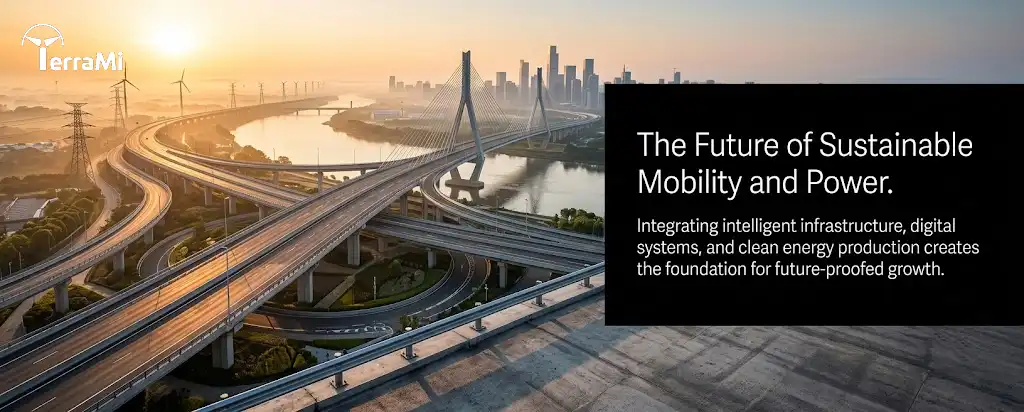
Yet many infrastructure assets continue to be designed as though their initial purpose will remain unchanged for decades. This mismatch creates a growing economic and environmental problem.
Every time an infrastructure asset cannot be efficiently modified, dismantled, or repurposed, significant quantities of valuable materials are lost. Steel, concrete, engineered timber, mechanical equipment, electrical systems, and specialized components frequently become construction waste instead of future resources.
The result is not merely increased demolition costs—it is the permanent destruction of embedded economic value. Recoverable infrastructure addresses this challenge by considering future adaptability from the beginning of the project lifecycle rather than after the asset reaches the end of its operational life.
Instead of asking:
“How long will this infrastructure survive?”
Project teams increasingly ask:
“How many future lives can this infrastructure support?”
This subtle change fundamentally transforms design priorities.
Infrastructure Is No Longer a Finished Product—It Is Becoming a Long-Term Resource System
The most valuable infrastructure of the coming decades will not necessarily be the assets that last the longest. They will be the assets that remain useful under changing conditions. Recoverability shifts engineering away from designing permanent structures toward designing adaptable systems capable of retaining material, functional, and economic value across multiple generations of infrastructure development.
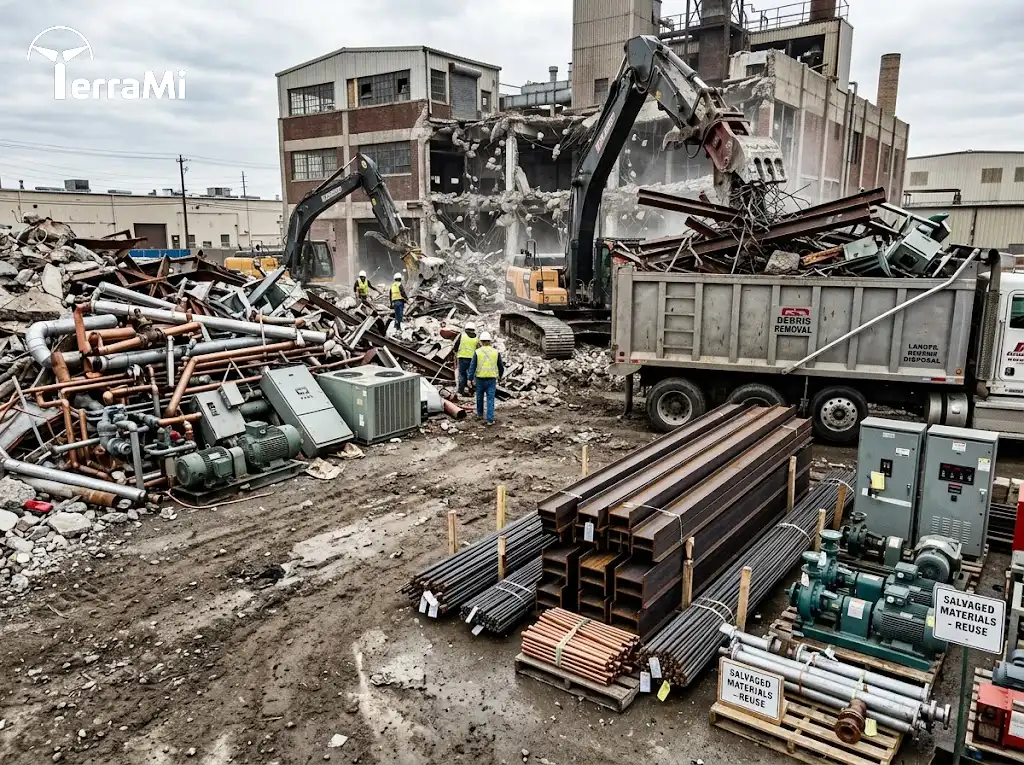
Why Traditional Infrastructure Design Creates Future Waste
Historically, engineering optimization focused on delivering maximum performance at the lowest initial cost. While this approach achieved remarkable infrastructure expansion throughout the twentieth century, it also created an unintended consequence: infrastructure became increasingly difficult to modify, dismantle, or reuse.
Several characteristics of conventional design contribute to this problem:
- Permanent material connections that prevent efficient disassembly.
- Limited documentation of installed materials and components.
- Design decisions optimized solely for construction efficiency.
- Minimal consideration of future technological upgrades.
- Poor traceability of material composition throughout the asset lifecycle.
These limitations often remain invisible during construction because the infrastructure performs exactly as intended. The challenges only emerge decades later. When rehabilitation, expansion, climate adaptation, or redevelopment becomes necessary, organizations frequently discover that valuable assets cannot be economically recovered.
Instead, demolition becomes the default solution. This pattern creates significant financial losses while simultaneously increasing carbon emissions, resource extraction, and waste generation. Recoverable infrastructure seeks to reverse this pattern by integrating lifecycle intelligence into the earliest engineering decisions. Rather than optimizing only for today’s construction process, engineers begin optimizing for tomorrow’s recovery opportunities.
The implications extend beyond sustainability.
Recoverability also improves investment resilience by preserving optionality. Infrastructure owners gain greater flexibility to respond to future technological innovations, regulatory changes, market conditions, and evolving community needs without abandoning existing asset value.
Designing Infrastructure for Recoverability Begins at the Concept Stage
Recoverability is often misunderstood as a demolition strategy or a waste management practice. In reality, it begins much earlier—during conceptual planning and preliminary engineering. By the time construction documents are finalized, many of the decisions that determine an asset’s future adaptability have already been made.
This is why recoverability should be viewed as a design philosophy rather than an end-of-life procedure.
Every major engineering decision influences the future value of an infrastructure asset. Structural systems, material selection, connection methods, spatial layouts, utility routing, documentation standards, and digital asset records all contribute to whether an asset can evolve efficiently over time.
For example, selecting mechanical fastening systems instead of irreversible bonded connections may appear to be a relatively small technical decision during design. Decades later, however, that decision can determine whether valuable structural components are reused or permanently discarded.
Similarly, designing modular infrastructure elements allows future expansion, relocation, replacement, or technological upgrades with significantly less disruption than conventional construction methods. Recoverability therefore shifts engineering priorities away from designing for permanence and toward designing for controlled transformation. Rather than assuming infrastructure will remain unchanged for fifty years, designers begin accepting that change itself is inevitable.
The objective becomes enabling that change with minimal environmental, financial, and operational cost.
Tomorrow’s Infrastructure Will Be Judged by How Easily It Can Change, Not Simply by How Long It Can Last
Longevity remains important, but longevity alone no longer defines infrastructure value. Assets that cannot adapt to new technologies, changing communities, evolving climate conditions, or shifting economic realities risk becoming stranded investments. Recoverability transforms flexibility from an operational advantage into a core engineering objective.
Recoverability Requires Information as Much as Engineering
Recovering infrastructure is impossible without understanding what exists inside the asset.
Historically, infrastructure documentation has been fragmented across drawings, maintenance records, procurement documents, spreadsheets, contractor archives, and institutional knowledge. Over decades, information is often lost, duplicated, or becomes inaccessible. This information gap creates one of the greatest barriers to recoverability.
When project teams cannot accurately identify installed materials, structural capacities, equipment specifications, maintenance history, or embedded components, recovery decisions become increasingly uncertain. In many cases, demolition becomes the simplest option—not because recovery is technically impossible, but because reliable information no longer exists.
This challenge highlights an important transition occurring across the infrastructure sector. Recoverability is no longer dependent solely on engineering expertise. It increasingly depends on digital information management. Material passports, digital asset registers, BIM environments, lifecycle databases, GIS platforms, and digital twins are beginning to provide the knowledge necessary to preserve asset value throughout decades of operation.
These technologies do not create recoverability by themselves.
Instead, they make recoverability practical.
When every significant component has a digital identity, project teams gain visibility into material composition, maintenance history, replacement cycles, embodied carbon, and future reuse potential. Decisions that once relied on assumptions can instead be supported by accurate, continuously updated information. Recoverability therefore becomes both a physical capability and an informational capability.
Organizations that invest in digital asset intelligence today are creating the conditions for future circular infrastructure systems.
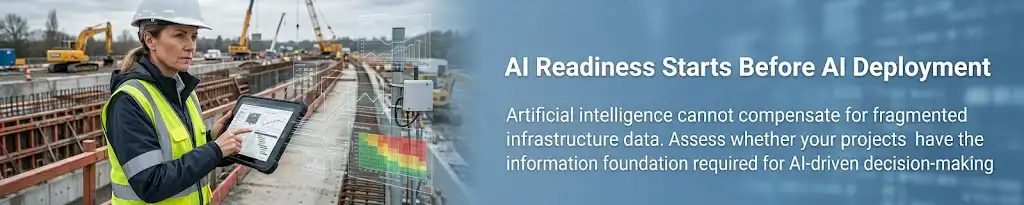
This convergence between engineering and information management marks the beginning of a broader transformation. Infrastructure is evolving from collections of physical assets into connected knowledge systems capable of supporting better decisions throughout the entire lifecycle.
Recoverability Is Becoming a Strategic Investment Decision
For many organizations, infrastructure investment has traditionally focused on minimizing capital expenditure while maximizing operational performance. Although this approach remains important, it no longer captures the full value—or risk—associated with long-lived infrastructure assets.
Today’s infrastructure projects operate within an environment defined by uncertainty.
Climate adaptation requirements continue to evolve. New construction technologies emerge faster than asset replacement cycles. Regulations surrounding embodied carbon and material reuse are becoming increasingly stringent. At the same time, investors, governments, and infrastructure owners are placing greater emphasis on resilience, transparency, and lifecycle performance.
Under these conditions, infrastructure should no longer be evaluated solely on how efficiently it performs today. It should also be evaluated on how effectively it can respond to tomorrow. Recoverability introduces this additional dimension of value.
An asset that can be upgraded without major reconstruction, dismantled without destroying valuable components, or repurposed for entirely new operational requirements represents a fundamentally different investment proposition than one designed for a single, irreversible lifecycle.
The financial implications are significant.
Recoverable infrastructure can reduce future redevelopment costs, preserve material value, minimize operational disruption during upgrades, and improve long-term return on investment. Instead of repeatedly replacing entire systems, organizations gain the ability to retain and evolve existing assets.
This represents a transition from depreciation toward value preservation. Infrastructure owners are no longer simply managing physical assets—they are managing future opportunities.
The Infrastructure Economy Is Gradually Shifting from Asset Ownership to Asset Intelligence
Competitive advantage will increasingly belong to organizations that understand not only what they own, but also what their infrastructure can become. Recoverability expands infrastructure value beyond physical performance by preserving future options. In an uncertain world, optionality is rapidly becoming one of the most valuable engineering outcomes.
Infrastructure Intelligence Does Not Begin with Artificial Intelligence—It Begins with Recoverability
Organizations often view digital twins, AI, and predictive analytics as the starting point of intelligent infrastructure. In reality, these technologies can only unlock their full value when infrastructure is engineered to adapt, preserve information, and retain recoverable assets. Intelligence is not added after construction—it is designed into infrastructure from the very beginning.Recoverability as the Foundation of Infrastructure Intelligence
Recoverable infrastructure is not the final destination of infrastructure innovation. It is the foundation upon which the next generation of intelligent infrastructure will be built. Digital twins cannot deliver meaningful insights if the physical assets they represent cannot evolve. Artificial intelligence cannot optimize infrastructure that was never designed to accommodate change.
Predictive maintenance creates greater value when assets are capable of efficient repair, upgrading, and component replacement. Similarly, circular economy strategies become substantially more effective when engineering decisions preserve the long-term recoverability of materials, systems, and infrastructure components.
These developments are not isolated trends.
They are converging into a broader transformation that redefines how infrastructure will be designed, operated, and continuously improved over the coming decades.

Recoverability serves as the bridge connecting traditional engineering with digital infrastructure intelligence. It links physical assets with digital information. It connects sustainability with operational resilience. It transforms lifecycle management from a maintenance activity into a strategic capability. Perhaps most importantly, it changes how engineers define success.
Success is no longer measured solely by whether infrastructure survives its intended design life. Success increasingly depends on whether that infrastructure continues creating value long after its original purpose has evolved. For organizations planning infrastructure that must remain relevant throughout decades of technological, environmental, and societal change, recoverability is no longer an optional sustainability feature.
It is becoming a fundamental design principle.
The infrastructure leaders of the next decade will not be those who build the most assets. They will be those who design assets that can continue creating value through change. Recoverability is not about preparing infrastructure for its end of life—it is about preparing it for its next life.
TerraMi Perspective
Infrastructure has entered an era where uncertainty is no longer an exception—it is the operating environment. For decades, engineering excellence was defined by permanence. Today, excellence is increasingly defined by adaptability. Infrastructure that cannot evolve risks becoming economically obsolete long before it reaches the end of its physical life.
At TerraMi, we believe that recoverability is far more than a circular economy concept. It represents a new way of thinking about infrastructure systems—one that integrates engineering, digital intelligence, lifecycle information, and strategic decision-making from the earliest stages of project development. Designing for recoverability means designing for resilience. Designing for resilience means preserving future choices.
And preserving future choices is ultimately what enables infrastructure to remain valuable in a rapidly changing world.
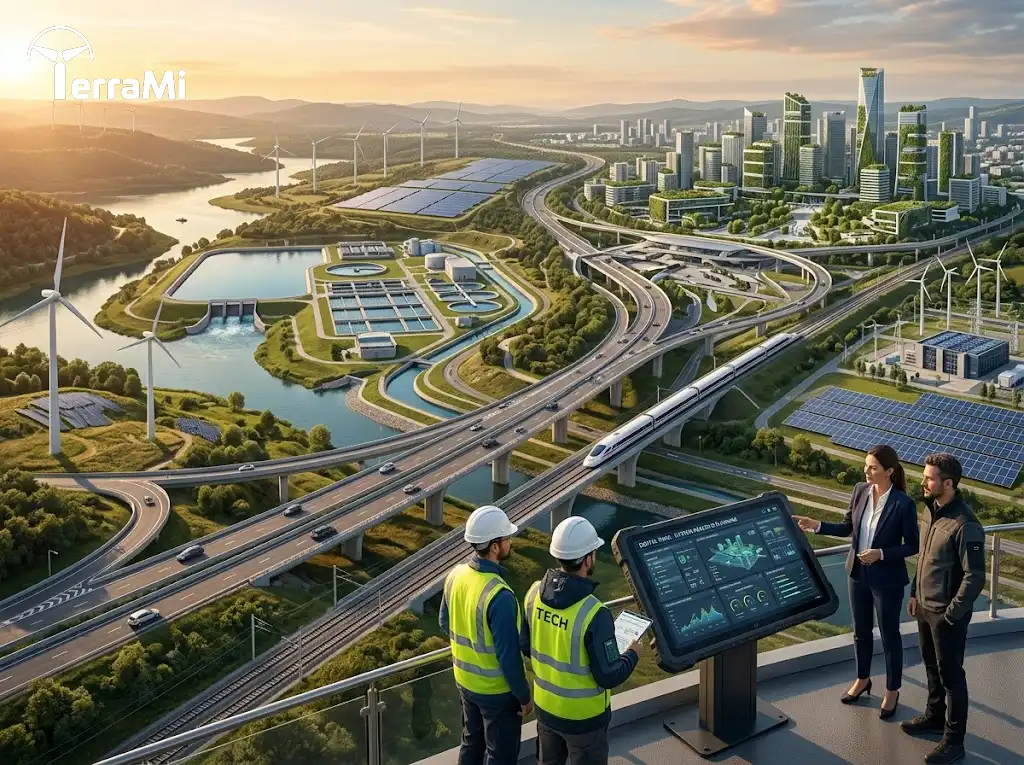
As the infrastructure sector moves toward digital twins, AI-enabled asset management, and predictive infrastructure intelligence, recoverability provides the practical foundation that allows these technologies to generate lasting value rather than temporary efficiency gains.
The future of infrastructure will not be determined solely by what we build.
It will be determined by how intelligently today’s infrastructure can support tomorrow’s possibilities.
Frequently Asked Questions (FAQ)
What is recoverable infrastructure?
Recoverable infrastructure is infrastructure designed so that its materials, components, and systems can be efficiently adapted, upgraded, reused, or recovered throughout multiple lifecycle stages instead of being discarded at the end of their initial use.
How is recoverability different from infrastructure resilience?
Resilience focuses on an asset’s ability to withstand and recover from disruptions such as natural disasters or operational failures. Recoverability focuses on preserving the long-term value of infrastructure by enabling future adaptation, reuse, and transformation throughout its lifecycle.
Why is recoverability important for ESG and circular economy strategies?
Recoverability reduces waste, extends material value, lowers embodied carbon, and supports more efficient resource management. These outcomes directly contribute to environmental performance while strengthening long-term economic resilience.
What role does digital information play in recoverable infrastructure?
Digital asset information—including BIM, material passports, digital twins, and lifecycle databases—provides the knowledge required to identify, manage, maintain, and recover infrastructure assets efficiently over time.
How does recoverability prepare infrastructure for AI and digital twins?
Artificial intelligence and digital twins deliver the greatest value when infrastructure is capable of adaptation. Recoverability ensures that physical assets can evolve alongside the digital technologies used to manage and optimize them.