
The Integration Gap Between Physical and Digital Infrastructure
Physical and digital infrastructure integration is becoming one of the defining challenges of infrastructure digitalization. The industry has invested heavily in sensors, BIM models, cloud platforms, digital twins and data systems, yet the physical asset and its digital representation often remain only loosely connected. A bridge can exist in a digital model while its current condition is recorded somewhere else. A pumping station can generate operational data without that information being connected to the engineering assumptions behind its design. A transportation network can have sophisticated monitoring systems while the people responsible for planning and maintenance still work with fragmented information.
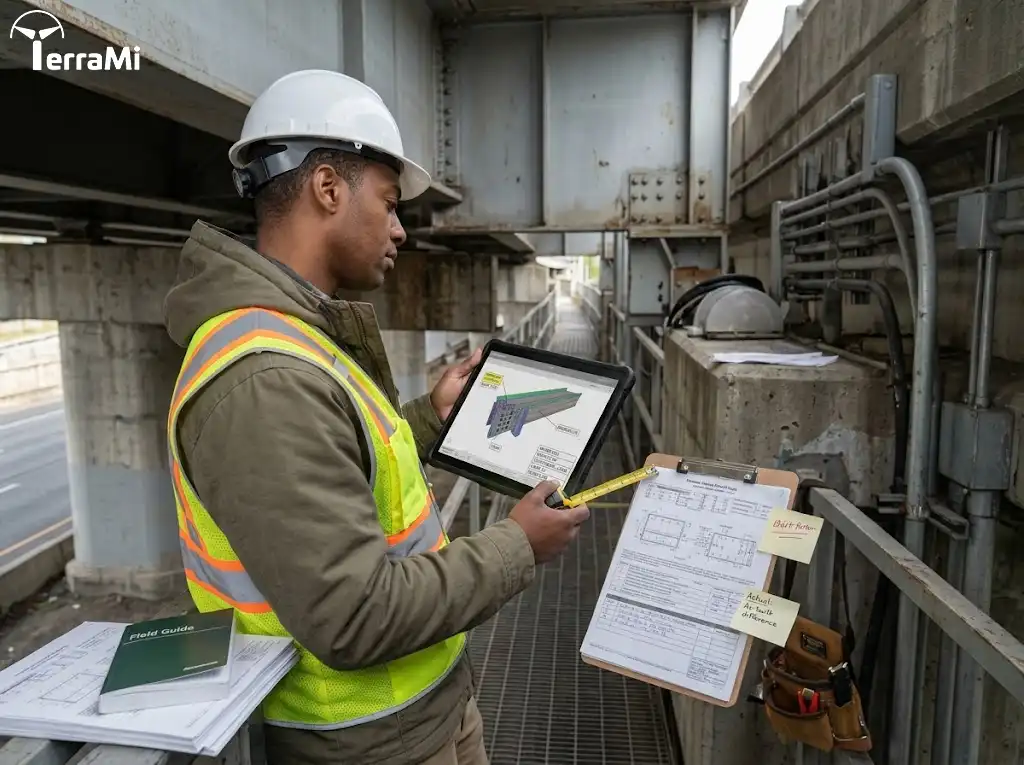
The problem is not a lack of digital information. It is the gap between information about an asset and information that remains connected to the asset as it changes.
When Infrastructure Becomes Digital but Not Connected
Infrastructure digitalization has often progressed in layers.
First came digitization: paper drawings, inspection records and technical documents were converted into digital formats.
Then came digital systems: project-management platforms, BIM environments, geographic information systems, asset-management databases and operational dashboards began replacing isolated spreadsheets and physical records.
More recently, organizations have started connecting these environments with sensors, analytics and digital-twin technologies.
Each step has created value. But the layers do not automatically form one integrated system.
A digital model created during design may contain detailed information about geometry, materials and specifications. Years later, the physical asset may have undergone repairs, modifications, deterioration or changes in operating conditions that are not reflected in that original model.
The digital representation has not necessarily become wrong. It has simply stopped representing the current state of the asset.
This distinction is critical.
A digital model can describe what an infrastructure asset was designed to be without accurately representing what that asset has become.
The integration gap appears in the space between those two states.
The Physical Asset and Its Digital Representation
Every infrastructure asset exists simultaneously in two environments.
The first is physical.
It consists of concrete, steel, cables, pumps, roads, tunnels, electrical equipment, mechanical systems and all the other components that perform a physical function.
The second is informational.
It consists of drawings, specifications, models, inspection records, sensor readings, maintenance histories, operating data, photographs, schedules and other information describing the asset.
The difficulty begins when these two environments evolve at different speeds.
A physical asset changes continuously, even when nobody is actively modifying it. Materials age. Components deteriorate. Operating conditions fluctuate. Environmental exposure changes. Repairs alter configurations. Equipment is replaced. New connections are added.
The information environment may not capture those changes with the same consistency.
This creates what can be described as an integration gap: the increasing distance between the current physical condition of an infrastructure asset and the digital information used to understand, operate or manage it.
The consequences can be subtle at first.
An engineer may be working from an outdated component specification.
A maintenance team may not know that a modification was made during a previous intervention.
An asset manager may analyse condition data without access to the original design assumptions.
A project team may create a new digital model without fully incorporating the operational history of the existing asset.
Each individual gap may appear manageable. Across an infrastructure portfolio, however, these gaps can accumulate into significant decision risk.
Why Synchronization Is Hard
Keeping a physical and digital system synchronized sounds straightforward in principle.
In practice, infrastructure creates a difficult synchronization problem because different types of information are generated by different people, systems and processes.
Design information is typically created during a defined project phase.
Construction information changes as the project is built.
Commissioning information establishes the starting operational condition.
Inspection data appears periodically.
Sensor data may arrive continuously.
Maintenance records are generated when interventions occur.
Environmental and operational conditions can change from hour to hour.
These information streams do not naturally share the same structure, frequency or ownership.
A design model may describe an asset at a very high level of geometric and technical detail but contain little information about its current operational condition.
A sensor may provide thousands of measurements while saying almost nothing about the design intent of the component being monitored.
An inspection report may identify a defect without being structurally connected to the asset’s digital model.
The challenge is therefore not simply to collect more data.
It is to establish the relationships that allow one piece of information to make sense in the context of another.
That is the foundation of meaningful infrastructure data integration.
From Data Integration to Asset Synchronization
Data integration is often treated as the technical task of moving information between systems.
Asset synchronization is a more demanding concept.
It asks whether the digital representation of an infrastructure asset can remain sufficiently aligned with the physical asset to support real engineering and operational decisions.
That requires more than interfaces between software platforms.
It requires common identifiers, consistent data structures, defined ownership, reliable update processes and a clear understanding of which information represents the current state of the asset.
Consider a bridge component that has been repaired.
The physical component has changed.
The engineering record should change.
The maintenance history should change.
The asset register may need to change.
The digital model may need to change.
If these updates occur independently, the organization can end up with several technically valid records describing different versions of the same physical component.
The issue is not that any one database is necessarily incorrect.
The issue is that the organization no longer has a reliable answer to a basic engineering question:
Which digital record represents the asset as it exists today?
That question becomes increasingly important as infrastructure owners move toward predictive maintenance, automated monitoring and digital-twin environments.
Digital Twins Do Not Automatically Solve the Integration Gap
Digital twins are often presented as the answer to this problem.
They can be an important part of the solution, but a digital twin is not simply a 3D model with a live data feed.
Its value depends on the quality of the relationships between the physical asset, its digital representation and the information flowing between them.
A model can be highly detailed and still have limited operational value if it is not updated when the physical asset changes.
Likewise, an asset can generate extensive sensor data without becoming a meaningful digital twin if that data cannot be connected to the relevant components, engineering context and lifecycle history.
This is why digital twin integration should be treated as an information-management challenge as much as a technology challenge.
The central question is not:
How detailed is the digital model?
It is:
How reliably does the digital environment represent the current state, behaviour and history of the physical asset?
That is a much higher standard.
It also changes how organizations should evaluate digital-twin initiatives. The objective should not be to produce the most visually sophisticated representation. It should be to create a digital environment that can support better engineering, operational and lifecycle decisions.
The Lifecycle Problem
The integration gap often begins before an asset even enters operation.
Infrastructure information is typically created across a sequence of lifecycle stages, but those stages do not always preserve information in a form that remains useful later.
Design teams optimize for design decisions.
Construction teams focus on delivery.
Commissioning teams establish operational readiness.
Operations teams focus on service performance.
Maintenance teams focus on condition and intervention.
Asset managers focus on lifecycle value.
Each function has a legitimate purpose. The problem is that information created for one stage can lose its context when transferred to the next.
A design model may be handed to an operator without the assumptions that shaped the design.
Construction changes may be documented separately rather than incorporated into the asset’s central information environment.
Maintenance records may describe what was repaired without maintaining a structured relationship with the original engineering information.
This creates a lifecycle discontinuity.
The infrastructure may be continuous.
The information about it is not always continuous.
That discontinuity is one of the reasons why connected infrastructure requires more than connecting software platforms. It requires preserving the relationships between decisions, physical changes and information throughout the asset lifecycle.
The Integration Gap Is an Information Architecture Problem
The physical-digital divide is often described as a connectivity problem. Put more sensors on the asset. Connect more systems. Move the data to the cloud. Add an analytics layer.
Those interventions can help, but they do not address the deeper issue.
The real challenge is whether the information architecture can preserve the identity, context and relationships of an infrastructure asset as it moves through its lifecycle.
A bridge component, for example, should not become a different information object simply because it moves from design into construction and then into operations. Its geometry may change. Its condition may change. Its maintenance history will change. But the organization still needs to understand that all of these records refer to the same physical component.
This is where integration becomes more than a software exercise.
It becomes a question of identity and continuity.
One Asset, Many Information Systems
A major infrastructure asset can generate information across dozens of systems.
A BIM environment may contain design information.
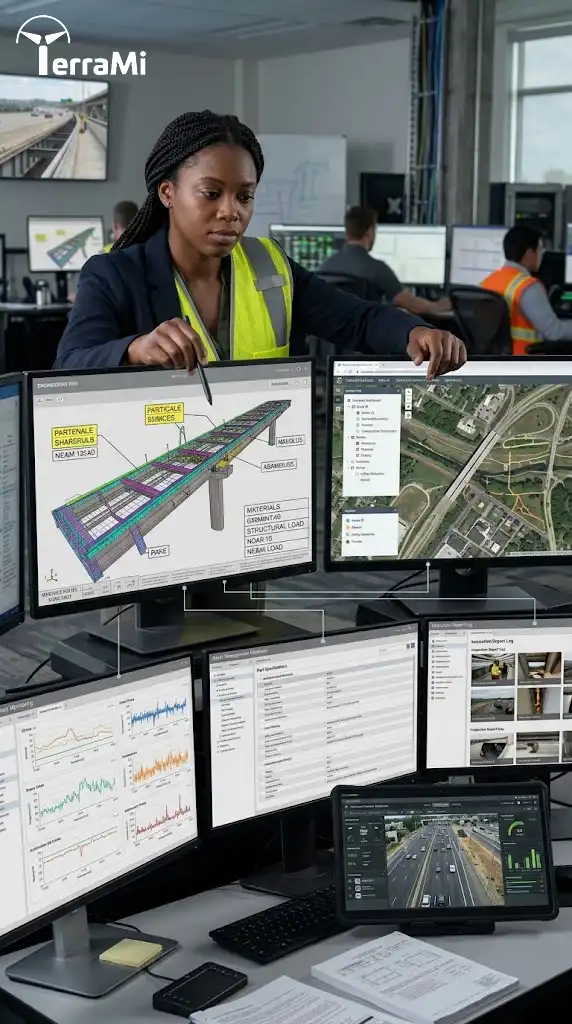
A geographic information system may contain location and spatial relationships.
An enterprise asset-management platform may contain maintenance records.
A building or infrastructure management system may contain operational information.
IoT platforms may receive sensor data.
Inspection applications may generate condition assessments.
Procurement systems may contain component and supplier information.
Environmental systems may track energy, emissions or resource use.
Each system has a legitimate role. The integration gap emerges because these systems often describe the same physical asset using different structures, identifiers and assumptions.
The result is a fragmented digital representation.
An asset manager may know that a pump has experienced three failures.
The maintenance system may know the component ID.
The engineering model may know its physical location.
The procurement system may know its manufacturer.
The operational system may know its current pressure and temperature.
But unless those records can be related reliably, the organization does not have one coherent understanding of the pump.
It has several partial descriptions.
That distinction matters because smart infrastructure systems depend on context. Data becomes much more useful when the organization knows exactly which physical object generated it, where that object sits within the larger system, what role it performs and how its condition has changed over time.
Interoperability Is the Missing Layer
This is where interoperability becomes central.
Interoperability is not simply the ability of two software platforms to exchange a file.
It is the ability of different information environments to exchange information without losing the meaning required to use that information.
That distinction is particularly important for infrastructure because the same asset can be represented through different technical models, databases and operational systems.
A common identifier can establish that two records refer to the same asset.
But that is only the beginning.
The systems also need to understand what the information means.
A temperature value needs a unit.
A component needs a classification.
A maintenance event needs a date and relationship to the relevant asset.
A sensor reading needs to be associated with a physical location and measurement context.
Without this semantic layer, organizations can achieve technical connectivity without achieving meaningful integration.
This is one reason why the development of digital-twin architectures increasingly focuses on the relationship between the physical system, its digital representation and the interface connecting them. ISO’s recently published ISO/TS 25271, for example, explicitly structures an industrial digital-twin architecture around a physical twin, a digital twin and the interface linking the two.
For infrastructure owners, the principle is highly relevant even when the specific implementation differs from an industrial setting.
The digital environment must be connected to the physical environment through information structures that preserve meaning.
Synchronization Has a Time Dimension
There is another problem that is easy to overlook: time.
Infrastructure information is not static.
The physical asset changes.
The digital representation changes.
But they do not always change simultaneously.
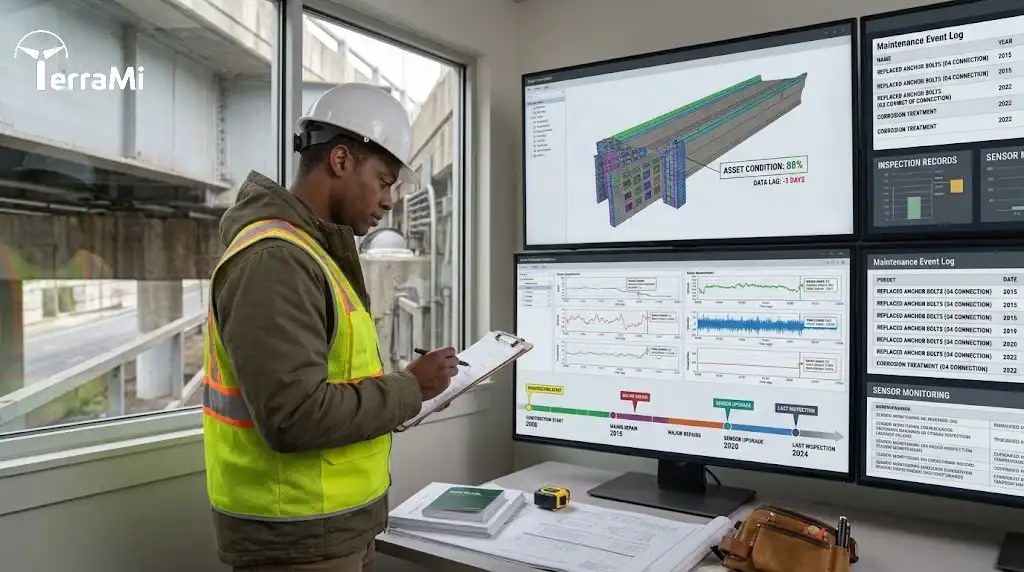
A component can be replaced on Monday while the central asset record is updated two weeks later. A sensor can detect deterioration before an inspection record is created. A construction modification can be completed in the field without being incorporated immediately into the engineering model.
During that interval, two versions of reality exist.
The physical asset says one thing.
The information system says another.
This does not necessarily mean the information system is poorly designed. In many cases, the delay is a consequence of how infrastructure work is organized.
Field teams, engineers, contractors and asset managers operate on different schedules. Some information is generated automatically while other information still depends on human inspection, approval or documentation.
The result is a synchronization lag.
For conventional reporting, that lag may be acceptable.
For predictive operations, it can become a serious limitation.
A digital environment that is intended to support real-time or near-real-time decisions cannot rely on information that systematically describes yesterday’s asset condition.
The Cost of an Outdated Digital Representation
The consequences of synchronization failure are not limited to inaccurate dashboards.
They can affect engineering decisions.
Consider an asset whose physical configuration has changed following a major maintenance intervention. If the digital model does not reflect that intervention, an engineer may analyse the asset using assumptions that no longer apply.
The problem can become even more serious when analytics are introduced.
Predictive models depend on relationships between historical conditions and observed outcomes. If the underlying asset identity or configuration changes without being captured in the data, the model may interpret a structural change as a behavioural change.
In other words, the analytics can be mathematically correct while the engineering interpretation is wrong.
This is one of the less visible risks of digital transformation.
Better analytics do not compensate for disconnected asset information.
They can actually make the consequences of poor integration harder to detect because the output appears precise.
The more organizations rely on predictive systems, the more important it becomes to establish whether the data describes the same physical reality over time.
Integration Must Follow the Asset, Not the Software
A common approach to digital transformation is to start with the software environment.
Which platform should we use?
Which database should become the master?
Which dashboard should connect to which API?
Those questions matter, but they can lead organizations toward technology-centred integration.
Infrastructure requires an asset-centred approach.
Start with the physical system.
Identify its components.
Define the relationships between them.
Determine what information is needed to design, construct, operate, maintain and eventually renew those components.
Then determine which systems generate and manage that information.
This reverses the logic.
Instead of asking how existing software can be connected, the organization asks what information continuity the physical asset requires—and then designs the digital architecture around that requirement.
That is a much stronger foundation for a digital twin.
It also creates a clearer path for organizations with legacy systems because integration does not necessarily require replacing every existing platform. It requires establishing the relationships that allow those platforms to contribute to a coherent asset information environment.
BIM Is Important, But It Is Not the Whole Answer
Building Information Modelling has an important role in this architecture because it can provide structured information about physical assets, their components and their relationships.
But a BIM model alone does not solve the integration problem.
A model created during design or construction may contain highly valuable information while still being disconnected from operational reality.
The challenge is to carry useful information forward and connect it to the data generated after handover.
Research presented through the American Society of Civil Engineers has specifically identified the difficulty of connecting BIM model objects with operational and asset datasets as a central challenge in developing digital twins for the architecture, engineering and construction sector.
This suggests an important distinction:
BIM can provide part of the information foundation; integration is what turns that foundation into a connected lifecycle environment.
That environment needs to accommodate not only geometry and specifications, but also condition, operation, maintenance, intervention history and changing performance.
The Digital Thread Across the Infrastructure Lifecycle
The deeper objective is not to create one enormous database.
It is to create continuity.
A design decision should remain traceable to the physical element it produced.
A construction change should remain traceable to the asset configuration it altered.
A maintenance intervention should remain connected to the component it affected.
A sensor reading should remain connected to the physical condition it represents.
An operational event should be available as evidence for future engineering decisions.
This creates what can be thought of as a digital thread across the infrastructure lifecycle.
The thread does not require every piece of information to exist in one platform.
It requires the relationships between information to survive as the asset moves from one lifecycle stage to another.
That is the difference between a collection of digital systems and a genuinely integrated infrastructure environment.
Integration Must Create Operational Value
Closing the integration gap is not an end in itself.
An infrastructure owner does not gain strategic value simply because its BIM model, asset-management system, sensor platform and operational database can exchange information. The value appears when that connected information changes what the organization can see, decide or do.
This is an important distinction because integration projects can become technology projects without producing meaningful operational change.
A platform may connect hundreds of data sources and still leave engineers searching manually for the information they need.
A digital twin may represent thousands of components and still fail to answer which component requires attention.
A dashboard may display current asset conditions while providing no context about whether a change is normal, significant or likely to affect future performance.
Integration becomes valuable when it reduces this friction between information and action.
For example, an inspection finding should ideally connect the affected asset to its previous condition, relevant maintenance history, current operating conditions and, where appropriate, predicted future behaviour. The engineer should not have to reconstruct those relationships manually from several systems.
That is where an integrated digital environment begins to move beyond information management and into decision support.
From Synchronization to Predictive Capability
Once the physical and digital environments are sufficiently connected, a new possibility emerges.
The digital environment can begin to reveal changes that are difficult to identify through periodic inspection or isolated system reports.
A pattern of increasing vibration may indicate developing equipment degradation.
Repeated maintenance interventions may reveal an underlying reliability problem.
Changes in traffic loading may alter assumptions about asset deterioration.
Environmental exposure may accelerate degradation in ways that are not visible through a fixed inspection schedule.
None of these signals is necessarily decisive on its own.
Their value comes from being interpreted in context.
This is why the integration gap matters so much for predictive infrastructure. Predictive infrastructure depends on relationships between physical conditions, historical events, operational behaviour and future outcomes.
If those relationships are fragmented, predictive systems are forced to work with incomplete context.
If they are connected, the same data can become much more useful.
The progression is therefore not simply:
more sensors → more data → more analytics
It is:
physical asset → connected information → contextual understanding → prediction → decision
That distinction should shape how infrastructure organizations evaluate digital transformation initiatives.
Integration Also Changes Infrastructure Governance
The integration challenge is not purely technical.
It creates questions of ownership and accountability.
Who is responsible for updating the digital representation when the physical asset changes?
Who approves a change to a critical asset record?
Which system is authoritative for condition information?
How quickly must a field intervention be reflected in the digital environment?
Who determines whether two datasets can be treated as equivalent?
These questions become more important as digital infrastructure becomes part of operational decision-making.
An organization cannot depend on a digital representation for engineering decisions without establishing some level of confidence in its accuracy and currency.
That means infrastructure information governance must evolve alongside digital infrastructure.
Governance should define not only who owns information, but also how information changes, how its quality is assessed and how discrepancies between systems are resolved.
This is particularly important for long-lived infrastructure.
A road, bridge, water facility or energy asset may remain in service for decades. The systems used to design and manage it will almost certainly change several times during that period.
A sustainable digital strategy therefore cannot depend on one software platform surviving for the entire asset lifecycle.
It must depend on information relationships that can survive technological change.
The Human Factor in Integration
There is another reason why integration projects fail: people often work according to organizational boundaries rather than asset boundaries.
Design teams have their own workflows.
Contractors have their own systems.
Operations teams use different information.
Maintenance teams may have different terminology and priorities.
IT departments are responsible for platforms and interfaces.
Asset managers focus on lifecycle performance.
The physical infrastructure, however, does not recognize these boundaries.
A bridge does not stop being a bridge when it moves from construction into operations.
A pump does not become a different physical object because responsibility transfers from a project team to an operations team.
The information environment needs to preserve continuity even when organizational responsibility changes.
That requires common definitions, agreed information requirements and processes that make information transfer part of the work itself rather than an administrative activity performed after the work is complete.
Technology can facilitate this process.
It cannot establish the organizational discipline on its own.
What an Integrated Infrastructure Environment Looks Like
A genuinely integrated infrastructure environment does not necessarily look like one enormous screen displaying every available data point.
It is more likely to appear as a series of connected workflows.
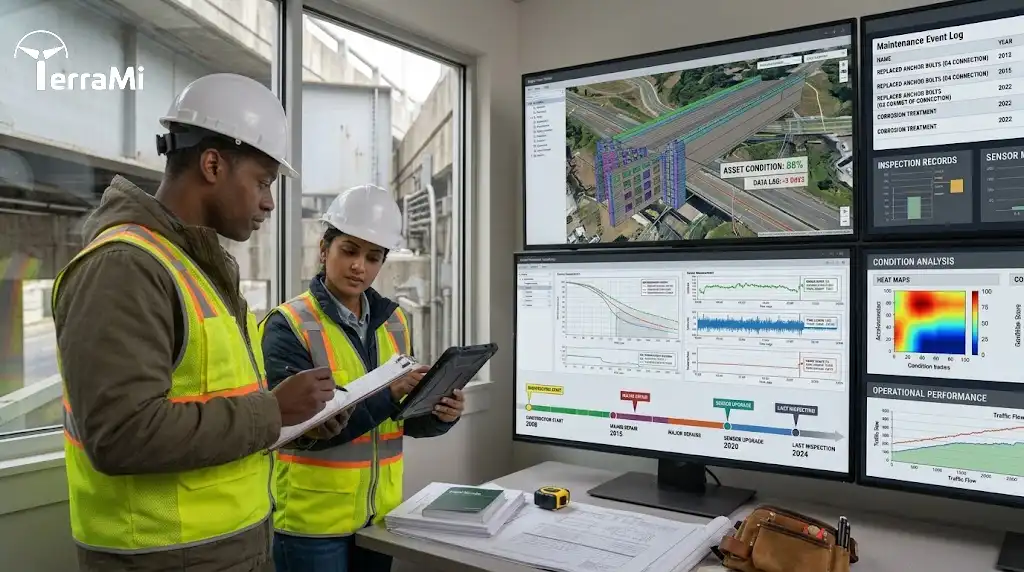
An engineer investigating a structural concern can access the relevant design information, inspection history and current monitoring data without reconstructing the asset’s history manually.
A maintenance manager can see not only which assets require intervention, but why they have been identified and what previous interventions have revealed.
An asset manager can evaluate condition alongside lifecycle cost, operational importance and future investment requirements.
A project team working on an existing facility can understand the current asset configuration before designing a modification.
The common element is context.
Information becomes valuable because it is connected to the physical asset, its history and the decision being made.
This is the practical meaning of integrated infrastructure systems.
It is not simply that systems communicate with each other.
It is that information can travel across organizational and lifecycle boundaries without losing the context required for action.
Closing the Gap Requires a Different Digital Strategy
The most effective response to the integration gap is unlikely to be a single technology purchase.
Infrastructure organizations need to treat digital integration as an evolving capability.
That starts with identifying the physical assets and decisions that matter most.
Not every data source needs to be connected immediately. Not every asset requires the same degree of digital representation. And not every process needs real-time information.
A more practical strategy is to identify where the absence of connected information creates the greatest operational, engineering or lifecycle risk.
For one asset, that may be predictive maintenance.
For another, it may be construction-to-operations handover.
For a large infrastructure network, it may be understanding how changes in one component affect system-level performance.
The integration architecture can then be developed around those high-value use cases.
This approach also makes legacy environments more manageable.
Instead of attempting to replace every existing system, organizations can progressively establish the identifiers, interfaces, information standards and governance processes needed to connect the most important information first.
Over time, the digital environment becomes more coherent without requiring a single disruptive transformation event.
The Next Stage of Infrastructure Digitalization
The infrastructure sector is moving toward increasingly connected digital environments.
Sensors are becoming more common.
Analytics are becoming more capable.
Digital twins are becoming more sophisticated.
Artificial intelligence is creating new possibilities for interpreting infrastructure data.
But none of these developments removes the underlying integration challenge.
If the digital representation does not remain connected to the physical asset, more technology can simply create a more elaborate version of the same fragmentation.
The next stage of infrastructure digitalization is consequently less about adding another digital layer and more about strengthening the relationship between the layers that already exist.
The objective is not to make infrastructure look digital.
It is to make the digital environment faithful enough, connected enough and current enough to support the physical infrastructure throughout its lifecycle.
That is a much more demanding objective.
It also offers a much more meaningful definition of digital maturity.
An organization should not ask only whether it has a digital twin, an IoT platform, a BIM environment or an analytics system.
It should ask whether those capabilities work together around the physical assets that the organization is responsible for.
From Digital Representation to Digital Continuity
The integration gap will not disappear simply because infrastructure organizations adopt better technology.
It will narrow when the industry begins to treat information continuity as part of infrastructure lifecycle management.
The physical asset should remain identifiable as it moves from design to construction, commissioning, operation, maintenance and renewal.
The information generated at each stage should retain its relationship to the asset.
Changes in the physical world should be reflected in the digital environment through defined processes.
And the resulting information should be available in a form that supports the decisions being made at each stage.
This is the foundation of digital continuity.
It does not mean that every piece of information must be permanently stored or that every system must be integrated into one platform.
It means that the critical relationships between the asset, its information and its lifecycle decisions should not disappear when responsibility, technology or project phases change.
That is the difference between infrastructure that is merely digitized and infrastructure that is genuinely connected.
The Integration Gap Is Becoming a Strategic Issue
For years, infrastructure digitalization could be treated primarily as a technology agenda.
That is becoming harder to justify.
As infrastructure owners rely increasingly on digital models, automated monitoring, predictive analytics and AI-assisted decision-making, the quality of the connection between physical and digital systems becomes a strategic concern.
The question is no longer whether infrastructure organizations will have digital information.
They already do.
The question is whether that information will remain sufficiently connected to the physical assets it describes to support decisions when those decisions matter.
Closing the integration gap is therefore not about creating a perfect digital replica.
It is about creating a trustworthy relationship between physical infrastructure and digital intelligence.
That relationship is what allows infrastructure organizations to move from isolated digital tools toward connected systems capable of learning from the assets they manage.
And that is where the next generation of infrastructure digitalization begins.
TerraMi Perspective
TerraMi Perspective: The Real Infrastructure Digitalization Challenge
The infrastructure industry has become very good at creating digital representations of physical assets. The harder task is keeping those representations connected to reality.
A model created during design, a sensor installed during operations and a maintenance record created years later may all describe the same asset. Yet without a reliable information relationship between them, they remain fragments rather than a continuous digital representation.
That is where TerraMi sees the next stage of infrastructure digitalization.
The objective should not be to create more digital systems simply because the technology is available. It should be to create continuity between the physical asset, its information and the decisions made throughout its lifecycle.
A genuinely mature digital infrastructure environment should be able to answer three questions with confidence:
What is the asset?
What is happening to it now?
What does that information mean for the next decision?
When those answers remain connected from design through operation, maintenance and renewal, digital infrastructure becomes more than a collection of tools.
It becomes part of the infrastructure itself.
FAQ
What is the integration gap between physical and digital infrastructure?
The integration gap is the disconnect between the current physical condition or configuration of an infrastructure asset and the digital information used to represent, operate or manage it. The gap can emerge when asset changes, maintenance interventions, operational conditions or inspection findings are not reflected consistently in digital systems.
Why is physical and digital infrastructure integration important?
Physical and digital infrastructure integration allows organizations to connect engineering, operational and lifecycle information with the assets that information describes. This can improve asset visibility, support predictive analysis and reduce the need to reconstruct information manually across disconnected systems.
Is a digital twin the same as a digital model?
No. A digital model can represent an asset’s design, geometry or characteristics without maintaining an active relationship with the physical asset. A digital twin requires a stronger connection between the physical and digital environments, including relevant data and an interface that supports ongoing interaction between them.
Why do infrastructure digital twins become outdated?
Digital twins can become outdated when changes to the physical asset are not captured in the digital environment with sufficient speed, accuracy or context. Construction modifications, maintenance interventions, component replacements and changing operating conditions can all create differences between the physical asset and its digital representation.
What role does interoperability play in infrastructure integration?
Interoperability allows different systems to exchange information while preserving the meaning needed to use that information. In infrastructure, this can involve connecting BIM, GIS, asset-management, inspection, sensor and operational systems around common asset identities and information relationships.
Does infrastructure integration require replacing legacy systems?
Not necessarily. An organization can progressively connect existing systems by establishing common identifiers, interfaces, information standards and governance processes. In many cases, an asset-centred integration strategy is more practical than attempting to replace every existing platform.
How can organizations close the physical-digital integration gap?
They can start by identifying critical assets and high-value decisions, defining the information required to support those decisions, establishing consistent asset identities and relationships, and creating processes that keep digital information aligned with physical changes throughout the asset lifecycle.