Designing Infrastructure for a More Volatile Climate
Climate-resilient infrastructure design is becoming a core engineering requirement as climate conditions move further beyond the assumptions embedded in many existing design standards. Infrastructure is built to operate for decades, yet the climatic conditions that shape its performance are changing within that same period. Higher temperatures, shifting precipitation patterns, sea-level rise and more disruptive extreme events are altering the conditions under which roads, bridges, water systems, energy networks and buildings are expected to function. The challenge is no longer simply to make infrastructure stronger. It is to determine what future conditions an asset must be designed to withstand, how uncertain those conditions are, and how the asset can continue to perform as those conditions evolve.
For decades, infrastructure design has relied heavily on historical observations. Engineers used past rainfall records to establish drainage capacity, historical temperature ranges to assess material performance, and recorded flood levels or wind speeds to estimate design hazards. These approaches remain important, but they become less reliable when the underlying climate is changing. The IPCC identifies changing precipitation, temperature and sea levels as growing pressures on infrastructure performance, while also highlighting the cascading risks created by interdependent infrastructure systems.
The implication is significant: climate change is becoming a design variable rather than a background environmental condition.
Climate Volatility Is Changing the Design Baseline
Infrastructure does not fail because climate change exists in the abstract. It fails when physical conditions exceed the assumptions under which the asset was designed, maintained or operated.
That distinction matters.
A bridge designed for a particular range of temperatures, a drainage system sized around historical rainfall intensity, or a road engineered for a specific frequency of freeze-thaw cycles all contains assumptions about its operating environment. If those assumptions shift, the engineering margin can gradually narrow even when the asset itself has not changed.
Climate change can affect both chronic conditions and acute events. Chronic changes include higher average temperatures, gradual sea-level rise, changing seasonal precipitation and prolonged water stress. Acute hazards include floods, heatwaves, storms, wildfire and other extreme events. The two can interact. An infrastructure system exposed to repeated heat stress, for example, may become more vulnerable when an extreme heat event occurs.
This changes the meaning of a design baseline.
The question is no longer simply:
What conditions has this location experienced in the past?
It increasingly becomes:
What range of conditions could this asset experience during its operational life?
That shift is particularly important for infrastructure with long service lives. Decisions made during planning and design can remain embedded in an asset for decades, making later correction expensive or technically difficult. The IPCC notes that physical infrastructure decisions have long-lasting implications and can be difficult to reverse, which makes climate risk particularly important at the design and investment stage.
This is also why climate resilience cannot be treated as a final design check. Adding a resilience measure after the fundamental geometry, location or capacity of an asset has already been established can leave important risks untouched.
A flood-prone facility may need more than stronger walls. Its location, access routes, drainage, backup power, communications and recovery arrangements may all determine whether it continues to provide its intended service.
The same principle applies across infrastructure systems.
A transport corridor can be damaged by flooding, but the resulting disruption may extend into emergency response, supply chains and access to essential services. A power failure can affect water pumping, telecommunications and transportation. A damaged communications network can reduce the ability of operators to monitor and restore other infrastructure.
Climate risk is consequently not confined to the physical boundary of an asset. It can propagate through the systems that depend on it.
From Historical Design Standards to Forward-Looking Risk
Historical data remains valuable because it provides evidence about how infrastructure and natural systems behave. The problem arises when historical frequency is treated as a reliable proxy for future frequency without accounting for changing climate conditions.
For infrastructure planners, this creates a methodological shift.
Traditional risk assessment often starts with an observed probability: a flood of a certain magnitude may historically have occurred once within a particular return period. But when precipitation patterns are changing, the historical return period may no longer describe the future hazard with the same confidence.
This does not mean abandoning established engineering standards. It means understanding where those standards may require additional climate information, scenario analysis or adaptive design.
A forward-looking approach can combine several layers of information:
- historical observations;
- climate projections;
- asset-specific exposure;
- vulnerability and failure modes;
- expected service life;
- uncertainty ranges;
- consequences of service disruption;
- and the ability to modify the asset later.
The objective is not to predict one exact future.
That would create a false sense of precision.
The more useful objective is to understand a range of plausible future conditions and determine whether the infrastructure can perform acceptably across that range.
This distinction becomes especially important when investment decisions involve assets with very different levels of reversibility. A monitoring system can often be upgraded relatively easily. A bridge elevation, tunnel alignment or coastal facility location cannot.
The design response should reflect that difference.
Where future conditions are highly uncertain and the cost of modification is high, planners may need to build flexibility into the initial design. Where modifications are relatively easy, a staged adaptation pathway may be more efficient.
This approach moves infrastructure planning away from the idea of one permanent design toward a sequence of decisions that can respond to new information.
The IPCC describes adaptation pathways in similar terms: adaptation actions can be sequenced over time as risks and development conditions evolve, rather than assuming that one intervention can resolve all future risk at the outset.
The critical question is not whether infrastructure can withstand today’s climate. It is whether today’s design decision will remain defensible as the climate changes.
That is a different engineering question—and one that increasingly needs to be answered before construction begins.
Where Climate Change Changes Engineering Decisions
Climate risk becomes meaningful when it changes a specific engineering decision.
The effect is different for every infrastructure type and location, but several design variables are becoming increasingly important.
Design Loads and Environmental Thresholds
Temperature, precipitation, wind, flooding and other environmental conditions can influence the loads and stresses an asset experiences.
For some assets, the concern is a higher peak condition. For others, it is the cumulative effect of repeated exposure.
Heat can affect pavement behaviour, rail infrastructure, electrical equipment and building systems. Heavy precipitation can overwhelm drainage capacity. Drought can affect water availability and the operating conditions of water-dependent infrastructure. Coastal assets may face the combined influence of sea-level rise, storm surge and erosion.
The engineering response should not be reduced to simply increasing every design value.
That approach can be expensive and may still miss the underlying risk.
Instead, designers need to identify which performance thresholds matter most and how those thresholds may change during the asset’s life.
Drainage, Flooding and Water Management
Water infrastructure provides one of the clearest examples of why climate assumptions matter.
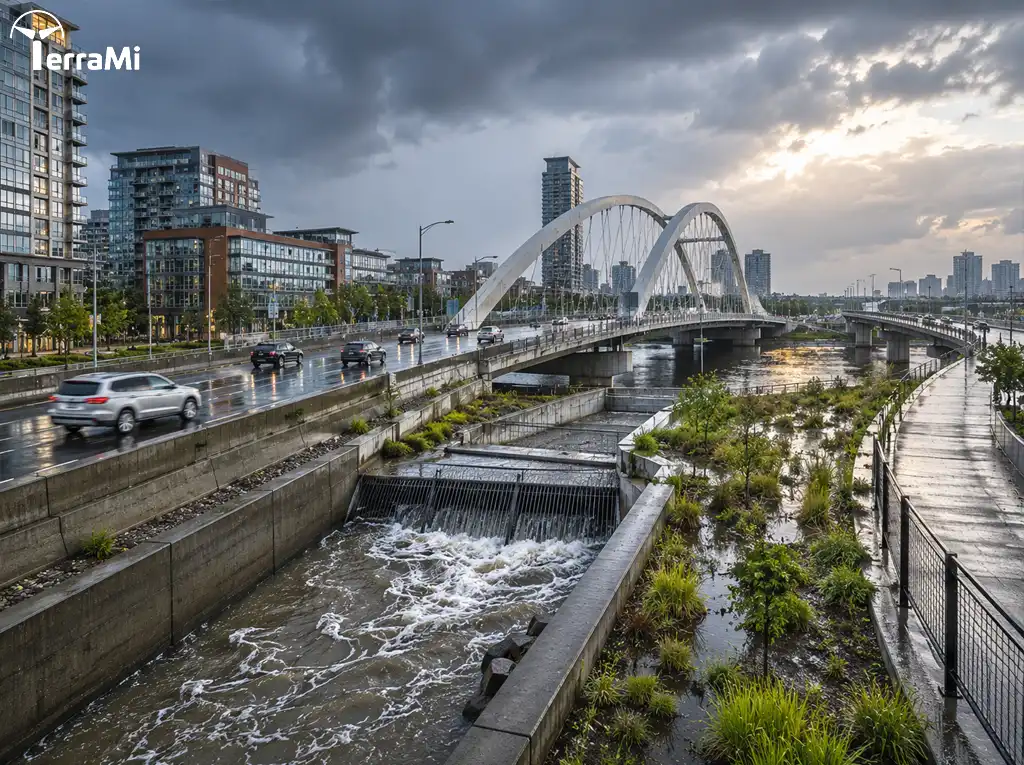
A drainage network designed around historical rainfall intensity may perform adequately under past conditions but experience greater stress if heavy precipitation becomes more intense or occurs in different seasonal patterns. The issue may not be a single undersized pipe. It can involve the capacity of the entire drainage network, upstream land use, surface permeability, storage, outfalls and downstream constraints.
The IPCC notes that changing precipitation patterns and urban development can combine to increase flood risk and place pressure on existing urban water systems.
This points toward a broader design principle: water resilience needs to be considered at system scale rather than only at the component level.
A larger culvert may solve one bottleneck while transferring risk downstream. A conventional flood barrier may protect one facility while increasing exposure elsewhere. Nature-based measures, storage capacity, permeable surfaces and watershed-level planning can sometimes address the same risk through a wider system response.
Heat and Material Performance
Temperature is another design variable that is often treated too narrowly.
Higher average temperatures and more frequent heat extremes can influence material durability, equipment operating limits and the thermal performance of buildings and transportation infrastructure. Repeated exposure can also contribute to degradation over time.
The question for designers is not simply whether a material can tolerate an extreme temperature once. It is whether the material and associated systems can maintain required performance across repeated and potentially prolonged exposure.
This distinction matters for lifecycle planning.
An asset may remain structurally functional while its maintenance requirements, energy demand or operational reliability deteriorate. Climate resilience must account for these performance changes rather than defining resilience only as the absence of catastrophic failure.
Location and Exposure
Some climate risks cannot be solved efficiently through structural reinforcement because the fundamental problem is exposure.
An asset located in a floodplain, unstable slope, wildfire-prone area or increasingly exposed coastal zone may face a level of long-term risk that is difficult to eliminate through conventional engineering.
This makes site selection a climate-resilience decision.
Land-use planning and infrastructure planning are closely connected because location determines exposure before engineering design begins. The IPCC identifies land-use planning and infrastructure siting as important factors in determining exposure to climate hazards.
In some cases, the most resilient design may involve relocation, revised alignment or avoiding a high-risk site altogether.
That can be politically and financially difficult. It can also be far more effective than attempting to engineer away an exposure that will continue increasing.
Interdependencies and Cascading Failure
Infrastructure systems rarely operate independently.
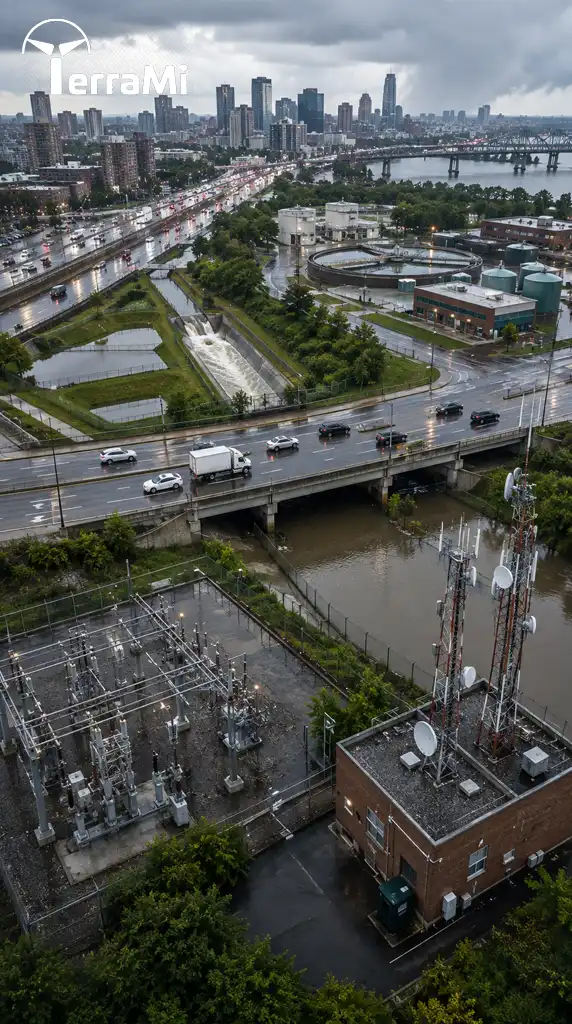
A wastewater facility requires electricity. A transportation network depends on communications and power. Emergency response depends on roads, telecommunications and reliable energy. Digital infrastructure increasingly depends on physical infrastructure for cooling, power and connectivity.
Climate-related disruption can therefore move across system boundaries.
The IPCC identifies these interdependencies as a source of compounding and cascading climate risk. A hazard affecting one infrastructure network can create consequences beyond the immediate physical footprint of the event.
This means that infrastructure design should consider not only asset failure, but also service failure.
A resilient pumping station, for example, is not necessarily sufficient if the surrounding electrical supply and access infrastructure remain vulnerable. Similarly, strengthening one transportation link may have limited value if another critical connection remains exposed.
The relevant unit of analysis is often the service network rather than the individual asset.
Designing for Uncertainty, Not Just for Extremes
One of the most difficult consequences of climate change for infrastructure design is uncertainty.
Engineers are accustomed to working with uncertainty. Material properties vary. Loads fluctuate. Construction conditions change. Future demand is rarely known with complete precision. Climate change adds another layer because the environmental conditions themselves are shifting, and the magnitude and timing of that change depend on emissions, geography and local conditions.
The wrong response is to treat uncertainty as a reason to postpone decisions.
The better response is to design decisions that remain reasonable across a range of plausible conditions.
This requires a distinction between robustness and adaptability.
A robust asset is designed to perform under a wide range of conditions without major modification. An adaptable asset is designed so that it can be modified as conditions change.
Neither approach is universally better.
For a critical flood-control facility with a long service life, building additional capacity at the beginning may be justified if future modification would be extremely difficult. For a monitoring or control system, however, designing for easy technological upgrades may make more sense than attempting to predict exactly what the system will need decades from now.
The decision should be based on risk, cost, reversibility and the consequences of failure.
Avoiding the False Precision of Climate Forecasts
Climate projections should not be interpreted as a single forecast for a particular asset.
They are better understood as evidence about possible changes in the conditions that infrastructure may encounter. The engineering task is then to translate those changes into design-relevant variables.
For example, a projected change in precipitation becomes meaningful when it raises questions such as:
- Will drainage capacity remain adequate?
- How much temporary storage is required?
- Which components become critical during flooding?
- Can access routes remain operational?
- How quickly can the system recover?
The same logic applies to heat, drought, coastal exposure and other hazards.
This is where scenario-based planning becomes useful. Rather than designing around one assumed future, engineers and asset owners can test how a proposed design performs under several plausible conditions.
A design that performs acceptably across multiple scenarios may be preferable to one that performs extremely well under one assumed future but poorly under another.
That is a different definition of optimization.
Instead of asking which design produces the lowest cost under one forecast, the question becomes which design provides an acceptable level of performance across a reasonable range of future conditions.
Infrastructure Design Must Account for the Full Asset Life Cycle
Climate resilience cannot be separated from asset life.
A road, bridge, water treatment facility, transmission line or major building may operate for several decades. The environmental conditions present at commissioning may not represent those experienced near the end of its service life.
This creates a timing problem.
A design decision made today can lock in exposure for decades, while climate risks may increase gradually during that period. The most important resilience decision may consequently occur long before the first climate-related failure becomes visible.
This is one reason life-cycle thinking is essential to climate-resilient infrastructure design.
The analysis should extend beyond construction cost and initial performance. It should consider:
- changing hazard exposure;
- maintenance requirements;
- degradation rates;
- operational energy requirements;
- adaptation costs;
- downtime and service disruption;
- replacement timing;
- and the residual risk that remains after intervention.
An option with a slightly higher capital cost may be preferable if it substantially reduces future maintenance, disruption or adaptation costs.
Conversely, overbuilding every asset for highly uncertain future conditions can create unnecessary capital expenditure. The objective is not maximum protection at any cost. It is an appropriate level of performance over the asset’s expected life.
This is where climate adaptation becomes closely connected to asset management.
Asset owners already make decisions about inspection, maintenance, renewal and replacement based on asset condition and performance. Climate information can become another input into that process.
If a particular component is approaching replacement and its exposure to a climate hazard is expected to increase, replacement can become an opportunity to improve its resilience rather than simply reproduce the previous design.
That turns adaptation into part of normal asset decision-making.
The Shift from Resilient Assets to Adaptive Infrastructure Systems
Resilience has traditionally been discussed in terms of an asset’s ability to withstand disruption and recover from it.
That remains important. But for infrastructure facing persistent environmental change, recovery alone may not be enough.
An asset can recover repeatedly and still become increasingly unsuitable for its operating environment.
Adaptive infrastructure takes a broader approach. It combines physical design with monitoring, operational flexibility, maintenance planning and the ability to change as conditions evolve.
This does not necessarily mean fully autonomous infrastructure or sophisticated technology.
Sometimes adaptation is remarkably simple.
A drainage system may be designed with reserved space for future capacity expansion. A coastal facility may include provisions for raising protective elements later. A building may be designed so that cooling systems can be upgraded without major structural intervention. A transportation corridor may preserve options for modifying drainage or slope protection as exposure changes.
These are forms of designing for future decisions.
The value lies in preserving choices.
Monitoring Becomes Part of the Design
Adaptive infrastructure depends on knowing when conditions are changing enough to justify intervention.
That makes monitoring increasingly important.
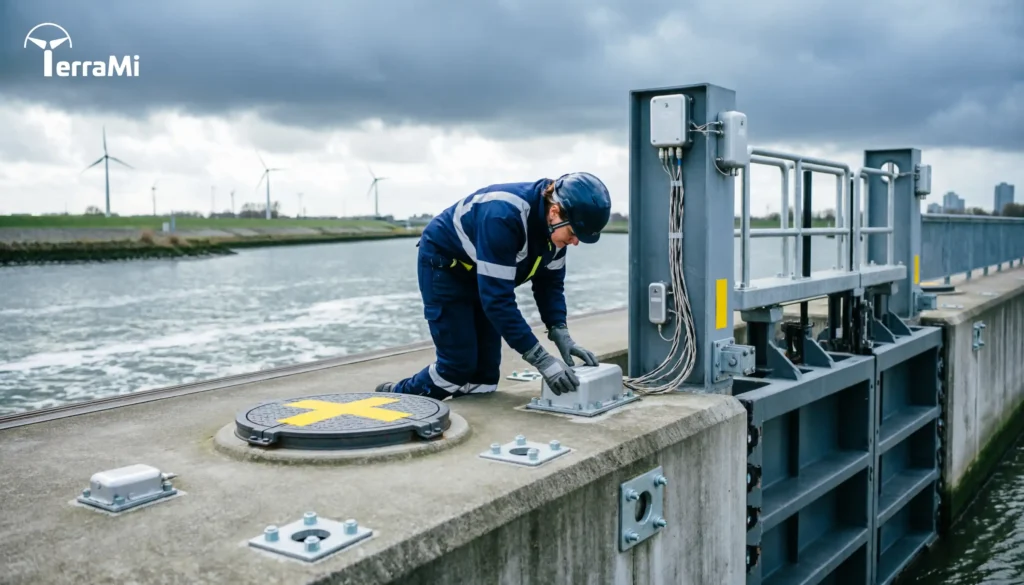
Sensors, remote inspection, weather data, asset-performance data and digital models can help owners identify changes in operating conditions before they become failures. But technology is useful only when the information leads to a defined decision.
A temperature sensor is not an adaptation strategy by itself. A flood-monitoring system is not resilience simply because it generates more data.
The important connection is:
measurement → interpretation → threshold → action.
For example, an infrastructure owner might define a performance threshold at which a component requires inspection, operational modification or capital intervention.
This creates a feedback loop between environmental conditions and asset management.
That approach also creates an important connection between climate adaptation and digital infrastructure. Digital twins, predictive analytics and real-time monitoring can support adaptive decisions when they are connected to reliable physical and operational data.
But digital tools should support engineering judgment rather than substitute for it. A highly detailed model based on poor climate assumptions can produce a precise answer to the wrong question.
Adaptation Should Be Designed Before It Is Needed
One of the strongest arguments for adaptive design is that adaptation is usually cheaper and less disruptive when it is anticipated.
Consider two otherwise identical facilities.
The first is constructed without provisions for future climate adaptation. If flood exposure increases, substantial reconstruction may be required.
The second incorporates accessible structural elements, reserved capacity and upgrade pathways during initial design. The same future change may then require a targeted modification rather than a major reconstruction.
The difference is not necessarily the amount of material used in the original asset. It is the degree of future choice preserved by the design.
This principle is especially relevant to infrastructure with high modification costs or major consequences of failure.
It also changes how resilience should be evaluated during design review. Instead of asking only whether the proposed asset meets current requirements, project teams can ask:
- Which climate assumptions are embedded in the design?
- Which of those assumptions are most uncertain?
- Which failure modes become more likely under future conditions?
- Which design elements are difficult or impossible to modify later?
- What adaptation options should be preserved now?
- What indicators would tell the owner that adaptation is becoming necessary?
These questions do not require certainty about the future.
They require discipline about how uncertainty is handled.
A Design Decision Is Also a Future Constraint
Every major infrastructure project makes decisions that can constrain future responses.
A fixed alignment determines where exposure will occur. A structural configuration determines what can be upgraded. A drainage layout determines how future capacity can be added. A site decision can determine whether relocation remains realistic.
This means climate adaptation should be considered not only as a response to risk, but as a question of option value.
A design that preserves several future adaptation options may be more valuable than one that appears marginally cheaper today but leaves the owner with few choices later.
That is increasingly important as infrastructure systems face conditions that cannot be characterized reliably by historical averages alone.
What This Means for Infrastructure Owners and Engineers
The shift toward climate-resilient infrastructure design changes more than technical specifications. It changes when and how infrastructure decisions are made.
For engineers, climate risk needs to enter the design process early enough to influence fundamental choices such as site selection, system configuration, capacity and material selection. If climate considerations are introduced only after the core design is complete, the available options may already be limited.
For infrastructure owners, the issue is broader. Owners are responsible not only for whether an asset is structurally adequate, but whether it can continue delivering its intended service over time.
That means resilience needs to be connected to asset performance.
A useful approach is to identify the climate hazards that could materially affect an asset, determine which components and services are most sensitive to those hazards, and then establish practical performance thresholds. Those thresholds can guide inspection, maintenance, operational changes and capital planning.
The process can be summarized as:
Hazard → Exposure → Vulnerability → Performance impact → Adaptation response
This is more useful than treating climate risk as a separate environmental assessment because it connects the hazard directly to an infrastructure decision.
Prioritize Consequences, Not Just Hazards
Not every climate hazard deserves the same level of design response.
A project exposed to several hazards may have one or two that dominate its actual risk. A moderate flood risk could be more consequential than a higher but easily managed heat exposure if flooding can interrupt a critical service for an extended period.
Risk assessment should consequently consider both probability and consequence.
The consequence dimension is particularly important for critical infrastructure. A short disruption to a non-critical facility may be manageable. The same disruption to a water treatment plant, major transportation connection or emergency communications network can affect thousands of people and other infrastructure systems.
This makes service criticality an important part of climate adaptation planning.
Integrate Climate Risk into Capital Planning
Climate adaptation becomes difficult when it exists only as a technical recommendation without a financial pathway.
Infrastructure owners need to know not only what should be changed, but when.
A useful capital-planning process can distinguish between:
- measures required immediately;
- measures that should be incorporated during planned renewal;
- measures that can be triggered by defined changes in conditions;
- and measures that are unlikely to be justified under current risk levels.
This avoids two common extremes.
The first is reactive adaptation, where significant investment occurs only after a failure or damaging event.
The second is indiscriminate overbuilding, where every asset is designed for an extreme future scenario regardless of uncertainty or consequence.
A staged approach can be more rational. Adaptation investments can be aligned with asset renewal cycles, risk thresholds and the cost of future intervention.
This also creates a stronger connection between climate resilience and long-term infrastructure investment decisions.
The New Design Priority: Performance Under Future Conditions
The central change in infrastructure design is not simply that engineers need to account for more extreme weather.
It is that the definition of acceptable performance is changing.
Historically, a design could be evaluated largely against known environmental conditions and established technical standards. In a changing climate, that evaluation needs another dimension: how the asset is expected to perform as those conditions evolve.
That does not mean abandoning standards or attempting to predict the climate decades into the future with false precision.
It means asking whether the design remains technically and economically defensible across plausible future conditions.
For some infrastructure, the answer may be a stronger physical design.
For another asset, it may be additional redundancy, better drainage, greater thermal tolerance or improved emergency access.
For another, the most appropriate response may be monitoring and an explicit adaptation pathway rather than significant additional capital expenditure on day one.
There is no single climate-resilient design solution.
The appropriate response depends on the asset, its location, its criticality, its expected life, the uncertainty surrounding future conditions and the consequences of failure.
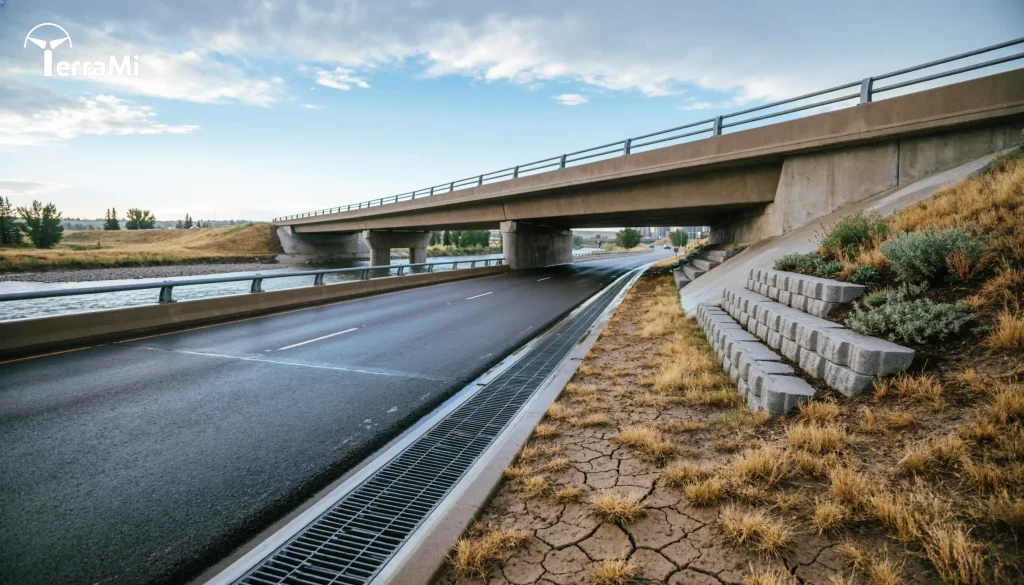
From Static Design to Managed Performance
This is where the traditional boundary between design and operations begins to weaken.
Infrastructure should not be considered finished when construction ends. For assets facing changing environmental conditions, performance needs to be monitored throughout the operating life.
Design decisions establish the initial level of resilience. Operations and maintenance determine how much of that resilience is retained. Monitoring provides evidence about whether the original assumptions remain valid. Capital planning determines when adaptation or renewal should occur.
The result is a continuous management cycle rather than a one-time design exercise:
Design → Operate → Monitor → Assess → Adapt → Renew
This cycle is particularly important for long-lived infrastructure because climate exposure can change faster than the physical asset.
It also creates an opportunity to connect climate resilience with the broader evolution of infrastructure management. Data from asset monitoring, climate models, inspections and operational systems can increasingly be brought together to support decisions about maintenance and adaptation.
The value of this information is not the volume of data collected. It is whether the data improves a decision.
Climate Resilience Is Becoming a Core Engineering Discipline
The infrastructure sector has spent years treating climate resilience as an emerging concern. That framing is becoming less useful.
For long-lived assets, climate conditions are already part of the environment in which infrastructure must operate. The practical question is no longer whether climate change should influence infrastructure design, but how deeply it should influence the design process.
The answer should begin with the earliest decisions.
Site selection, system configuration, design criteria, materials, redundancy, drainage, access and maintenance strategies all influence how an asset will perform under future conditions. Once these decisions are embedded in concrete, steel, pavement, pipes and fixed alignments, changing them becomes increasingly expensive.
Climate-resilient design is consequently as much about avoiding future lock-in as it is about strengthening infrastructure.
A well-designed asset does not need to anticipate every possible future. It needs to recognize the important uncertainties, manage the consequences that matter most and preserve reasonable options for adaptation.
That is a more practical definition of resilience.
It also reflects the reality facing infrastructure owners and engineers: climate change is not creating a separate category of infrastructure risk. It is changing the conditions under which almost every infrastructure system is expected to perform.
TerraMi Perspective
Infrastructure resilience should begin with the design assumptions that shape an asset’s future.
For TerraMi, the critical shift is from designing infrastructure for a fixed set of historical conditions toward managing performance across a changing range of conditions. This requires climate risk to be connected with asset data, lifecycle planning and investment decisions rather than isolated in a separate sustainability exercise.
The strongest infrastructure strategies will not be those that attempt to predict the future perfectly. They will be those that recognize uncertainty, preserve adaptation options and make future intervention measurable and manageable.
FAQ
What is climate-resilient infrastructure design?
Climate-resilient infrastructure design is the process of planning and engineering infrastructure so it can maintain acceptable performance under current and plausible future climate conditions. It considers hazards, exposure, vulnerability, asset life, service criticality and adaptation options.
Why is historical climate data no longer enough for infrastructure design?
Historical data remains valuable, but it describes conditions that have already occurred. When temperature, precipitation, sea levels and extreme-event patterns are changing, historical records alone may not represent the conditions an infrastructure asset will experience during its future service life.
How does climate change affect infrastructure design?
Climate change can influence design loads, drainage capacity, material performance, site selection, water availability, thermal performance and exposure to flooding, storms, wildfire and other hazards. It can also increase the risk of cascading failures between interconnected infrastructure systems.
What is adaptive infrastructure?
Adaptive infrastructure is designed to accommodate changing conditions through a combination of physical flexibility, monitoring, operational adjustments, maintenance and future upgrade options. Rather than assuming one permanent solution, it preserves the ability to respond as risk evolves.
Should every infrastructure project be designed for the most extreme climate scenario?
Not necessarily. Effective adaptation should consider the probability and consequence of hazards, the asset’s criticality and service life, the cost of intervention, uncertainty in future conditions and the feasibility of later modification. In some cases, staged adaptation can be more appropriate than building maximum capacity from the beginning.