
How to Design Resilient Infrastructure Systems for Extreme Events
Engineering for a Different Climate Reality
Resilient infrastructure systems are no longer designed against a stable set of environmental conditions. Roads, bridges, drainage networks, power systems, water infrastructure, and other critical assets are increasingly expected to perform under conditions that can depart significantly from the historical patterns used in conventional engineering design.
This shift matters because infrastructure failure rarely results from the intensity of an event alone. A flood may overwhelm a drainage system, but the consequences depend on the system’s capacity, redundancy, maintenance condition, exposure, and the availability of alternative routes or services. A heatwave may damage pavement or strain an electricity network, but the resulting disruption also depends on how the asset was designed, operated, and connected to the wider infrastructure system.
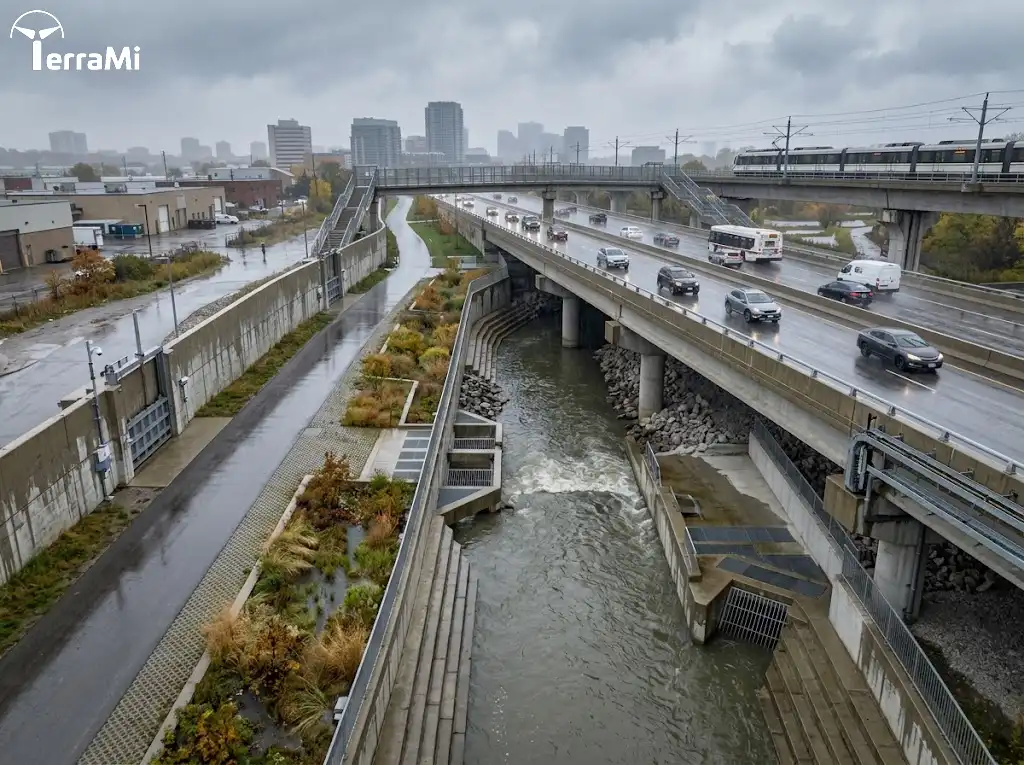
The engineering challenge, then, is broader than making individual assets stronger. It is about understanding how infrastructure behaves when environmental conditions exceed expected thresholds, how failures propagate through interconnected systems, and how quickly essential functions can be restored. This requires a move from designing primarily for expected conditions toward designing for performance under uncertainty.
From Designing for Events to Designing for System Performance
Traditional infrastructure design has generally relied on defined performance criteria, historical observations, engineering standards, and estimated return periods. These remain essential tools. The problem emerges when historical conditions are treated as reliable proxies for future conditions even though the underlying environmental and operational context is changing.
Extreme events expose the limitations of that assumption. The relevant question is not simply whether a structure can withstand a specified event. Engineers and infrastructure owners increasingly need to ask what happens when an event is more severe than anticipated, occurs in combination with another hazard, or affects several interconnected assets at the same time.
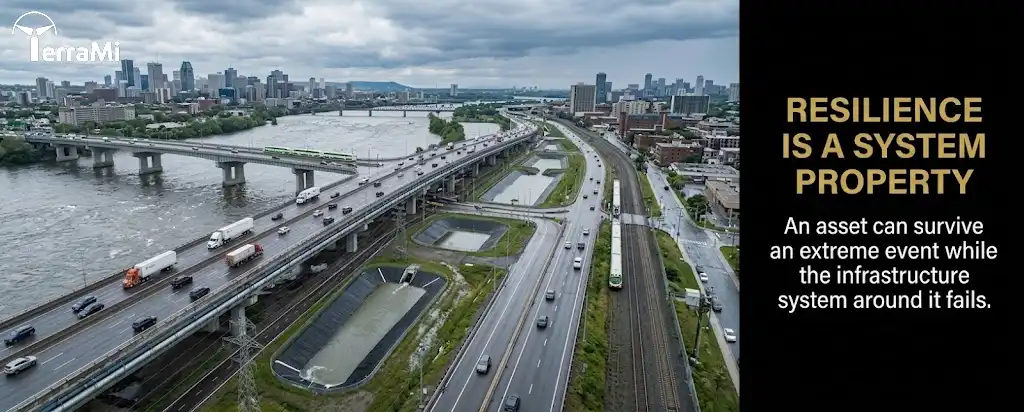
Consider a major rainfall event affecting an urban transportation network. A road may be structurally sound while still becoming unusable because surrounding drainage infrastructure is overwhelmed. A bridge may remain intact while access roads are flooded. An electricity substation may continue operating while the communications network required to coordinate emergency response is disrupted. The physical performance of one asset is therefore only part of the resilience equation.
This systems perspective changes the engineering objective. Instead of optimizing an asset for a narrow design condition, the objective becomes maintaining critical functions across a range of plausible conditions.
That distinction is particularly important for infrastructure with long service lives. An asset designed today may remain in operation for several decades, during which its environmental exposure, surrounding land use, demand profile, technology, and maintenance requirements can all change. Designing only for today’s conditions can transfer significant risk into the future.
The Limits of Historical Design Assumptions
Historical data remains valuable, but its role needs to be considered carefully. Engineering practice has traditionally used past observations to estimate the probability and magnitude of events such as floods, storms, heat extremes, and other hazards. Where environmental patterns are relatively stable, this approach provides a practical foundation for design.
The difficulty is that infrastructure decisions often have consequences extending far beyond the period represented by available historical records.
A drainage system, for example, may be designed around a particular rainfall intensity associated with a specified probability of occurrence. If future rainfall patterns change, the original relationship between the design assumption and actual risk can weaken. The same issue can appear across transportation, water, energy, and coastal infrastructure, although the specific mechanisms differ.
This does not mean that historical engineering standards have become irrelevant. It means that standards should be complemented by scenario-based thinking, sensitivity analysis, and an explicit consideration of uncertainty.
The distinction is important. A resilient design does not require engineers to predict the exact weather conditions that will occur decades from now. Such precision is neither realistic nor necessary. Instead, it requires designs that can maintain acceptable performance across a wider range of conditions and that can be modified when assumptions change.
Designing Around Failure, Not Just Preventing It
One of the most important changes in resilient infrastructure engineering is the recognition that failure cannot always be eliminated.
Attempting to make every component capable of withstanding every conceivable event can produce disproportionate costs. A more practical approach is to determine which functions must be protected, which failures are tolerable, how failures can be contained, and how essential services can be restored.
This introduces several engineering concepts that are central to resilience.
Redundancy provides alternative components, routes, or systems when one element fails. In transportation, this may mean having more than one viable route between critical locations. In energy systems, it can involve alternative supply paths or distributed generation. In water infrastructure, redundancy may involve multiple treatment, storage, or distribution capabilities.
Robustness concerns the ability of an asset or system to withstand stress without unacceptable loss of function. Structural capacity, protective systems, drainage capacity, and material selection all contribute to robustness.
Recoverability addresses what happens after failure has occurred. An infrastructure system that experiences temporary damage but can be rapidly repaired may provide better overall service than one designed to resist a wide range of events but requiring prolonged restoration after a major failure.
These characteristics should not be considered independently. Excessive reliance on robustness, for example, can lead to expensive assets with limited flexibility. A system with redundancy but poor recoverability may still experience prolonged disruption. The engineering task is to find an appropriate balance between prevention, tolerance, adaptation, and recovery.
Designing for Cascading and Interdependent Failures
Extreme events become particularly difficult when infrastructure systems are interconnected.
Modern infrastructure rarely operates as a collection of independent assets. Transportation depends on energy and communications. Water and wastewater systems depend on electricity. Emergency response depends on transportation, telecommunications, and functioning public facilities. Disruption in one system can therefore create secondary failures elsewhere.
A resilient engineering methodology needs to account for these dependencies before an extreme event occurs.
This begins with identifying critical functions rather than looking only at individual assets. Engineers and asset owners can then examine which components are essential to those functions, what external systems they depend on, and where a single point of failure could create disproportionate consequences.
The resulting risk picture is often different from the one produced by asset-by-asset assessment. An apparently minor component may become strategically important because its failure interrupts several other services. Conversely, an expensive structural upgrade may provide limited resilience if the surrounding network remains vulnerable.
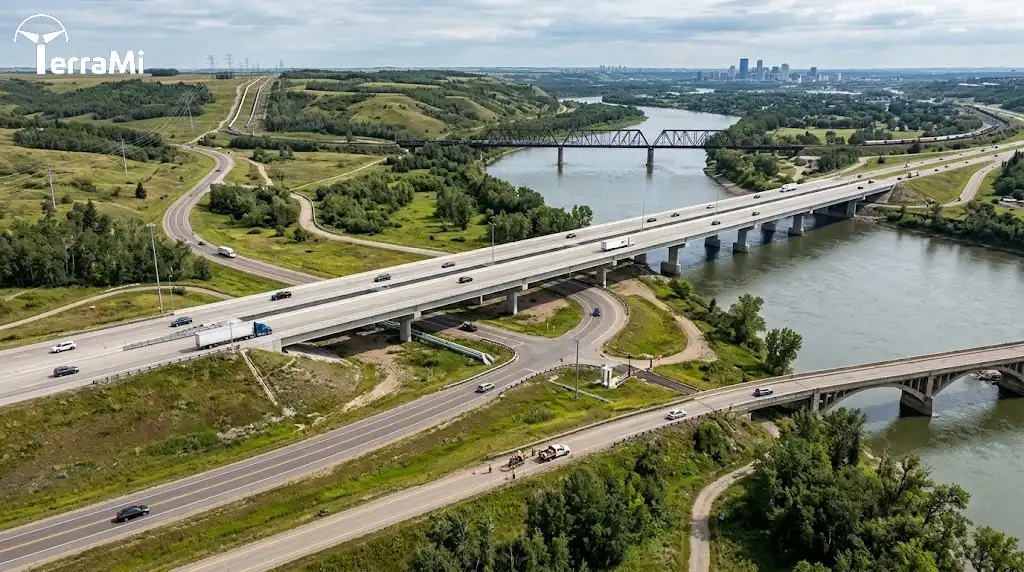
This is why resilience assessment increasingly needs to move across organizational and engineering boundaries. The relevant unit of analysis is often not the bridge, road, pump station, substation, or treatment plant by itself, but the network of functions that allows infrastructure to serve communities and economies.
Risk Mitigation as a Design Decision
Risk mitigation should not be treated as a separate activity that begins after engineering design has been completed. The most effective mitigation measures are often determined during the earliest stages of planning, when the location, configuration, capacity, materials, interfaces, and operational requirements of an infrastructure system are still flexible.
At this stage, engineers can compare different design pathways rather than attempting to retrofit resilience into an already constrained asset.
A useful approach is to consider mitigation across several levels. The first is hazard exposure: can the asset be located or configured to reduce exposure in the first place? The second is vulnerability: if exposure cannot be avoided, which components are most likely to fail? The third is consequence: if failure occurs, which functions are affected and for how long? The fourth is recovery: what capabilities are required to restore service?
This framework shifts the discussion away from a single question—”How strong does this asset need to be?”—toward a more useful one: “What level of performance does this system need to maintain under plausible disruption?”
That is a more demanding engineering question, but it also produces more useful decisions.
The answer may involve structural reinforcement in one location, additional drainage capacity in another, operational changes elsewhere, and a completely different configuration for a critical network. Resilience is therefore not necessarily synonymous with more material, larger structures, or higher capital expenditure. It is the result of matching engineering decisions to the consequences of disruption.
From Resilience Principles to Engineering Methodology
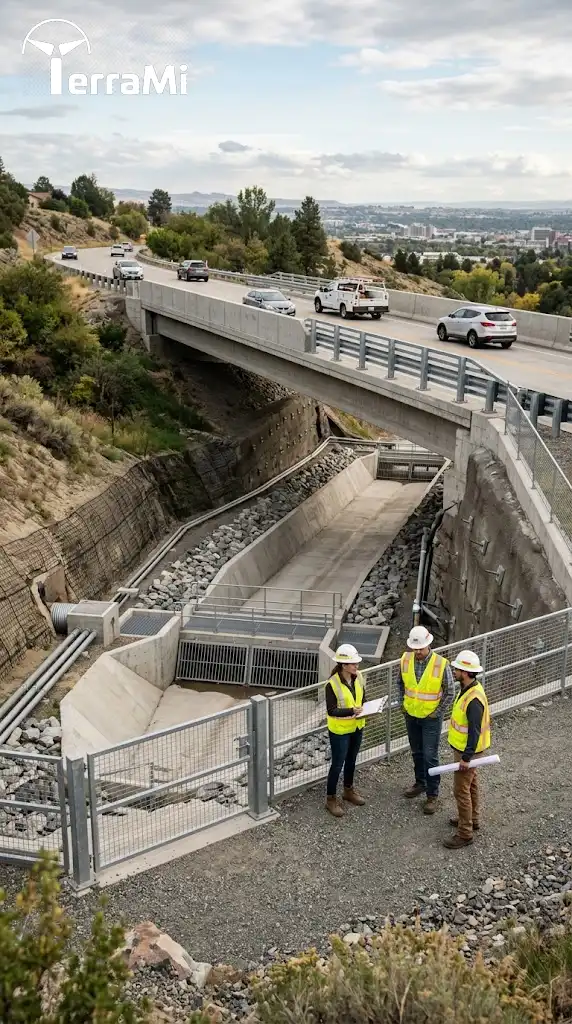
Designing for resilience becomes meaningful only when it changes how engineering decisions are made. The principles of robustness, redundancy, recoverability, and adaptation need to be translated into measurable requirements that can influence planning, detailed design, procurement, construction, and asset management.
One useful starting point is to define the critical functions an infrastructure system must maintain during and after an extreme event. This shifts attention away from asking whether every component can remain fully operational and toward determining which services must continue, which level of disruption is acceptable, and how quickly degraded functions must be restored.
For a transportation corridor, uninterrupted operation may not be necessary across every lane or segment. Maintaining emergency access, preserving connections to hospitals and other critical facilities, and restoring normal traffic within a defined period may be more important than preventing every form of physical damage. Similar distinctions can be made for water, energy, telecommunications, and other infrastructure systems.
This functional approach also creates a stronger basis for prioritizing investment. Not every asset requires the same level of protection. Resources can be directed toward components whose failure would produce the greatest social, economic, environmental, or operational consequences.
Scenario-Based Design for Uncertain Conditions
Once critical functions have been identified, engineers can test how the system performs under different disruption scenarios. The objective is not to forecast one precise future event, but to examine a range of plausible conditions and identify where the design becomes vulnerable.
Scenario-based design can include variations in event intensity, duration, spatial distribution, and timing. It can also examine combinations of hazards. A severe rainfall event occurring while a region is already experiencing a power outage, for example, can create very different consequences from the same rainfall event occurring under normal operating conditions.
This approach is particularly valuable for long-lived infrastructure because uncertainty increases with the time horizon. The further into the future an asset must operate, the less defensible it becomes to rely on a single forecast or fixed environmental assumption.
A resilient design can instead be evaluated against multiple performance states. Engineers can ask whether the system remains functional under moderate disruption, how performance deteriorates as conditions become more severe, and whether there are practical interventions that can be introduced before critical thresholds are reached.
The result is a design process that treats uncertainty as an engineering parameter rather than an external problem that cannot be addressed until more information becomes available.
Adaptability as an Engineering Requirement
Resilience is often discussed as the ability to withstand an event, but long-lived infrastructure also needs the ability to respond when the conditions surrounding it change.
Adaptability can be incorporated into engineering decisions in relatively practical ways. A drainage system may be configured so that additional capacity can be introduced later. A facility may reserve physical space for future equipment. A transportation asset may be designed to accommodate changes in traffic patterns or protective infrastructure. Utility systems may be configured with modular components that can be upgraded without replacing the entire installation.
These decisions can appear modest during initial construction, yet they can materially affect lifecycle risk. The value of adaptability lies in preserving future options.
This is particularly relevant when the cost of early intervention is relatively low compared with the cost of reconstruction after an asset has become operational. Designing flexibility into the original system can prevent future adaptation from becoming a major capital project.
The concept also reinforces the importance of designing infrastructure for future adaptation rather than treating resilience as a fixed property established on the day an asset is commissioned.
Materials, Construction and Physical Durability
Engineering resilience also depends on the physical characteristics of infrastructure. Material selection, structural detailing, drainage, protective systems, corrosion resistance, thermal performance, and construction quality can all influence how an asset responds to extreme conditions.
Yet physical durability should not be considered in isolation from the environment in which an asset operates. A material that performs well under one exposure profile may experience accelerated deterioration under another. Repeated heat cycles, moisture, salinity, freeze-thaw conditions, flooding, or prolonged exposure to contaminants can gradually alter performance even when no single event causes immediate failure.
This creates an important connection between resilience and lifecycle thinking. An asset does not become resilient simply because it survives its first major extreme event. Its ability to retain performance after repeated stress is equally important.
Maintenance consequently becomes part of resilience engineering rather than an activity that sits outside the original design problem. Inspection regimes, condition monitoring, replacement strategies, and maintenance access can all influence whether an infrastructure system remains capable of absorbing disruption over decades.
Connecting Design Decisions to Asset Management
The relationship between design and resilience does not end when construction is complete. The assumptions made during design need to remain visible throughout the asset’s operating life.
Asset management provides the mechanism for doing this. Condition data, inspection results, operational records, failure histories, and environmental observations can reveal whether the infrastructure is performing as originally expected. Over time, these inputs can also show where assumptions are becoming less reliable.
This creates a feedback loop between infrastructure performance and future engineering decisions. If monitoring shows that a component is deteriorating faster than anticipated, intervention can occur before the loss of condition becomes a system-level failure. If operating conditions change, the asset management strategy can be adjusted accordingly.
The value of this approach is not limited to maintenance efficiency. It creates a more informed basis for risk mitigation, because interventions can be prioritized according to changing exposure, condition, criticality, and consequence.
The connection is especially important for infrastructure owners managing large portfolios. A resilience strategy cannot depend solely on major capital projects. Many resilience improvements will need to be delivered through a sequence of operational, maintenance, renewal, and targeted upgrade decisions across the asset lifecycle.
Measuring Resilience Beyond Structural Survival
A central challenge is deciding how resilience should be measured.
Traditional engineering metrics often focus on whether an asset meets a defined technical standard. Those measures remain necessary, but they do not fully describe system resilience. An infrastructure asset can remain structurally intact while its service becomes unavailable, or it can experience physical damage while continuing to provide a reduced but critical level of service.
Resilience assessment should consequently consider performance over time.
One useful conceptual model is to examine the level of service before, during, and after an extreme event. A resilient system experiences limited performance degradation, avoids uncontrolled cascading failure, and returns to an acceptable level of service within a reasonable recovery period.
This perspective allows different design options to be compared using consequences rather than construction characteristics alone. A more expensive intervention may be justified if it substantially reduces service disruption for a critical network. Conversely, an expensive structural upgrade may provide limited value if the dominant source of vulnerability exists elsewhere in the system.
The question is not simply whether an asset can survive an extreme event. It is whether the infrastructure system can continue delivering the functions society depends on while absorbing and recovering from disruption.
Resilience Across the Infrastructure Lifecycle
A resilient infrastructure system is rarely created by a single engineering decision. Its performance is shaped by a chain of decisions extending from planning and site selection through design, construction, commissioning, operation, maintenance, renewal, and eventual replacement.
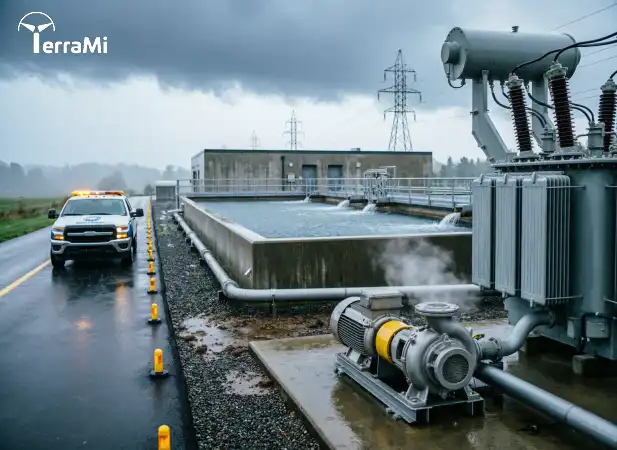
This lifecycle perspective changes how resilience investments should be evaluated. A decision that appears inexpensive during design may create substantial operational exposure later. Conversely, a modest increase in upfront investment may reduce maintenance requirements, extend useful life, or preserve adaptation options.
The same principle applies to data. Resilience cannot be managed effectively when information about design assumptions, vulnerabilities, dependencies, condition, and previous interventions is fragmented across organizational silos. Engineers and asset managers need enough continuity of information to understand how the infrastructure has evolved and where its remaining vulnerabilities lie.
This is where infrastructure resilience begins to intersect with broader digital and asset-management practices. The objective is not to digitize resilience for its own sake, but to improve the quality and timing of decisions that determine whether infrastructure can continue to perform under changing conditions.
A resilient system is, in this sense, not simply a stronger physical system. It is a system whose physical design, operational strategy, maintenance regime, information, and future adaptation pathways work together.
Making Resilience an Investment Decision
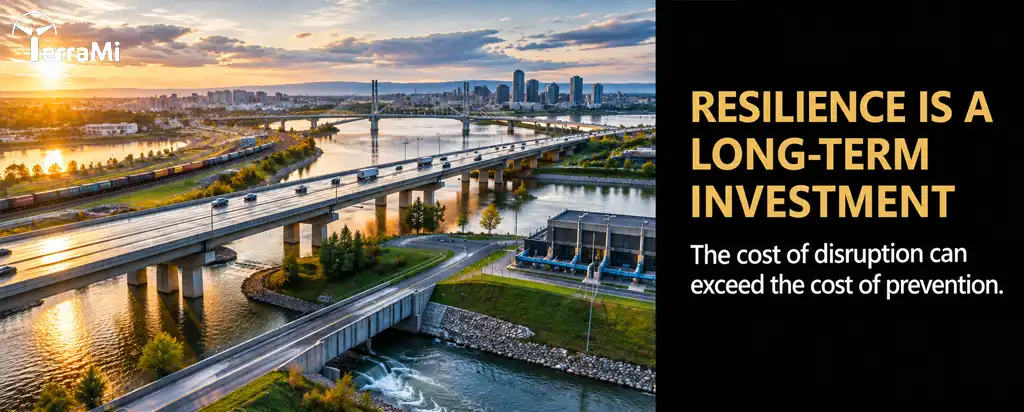
The engineering case for resilience becomes stronger when it is connected to the economics of infrastructure performance. Extreme-event risk is not limited to the cost of repairing damaged physical assets. Disruption can affect mobility, energy supply, water services, logistics, business activity, public safety, and the wider economy. For critical infrastructure, the indirect consequences of downtime can substantially exceed the cost of the physical repair itself.
This makes resilience an investment question as much as an engineering question.
A useful assessment should compare the cost of an intervention with the reduction in expected disruption and lifecycle risk that it can provide. The analysis does not need to assume that every extreme event can be prevented. Instead, it should examine how different design and adaptation options change the probability, severity, and duration of service disruption.
This also changes the way infrastructure owners think about capital expenditure. A resilience measure that appears expensive when assessed only against construction cost may become economically attractive when its effect on asset life, service continuity, emergency response, maintenance, and recovery is included.
The same principle applies to decisions about when to intervene. Waiting until an extreme event exposes a vulnerability can result in emergency expenditure, constrained procurement options, and accelerated reconstruction. Earlier intervention can provide greater control over both cost and design.
The Role of Predictive Information
Resilience engineering depends on knowing where vulnerability is emerging. This is one reason the relationship between design, monitoring, and asset management is becoming increasingly important.
A system may have been designed to withstand a particular range of conditions, but its effective resilience can decline as materials deteriorate, drainage capacity is reduced, protective systems age, or surrounding conditions change. Without reliable information about asset condition and operating performance, infrastructure owners may continue to rely on assumptions that no longer reflect reality.
This is where “predictive maintenance” becomes relevant to resilience. Predictive approaches can help identify developing deterioration and prioritize intervention before a condition-related failure becomes a larger operational problem. The value is not simply lower maintenance cost. When applied to critical assets, earlier intervention can preserve the system’s capacity to absorb disruption.
Resilience therefore benefits from a continuous information cycle:
design assumptions → observed performance → condition assessment → risk evaluation → intervention → updated performance data
The cycle creates an opportunity to move away from static resilience plans and toward infrastructure systems that are continually reassessed as evidence changes.
Designing for Compound and Sequential Events
Another challenge is that infrastructure is often exposed to more than one stressor at a time.
Extreme heat can increase electricity demand while reducing the efficiency or capacity of certain infrastructure systems. Heavy rainfall can occur alongside power interruptions or transportation disruption. Coastal infrastructure can face storm surge, flooding, erosion, and prolonged exposure to corrosive conditions. The sequence of events can matter just as much as their individual intensity.
A system that performs adequately under each hazard considered separately may behave very differently when those hazards interact.
Engineering assessments should consequently consider compound and sequential scenarios where the consequences justify doing so. This does not mean designing every asset for every conceivable combination of hazards. It means identifying combinations that could produce disproportionate consequences for critical infrastructure and testing whether existing safeguards remain effective.
This approach can also reveal vulnerabilities that conventional asset-level assessments overlook. A backup system may appear adequate until its own supporting infrastructure is exposed to the same event. A secondary transportation route may provide redundancy in normal circumstances but become inaccessible during a regional flood. A backup power source may exist but depend on fuel, communications, or access routes that are themselves vulnerable.
Resilience is strongest when dependencies are understood before they are tested by an emergency.
Avoiding the False Choice Between Protection and Adaptation
Infrastructure discussions sometimes frame resilience as a choice between building stronger assets today and adapting them later. In practice, the most effective strategies often combine both.
Protection is appropriate where failure would have severe consequences and the relevant hazard is sufficiently understood. Structural reinforcement, flood protection, improved drainage, thermal protection, or other physical measures can reduce immediate vulnerability.
Adaptation becomes increasingly valuable where future conditions are uncertain or expected to evolve over the asset’s service life. The design can preserve options for modification, expansion, relocation, operational change, or replacement of vulnerable components.
The balance between these approaches should be determined by the asset’s criticality, expected service life, exposure, uncertainty, and cost of future intervention.
This is one reason “designing infrastructure for future adaptation” is becoming an important engineering principle. A design that preserves future options can avoid locking infrastructure into assumptions that may become obsolete.
The objective is not to predict the future perfectly. It is to avoid making today’s infrastructure unnecessarily dependent on one version of it.
Governance and Engineering Need to Work Together
Resilience cannot be delivered through engineering design alone. Decisions about acceptable disruption, service priorities, investment levels, land use, emergency response, and long-term asset management involve owners, operators, governments, communities, and other stakeholders.
Engineering provides the evidence needed to understand what different choices mean physically and operationally. Governance determines how those choices are prioritized.
This relationship becomes especially important when resources are limited. An infrastructure owner may face many assets with different levels of exposure and deterioration. Treating every asset as equally vulnerable is neither practical nor economically defensible.
A risk-based approach can instead prioritize assets according to criticality and consequence. This allows limited resilience investment to be directed toward interventions that protect the most important functions.
The result should be a portfolio-level view of resilience rather than a collection of disconnected engineering projects.
Resilience Is a Property of the System, Not a Single Asset
The most important implication of this engineering shift is that resilience cannot be assigned to an infrastructure asset in isolation.
A bridge may have sufficient structural capacity. A pumping station may have flood protection. A power facility may have backup generation. Yet the infrastructure system can still fail to deliver its intended service if critical dependencies remain exposed.
This is why resilience assessment needs to move between scales.
At the component level, engineers need to understand physical vulnerability and failure modes.
At the asset level, they need to evaluate performance, condition, maintenance requirements, and recovery.
At the network level, they need to understand redundancy, dependencies, bottlenecks, and cascading failures.
At the system level, they need to connect infrastructure performance to the continuity of essential social and economic functions.
Each scale answers a different question. None is sufficient on its own.
This broader perspective also strengthens the case for integrated infrastructure planning. Decisions about a new asset should consider not only whether the asset meets its immediate engineering requirements, but also how it changes the resilience profile of the network into which it is introduced.
Building Infrastructure That Can Learn
Long-lived infrastructure is often described as durable because it is expected to remain functional for decades. But durability alone is not enough when the conditions surrounding an asset continue to change.
A more useful objective is infrastructure that can learn from its own performance.
This means retaining information about design assumptions, observed conditions, failures, repairs, environmental exposure, and operational behaviour. It means using that information to refine maintenance priorities, reassess vulnerabilities, and inform future capital decisions.
The principle is straightforward: infrastructure should not have to wait for failure before its owners learn that its risk profile has changed.
This does not require every infrastructure system to become technologically complex. It requires a disciplined connection between engineering knowledge and operational evidence. Where digital monitoring, analytics, or modelling provide useful information, they should support that decision process rather than become objectives in themselves.
For infrastructure owners, this creates a gradual shift from static design compliance toward continuous performance management.
The Engineering Standard for the Next Generation
The central challenge facing resilient infrastructure is not that engineers lack methods for designing stronger structures. The deeper challenge is that infrastructure must continue performing while the conditions influencing its performance become less predictable.
That requires a broader definition of engineering success.
A resilient infrastructure system should be capable of absorbing credible disruption without disproportionate loss of critical function. It should limit cascading consequences, provide practical recovery pathways, and retain enough flexibility to respond when conditions change. Its resilience should also be maintainable throughout its service life rather than being treated as a characteristic established at commissioning.
This perspective places greater responsibility on the early stages of infrastructure development. Site selection, system configuration, material choices, dependencies, maintenance access, monitoring requirements, and future adaptation pathways can all determine how much resilience an asset will possess decades later.
It also reinforces the importance of connecting resilience with established disciplines rather than treating it as a separate technical category. Infrastructure resilience is strengthened when climate risk, asset management, engineering design, lifecycle economics, and operational data inform the same decision process.
The question facing infrastructure leaders is consequently changing. It is no longer enough to ask whether an asset has been designed to withstand the conditions specified today.
The more consequential question is whether the infrastructure will still be capable of delivering its essential function when the conditions of tomorrow are different from those assumed at the time of design.
The Shift from Durable Assets to Resilient Systems
Durability remains fundamental. Infrastructure that deteriorates prematurely cannot be resilient, regardless of how sophisticated its risk-management framework may be.
But durability and resilience are not interchangeable.
Durability concerns the ability of an asset to retain its physical and functional characteristics over time. Resilience adds another dimension: how the system behaves when subjected to disruption, how it degrades, how it recovers, and whether it can adapt to changing conditions.
That distinction should influence infrastructure decisions from the earliest planning stage through decades of operation.
The strongest infrastructure systems will not necessarily be those with the largest structures, the greatest redundancy, or the highest initial expenditure. They will be systems in which engineering capacity, risk mitigation, operational intelligence, maintenance, and future adaptability have been deliberately connected.
Extreme events are exposing the consequences of designing these elements separately.
The next generation of infrastructure needs to be designed as a system capable of performing, adapting, and recovering—not simply as an asset expected to survive a predefined event.
TerraMi Perspective
Resilience should not be treated as a premium feature added to infrastructure after conventional engineering decisions have already been made. It should be part of the definition of infrastructure performance itself.
For TerraMi, the more important shift is from asking whether infrastructure can withstand a known hazard toward asking whether it can continue creating value when conditions become uncertain. That requires engineering, asset management, risk intelligence, and lifecycle decision-making to operate as connected disciplines.
Infrastructure owners do not need perfect forecasts to begin this transition. They need better visibility into what their assets depend on, where critical vulnerabilities exist, how performance is changing, and which interventions preserve future options.
The opportunity is to build infrastructure that does more than resist disruption: infrastructure that can sense changing conditions, adapt its response, and recover its function without losing sight of long-term value.
That is the direction in which resilient infrastructure engineering needs to move. TerraMi sees an opportunity to work with infrastructure owners, engineers, and decision-makers to turn that principle into practical, lifecycle-based strategies for the assets and systems they are responsible for.
Frequently Asked Questions
What are resilient infrastructure systems?
Resilient infrastructure systems are infrastructure networks designed and managed to maintain critical functions during disruption, limit cascading failures, recover efficiently after damage, and adapt to changing environmental and operational conditions.
How does resilient infrastructure differ from durable infrastructure?
Durability focuses primarily on an asset’s ability to maintain physical and functional performance over time. Resilience is broader: it considers how infrastructure responds to disruption, how quickly it recovers, and whether it can adapt when conditions change.
Why are extreme events changing infrastructure engineering?
Extreme events can expose weaknesses in historical design assumptions, particularly when environmental conditions change or multiple hazards interact. Engineering therefore needs to consider uncertainty, system dependencies, service continuity, and recovery alongside conventional structural performance.
What role does risk mitigation play in resilient infrastructure design?
Risk mitigation helps identify where exposure, vulnerability, and consequences can be reduced through design, operational, maintenance, or adaptation measures. The objective is to prioritize interventions according to their effect on critical infrastructure functions.
Can infrastructure be resilient without being designed for every possible extreme event?
Yes. Resilience does not require predicting or preventing every possible failure. It requires understanding credible risks, protecting critical functions, limiting cascading consequences, providing recovery pathways, and preserving the ability to adapt as conditions change.