
AI in Civil Engineering: Current Applications, Practical Limits, and Responsible Adoption
Why AI Has Become a Strategic Engineering Issue
AI in civil engineering is no longer limited to academic experiments or highly specialized research laboratories. It is increasingly being considered as a practical tool for design, construction, asset management, infrastructure monitoring, and project planning. This shift is being driven by several pressures at the same time: aging infrastructure, more complex projects, changing climate conditions, limited resources, rising safety expectations, and the growing volume of data generated throughout the infrastructure lifecycle.
Civil engineering organizations already collect information from surveys, inspections, building information models, geographic information systems, sensors, project management platforms, maintenance records, and financial systems. The challenge is that this information is often fragmented, inconsistent, or difficult to interpret quickly. AI can help identify patterns across large datasets, but its value depends on whether the data is relevant, reliable, and connected to a decision that engineers and project managers actually need to make.
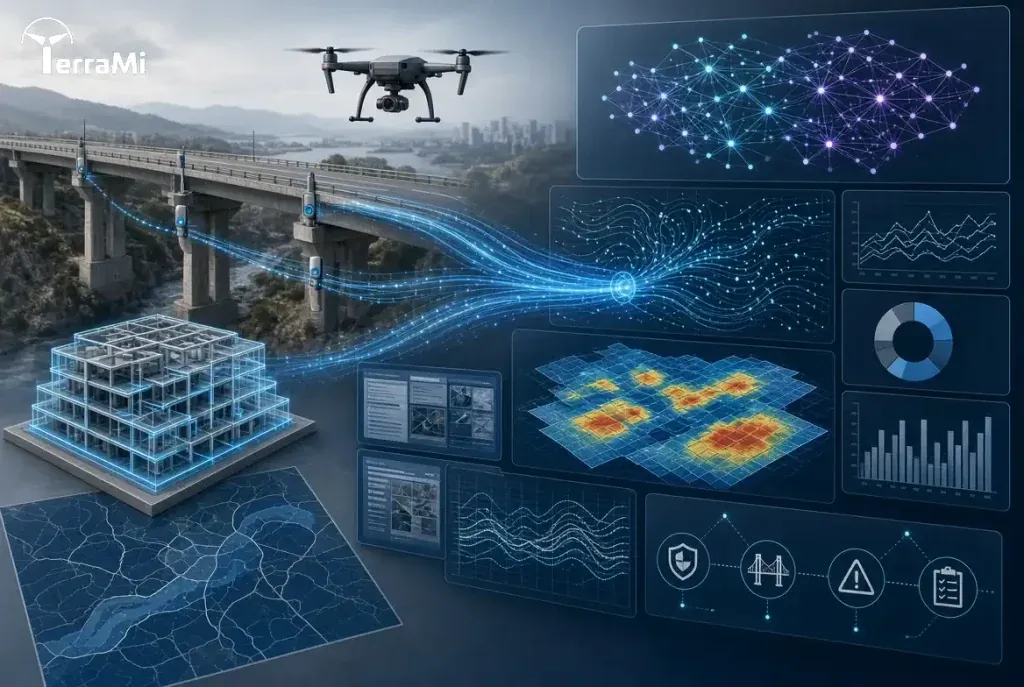
The adoption of AI should therefore not be understood as a simple software upgrade. It represents a change in how engineering knowledge is produced, reviewed, and applied. A model may identify an unusual structural pattern, forecast material demand, or suggest a design alternative, but the result still requires professional interpretation. The important question is not whether an algorithm can produce an answer. It is whether the answer is sufficiently explainable, accurate, and useful for the decision under consideration.
From Data Collection to Engineering Intelligence
Traditional engineering workflows often separate data collection from analysis and action. Field personnel gather information, specialists process it, managers review reports, and decisions are made through meetings or scheduled approvals. This structure can work for stable and predictable conditions, but it becomes less effective when infrastructure systems generate information continuously or when risks develop faster than conventional reporting cycles.
AI introduces the possibility of bringing these activities closer together. A system can process large quantities of information, detect relationships that are difficult to identify manually, and provide a ranked view of risks or opportunities. This can support earlier intervention and reduce the time required to move from observation to action.
The transition towards “data-driven decision-making” does not mean that engineering judgement becomes less important. It means that professional judgement can be supported by a broader and more timely evidence base. Engineers can spend less time searching for fragmented records and more time evaluating assumptions, comparing alternatives, and determining whether a recommendation is appropriate for a specific physical and regulatory context.
Engineering intelligence also requires the ability to connect information across the lifecycle. A design decision may affect material use, construction sequencing, maintenance access, energy performance, resilience, and eventual decommissioning. If AI is applied only to one isolated stage, it may optimise a local task while creating costs or limitations elsewhere. The more valuable applications are likely to be those that help teams understand these connections.
What AI Can Do in Civil Engineering Today
Current AI applications in civil engineering range from narrow analytical functions to broader decision-support environments. Their level of maturity varies considerably, and many applications remain dependent on human review. Nevertheless, several capabilities are already relevant to engineering practice.
Detecting Patterns and Anomalies
AI can review images, sensor readings, inspection records, and operational data to identify patterns that may require attention. In infrastructure monitoring, computer vision can assist with the detection of cracks, surface deterioration, corrosion, deformation, or changes in site conditions. In equipment management, analytical models can identify behaviour that differs from an established operating pattern.
An anomaly does not automatically indicate a failure. It may result from a sensor problem, a temporary environmental condition, or a change in normal usage. AI is therefore most useful when it helps engineers focus their attention and investigate potential issues earlier, rather than presenting every detected variation as a confirmed risk.
Forecasting Future Conditions
Predictive models can support forecasts related to demand, deterioration, maintenance requirements, project delays, energy consumption, material availability, or environmental exposure. These forecasts can help organizations compare possible scenarios and allocate resources more effectively.
Forecasting is inherently uncertain, especially when the available data reflects past conditions that may not represent the future. A model trained on historical traffic patterns may perform poorly after a major land-use change. A deterioration model may be unreliable when an asset has been exposed to climate conditions outside the range represented in its training data. Responsible use requires the forecast to be presented with its assumptions and uncertainty, not as a guaranteed outcome.
Supporting Design and Planning
AI can assist with option generation, design checking, spatial analysis, scheduling, quantity estimation, and constructability review. It can compare a large number of possible configurations more quickly than a manual process, helping engineers explore alternatives that might otherwise receive limited attention.
However, rapid option generation is not the same as sound design. A technically feasible option may conflict with regulations, site conditions, community priorities, maintenance requirements, or long-term resilience objectives. AI can expand the range of alternatives considered, but professional teams must still determine which criteria matter and how competing objectives should be balanced.
Improving Resource and Workflow Management
Construction and infrastructure projects involve complex interactions between labour, equipment, materials, schedules, suppliers, weather, approvals, and site conditions. AI can help identify potential schedule conflicts, forecast resource requirements, optimize logistics, and detect deviations from planned progress.
These applications may produce operational value without requiring full autonomy. A system that alerts a project manager to a likely delay or highlights an inefficient material flow can improve coordination while leaving the final decision with the project team. This form of decision support is often more practical than attempting to automate the entire project management process.
Supporting Technical Knowledge Work
Generative AI and language-based systems can assist with document classification, information retrieval, preliminary drafting, meeting summaries, specification comparison, and access to internal technical knowledge. These tools may reduce time spent on repetitive administrative work and help teams locate relevant information more quickly.
Their outputs must still be reviewed carefully. A language model can produce a fluent explanation that contains an incorrect technical interpretation, an incomplete reference, or an assumption that is not valid for the project. In safety-critical engineering work, fluency should never be mistaken for accuracy.
AI Is a Capability, Not a Complete Engineering Method

The variety of applications can create the impression that AI is a universal solution for civil engineering. In practice, AI is a collection of methods that perform different tasks under different conditions. A computer vision model, a predictive maintenance model, a generative design tool, and a language model do not have the same data requirements, validation methods, or operational risks.
This distinction matters because the suitability of AI depends on the problem being addressed. A process with clear inputs, repeatable outcomes, and sufficient historical data may be a strong candidate for AI assistance. A problem involving limited evidence, rapidly changing conditions, conflicting public interests, or irreversible consequences may require a more cautious approach.
The engineering context must also be defined before a model is selected. Teams need to understand what decision the system will support, who will use the output, what happens if the output is wrong, and how the result will be verified. Without these questions, organizations may adopt tools because they are technically impressive rather than because they solve a meaningful operational problem.
The most useful applications will not necessarily be the most autonomous ones. In many cases, the greatest value will come from systems that improve visibility, accelerate analysis, and help experts identify important issues earlier. AI can strengthen engineering workflows without removing the accountability and contextual judgement that responsible infrastructure management requires.
Where AI Creates Practical Value
The most useful applications of AI in civil engineering are usually connected to decisions that already exist within an organization. AI does not need to create an entirely new engineering process to provide value. It can improve an existing process by helping teams identify relevant information faster, recognize patterns earlier, compare more alternatives, or allocate limited resources more effectively.
A recent review in Proceedings of the Institution of Civil Engineers – Civil Engineering examines the use of artificial intelligence and machine learning across civil engineering while also highlighting the importance of data quality, engineering context, and implementation constraints. The study “Harnessing artificial intelligence and machine learning in civil engineering: a review” provides a useful scientific basis for evaluating AI as an engineering capability rather than as a standalone technology trend.
Condition Assessment and Infrastructure Monitoring
Condition assessment is one of the most established areas for AI application. Computer vision systems can review photographs, inspection videos, drone imagery, and remote sensing data to identify visible signs of deterioration. Depending on the asset and the quality of the imagery, these systems may assist with the detection of cracks, corrosion, surface damage, settlement, vegetation growth, or changes in site conditions.
The primary benefit is not that AI replaces inspectors. It can help create a more consistent first review, identify areas that require closer attention, and prioritize field inspections. This can be particularly valuable for large infrastructure networks where it is difficult to inspect every asset with the same frequency and level of detail.
AI-based monitoring must still be treated as an aid rather than a final assessment. Image quality, lighting, occlusion, camera angle, asset material, and environmental conditions can affect the result. A system trained to identify concrete deterioration may not perform reliably on unfamiliar materials or under conditions that are not represented in its training data.
Forecasting Deterioration and Maintenance Needs
Civil infrastructure deteriorates through a combination of age, usage, environmental exposure, design conditions, construction quality, and maintenance history. AI can help analyze these variables to estimate the likelihood of future deterioration or identify assets that may require closer review.
This creates an opportunity to move from calendar-based maintenance towards risk-informed intervention. Rather than treating all assets in the same category as equally urgent, an organization can use analytical models to compare condition, consequence, exposure, and expected performance. This may improve the allocation of inspection teams, maintenance budgets, materials, and equipment.
The value of “predictive maintenance” depends on what happens after a risk is identified. A forecast is not an intervention. The organization must still verify the condition, determine the appropriate response, schedule the work, obtain resources, and record the result. If these operational processes are not connected to the AI system, the forecast may produce additional alerts without improving asset performance.
Design Exploration and Optimization
AI can support design by exploring alternatives according to defined criteria. A model may help compare structural configurations, evaluate material quantities, identify spatial conflicts, assess energy performance, or balance competing objectives across a large number of options.
This type of assistance can be useful during early-stage planning, when decisions remain flexible and the cost of changing the design is relatively low. AI may help teams explore alternatives that would be difficult to evaluate manually, particularly when a project must balance cost, constructability, resilience, environmental impact, schedule, and long-term maintenance.
Design optimization must be managed carefully because an algorithm optimizes the criteria it is given. If the model prioritizes cost and schedule while giving limited weight to maintenance access, climate exposure, or community impact, its preferred solution may not represent the best engineering decision. The quality of the result depends on the quality of the objectives, constraints, and assumptions established by the project team.
Construction Planning and Site Coordination
Construction projects contain numerous sources of uncertainty. Weather, labour availability, equipment performance, material deliveries, design changes, inspections, approvals, and site conditions can all influence the sequence of work. AI can help project teams identify potential conflicts, forecast schedule impacts, and compare possible responses.
Progress monitoring is one possible application. Computer vision, site sensors, and project records can be combined to compare actual conditions with planned activities. The system may identify that an activity is progressing more slowly than expected or that a dependency is likely to affect a later stage of the schedule.
These capabilities are most useful when they support coordination rather than create a false sense of control. Construction environments change quickly, and information may be incomplete or delayed. A project manager must still understand why a deviation has occurred and whether the recommended response is realistic for the site.
Simulation and Scenario Analysis
AI can be combined with simulation to evaluate how infrastructure may perform under different conditions. Teams can examine possible traffic patterns, energy demand, flood exposure, construction sequences, emergency scenarios, or asset deterioration pathways before committing to a physical intervention.
This is where “simulation-based infrastructure planning” can become more valuable than simple forecasting. A forecast may estimate what is likely to happen under a given set of conditions, while a simulation can help compare how different decisions may alter the outcome. The distinction is important when infrastructure owners are evaluating investments with long service lives and uncertain future conditions.
Simulation results should not be treated as predictions of a single certain future. They are structured explorations of possible outcomes based on defined assumptions. If those assumptions change, the result may change as well. Engineering teams must therefore understand the boundaries of each scenario and communicate uncertainty clearly.

AI-Enabled Digital Twins
AI can also strengthen digital twins by helping interpret the continuous flow of information connected to an asset or infrastructure system. It may identify unusual behaviour, update forecasts, estimate future conditions, or compare current performance with expected operating patterns.
A digital twin supported by AI can become more than a static model or information archive. It can provide a working environment for monitoring, analysis, scenario testing, and operational decision support. However, the digital twin still depends on the quality of its physical and digital connections.
The challenges associated with “digital twin adoption” become more significant when AI is introduced. A weak data foundation may limit the reliability of the model, while an opaque algorithm may make its recommendations difficult to validate. The combination of digital twins and AI is therefore powerful only when supported by reliable asset information, clear governance, and engineering review.
The Data Problem Behind AI
AI systems learn from data, but engineering data is rarely created for a single analytical purpose. Records may be collected by different departments, at different times, with different definitions and levels of accuracy. A maintenance team may classify an asset differently from a design team, while a financial system may use another identifier altogether.
These inconsistencies can make it difficult to combine information into a dependable training or decision environment. A model may appear technically advanced while relying on incomplete inspection records, unbalanced examples, outdated asset information, or measurements that were collected under inconsistent conditions.
Data volume does not solve this problem. A large dataset can still be unsuitable if it contains systematic gaps or does not represent the conditions in which the model will be used. For example, a model trained mostly on normal operating conditions may have limited ability to identify rare but high-consequence events. A model built from one geographic region may not transfer reliably to another region with different materials, weather, regulations, or construction practices.

Context Determines Whether a Model Can Be Trusted
A model that performs well in one environment may not perform equally well in another. Civil engineering projects are shaped by local geology, climate, construction methods, asset age, regulatory requirements, operational practices, and community conditions. These factors can change the relationship between an input and the outcome an AI system is trying to estimate.
This creates a generalization problem. A model may identify patterns that are valid for the data on which it was trained but unreliable when conditions change. The risk becomes greater when users assume that a high-performing model is universally applicable without testing it against local data and engineering knowledge.
Models must also be monitored after deployment. Asset conditions evolve, data sources change, and operating patterns may shift. A system that was accurate when first introduced may gradually become less reliable if its assumptions are not reviewed. Ongoing validation is therefore part of responsible AI management, not an optional technical exercise.
The practical role of AI is strongest when it creates a structured dialogue between data and expertise. The model can identify patterns, estimate possibilities, or highlight exceptions, while engineers evaluate whether those outputs make sense in the physical and operational context of the project. This relationship provides a stronger foundation than either manual judgement or automated analysis used in isolation.
The Practical Limits of AI in Civil Engineering
AI can improve engineering analysis, but it cannot remove uncertainty from the physical world. Civil infrastructure operates under changing weather, imperfect construction conditions, incomplete records, human behaviour, material degradation, and unexpected events. A model may support better decisions, but it cannot guarantee that every future condition will resemble the data on which it was trained.
The limitations of AI should not be treated as reasons to reject the technology. They should determine how the technology is designed, tested, governed, and used. In safety-critical environments, the objective is not to make AI appear autonomous. The objective is to ensure that its recommendations are reliable enough to support responsible engineering decisions.
Explainability and Accountability
Many engineering decisions require more than a numerical result. Engineers need to understand the assumptions behind a recommendation, the information used to produce it, and the conditions under which it may become unreliable. If a model identifies a bridge as high risk or recommends a particular maintenance intervention, the project team must be able to examine the reasoning behind that result.
Some AI systems are difficult to interpret because their internal calculations involve many variables and complex relationships. This does not automatically make them unsuitable for engineering, but it does create a stronger requirement for validation and documentation. Users should know what the model was designed to do, what data it uses, and how its performance is measured.
Accountability must also remain clear. If an AI-supported recommendation contributes to a poor outcome, an organization must be able to determine who approved the system, who reviewed the output, and who was responsible for the final decision. Responsibility should not disappear behind the phrase “the algorithm recommended it.”
Uncertainty and Rare Events
AI models often perform best when they encounter conditions similar to those represented in their training data. Infrastructure, however, is frequently exposed to rare events that have limited historical examples. Extreme flooding, unusual structural behaviour, compound failures, major disruptions, and sudden changes in demand may not be well represented in the available records.
This creates a particular challenge for civil engineering. The events that matter most may be the events that occur least often. A model can perform well during ordinary conditions while providing limited guidance during a high-consequence event. Engineers must therefore understand where the model has strong evidence and where it is operating beyond its reliable range.
Uncertainty should be communicated as part of the result rather than hidden from the user. A forecast that includes a range of possible outcomes may be more useful than a single precise-looking number. It allows decision-makers to compare risk, consider contingency measures, and determine whether additional information is required before acting.
Bias, Data Governance, and Cybersecurity
AI systems can reflect weaknesses in the data used to develop them. If inspection records are more complete for certain asset types, neighbourhoods, or operating conditions, the system may appear more accurate in those areas than elsewhere. If historical decisions reflect unequal investment or inconsistent monitoring, an AI model may reproduce those patterns rather than correct them.
Data governance is therefore an engineering requirement. Organizations need to identify where information comes from, how it has been collected, what limitations it contains, and who is permitted to change it. Data lineage and version control can help teams determine whether a recommendation is based on current, verified information or on an outdated record.
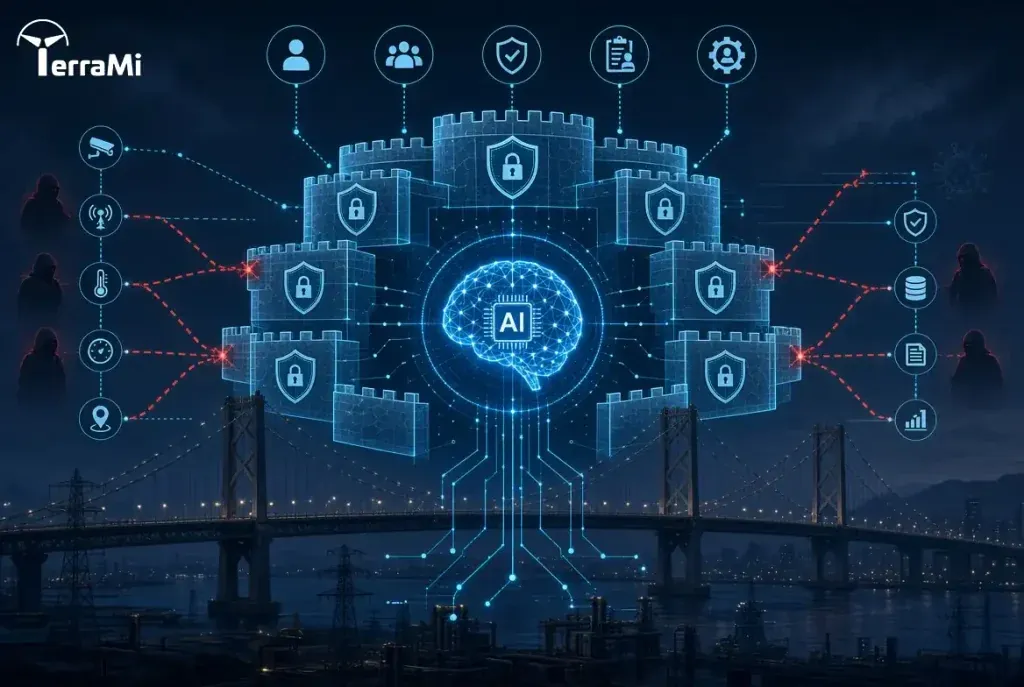
Cybersecurity is equally important. AI systems may connect operational technology, cloud platforms, sensors, project records, and external data sources. A security breach could expose sensitive asset information, manipulate inputs, interrupt monitoring, or influence a decision-support system. In systems connected directly to physical equipment, the consequences may extend beyond data loss.
Security controls should include role-based access, protected communication, system segmentation where appropriate, audit trails, backup procedures, and tested recovery plans. These measures should be considered during system design rather than added after an AI application has already been integrated into operations.
Integration with Existing Engineering Systems
Many organizations already use established tools for design, asset management, geographic information, project controls, maintenance, and field operations. AI must work within this environment if it is to create practical value. A separate application that requires teams to copy information manually or maintain another isolated database may increase complexity instead of reducing it.
Integration is not only a technical challenge. It also involves definitions, responsibilities, workflows, and organizational trust. Different departments may use different terms for the same asset or measure performance according to different objectives. An AI application cannot resolve these differences automatically unless the organization first establishes a shared understanding of the information being used.
This is why implementation should begin with a defined decision or workflow. The organization should determine which systems contain the relevant data, which people are responsible for the decision, how the output will be reviewed, and what action will follow. A clear operational connection is more valuable than a technically impressive tool that has no defined place in the engineering process.

The Role of Human Expertise
AI can support engineers, but it cannot replace the contextual knowledge required to understand a project fully. Experienced professionals recognize site conditions, construction realities, unusual material behaviour, regulatory constraints, and practical limitations that may not be represented in a dataset.
Human review is especially important when the consequences of an error are severe or difficult to reverse. Engineers should be able to question a model, request additional evidence, override a recommendation, and record why a different decision was made. This is not a failure of automation. It is an essential part of responsible engineering practice.
Workforce preparation must therefore accompany technology adoption. Engineers and operators need to understand how AI systems work at a practical level, how to interpret uncertainty, how to detect unusual outputs, and how to identify when a model should not be trusted. Training should focus on building informed collaboration between professionals and analytical systems.
A Responsible Path to AI Adoption
Start with a Specific Decision
Organizations should begin with a clearly defined problem rather than with a general ambition to “use AI.” The problem may involve prioritizing inspections, forecasting equipment failure, reviewing design alternatives, monitoring construction progress, or identifying schedule risks.
The selected use case should have a clear owner, a measurable outcome, and a realistic data supply. If no one is responsible for acting on the result, the project may produce analysis without operational improvement. If the outcome cannot be measured, it becomes difficult to determine whether the AI application is creating value.
Establish the Data Foundation
Before developing or purchasing a model, the organization should review the quality and structure of its data. This includes asset identifiers, historical records, measurement periods, missing values, data ownership, access permissions, and the consistency of relevant definitions.
A weak data foundation does not always mean that the project must stop. It may indicate that the first objective should be to improve data collection, standardize records, or connect existing systems. Building this foundation can create value independently while preparing the organization for more advanced analytical applications.
Pilot with Human Oversight
A controlled pilot allows teams to assess the performance of a model under realistic conditions without immediately transferring full responsibility to an automated system. The system can first provide alerts, rankings, forecasts, or recommendations while engineers review the results and record where the model performs well or poorly.
The pilot should test more than technical accuracy. It should examine whether the output is understandable, whether users trust it, whether the workflow can accommodate it, and whether the organization has the resources to respond. These practical factors often determine success more than the model’s performance in a controlled demonstration.
Measure Outcomes and Scale Carefully
Scaling should follow evidence rather than enthusiasm. Organizations should evaluate whether the system reduces response time, improves inspection prioritization, lowers avoidable disruption, supports better design decisions, or improves resource use. They should also monitor false positives, missed conditions, user behaviour, cybersecurity events, and changes in model performance.
If the system demonstrates reliable value, it can be extended to additional assets or workflows. This should occur through repeatable data structures and governance processes rather than through a series of isolated deployments. A scalable AI environment is one that can accommodate new use cases without losing transparency, control, or accountability.
AI as Part of a Larger Infrastructure Ecosystem
AI will become more useful as it is integrated with the wider infrastructure intelligence environment. Connected sensors can provide current conditions, digital twins can organize physical and operational context, simulation can explore possible outcomes, and AI can help interpret patterns across these sources. Human experts remain responsible for determining whether the resulting insight is appropriate for the decision at hand.
This combination can support infrastructure that is more adaptive and more transparent. It can help organizations connect project decisions with lifecycle performance, environmental objectives, social consequences, and resource efficiency. However, integration must be guided by clear priorities. Adding more technology does not automatically create a better system.
The future of AI in civil engineering will therefore depend on balance. Organizations must pursue innovation without ignoring uncertainty, automation without abandoning accountability, and efficiency without weakening resilience. The most successful applications will be those that improve the relationship between engineering knowledge, reliable data, and practical action.
The strategic question is not whether AI can perform an engineering task. It is whether the organization can create the data, governance, expertise, and operational conditions required for AI to contribute responsibly. That question will determine whether AI becomes a dependable part of infrastructure management or remains a collection of disconnected experiments.
TerraMi Perspective
AI Must Strengthen Engineering Decisions
TerraMi views AI as an important layer within the wider transformation of infrastructure management, but not as a substitute for engineering knowledge. The purpose of AI is to help organizations interpret complex information, identify emerging conditions, compare alternatives, and make decisions that are more timely, transparent, and measurable.
The most valuable applications will be those that connect AI to the complete infrastructure lifecycle. Design choices influence construction, construction affects asset performance, and asset management determines long-term resource use, resilience, and value. AI should therefore be evaluated not only by its analytical accuracy, but also by its ability to support better environmental, social, economic, and operational outcomes.
For infrastructure organizations, responsible adoption begins with the fundamentals. Reliable data, clear performance indicators, interoperable systems, defined responsibilities, and qualified human oversight are more important than adopting the most advanced model available. Organizations that establish these foundations can introduce AI gradually while preserving accountability and maintaining control over critical decisions.
TerraMi’s approach is to connect infrastructure intelligence with ESG principles, circular economy thinking, lifecycle management, and measurable performance. This creates a pathway in which AI supports practical infrastructure decisions rather than operating as an isolated technology experiment.
Organizations evaluating the use of AI in civil engineering are invited to connect with TerraMi to discuss their data readiness, infrastructure priorities, operational challenges, and opportunities for responsible AI-supported decision-making.
FAQ
What is AI in civil engineering?
AI in civil engineering refers to the use of artificial intelligence and machine learning to support design, construction, inspection, infrastructure monitoring, asset management, and project decision-making. It can identify patterns, generate forecasts, compare alternatives, and assist professionals with complex information.
How is AI currently used in civil engineering?
Current applications include computer vision for condition assessment, predictive maintenance, construction progress monitoring, design optimization, schedule analysis, resource planning, simulation, and digital twin management. Most applications still require professional review before a decision is implemented.
Can AI replace civil engineers?
AI cannot replace the contextual judgement, accountability, and professional responsibility of civil engineers. It can automate repetitive analysis and provide decision support, allowing engineers to focus more on complex assessments, trade-offs, safety, and long-term infrastructure performance.
What data does AI need in civil engineering?
AI may require inspection records, sensor data, design information, asset histories, geographic data, project schedules, environmental conditions, and operational measurements. The data must be relevant, sufficiently complete, consistently structured, and representative of the conditions in which the model will be used.
What are the main limitations of AI in civil engineering?
Important limitations include poor data quality, limited historical examples of rare events, difficulty transferring models between locations, lack of explainability, cybersecurity risks, and overreliance on automated recommendations. These limitations require validation, governance, monitoring, and human oversight.
How should an organization begin adopting AI?
An organization should begin with a specific engineering or operational decision that can be measured. It should assess data readiness, test a focused use case with human review, evaluate both technical and operational outcomes, and scale only after the system demonstrates reliable value.