
Intelligent Infrastructure Systems: The Future of Autonomous Infrastructure
The Infrastructure Operating Model Is Changing
Intelligent infrastructure systems are no longer a distant concept reserved for experimental research or technology demonstrations. They are emerging in response to a practical problem: infrastructure assets must continue to deliver reliable services while operating under greater climate volatility, rising maintenance demands, constrained budgets, labour shortages, and increasingly complex regulatory expectations. Roads, bridges, water networks, energy systems, buildings, and transportation corridors are expected to perform for decades, yet many are still managed through fragmented data, periodic inspections, fixed maintenance schedules, and decisions based primarily on historical conditions.
This operating model is becoming increasingly difficult to sustain. Infrastructure owners now collect data from sensors, geographic information systems, building information models, enterprise platforms, inspection records, and operational equipment. However, the existence of more data does not automatically produce better decisions. When information remains distributed across disconnected systems, teams may still react slowly to emerging risks, duplicate analysis, overlook relationships between assets, or make important decisions without a complete view of system performance.
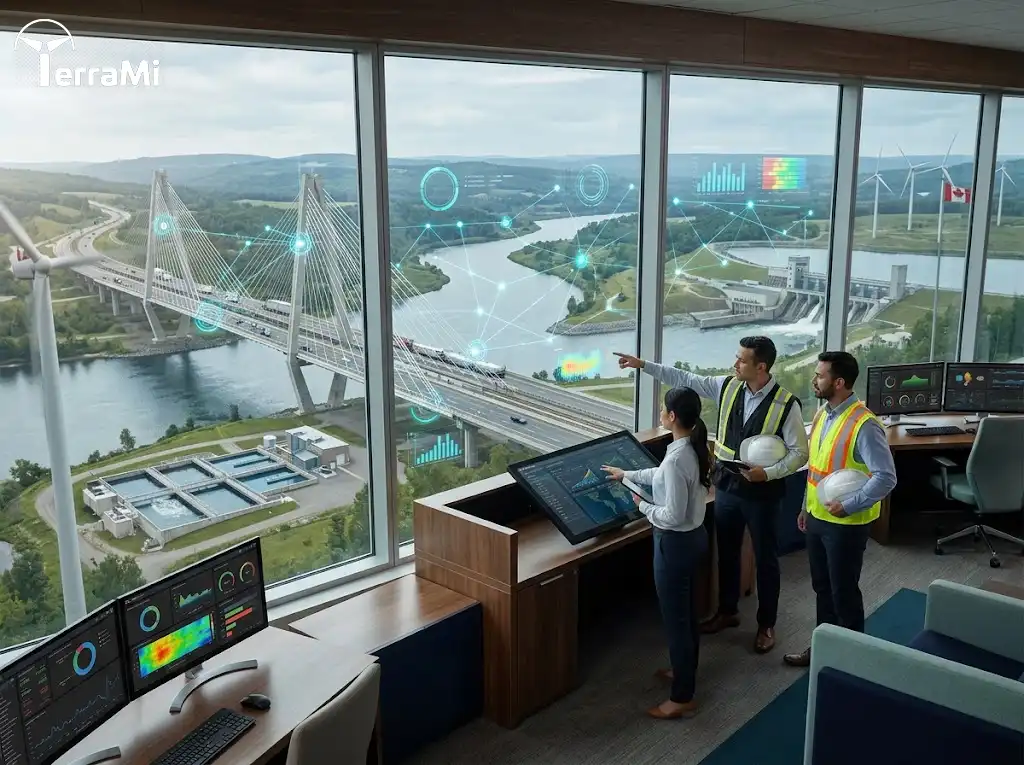
The central challenge is therefore not simply to digitize more assets. It is to create infrastructure systems that can interpret changing conditions, identify meaningful patterns, support timely decisions, and improve their performance over time. This requires a transition from isolated digital tools towards integrated systems in which physical infrastructure, data, analytics, operational processes, and human expertise work together.
From Connected Assets to Intelligent Infrastructure Systems
The first stage of infrastructure digitalization focused on connectivity. Assets were equipped with sensors, connected to software platforms, represented in digital models, or brought into centralized dashboards. This created valuable visibility, but visibility alone does not make an infrastructure system intelligent. A dashboard may show that a bridge is experiencing unusual vibration, that a water network is losing pressure, or that a road corridor is facing rising congestion. It does not necessarily explain why the change is occurring, what consequences may follow, or which intervention should be prioritised.
An intelligent infrastructure system adds interpretation and decision support to the connected asset environment. It combines information from multiple sources, establishes relationships between physical conditions and operational outcomes, and helps decision-makers understand both immediate events and longer-term consequences. The system is not merely recording what has happened. It is helping project owners and operators determine what may happen next and how they should respond.
This distinction is important because infrastructure performance is rarely determined by a single asset in isolation. A disruption at a pumping station may affect water supply, public health, emergency response, and industrial operations. A failure on a transport route may interrupt logistics, labour access, and access to essential services. A power interruption can affect telecommunications, water treatment, traffic management, and building operations at the same time. Intelligence must therefore extend beyond individual assets and account for the relationships that define the wider infrastructure ecosystem.
The transition described in “Beyond BIM” reflects this broader change in thinking. Digital models can provide a strong foundation for infrastructure intelligence, but their value increases when they are connected to operational data, lifecycle decisions, performance indicators, and real-world management processes. A model that remains limited to design coordination cannot, by itself, provide the intelligence required to manage a complex asset throughout its operational life.
The Four Capabilities of an Intelligent System
An intelligent infrastructure system can be understood through four connected capabilities: observation, interpretation, decision support, and continuous learning. These capabilities do not necessarily require full autonomy. They describe a progressive operating model in which infrastructure organizations move from collecting information to using it more effectively.
Observation
The system must first establish a reliable view of current conditions. This may include structural monitoring, energy consumption, traffic flows, weather conditions, water levels, equipment performance, maintenance records, financial data, and information about the surrounding environment. Observation is most useful when data is collected consistently and connected to a clear asset structure.
Poorly organized data can create the appearance of intelligence without providing dependable insight. If asset identifiers are inconsistent, measurement periods are incomplete, or data is stored in incompatible systems, the organization may spend more time reconciling information than acting on it. Reliable observation therefore depends on data quality, common definitions, and clear ownership.
Interpretation
Raw data must be interpreted in relation to engineering requirements, operational thresholds, project objectives, and potential risks. A temperature reading has limited meaning on its own. Its significance may change depending on the asset’s material, age, design tolerance, maintenance history, location, and exposure to other stresses.
Interpretation enables the system to distinguish between normal variation and meaningful change. It can support the identification of deteriorating conditions, unusual behaviour, emerging bottlenecks, or relationships that may not be visible through manual review. This is where analytics, simulation, rules-based systems, and machine learning may contribute, provided that the underlying data and assumptions remain transparent.
Decision Support
The purpose of intelligence is not to create more reports. It is to improve decisions. An intelligent system should help teams compare possible interventions, understand trade-offs, assess consequences, and determine when action is required. For example, an infrastructure owner may need to decide whether to continue monitoring an asset, perform targeted maintenance, restrict its use, accelerate rehabilitation, or replace it entirely.
Decision support should make complex information easier to use without hiding uncertainty. Infrastructure decisions often involve competing priorities, including safety, cost, service continuity, environmental performance, and social impact. A system that presents only a single automated recommendation may create false confidence. A more responsible approach is to show the basis of a recommendation, identify relevant constraints, and preserve appropriate human oversight.
Continuous Learning
Infrastructure systems operate in changing environments. Weather patterns shift, usage levels evolve, materials age, regulations change, and new technologies are introduced. An intelligent system must therefore be capable of learning from new data and from the outcomes of previous decisions.
Continuous learning does not mean that an infrastructure system should change its behaviour without controls. It means that performance information can be used to improve models, refine thresholds, identify recurring causes of failure, and support better planning. The system should become more useful over time while remaining auditable and subject to defined governance.

Automation Is Not the Same as Autonomy
Automation and autonomy are related, but they describe different levels of operational capability. Automation performs a defined action when a known condition occurs. A control system may adjust a pump, activate a warning, change a traffic signal, or schedule a maintenance task according to predefined rules. These applications can improve consistency and reduce the burden of repetitive work.
Autonomy involves a higher level of contextual decision-making. An autonomous system must assess changing conditions, evaluate several possible responses, account for uncertainty, and select an appropriate action within clearly defined boundaries. In infrastructure operations, this distinction is significant because real environments rarely remain completely predictable. Equipment may fail in unexpected ways, weather conditions may change rapidly, and the effects of an intervention may extend beyond the asset being controlled.
For this reason, autonomous infrastructure systems should not be understood as systems that remove people from the decision process. In many applications, the more realistic model is supervised autonomy. The system can identify a risk, recommend a response, or execute a low-risk adjustment, while human operators retain responsibility for major interventions, exceptional circumstances, and decisions involving public safety or long-term investment.
This approach also clarifies the role of AI infrastructure. Artificial intelligence can help detect patterns, forecast demand, identify anomalies, and support complex analysis. It cannot replace sound engineering judgement, reliable data governance, or clearly defined accountability. The value of AI depends on the quality of the infrastructure environment in which it operates and the quality of the decisions it is designed to support.
Why Intelligence Must Extend Beyond Individual Assets
The future of infrastructure will be shaped less by isolated smart assets and more by the ability to coordinate interconnected systems. A smart building, intelligent bridge, or automated water facility may provide operational benefits on its own. However, the largest gains may emerge when these assets exchange information and support decisions across organizational and physical boundaries.
This is also where the relationship between “physical and digital infrastructure” becomes critical. Digital systems must remain connected to the conditions, constraints, and consequences of the physical world. If a digital model is not updated by operational reality, its recommendations may become unreliable. Conversely, if physical assets cannot respond to the insights generated by digital systems, advanced analytics may have little practical value.
The next stage of this transition will depend on architecture, interoperability, governance, and organizational readiness. Infrastructure owners will need to determine which decisions should be automated, which require human approval, how data should move between systems, and how the performance of intelligent applications should be measured. These questions are not secondary technical details. They will define whether intelligent infrastructure becomes a dependable operating model or another collection of disconnected digital initiatives.
The Architecture Behind Intelligent Infrastructure
The move towards intelligent and autonomous infrastructure requires more than adding sensors or purchasing an advanced software platform. It depends on an architecture that connects physical assets, data environments, analytical models, operational workflows, and human decision-makers. If one of these layers is weak, the performance of the entire system can be limited.
At the physical layer, infrastructure assets generate conditions that must be observed and managed. The connectivity layer transfers information from equipment, sensors, field teams, and external data sources. The data layer organizes this information around consistent asset identifiers, locations, time periods, performance indicators, and lifecycle stages. Above these layers, analytical models interpret conditions and support decisions, while operational applications translate insights into actions.
A final layer is required to govern the entire environment. It defines who can access information, how models are validated, which actions may be automated, how exceptions are handled, and how performance is reviewed. Without governance, an intelligent system may produce technically sophisticated outputs without establishing sufficient trust for operational use.
Interoperability Is the Foundation of Scale
Many infrastructure organizations operate with systems that were acquired at different times for different purposes. Geographic information systems may manage location data, building information models may support design and construction, enterprise asset management platforms may track maintenance, and operational technology may control equipment in the field. Each platform may be effective within its own function, but the information may not move easily between them.
This creates an interoperability problem. A system cannot provide a complete view of infrastructure performance if important information remains isolated in separate databases, incompatible file formats, or departmental workflows. Teams may use different names for the same asset, apply different measurement periods, or define performance indicators in ways that cannot be compared.
Interoperability does not require every organization to replace its existing systems. It requires a deliberate approach to connecting them. Common asset identifiers, shared data definitions, application programming interfaces, standardized exchange formats, and clear data ownership can allow established platforms to contribute to a wider intelligence environment. The objective is not technological uniformity. It is dependable cooperation between systems.
Data quality is equally important. A large volume of information does not compensate for missing records, duplicated entries, inconsistent units, or unclear sources. Intelligent systems must be able to distinguish between verified measurements, estimates, historical records, and modelled results. This distinction becomes especially important when an automated recommendation could affect safety, service continuity, or capital allocation.
Digital Twins as Operational Interfaces
Digital twins can provide an important bridge between the physical and digital domains. A useful digital twin is not simply a three-dimensional representation of an asset. It is an operational environment that links the asset’s structure, condition, history, surrounding context, and performance data.
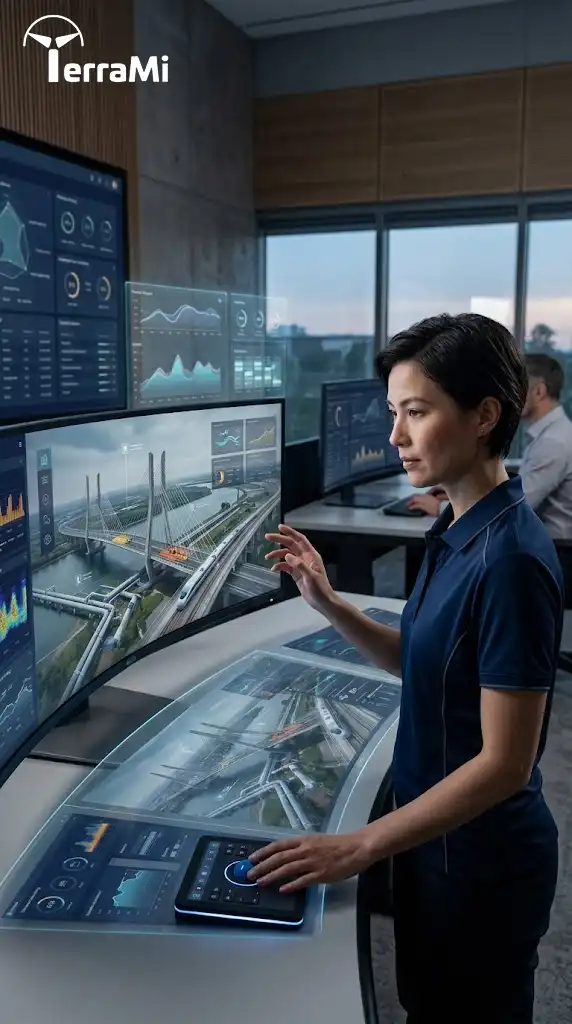
For an infrastructure owner, this may mean connecting design information with inspection records, sensor readings, maintenance history, environmental conditions, and projected scenarios. The resulting system can help users understand how an asset is performing now, how it has changed over time, and how it may respond to different interventions.
However, a digital twin does not automatically create intelligence. Its value depends on the reliability of the data connected to it, the relevance of the analytical models, and the decisions that it supports. Peer-reviewed research in IEEE Access similarly identifies interoperability, data integration, and implementation challenges as central to the operational value of digital twins. The study “Digital Twin: Enabling Technologies, Challenges and Open Research” provides a scientific foundation for treating digital twins as more than visual 3D representations.
This is why “digital twin adoption” often becomes more difficult after a successful pilot. A small pilot may depend on a dedicated team, manually corrected data, a limited number of assets, and close support from a technology provider. Scaling the system requires repeatable data structures, clear ownership, interoperable platforms, security controls, and staff who can maintain the environment over time.
A mature digital twin environment should therefore be judged by the decisions it improves rather than by the number of models it contains. It may help an organization identify a developing failure, compare rehabilitation options, forecast demand, coordinate construction activities, or assess the effects of climate-related stresses. The digital representation is valuable because it improves the quality and timing of action.
Automation Requires Governance Before Scale
Automation is most dependable when the conditions, rules, and consequences are clearly understood. A system can automatically adjust a process when a measured value crosses a defined threshold, but infrastructure environments rarely remain perfectly stable. Sensors can fail, data can be delayed, operating conditions can change, and several risks can occur at the same time.
For this reason, autonomous systems in infrastructure should operate within carefully defined boundaries. These boundaries may specify which actions can be performed without approval, which conditions require human review, and which events must trigger a safe fallback mode. The system should also record why an action was taken, what information informed the decision, and what happened afterwards.
Model validation is another essential requirement. An algorithm that performs well under ordinary conditions may behave differently during an extreme event or in an unfamiliar operating environment. Infrastructure owners must understand the data used to train or configure a model, the assumptions embedded in its logic, and the conditions under which its recommendations may become unreliable.
Governance should also address the gradual modification of intelligent systems. If thresholds, models, or data sources change without proper review, the system’s behaviour may change in ways that operators do not expect. Version control, testing, approval procedures, and performance monitoring help ensure that improvements do not introduce hidden risks.
Cybersecurity and Resilience Are Core Requirements
As infrastructure becomes more connected, the consequences of a digital disruption can extend into the physical world. A compromised information system may expose sensitive asset data, interrupt monitoring, manipulate operational information, or prevent personnel from responding effectively to an incident. In systems that control equipment directly, a cyber event may also create safety and service risks.
Cybersecurity must therefore be treated as part of infrastructure design rather than as an additional layer applied after deployment. Access should be limited according to defined roles, critical systems should be segmented where appropriate, and communication between platforms should be monitored. Data should be protected during transmission and storage, while audit trails should make it possible to investigate unusual activity.
Resilience requires more than preventing unauthorized access. Intelligent infrastructure must also continue to function when part of its digital environment is unavailable. Backup communication channels, local operating modes, redundant data storage, manual overrides, and tested recovery procedures can reduce dependence on a single platform or connection.
These requirements become more complex when several organizations share responsibility for an infrastructure ecosystem. A transport network, utility system, and municipal platform may exchange information even though they have different owners, security policies, and operational priorities. Effective governance must define responsibilities across these boundaries without preventing the information exchange required for coordinated decisions.
Human Expertise Remains Part of the System
The growth of automation does not eliminate the need for engineers, operators, planners, and maintenance specialists. It changes how their expertise is used. Routine monitoring and repetitive data processing may be automated, allowing specialists to focus more attention on unusual conditions, strategic planning, system improvement, and decisions involving competing public interests.
Human involvement is particularly important when the available data is incomplete or when several legitimate objectives conflict. A system may identify the most cost-effective intervention, but decision-makers may also need to consider community disruption, environmental impact, accessibility, regulatory obligations, and long-term resilience. These considerations cannot always be reduced to a single technical score.
The relationship between people and intelligent systems must therefore be designed deliberately. Operators need to understand what the system is recommending, why the recommendation has been produced, and how to challenge or override it when necessary. Training should focus not only on using a new interface, but also on interpreting uncertainty, identifying abnormal system behaviour, and escalating decisions appropriately.
An organization that deploys advanced technology without preparing its workforce may create a new form of operational dependency. Staff may follow automated recommendations without questioning them, or they may avoid the system because its outputs are difficult to interpret. Both outcomes reduce the value of the investment.
From Pilot Projects to Operating Models
The transition to intelligent infrastructure should begin with a clearly defined operational problem rather than with the technology itself. A high-value use case may involve reducing unplanned equipment failure, improving energy performance, managing flood risk, coordinating construction activities, or improving the reliability of a critical service.
Once the use case is defined, the organization must assess whether the necessary data exists, whether it is sufficiently reliable, and whether the people responsible for the decision are prepared to use a new system. This readiness assessment can prevent organizations from attempting to automate a process that is not yet understood or supported by dependable information.
A sensible implementation path usually begins with decision support rather than unrestricted autonomy. The system may first identify anomalies, rank risks, or recommend interventions while human operators remain responsible for approval. As the system demonstrates reliable performance, selected actions can be automated within clearly defined limits.
This staged approach is also relevant to “predictive maintenance“. Forecasting a potential failure is valuable only when the organization can validate the warning, schedule the intervention, obtain the required resources, and record the outcome. Intelligence must therefore be connected to the operational capacity to respond.
The long-term objective is not to automate every infrastructure decision. It is to create a coordinated environment in which data, models, people, and physical assets support better performance across the entire lifecycle. Achieving that objective requires organizations to measure not only technical accuracy, but also response time, avoided disruption, maintenance effectiveness, service reliability, environmental performance, and the quality of decisions made under uncertainty.
The Business Case for Intelligent Infrastructure
The case for intelligent infrastructure should not be reduced to faster data processing or lower operating costs. The more important question is whether intelligent systems can help infrastructure owners make better decisions across the asset lifecycle. A system that improves planning, reduces avoidable disruption, supports safer operations, and clarifies long-term investment priorities may create value even when the financial benefit is not immediately visible in a single project budget.
Lifecycle value is particularly important because infrastructure decisions made during planning and design can influence performance for decades. An intelligent system can help compare design alternatives, identify future constraints, assess maintenance requirements, and evaluate how an asset may perform under changing environmental or operational conditions. This can reduce the risk of making decisions that appear efficient in the short term but create higher costs or greater vulnerability later.
The value of autonomous infrastructure systems may also emerge through coordination. A transport network that responds to changing demand can improve the use of existing capacity. A water system that detects abnormal pressure patterns may reduce losses and avoid service interruptions. An energy network that combines demand forecasts with operational data may improve reliability while supporting more efficient resource use. These benefits become more significant when intelligent systems are connected across infrastructure boundaries.
Intelligence can also strengthen transparency. When decisions are supported by traceable data, defined performance indicators, and documented assumptions, organizations can communicate more clearly with regulators, investors, project partners, and communities. This is especially relevant when infrastructure projects must demonstrate environmental performance, social responsibility, resilience, and responsible use of public or private capital.
The Limits of Autonomous Infrastructure
Autonomy should not be treated as an objective in itself. A system that performs more actions without human involvement is not necessarily more intelligent, more resilient, or more valuable. In infrastructure, the quality of an automated decision must be evaluated in relation to safety, service continuity, public interest, environmental consequences, and the reversibility of the action.
Some decisions are suitable for bounded automation because their consequences are limited and their operating conditions are well understood. Other decisions require human involvement because they affect public safety, essential services, long-term investment, or competing community interests. The appropriate level of autonomy will therefore vary according to the asset, the operating context, and the consequences of failure.
There is also a risk that organizations may overestimate what artificial intelligence can determine from incomplete or biased data. Historical records may reflect past investment priorities, uneven monitoring, or conditions that no longer represent the future. If these limitations are not recognized, an intelligent system may reproduce existing weaknesses while presenting its output with an appearance of technical confidence.
Accountability must remain clear when an automated recommendation contributes to a poor outcome. Infrastructure owners need to know who is responsible for the system, who approves its use, who reviews its performance, and who can intervene when it behaves unexpectedly. A lack of accountability can undermine trust and create hesitation among the very professionals expected to use the technology.
A Practical Roadmap for Infrastructure Owners
A successful transition to intelligent infrastructure begins with a decision that matters. Organizations should first identify a recurring operational or planning challenge where better information could produce a measurable improvement. The starting point might be asset deterioration, energy demand, flood exposure, construction coordination, maintenance prioritization, or service reliability.
The initial use case should be narrow enough to manage but important enough to justify organizational attention. A project that attempts to connect every asset, data source, and operational department at once can become difficult to govern before its value is demonstrated. A focused implementation provides an opportunity to test data quality, user needs, system integration, and decision processes under realistic conditions.
The next step is to establish a dependable data foundation. This involves defining the assets involved, identifying authoritative data sources, resolving conflicting records, creating common identifiers, and clarifying who owns each part of the information environment. It may also require connecting systems that were previously managed independently.
Organizations should then introduce decision support before expanding into higher levels of automation. A system can begin by identifying anomalies, comparing risks, or recommending interventions while experienced personnel review the results. This creates a feedback loop in which the organization can assess whether the system is producing useful and explainable outputs.
Performance must be evaluated through operational outcomes rather than technical demonstrations. Important measures may include reduced downtime, faster response, fewer emergency interventions, improved maintenance planning, lower resource consumption, better service continuity, or improved visibility into project risk. If the system does not improve a real decision or operational result, additional complexity is unlikely to create meaningful value.
Scaling should occur only after the use case, data environment, governance structure, and workforce requirements have been tested. At that point, the organization can determine which processes should remain under human control, which can be automated, and how the system can be extended to additional assets or departments without rebuilding the entire foundation.
Designing for Adaptation and Interdependence
The future of infrastructure will be influenced by the interaction between digital intelligence and physical change. Climate conditions, population patterns, economic priorities, resource availability, and regulatory expectations will continue to evolve. Infrastructure systems designed around fixed assumptions may become less effective as these conditions change.
Intelligent systems can support adaptation by helping organizations monitor changing conditions and adjust their plans before performance declines. They can identify emerging stress, test alternative responses, and connect short-term operational decisions with long-term investment strategies. This makes infrastructure management more dynamic, but it also increases the importance of transparent assumptions and continuous review.
Adaptation must also account for interdependence. Infrastructure systems are connected through shared land, energy, communications, materials, labour, and users. A decision that improves one asset may create pressure elsewhere. For example, an intervention that increases the capacity of a transport corridor may influence land use, energy demand, air quality, maintenance requirements, and access to surrounding services.
This broader view changes the definition of system performance. A successful infrastructure system is not only one that operates efficiently in normal conditions. It must also maintain essential functions during disruption, recover within an acceptable period, and avoid transferring risk to another asset, community, or future generation.

From Intelligent Assets to Autonomous Ecosystems
The long-term direction of infrastructure is likely to involve ecosystems of connected assets rather than isolated autonomous machines. Buildings, transportation networks, utilities, industrial facilities, and public services will increasingly exchange information through shared digital environments. The purpose of this connectivity will be to coordinate decisions that cannot be managed effectively by one asset or one organization alone.
In such an ecosystem, artificial intelligence may help identify patterns across large and diverse data sets. Internet-connected devices may provide continuous information about conditions in the field. Digital twins may support scenario analysis and lifecycle planning. Automation may execute defined responses, while human specialists supervise high-consequence decisions and manage exceptional circumstances.
This does not mean that infrastructure will become independent of people. It means that responsibility will shift from manually monitoring every condition towards governing a more capable system. Engineers and operators will need to understand how data is generated, how models behave, how recommendations are produced, and how interventions affect the wider infrastructure environment.
Standards will become increasingly important as these systems expand. Shared definitions, interoperable data structures, secure communication protocols, and consistent methods for evaluating performance can help different organizations coordinate without requiring identical platforms. Without these foundations, the future may consist of many intelligent systems that remain unable to cooperate when a complex event crosses organizational boundaries.
The most resilient infrastructure ecosystem will therefore be one that combines automation with judgement, intelligence with accountability, and digital capability with a clear understanding of physical reality. Its success will depend not on how autonomous a system appears, but on whether it can help people deliver safer, more adaptive, and more sustainable infrastructure over time.
TerraMi Perspective
Intelligence Must Serve Infrastructure Outcomes
TerraMi views the future of infrastructure as a transition from isolated digital tools towards integrated intelligence. The objective is not to automate every decision or to replace the expertise of engineers and operators. It is to create a dependable operating environment in which data, physical assets, analytical models, and human judgement work together throughout the infrastructure lifecycle.
Intelligent infrastructure systems should be evaluated by the outcomes they enable. These outcomes include stronger resilience, more transparent decision-making, better resource efficiency, reduced operational disruption, and improved alignment between infrastructure performance and long-term environmental, social, and economic objectives. Technology becomes meaningful when it helps organizations manage these objectives as connected parts of the same system.
The path towards autonomy must therefore begin with a clear understanding of the organization’s data, processes, responsibilities, and risks. Infrastructure owners that establish reliable data foundations and practical governance today will be better positioned to introduce automation responsibly tomorrow. They will also be able to distinguish between technology that creates measurable value and technology that merely adds another disconnected layer of complexity.
TerraMi’s perspective is that intelligent infrastructure should function as an operating system for better project and asset decisions. By connecting ESG considerations, circular economy principles, lifecycle performance, and data-driven intelligence, infrastructure organizations can move beyond reactive management and begin building systems that are more adaptive, measurable, and prepared for future conditions.
Infrastructure owners, project teams, and organizations evaluating this transition are invited to contact TerraMi to discuss how intelligent systems can be aligned with their operational priorities, sustainability objectives, and long-term infrastructure strategy.
FAQ
What are intelligent infrastructure systems?
Intelligent infrastructure systems combine physical assets, connected data, analytical models, operational processes, and human oversight. They help organizations monitor conditions, interpret performance, support decisions, and improve infrastructure management over time.
How are autonomous infrastructure systems different from automated infrastructure?
Automated infrastructure follows predefined rules to perform specific actions. Autonomous infrastructure can assess changing conditions, evaluate possible responses, and act within defined boundaries while maintaining appropriate human oversight.
What role does AI play in infrastructure operations?
AI can help identify patterns, detect anomalies, forecast demand, support predictive analysis, and improve decision-making. Its effectiveness depends on reliable data, transparent models, strong governance, and clear accountability.
Can organizations adopt intelligent infrastructure without replacing existing systems?
Yes. Organizations can connect existing platforms through shared data definitions, common asset identifiers, application interfaces, and appropriate integration methods. A phased approach can improve current systems while gradually creating a more coordinated intelligence environment.
What are the main risks of autonomous infrastructure systems?
The main risks include poor data quality, cyberattacks, model errors, unclear accountability, overreliance on automated recommendations, and failure to account for unusual conditions. These risks can be reduced through validation, monitoring, human review, security controls, and clearly defined operating limits.
How should infrastructure owners begin the transition?
Infrastructure owners should begin with a specific operational or planning problem where better information can create measurable value. They should then assess data readiness, establish governance, test decision support, measure outcomes, and scale automation only after the initial use case has demonstrated reliable performance.