
When Projects Progress but Safety Lags: The Hidden Cost of Speed
Main Focus Keyword: Operational Safety Lags
In the high-pressure environment of global infrastructure delivery, the pressure to meet ribbon-cutting deadlines often creates a dangerous disconnect between physical progress and operational readiness. Operational Safety Lags emerge when the pace of construction advances faster than the maturity of safety protocols, training, supervision, and behavioral discipline. The result is not simply a higher incident rate; it is a structural weakness in how the project is governed.
At TerraMi, we see this as more than a site-level safety issue. It is a strategic performance problem. Projects that optimize only for visible milestones—such as structural completion, equipment installation, or turnover dates—often underinvest in the invisible systems that make those milestones sustainable. In practice, this creates a false sense of success: the project appears to be progressing, yet the operational foundation is becoming more fragile.
Addressing Operational Safety Lags requires a leadership shift from “speed at any cost” to synchronized progress, where schedule acceleration is never allowed to outrun workforce readiness, procedure discipline, or risk control.
The Anatomy of Operational Safety Lags in Mega-Projects
The primary driver of Operational Safety Lags is misaligned incentive architecture. When a project begins to slip behind schedule, the natural response is often to compress activities, overlap tasks that should remain sequential, and normalize exceptions in the name of recovery. That is where risk compounds.
This pattern is especially dangerous in mega-projects, where multiple subcontractors, complex interfaces, and compressed handover sequences already create operational pressure. A site may look increasingly complete while, beneath the surface, its safety controls are becoming less coherent. High-risk tasks may be executed in close proximity to each other, supervision may become diluted, and new workers may be introduced into an environment that has not yet stabilized.
The real problem is not just that work is happening faster. It is that the project is often advancing faster than the organization’s ability to verify whether the work is still safe to perform. That is the essence of Operational Safety Lags: the gap between progress and operational maturity.
Why Digital Monitoring Cannot Ignore Operational Safety Lags
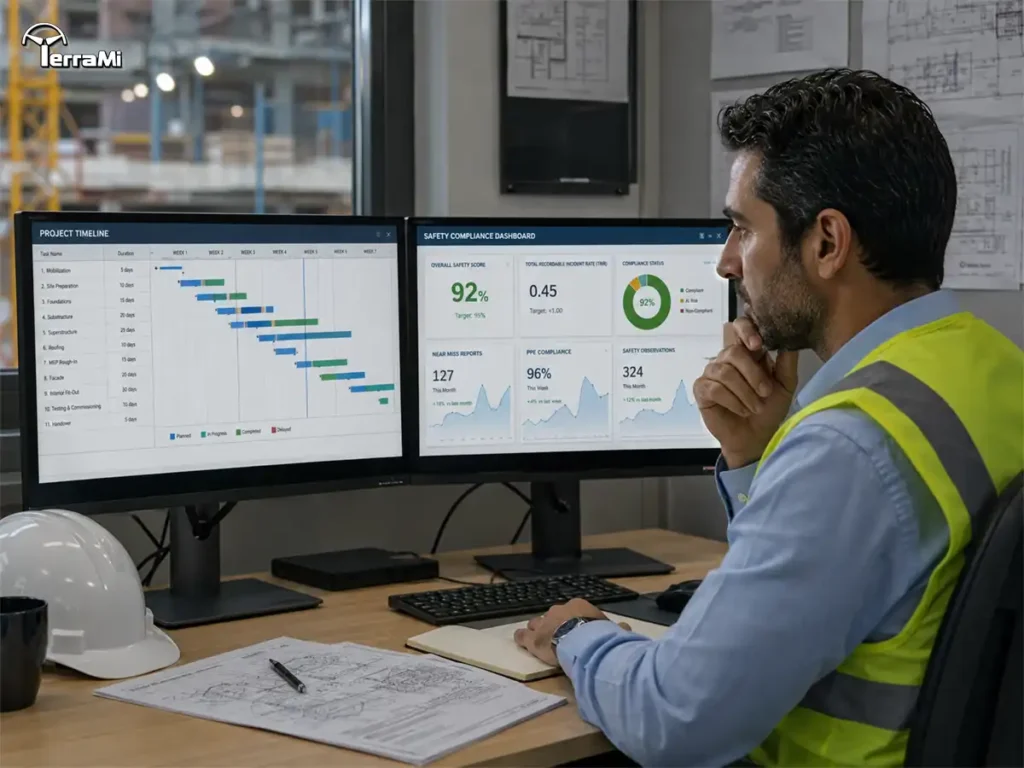
Digital twins, sensors, and AI-enabled dashboards have transformed project visibility, but they do not automatically eliminate Operational Safety Lags. In fact, they can sometimes obscure them.
A dashboard may indicate that PPE compliance is high, permit logs are up to date, and production targets are being met. Yet those indicators do not always capture fatigue, normalization of deviance, pressure-induced shortcuts, or the gradual erosion of safety judgment that tends to appear during extended overtime and schedule compression. In other words, digital visibility can create the impression of control without proving that control actually exists.
That is why TerraMi treats the human-digital interface as a governance challenge, not a software challenge. Predictive analytics should not only track output; it should identify when work tempo, fatigue patterns, or task concurrency are drifting toward a hazard zone. The most effective use of digital systems is not to celebrate speed, but to detect when speed is beginning to exceed safe operational capacity.
Governance and the Financial Impact of Safety Gaps
From an investor and governance perspective, Operational Safety Lags are not isolated incidents. They are liabilities.
In the current ESG environment, stakeholders are increasingly attentive to occupational health and safety performance, near-miss reporting, incident transparency, and the quality of risk controls across the project lifecycle. A project that delivers on time but accumulates repeated safety exceptions carries hidden costs: insurance pressure, regulatory exposure, reputational damage, and in some cases divestment risk.
This is where the logic of ESG 2.0 becomes important. Safety is no longer just a compliance line item. It is a core indicator of operational quality and long-term asset viability. Organizations that tolerate Operational Safety Lags may appear efficient in the short term, but they often pay for that efficiency later through claims, delays, rework, workforce turnover, and lower confidence from capital providers.
At TerraMi, we advocate aligning financial objectives with safety outcomes so that the project is evaluated not only on what it delivers, but on how reliably and responsibly it delivers it.
Case Study: Recovering from Operational Safety Lags in Industrial Sites
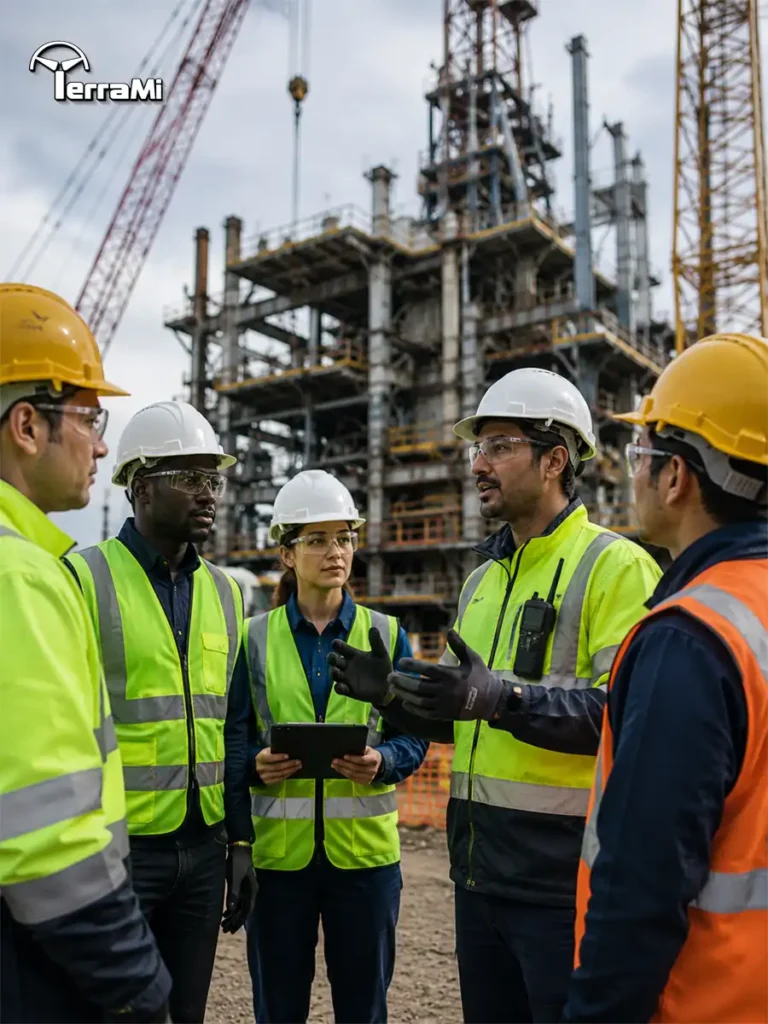
In a recent assessment of a mega-project in Southeast Asia, TerraMi identified a critical safety drift at a stage when the project was already near physical completion. Although the construction program was advancing on schedule, the site had begun to show warning signs: minor incidents were rising, new subcontractors had not been fully integrated into the safety system, and supervision quality was weakening under deadline pressure.
The issue was not one catastrophic failure. It was a pattern of cumulative exposure. The project had developed Operational Safety Lags because safety onboarding, procedural reinforcement, and site discipline were no longer evolving at the same pace as the construction program.
To stabilize the situation, TerraMi introduced a “Safety-Stop” protocol: a 48-hour recalibration that paused selected work fronts, reset training requirements, revalidated task sequencing, and restored alignment between physical progress and safety readiness. The intervention demonstrated a crucial principle: pausing to correct Operational Safety Lags is often faster, cheaper, and less disruptive than continuing until a major incident forces a far more expensive stop.
Closing the Gap: A Strategy for Synchronized Progress
To eliminate Operational Safety Lags, TerraMi recommends a three-part integration model:
Phase-Gate Safety Audits — Safety outcomes should be mandatory conditions for advancing into the next project phase. Progress should not be measured solely by physical completion, but by verified readiness.
Real-Time Safety Visibility — Wearable technology, fatigue monitoring, and live site intelligence should be used to detect when worker readiness or procedural discipline is deteriorating.
Leadership Accountability — Executive incentives should be tied not only to delivery milestones, but also to near-miss reporting quality, safety climate indicators, and the reduction of recurring operational gaps.
Taken together, these measures help create a project culture where schedule discipline and safety discipline are no longer in conflict.
Conclusion: Safety as a Performance Driver
The future of infrastructure is not defined only by how fast we build, but by how safely and sustainably we build. Operational Safety Lags are not an unavoidable side effect of complexity; they are usually the result of weak planning, misaligned incentives, and leadership that rewards visible acceleration over durable control.
The strongest projects are not the ones that move fastest at every stage. They are the ones that know when speed is appropriate, when sequencing must be protected, and when operational maturity must be allowed to catch up.
At TerraMi, we remain committed to helping infrastructure leaders close the gap between progress and preparedness. Because in complex projects, speed without synchronization is not progress—it is deferred risk.