
Infrastructure Resilience Series | Part I of III
This article is the first installment in a three-part thought leadership series exploring how infrastructure organizations can operate successfully in an era of increasing uncertainty, climate volatility, and systemic risk.
Part I: The End of Predictable Infrastructure: Why Historical Assumptions No Longer Work
Part II: Engineering for Uncertainty: The New Logic of Infrastructure Resilience
Part III: Why Infrastructure Resilience Fails Without Governance
Why Infrastructure Must Move Beyond Historical Predictability
For much of the last century, infrastructure planning operated within a relatively stable framework. Engineers, investors, governments, and project leaders could make decisions with a reasonable degree of confidence that future conditions would broadly resemble historical conditions. Population growth followed recognizable patterns. Climate conditions remained relatively predictable. Supply chains expanded steadily. Regulatory systems evolved gradually. Demand forecasts could be developed using historical data and long-established planning methodologies.
Under those circumstances, the concept of predictable infrastructure was not only reasonable; it was highly effective.
Many of the world’s most successful transportation corridors, power generation facilities, water systems, ports, airports, and industrial assets were designed using planning assumptions derived from historical experience. These assets helped create unprecedented economic growth, supported urban development, and enabled global trade at a scale never before achieved.
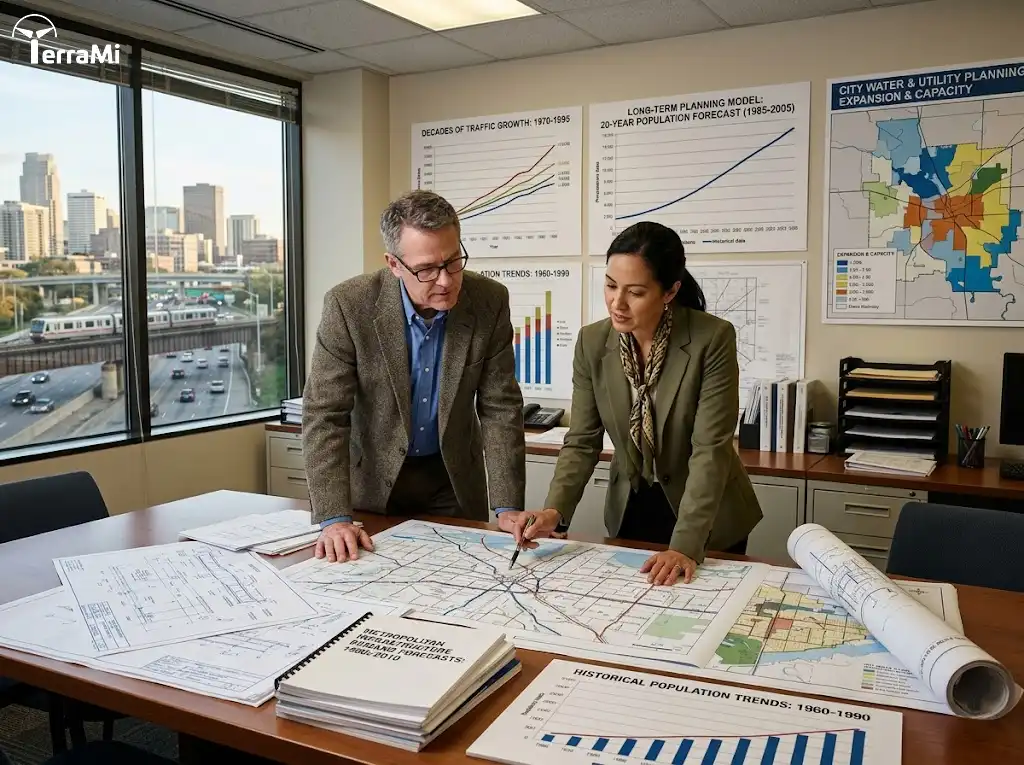
The challenge facing infrastructure leaders today is not that those systems were poorly designed.
The challenge is that the assumptions that made them successful are becoming increasingly unreliable.
Across nearly every sector, organizations are discovering that historical conditions no longer provide the same confidence they once did. Climate patterns are becoming more volatile. Supply chains experience disruptions that were once considered exceptional. Workforce shortages affect project delivery across multiple regions. Cybersecurity risks continue to evolve. Geopolitical instability increasingly influences infrastructure investment decisions.
The result is a world that remains understandable but is becoming significantly less predictable.
This distinction matters.
Many organizations continue to approach infrastructure planning as though future operating conditions can be estimated primarily through historical analysis. While historical data remains valuable, infrastructure leaders are increasingly recognizing that past performance alone may no longer provide sufficient guidance for future decision-making.
The future is not simply changing.
The nature of uncertainty itself is changing.
Why Predictable Infrastructure Became the Global Standard
To understand why infrastructure planning must evolve, it is first necessary to understand why predictable infrastructure became the dominant model in the first place.
Infrastructure assets are capital-intensive investments with long operational lifecycles. A bridge may remain in service for fifty years or more. A water treatment facility may operate for decades. Energy infrastructure often requires planning horizons extending well beyond twenty years.
Because these investments involve substantial financial commitments, decision-makers historically relied on forecasting methodologies designed to reduce uncertainty.
Traffic models estimated future transportation demand.
Hydrological records informed water infrastructure design.
Historical weather data influenced engineering standards.
Economic growth projections shaped investment decisions.
In many cases, these methodologies produced impressive results because the systems being modeled existed within relatively stable boundaries.
The objective was straightforward:
Optimize performance under expected conditions.
Organizations focused on maximizing efficiency, minimizing cost, and improving operational performance within relatively predictable environments.
The model worked.
However, its success created a hidden vulnerability.
As long as future conditions remained similar to historical conditions, predictable infrastructure continued performing as expected.
But when future conditions begin diverging from historical assumptions, optimization alone becomes insufficient.
Infrastructure systems optimized for a single expected future may struggle when confronted with multiple possible futures.
This is one of the defining infrastructure challenges of the twenty-first century.
Why Predictable Infrastructure Is Facing New Challenges
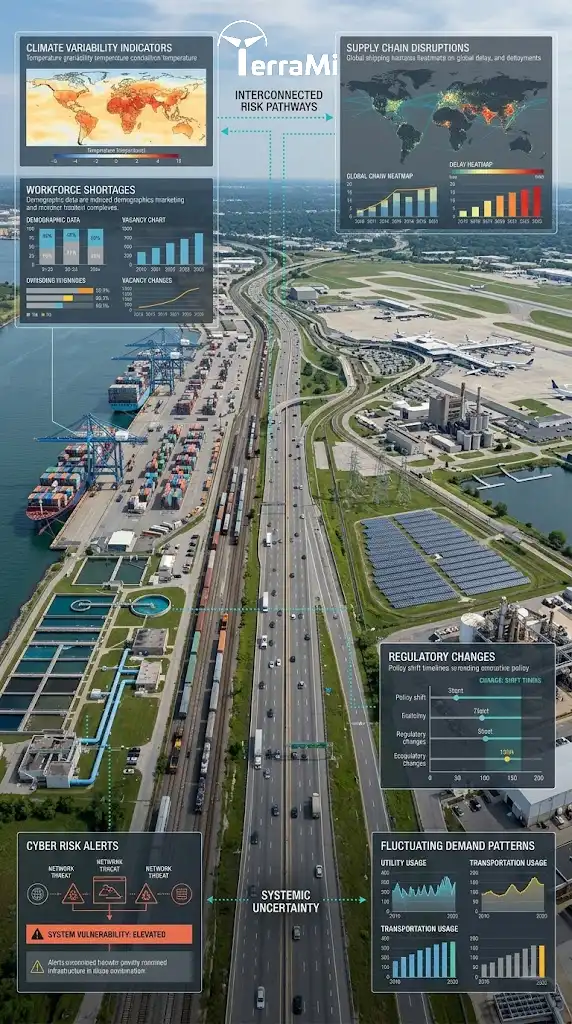
Modern infrastructure systems operate within environments that are becoming increasingly interconnected and increasingly volatile.
Traditionally, infrastructure risks were often evaluated independently.
A project team might assess weather risk.
A utility operator might evaluate equipment failure risk.
A transportation authority might analyze demand uncertainty.
Today, these risks rarely occur in isolation.
Climate events interact with supply chain disruptions.
Labor shortages affect maintenance activities.
Regulatory changes influence investment priorities.
Digital systems create both operational opportunities and cybersecurity vulnerabilities.
Financial pressures affect infrastructure renewal programs.
Each factor introduces additional complexity.
Combined, they create systemic volatility.
Systemic volatility differs from traditional risk because it emerges from the interaction of multiple pressures rather than a single identifiable event.
A severe storm may not create a major disruption on its own.
However, when combined with workforce shortages, aging infrastructure, procurement delays, and increased demand, the consequences can become far more significant.
This is why many infrastructure organizations are beginning to rethink how risk itself is understood.
The challenge is no longer simply protecting infrastructure against known threats.
The challenge is preparing infrastructure for conditions that may not yet be fully understood.
That requires a shift away from traditional assumptions about predictability.
Climate Volatility Is Challenging Predictable Infrastructure
Among the many forces reshaping infrastructure planning, climate volatility has emerged as one of the most visible.
For decades, infrastructure systems were designed using historical environmental records as a foundation for engineering decisions.
Rainfall patterns influenced drainage capacity.
Temperature records informed material specifications.
Hydrological data shaped water management strategies.
Environmental baselines provided confidence that future conditions would remain within historically observed ranges.
Increasingly, infrastructure leaders are finding that those assumptions deserve closer examination.
Extreme weather events are occurring in regions that previously experienced relatively stable conditions.
Heat waves are affecting infrastructure performance in new ways.
Water availability is becoming less predictable in many locations.
Seasonal patterns are becoming more variable.
These developments do not necessarily mean that historical data has become irrelevant.
Rather, they demonstrate that historical data must now be complemented by scenario-based thinking and adaptive planning approaches.
Organizations that continue relying exclusively on historical assumptions may find themselves repeatedly responding to unexpected conditions.
Organizations that acknowledge uncertainty as a permanent operating reality are often better positioned to build long-term resilience.
When Predictable Infrastructure Stops Predicting Future Performance
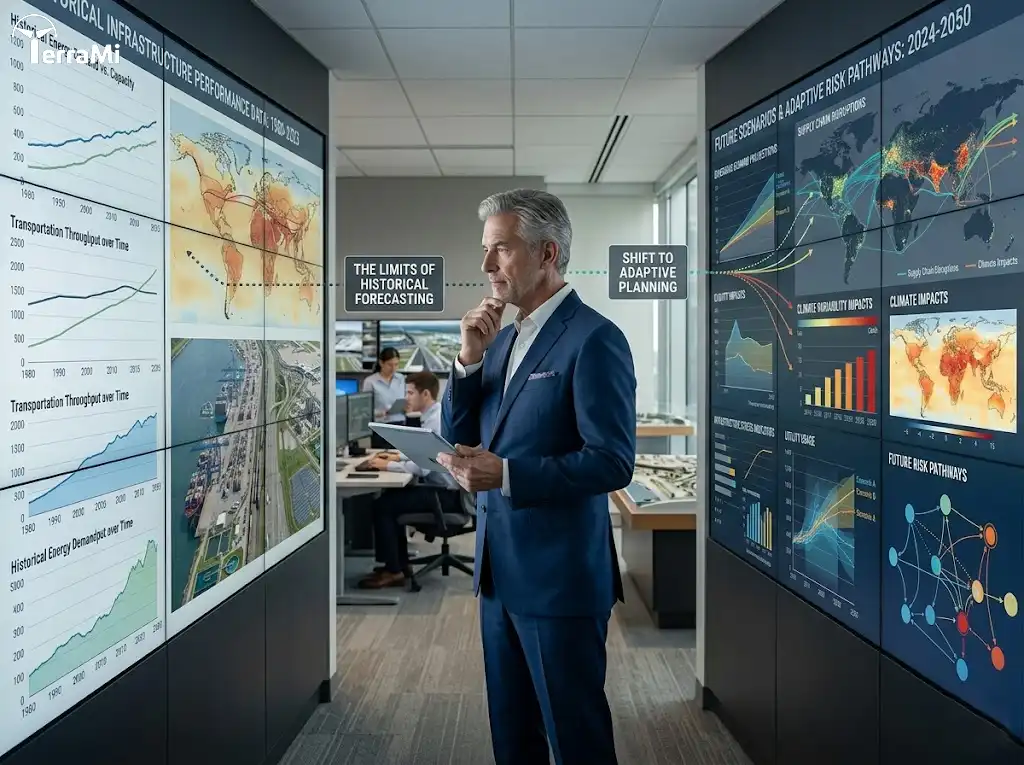
One of the most important lessons emerging from recent years is that historical performance does not automatically predict future performance.
This principle applies across sectors.
Transportation systems experience changing demand patterns.
Energy networks face new consumption profiles.
Industrial facilities operate within evolving regulatory environments.
Water systems confront increasingly complex resource management challenges.
Historical information remains essential.
However, infrastructure leaders must recognize its limitations.
Data describes what happened.
It does not guarantee what will happen next.
This distinction becomes increasingly important when planning assets expected to remain operational for decades.
Infrastructure investments made today will continue operating in environments that may differ significantly from those used during their design.
That reality demands a broader perspective
The most successful organizations are no longer asking only:
“What is the most likely future?”
They are increasingly asking:
“What range of futures should we be prepared to manage?”
That question marks the beginning of a fundamental shift in infrastructure thinking.
And it is the shift that ultimately leads to infrastructure resilience.
Why Predictable Infrastructure Must Evolve Into Resilient Infrastructure
If the era of predictable infrastructure is gradually coming to an end, an important question emerges:
What should replace it?
The answer is not abandoning planning, forecasting, or engineering discipline.
The answer is resilience.
Infrastructure resilience is often misunderstood as the ability to survive disruption. While survival is certainly important, true resilience extends much further. Resilient infrastructure systems are designed to anticipate change, absorb shocks, adapt to evolving conditions, and recover effectively when disruptions occur.
This distinction is critical.
Traditional infrastructure models focused primarily on efficiency. The objective was to optimize performance under expected operating conditions.
Resilient infrastructure accepts a different reality.
Future operating conditions may not always be expected.
This requires a broader design philosophy.
Instead of asking:
“How can we maximize efficiency under normal conditions?”
Organizations increasingly need to ask:
“How can we maintain performance across a range of possible conditions?”
This subtle shift changes everything.
Investment decisions change.
Asset management strategies change.
Risk management frameworks change.
Governance priorities change.
Most importantly, organizational culture begins to change.
The organizations that outperform over the next decade will not necessarily be those that predict the future most accurately.
They will be the organizations most capable of adapting when predictions prove incomplete.
Infrastructure Resilience as a Strategic Capability
Historically, resilience was often treated as a technical issue.
Engineers addressed structural resilience.
Utilities addressed operational resilience.
Emergency management teams addressed disaster resilience.
Today, resilience is becoming something much larger.
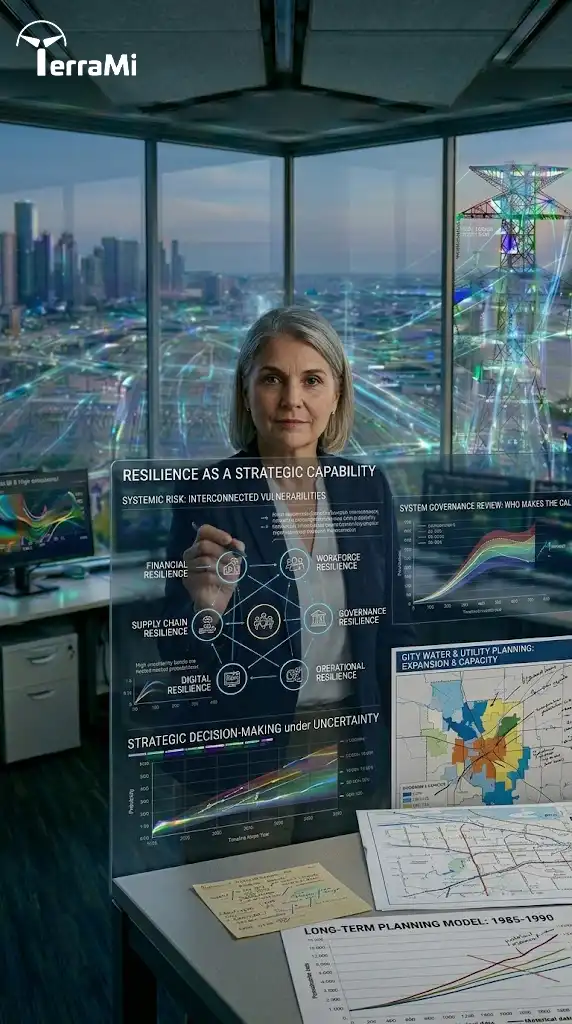
It is evolving into a strategic capability.
The distinction matters because strategic capabilities influence how organizations compete, invest, govern, and create value.
Infrastructure resilience is no longer limited to physical assets.
It now encompasses:
- Operational resilience
- Financial resilience
- Workforce resilience
- Supply chain resilience
- Governance resilience
- Digital resilience
Each component influences the performance of the others.
For example, a modern transportation system may possess highly resilient physical infrastructure while remaining vulnerable to digital disruptions.
An energy facility may have redundant equipment but face operational challenges due to workforce shortages.
A major infrastructure project may achieve technical excellence while struggling with governance complexity.
These examples illustrate an important reality.
Infrastructure systems do not fail solely because individual assets fail.
Infrastructure systems often fail because interconnected capabilities fail simultaneously.
This is why future infrastructure strategies must move beyond asset-focused thinking and toward system-focused thinking.
In many respects, this aligns closely with the concepts discussed in ESG integration within infrastructure projects.
Organizations increasingly recognize that infrastructure performance is influenced not only by engineering quality but also by governance quality, operational visibility, stakeholder alignment, and decision-making effectiveness.
Resilience therefore becomes a management challenge as much as an engineering challenge.
The Hidden Cost of Optimizing for a Single Future
One of the least discussed infrastructure risks is excessive optimization.
Optimization creates efficiency.
Efficiency creates value.
However, excessive optimization can also create fragility.
A system designed around a narrow range of expected conditions may perform exceptionally well when those conditions exist.
The problem emerges when conditions change.
Many modern infrastructure systems were optimized around assumptions that appeared reasonable when they were developed.
Stable weather patterns.
Reliable supply chains.
Predictable workforce availability.
Gradual technological change.
Consistent demand growth.
Today, each of those assumptions faces increasing uncertainty.
When uncertainty expands, flexibility often becomes more valuable than efficiency.
This does not mean efficiency should be abandoned.
It means efficiency must be balanced with adaptability.
Leading infrastructure organizations are increasingly exploring approaches such as:
- Scenario planning
- Adaptive asset management
- Dynamic risk assessment
- Flexible operating models
- Resilience-based investment strategies
These approaches recognize that infrastructure must remain effective across multiple potential futures rather than a single forecasted future.
Infrastructure Governance Beyond Predictability
The conversation about infrastructure resilience often focuses on technology and engineering.
Both are essential.
However, governance may ultimately be the most important resilience capability of all.
Consider two organizations facing identical disruptions.
Both experience severe weather.
Both encounter supply chain delays.
Both face workforce challenges.
Yet one organization adapts successfully while the other struggles.
Why?
The difference is often governance.
Governance determines how decisions are made.
Governance determines how risks are escalated.
Governance determines how resources are allocated.
Governance determines how quickly organizations respond to changing conditions.
Strong governance creates organizational agility.
Weak governance amplifies uncertainty.
This reality is becoming increasingly important as infrastructure organizations operate in more complex environments.
Future resilience will depend not only on physical assets but also on institutional capability.
Organizations that develop stronger governance frameworks will often outperform organizations that rely exclusively on technical solutions.
This observation is increasingly reflected in global infrastructure discussions.
The lesson is clear.
Infrastructure resilience is not merely an engineering outcome.
It is also a governance outcome.
Operational ESG and Decision-Making Under Uncertainty
This is where the discussion naturally intersects with Operational ESG.
For many organizations, ESG was initially viewed through the lens of reporting, compliance, and stakeholder communication.
Those elements remain important.
However, the most significant evolution occurring today is the movement of ESG from reporting frameworks into operational decision-making.
When infrastructure organizations evaluate climate risk, workforce resilience, governance effectiveness, operational transparency, resource efficiency, and stakeholder impacts, they are not simply addressing sustainability objectives.
They are improving their ability to navigate uncertainty.
Operational ESG therefore becomes a resilience mechanism.
It provides visibility into emerging risks.
It improves governance quality.
It strengthens decision-making processes.
It enhances long-term asset performance.
Most importantly, it helps organizations transition from reactive management toward adaptive management.
This shift may become one of the defining characteristics of future infrastructure leadership.
The Future Beyond Predictable Infrastructure
The future of infrastructure will not belong to the organizations that attempt to eliminate uncertainty.
Uncertainty cannot be eliminated.
The future will belong to organizations that learn how to operate successfully within uncertainty.
The concept of predictable infrastructure helped build the modern world.
It enabled extraordinary achievements.
It supported economic development.
It improved quality of life for billions of people.
Its success should be acknowledged and respected.
However, the conditions that shaped predictable infrastructure are evolving.
Infrastructure leaders now face a different challenge.
They must design systems capable of adapting to changing realities rather than merely optimizing for historical expectations.
This requires a new mindset.
A new governance philosophy.
A new approach to resilience.
A new understanding of risk.
And ultimately, a new vision for infrastructure itself.
The question facing organizations today is no longer:
“What does the future look like?”
The more important question may be:
“How prepared are we for futures that do not look like the past?”
Continue Reading the Series
Infrastructure Resilience Series | Part II of III
Next Article:
Engineering for Uncertainty: The New Logic of Infrastructure Resilience
In the next article, we explore how infrastructure organizations can move beyond traditional planning models and begin designing systems capable of performing effectively in environments characterized by volatility, uncertainty, and continuous change.

TerraMi Perspective
At TerraMi, we believe the future of infrastructure depends on more than engineering excellence alone. Organizations increasingly require the ability to integrate resilience, governance, operational ESG, and infrastructure intelligence into everyday decision-making.
As volatility becomes a defining characteristic of the operating environment, infrastructure leaders must move beyond assumptions of predictability and begin building systems capable of adapting to change. The organizations that succeed will not simply manage assets more efficiently. They will develop the visibility, governance, and resilience capabilities necessary to create long-term value under conditions of uncertainty.
The future belongs not to predictable infrastructure, but to infrastructure that can learn, adapt, and endure.