Digital Transformation in Infrastructure has become one of the defining priorities for governments, infrastructure owners, engineering firms, and asset managers worldwide. Yet despite unprecedented investments in digital technologies, many organizations continue to struggle with fragmented data, disconnected workflows, and limited organizational transformation. The challenge is no longer adopting digital tools—it is creating an integrated digital ecosystem that enables better engineering decisions across the entire infrastructure lifecycle.
On paper, the industry appears to be making remarkable progress.
Yet the day-to-day reality often tells a different story.
Project teams still spend valuable time searching for information instead of analysing it. Critical project data remains scattered across multiple software platforms. Departments continue to work with different versions of the same information. Decisions are delayed while engineers verify which dataset is actually correct.
This raises an uncomfortable question.
If infrastructure organizations have invested so heavily in digital technology, why do so many still struggle to operate as genuinely digital organizations?
The answer lies in a misunderstanding that has shaped digital transformation efforts for years.
Many organizations have focused on digitising activities rather than transforming the way information supports decisions.
These are not the same objective.
Replacing paper drawings with digital files is valuable.
Moving information into cloud platforms is valuable.
Introducing automation improves efficiency.
But none of these changes automatically improve the quality of engineering decisions.
True digital transformation begins when information moves freely across an organization, allowing every stakeholder to work from a consistent understanding of infrastructure assets throughout their lifecycle.
That is a much more demanding challenge than purchasing new technology.
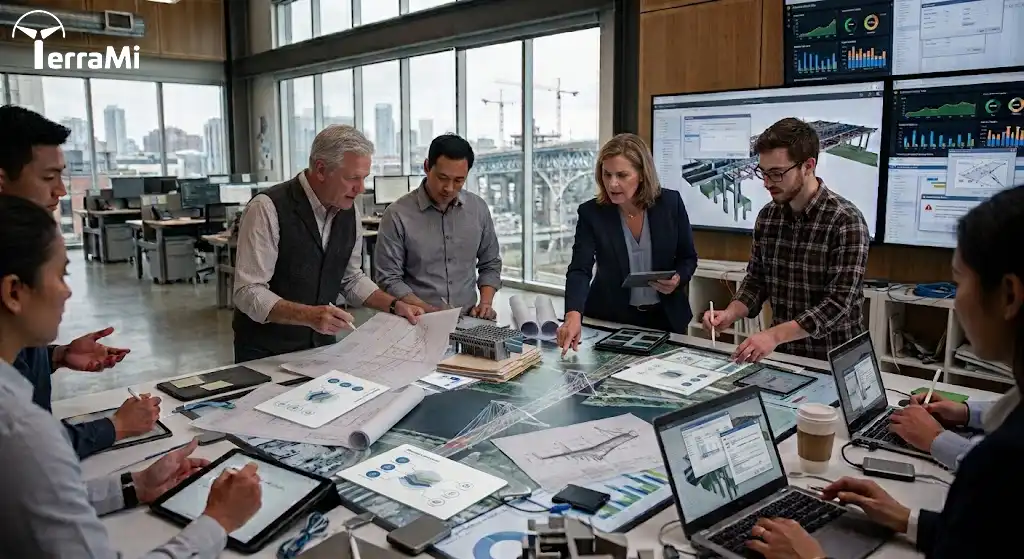
Digital Transformation Is About Decisions, Not Software
One of the most common misconceptions in infrastructure is that digital transformation is primarily an IT initiative.
It is not.
Technology provides the tools, but organizations create the outcomes.
Two engineering firms may invest in exactly the same software platforms, yet achieve completely different results. One develops faster workflows, improves collaboration, reduces project risk, and makes better long-term investment decisions. The other simply replaces old manual processes with digital versions of the same inefficiencies.
The difference is rarely the software itself.
It is how information is managed.
Infrastructure organizations generate extraordinary amounts of data throughout the lifecycle of every asset. Design models, procurement records, inspection reports, maintenance histories, environmental assessments, operational performance, financial information, and regulatory documentation all contribute to a growing body of knowledge.
Unfortunately, these information sources often evolve independently.
- Engineering teams maintain one dataset.
- Operations maintain another.
- Procurement creates its own records.
- Asset managers rely on separate systems.
When these environments fail to communicate effectively, organizations lose something far more valuable than efficiency.
They lose confidence in their own information.
Without trusted information, even experienced professionals become reluctant to make timely decisions. More meetings are scheduled. Additional reviews are requested. Reports are recreated. Data is verified repeatedly.
The cost is rarely visible on a balance sheet.
It appears instead as slower decisions, duplicated effort, delayed projects, and missed opportunities to improve asset performance.
This is why successful digital transformation should never be evaluated by the number of digital tools an organization owns.
It should be evaluated by the quality, accessibility, and reliability of the information supporting every decision.
Why Infrastructure Is Different from Most Industries
Digital transformation is challenging in almost every sector.
Infrastructure introduces another level of complexity.
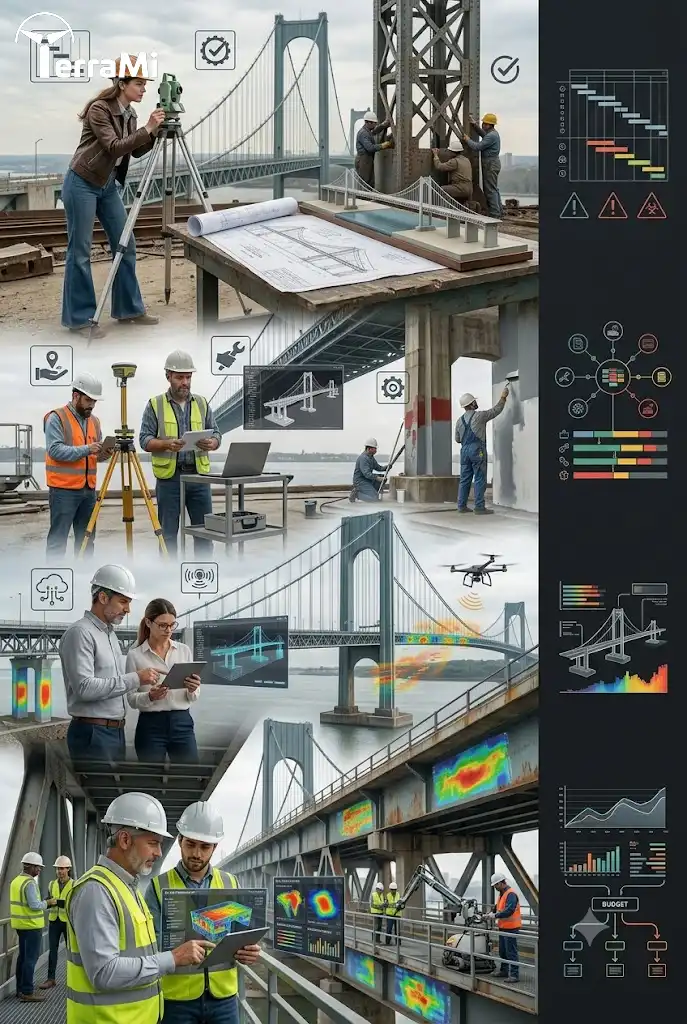
Unlike many industries where products are designed, manufactured, and replaced within relatively short periods, infrastructure assets often remain in service for fifty, seventy-five, or even one hundred years. During that time they pass through multiple owners, operators, maintenance contractors, regulatory environments, and technological generations.
Information created during the design phase may still be needed decades later.
- A maintenance engineer inspecting a bridge today may depend on decisions made by designers who retired years ago.
- An operator managing a water treatment facility may rely on documentation created long before modern digital systems existed.
This long lifecycle fundamentally changes the role of information.
Instead of supporting individual projects, information becomes part of the infrastructure itself.
When knowledge is lost, fragmented, or stored in incompatible systems, organizations are forced to rebuild understanding that once already existed.
That is one of the hidden costs of poor digital transformation.
The challenge is no longer collecting more data.
It is preserving institutional knowledge and making it available whenever decisions need to be made.
Organizations that recognise this shift begin treating information as a strategic infrastructure asset rather than simply another project deliverable.
From Digital Records to Digital Intelligence
Collecting data has never been easier.
Turning that data into useful knowledge remains one of the greatest challenges facing infrastructure organizations.
Modern infrastructure projects generate information continuously. Design revisions, procurement activities, construction progress, environmental monitoring, inspection reports, maintenance schedules, operational performance, financial records, and sensor data all contribute to an ever-expanding digital environment.
The problem is rarely a lack of information.
The problem is that information often exists without context.
A bridge inspection report may exist in one system.
The corresponding design model may exist somewhere else.
Maintenance records may be stored in a separate database.
Procurement documentation may be managed by another department entirely.
Each source contains valuable information, yet none provides a complete understanding of the asset.
Digital intelligence begins when these isolated pieces are connected.
Rather than asking where information is stored, organizations begin asking how information can support better decisions across the entire lifecycle of an infrastructure asset.
That shift changes the role of digital technology.
Instead of becoming a collection of software applications, it becomes an integrated decision-support environment.
The organizations making the greatest progress are not necessarily collecting more data than everyone else.
They are connecting existing information more effectively.
Why Integration Matters More Than Individual Technologies
Infrastructure organizations often discuss technologies individually.
- One team focuses on Building Information Modelling.
- Another invests in Geographic Information Systems.
- Operations deploy Internet of Things sensors.
- Maintenance teams explore artificial intelligence.
- Executives evaluate Digital Twins.
Each initiative delivers value on its own.
The real transformation, however, occurs when these technologies operate as part of a connected information ecosystem rather than as independent digital projects.
- A BIM model becomes far more valuable when it is continuously updated with operational information.
- GIS provides greater insight when engineering models, environmental conditions, and asset performance can be viewed together.
- IoT sensors become significantly more useful when their data feeds predictive maintenance strategies rather than simply reporting current conditions.
- Artificial intelligence produces more reliable recommendations when it learns from consistent, high-quality information rather than fragmented datasets.
Digital transformation therefore depends less on adopting individual technologies and more on creating meaningful relationships between them.
Technology creates capability.
Integration creates intelligence.
Organizations that recognise this distinction are increasingly able to respond more quickly to operational risks, allocate resources more effectively, improve collaboration across departments, and make decisions with greater confidence.
The Foundations of a Digitally Mature Organization
Digital maturity is often misunderstood as a measure of technological sophistication.
In practice, it reflects something much broader.
Digitally mature organizations develop the ability to make reliable decisions because their information is trusted, accessible, and consistently managed across the organization.
This capability does not emerge overnight.
It is built through deliberate governance, common data standards, shared terminology, and leadership that treats information as a strategic business asset rather than a by-product of individual projects.
Technology certainly plays an important role.
However, sustainable digital transformation depends equally on organizational culture.
- Teams must be willing to share information rather than protect it.
- Departments must collaborate instead of operating independently.
- Leadership must support long-term information management instead of focusing only on short-term technology procurement.
When these conditions exist, digital tools become significantly more valuable.
Information begins flowing across design, procurement, construction, operations, maintenance, sustainability, finance, and executive management.
Instead of multiple departments producing separate versions of reality, the organization gradually develops a shared understanding of its infrastructure assets.
This is where digital transformation begins delivering measurable value. Not because another software platform has been introduced. But because better information leads to better engineering decisions.

Looking Beyond Technology
Digital transformation is often described as a destination.
In reality, it is a continuous process of learning, adapting, and improving.
New technologies will continue to emerge. Artificial intelligence will become more capable. Digital Twins will become more sophisticated. Sensors will generate increasing volumes of operational data. Cloud platforms will continue to evolve.
None of these developments, however, will fundamentally change infrastructure organizations unless they also improve the way information is governed, shared, and applied.
The organizations that will lead the next generation of infrastructure are unlikely to be those with the largest technology budgets.
They will be the organizations that consistently transform information into knowledge, knowledge into decisions, and decisions into measurable outcomes.
That capability cannot be purchased as a software package.
It must be developed across the entire organization.
Digital transformation therefore represents a long-term commitment rather than a short-term implementation project.
Its success depends as much on leadership, collaboration, governance, and organizational culture as it does on technology itself.
Perhaps the most important lesson is this:
Infrastructure has always been built with concrete, steel, energy, and engineering expertise.
Increasingly, it will also be built on trusted information.
Organizations that recognise information as a strategic asset will be better prepared to manage uncertainty, improve resilience, strengthen operational performance, and create infrastructure capable of serving future generations.
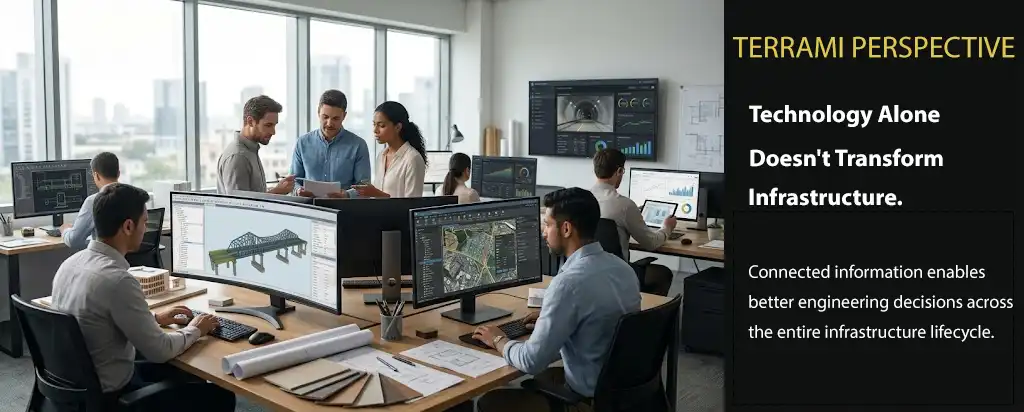
TerraMi Perspective
Many organizations begin their digital transformation journey by investing in technology.
Relatively few begin by asking whether their information is actually ready for digital transformation.
That distinction matters.
Digital maturity is not determined by the number of software platforms an organization operates. It is determined by whether reliable information can move efficiently between people, disciplines, and decision-makers throughout the lifecycle of infrastructure assets.
At TerraMi, we believe digital transformation should begin with information before technology.
When organizations understand the quality, structure, accessibility, and governance of their information, they create the conditions for technologies such as BIM, GIS, Digital Twins, artificial intelligence, and predictive analytics to deliver meaningful value.
Digital transformation is therefore not simply about becoming more digital.
It is about becoming better informed.
Frequently Asked Questions (FAQ)
What is digital transformation in infrastructure?
Digital transformation in infrastructure is the process of improving how infrastructure is planned, delivered, operated, and maintained by integrating reliable information, digital technologies, and organizational processes to support better decision-making throughout the asset lifecycle.
Why do many digital transformation initiatives fail?
Many initiatives focus primarily on implementing new technologies while overlooking governance, data quality, organizational culture, and collaboration. Without these foundations, digital tools often remain isolated and fail to improve decision-making.
Is BIM the same as digital transformation?
No.
Building Information Modelling (BIM) is one important component of digital transformation, but digital transformation extends beyond BIM to include data governance, Digital Twins, GIS, IoT, artificial intelligence, organizational processes, and lifecycle information management.
Why is information management important for infrastructure?
Infrastructure assets generate information throughout decades of operation. Effective information management helps organizations improve collaboration, reduce operational risk, support predictive maintenance, and make more confident engineering decisions.
What is the first step toward successful digital transformation?
The first step is understanding how information currently flows across the organization. Before investing in additional technology, organizations should evaluate data quality, governance, interoperability, and the ability of different teams to work from trusted information.