
The Coming Resource Century: Why Resource Security Is Becoming a Global Priority
TerraMi Special Series II
The Resource Future of Infrastructure
As infrastructure systems enter an era shaped by geopolitical instability, critical mineral competition, climate pressures, and increasingly fragile supply chains, engineering priorities are evolving beyond efficiency alone. This three-part TerraMi Special Series explores how resource security is becoming one of the defining challenges of twenty-first-century infrastructure.
Part I
The Coming Resource Century: Why Resource Security Is Becoming a Global Priority
Part II
From Extraction to Intelligence: The Rise of Circular Economy as a New Discipline
Part III
Why Developing Nations Cannot Afford Linear Growth
You are reading Part I of this special series.
Introduction
For much of modern history, infrastructure development has been evaluated through a relatively stable set of assumptions. Population growth, economic expansion, technological progress, and global trade were expected to ensure that construction materials, industrial resources, and strategic commodities would remain available whenever demand increased. Engineering challenges were therefore largely defined by cost, performance, and technical feasibility rather than by the availability of the resources themselves.
Those assumptions are beginning to change.
Today, Resource Security is emerging as one of the most influential forces shaping infrastructure planning around the world. Governments are reassessing their dependence on imported critical minerals. Construction industries are confronting unprecedented material price volatility. Water scarcity is altering regional development strategies, while geopolitical tensions continue to expose the vulnerability of global supply chains. Increasingly, the question is no longer whether infrastructure can be designed and financed, but whether the resources required to build, maintain, and modernize it will remain accessible, affordable, and resilient over the coming decades.
The implications extend far beyond procurement. Resource availability now influences national competitiveness, energy transition strategies, climate adaptation, industrial policy, and long-term infrastructure resilience. Engineering decisions that once focused primarily on structural performance must increasingly consider material availability, lifecycle value, recoverability, and strategic resource dependency.
This transformation represents more than another sustainability trend. It signals a structural shift in how infrastructure systems are conceived. Just as digital technologies introduced a new era of data-driven infrastructure management, resource constraints are introducing a new era of resource intelligence—one in which materials become strategic assets rather than disposable inputs.
Recent years have demonstrated how rapidly global events can disrupt long-established assumptions. Pandemic-related supply chain interruptions, geopolitical conflicts affecting energy and mineral markets, export restrictions on critical materials, and accelerating climate-related disruptions have collectively highlighted the fragility of infrastructure systems that depend on linear and globally concentrated resource flows. What was once considered an operational risk has become a strategic planning challenge.
For infrastructure professionals, this evolution requires a broader perspective. Designing resilient infrastructure can no longer be separated from understanding the resilience of the resources upon which that infrastructure depends. Material flows, supply chain diversity, circular recovery strategies, and resource governance are becoming integral components of engineering decision-making.
The twenty-first century may ultimately be remembered not only as the century of digital transformation or decarbonization, but also as the century in which Resource Security became central to infrastructure strategy.
From Energy Security to Resource Security
For decades, energy security dominated discussions about national resilience. Countries sought reliable access to oil, natural gas, and electricity because these resources powered industrial development and economic growth. Infrastructure planning largely reflected this priority, focusing on energy generation, transmission networks, and fuel diversification.
Today, however, the strategic landscape has broadened considerably.
Modern infrastructure depends on an increasingly complex portfolio of materials that extend well beyond traditional energy resources. Copper supports electrification and grid expansion. Lithium, cobalt, nickel, and graphite underpin battery technologies. Rare earth elements enable wind turbines, electric motors, telecommunications, and advanced manufacturing. High-performance concrete, engineered timber, recycled aggregates, and specialized construction materials are becoming essential components of low-carbon infrastructure.
In many cases, the availability of these resources has become as strategically important as access to energy itself.
This evolution has given rise to the broader concept of Resource Security—an integrated approach that considers not only whether resources exist, but also whether they can be accessed sustainably, transported reliably, managed efficiently, recovered after use, and protected against geopolitical or environmental disruption.
Unlike conventional resource management, resource security requires infrastructure organizations to evaluate entire material ecosystems. Questions that were once peripheral now become central to engineering and investment decisions:
- Where do critical construction materials originate?
- How geographically concentrated are supply chains?
- What environmental risks threaten long-term availability?
- Can materials be recovered at the end of an asset’s lifecycle?
- Which dependencies create strategic vulnerabilities?
These questions are redefining the relationship between engineering, economics, and public policy.
Rather than viewing materials as passive construction inputs, infrastructure organizations are beginning to recognize them as dynamic strategic assets whose availability directly influences long-term system resilience.
Why the Global Infrastructure Sector Is Entering the Resource Century
The phrase Resource Century reflects a profound change in the forces driving infrastructure development.
Previous generations largely assumed that economic growth would be constrained by capital, labour, or technology. While these factors remain important, future infrastructure expansion increasingly depends upon the availability, accessibility, and intelligent management of physical resources.
Several global trends are accelerating this transition simultaneously.
First, worldwide infrastructure demand continues to grow rapidly as urbanization, population expansion, renewable energy deployment, and transportation modernization require enormous quantities of construction materials and strategic minerals.
Second, the global energy transition is dramatically increasing demand for materials that were previously considered niche commodities. Electrification, battery storage, hydrogen technologies, and renewable energy infrastructure require substantially larger volumes of critical minerals than conventional energy systems.
Third, geopolitical fragmentation has altered assumptions about stable international trade. Export controls, regional conflicts, trade disputes, and strategic competition have encouraged governments to reconsider supply chain dependencies that once appeared economically efficient.
Fourth, climate change is directly affecting resource availability through droughts, extreme weather events, ecosystem degradation, and increasing pressure on water-intensive industries.
Finally, infrastructure itself is aging. Around the world, governments face the simultaneous challenge of maintaining existing assets while constructing entirely new systems designed for future environmental and economic conditions. This dual demand significantly increases pressure on already constrained material supply chains.
Taken together, these developments suggest that infrastructure resilience can no longer be understood solely through engineering design. It must also be evaluated through the resilience of the resource systems that support it.
Critical Minerals: The Foundation of Modern Infrastructure
Infrastructure has always depended on materials. Steel, cement, timber, and aggregates have traditionally formed the backbone of construction, while energy resources powered industrial growth. However, the infrastructure systems emerging in the twenty-first century rely on an increasingly sophisticated portfolio of critical minerals whose strategic importance extends far beyond their physical volume.
Copper, lithium, nickel, cobalt, graphite, manganese, and rare earth elements now underpin many technologies that define modern infrastructure. Electrified transportation systems, renewable energy facilities, battery storage, digital communication networks, advanced sensors, smart grids, and data centres all depend on secure access to these materials.
This shift fundamentally changes how infrastructure should be evaluated.
Historically, engineers focused on structural integrity, lifecycle costs, operational performance, and maintenance strategies. Material availability was largely assumed. Procurement teams could source required materials through global markets with relatively predictable pricing and lead times.
Today, that assumption no longer holds.
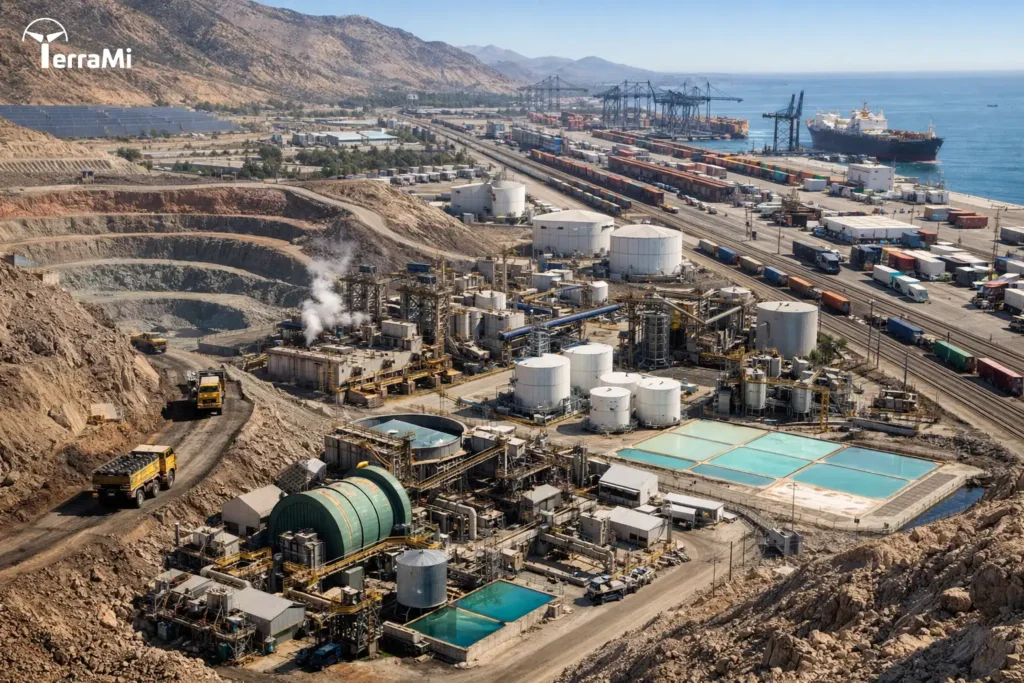
Many critical minerals originate from a limited number of producing countries. Processing capacity is often even more geographically concentrated than extraction itself. Consequently, infrastructure projects are becoming increasingly exposed to geopolitical events, export restrictions, transportation disruptions, environmental regulations, and market volatility that exist far beyond the construction site.
The challenge is therefore not simply resource scarcity. It is resource concentration.
A material may be abundant globally while remaining strategically vulnerable because production, refining, or transportation depends upon only a few regions or suppliers.
For infrastructure owners, this represents an entirely new category of project risk.
Material dependency has become infrastructure dependency.
Instead of asking whether sufficient materials exist globally, decision-makers must increasingly ask whether resilient access to those materials can be maintained throughout decades of infrastructure investment.
Supply Chains Have Become Critical Infrastructure
The pandemic exposed vulnerabilities that many industries had underestimated for decades.
Construction schedules slipped because basic materials could not be delivered. Equipment manufacturing slowed due to semiconductor shortages. Shipping costs multiplied. Lead times extended dramatically across multiple sectors.
These events demonstrated that infrastructure resilience depends not only on physical assets but also on the resilience of the supply networks supporting them.
Supply chains should therefore be viewed as infrastructure in their own right.
They connect extraction sites, processing facilities, manufacturers, logistics networks, ports, rail systems, warehouses, and construction projects into one integrated ecosystem.
Failure at any point can affect entire infrastructure programmes.
This represents an important conceptual shift.
Traditional project management treats procurement as a supporting function.
Resource security treats procurement as a strategic engineering consideration.
Infrastructure organizations are increasingly incorporating supplier diversification, regional sourcing, strategic inventories, long-term procurement partnerships, and lifecycle material planning into project governance.
Rather than minimizing procurement costs alone, organizations are beginning to optimize supply chain resilience.
This broader perspective aligns infrastructure planning more closely with national resilience strategies, particularly as governments seek to reduce dependence on highly concentrated global supply networks.
Water Security Is Also Infrastructure Security
Discussions about resource security often focus on minerals and industrial materials. Yet one of the world’s most strategically significant infrastructure resources is frequently overlooked.
Water.
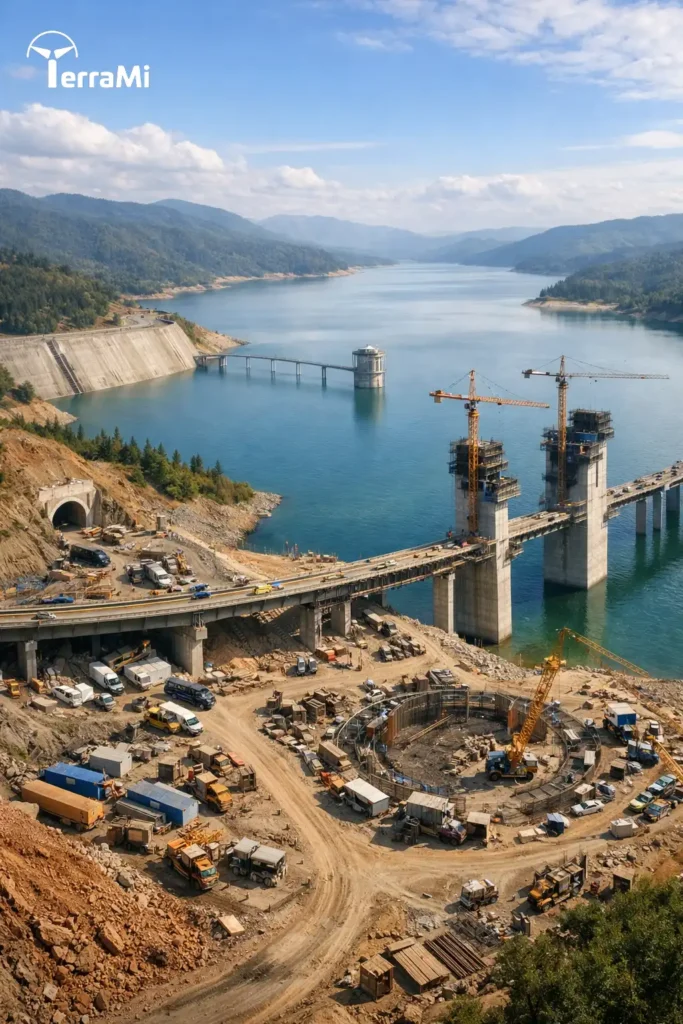
Virtually every infrastructure sector depends upon reliable water availability. Construction activities require substantial water consumption for concrete production, dust suppression, soil stabilization, tunnelling, and material processing. Manufacturing industries rely upon water for cooling systems, chemical processing, and industrial operations.
Energy production depends heavily on water resources. Agricultural infrastructure cannot function without reliable water systems. Even digital infrastructure—including hyperscale data centres—requires significant quantities of water for cooling technologies in many locations. Climate change is increasing uncertainty surrounding freshwater availability through prolonged droughts, changing precipitation patterns, declining groundwater reserves, glacier retreat, and more frequent extreme weather events.
As water stress intensifies, infrastructure planning must evolve accordingly. Projects can no longer assume that historical water availability will continue throughout an asset’s operational life. Instead, engineers must integrate water resilience into planning, design, operations, and long-term asset management. Resource security therefore extends well beyond mining and materials.
It encompasses every natural resource upon which infrastructure systems depend.
Circular Economy Is No Longer Only an Environmental Strategy
For many years, discussions surrounding the Circular Economy focused primarily on waste reduction, recycling, and environmental sustainability.
Those objectives remain essential. However, recent developments have fundamentally expanded the strategic significance of circularity. Circular Economy has become a resource strategy. Recovering materials from existing infrastructure reduces dependence on increasingly uncertain global supply chains.
Reusing structural components preserves embedded economic value while decreasing demand for virgin extraction. Designing infrastructure for adaptability extends asset lifecycles and postpones future resource consumption. Urban mining transforms existing cities into reservoirs of valuable construction materials and critical minerals.
Material passports enable future recovery instead of permanent disposal. These practices strengthen resource resilience while simultaneously reducing environmental impacts. This represents an important evolution in infrastructure thinking.
Circular systems are not merely tools for achieving sustainability objectives. They are mechanisms for improving national resource security. Every tonne of steel reused, every aggregate recovered, every component designed for future disassembly contributes to reducing strategic dependence on external resource flows.
Infrastructure organizations increasingly recognize that circularity enhances resilience, lowers exposure to market volatility, and improves long-term resource productivity. In this context, circular infrastructure becomes an economic strategy as much as an environmental one.
From Resource Management to Resource Intelligence
Managing resources efficiently is no longer sufficient. The next competitive advantage lies in understanding resources before they become constraints. This emerging capability may be described as Resource Intelligence.
Resource intelligence integrates engineering data, supply chain visibility, lifecycle analysis, digital technologies, environmental information, and strategic planning into a unified decision-making framework. Rather than reacting to shortages after they occur, organizations anticipate vulnerabilities before they disrupt projects. Instead of monitoring procurement alone, they analyse complete material lifecycles.
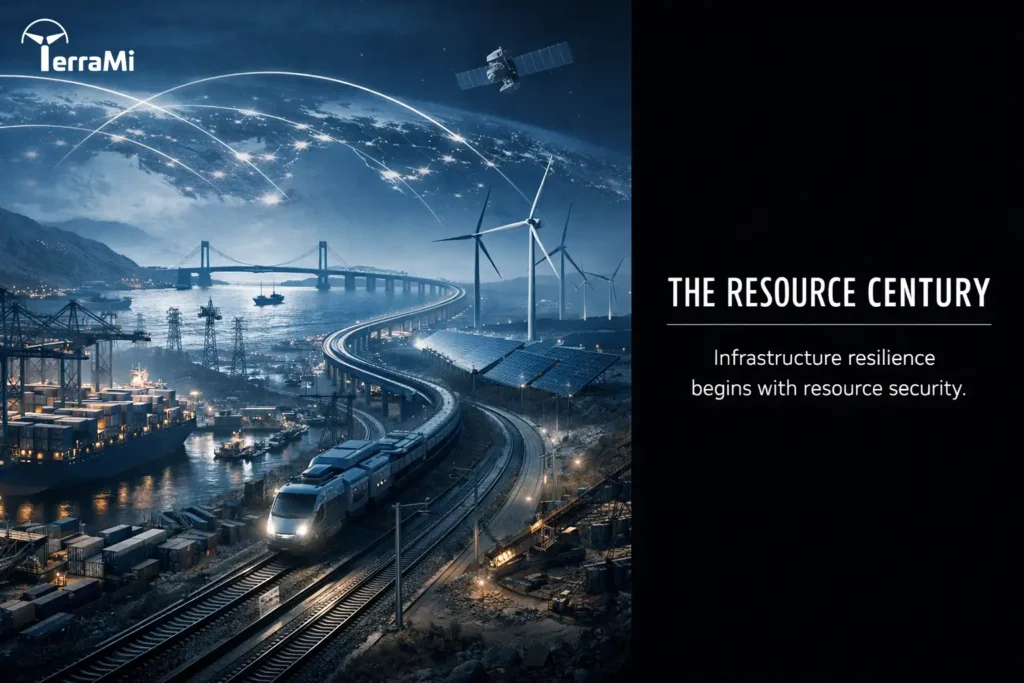
Instead of viewing infrastructure assets solely as physical structures, they recognise them as repositories of valuable resources that will retain economic significance long after their initial construction. Digital technologies accelerate this transformation.
Building Information Modelling (BIM), Digital Twins, Geographic Information Systems (GIS), Internet of Things (IoT) platforms, artificial intelligence, blockchain-enabled traceability, and advanced material databases collectively provide unprecedented visibility into infrastructure resource systems.
This visibility supports more informed decisions regarding procurement, maintenance, refurbishment, reuse, and end-of-life recovery. The result is not simply greater operational efficiency. It is greater strategic resilience.
Organizations capable of understanding where resources originate, how they move, how they are consumed, and how they can be recovered will be significantly better positioned to navigate future uncertainty.
In many respects, resource intelligence will become as important during the coming decades as financial intelligence has been throughout the previous century.
The Emerging Competitive Landscape
Competition between infrastructure organizations is gradually changing.
Historically, competitive advantage centred on engineering expertise, financial capacity, project delivery, and operational efficiency.
These capabilities remain indispensable.
However, an additional dimension is rapidly emerging.
Future infrastructure leaders will increasingly be distinguished by their ability to manage strategic resources intelligently.
Questions such as these are becoming increasingly important:
- Can an organization identify hidden material risks before procurement begins?
- Does it understand the lifecycle value of every major construction material?
- Can it recover high-value resources at the end of an asset’s service life?
- Is it capable of diversifying suppliers before geopolitical disruptions occur?
- Can it quantify resource resilience alongside financial performance and carbon emissions?
Organizations that answer these questions positively will possess a significant strategic advantage.
Conversely, organizations that continue relying upon linear procurement models may find themselves increasingly exposed to price volatility, supply disruptions, regulatory change, and resource scarcity.
The infrastructure sector is therefore entering an era in which engineering excellence will increasingly be measured not only by what is built, but by how intelligently the resources behind those assets are understood, protected, and managed.
Conclusion: Resource Security Is Becoming Infrastructure Strategy
Infrastructure has entered a period of profound transformation.
For decades, discussions about infrastructure focused on engineering innovation, economic efficiency, and environmental sustainability. While these priorities remain essential, they are no longer sufficient to address the realities of an increasingly interconnected and resource-constrained world.
Resource Security is emerging as a strategic foundation upon which future infrastructure resilience will depend.
The availability of critical minerals, the resilience of supply chains, the reliability of freshwater resources, and the ability to recover materials from existing assets are no longer peripheral considerations. They are becoming central variables that influence investment decisions, project feasibility, national competitiveness, and long-term infrastructure performance.
Perhaps the most significant shift is conceptual.
Infrastructure should no longer be viewed simply as a collection of roads, bridges, buildings, utilities, or transportation networks. It should be understood as part of a broader resource ecosystem in which every asset represents both a consumer and a future reservoir of valuable materials.
This perspective changes the role of engineering.
Rather than focusing solely on constructing assets, engineers increasingly become stewards of material value across multiple generations of infrastructure.
Governments face similar responsibilities.
Policies that encourage circular material flows, strengthen domestic processing capabilities, diversify supply chains, improve material transparency, and support resource innovation will increasingly influence economic resilience.
Private organizations also face new expectations.
Competitive advantage will depend not only on technical capability or financial strength, but on an organization’s ability to anticipate resource risks, integrate lifecycle thinking, and transform data into strategic resource intelligence.
The coming decades will therefore reward infrastructure systems that are not merely larger or more technologically advanced, but fundamentally more resource-aware.
Resource security is no longer an environmental discussion.
It is no longer solely an economic discussion.
It has become an infrastructure discussion.
And perhaps more importantly, it has become a leadership discussion.
The organizations that recognize this transition today will be significantly better positioned to build resilient infrastructure for tomorrow.
TerraMi Perspective
The conversation surrounding infrastructure often focuses on what should be built next. At TerraMi, we believe the more important question is what resources future infrastructure will depend upon—and how intelligently those resources will be managed.
Infrastructure resilience cannot be separated from resource resilience. Every bridge depends upon steel, every renewable energy project relies on critical minerals, every transportation corridor depends upon stable supply chains, and every city requires secure access to water, construction materials, energy, and recoverable resources. As these dependencies become increasingly interconnected, engineering must evolve beyond asset-centric thinking toward system-wide resource intelligence.
This evolution also changes how organizations measure success. Tomorrow’s leading infrastructure organizations will not simply build faster or cheaper; they will understand where materials originate, how they circulate through economies, how they retain value throughout multiple lifecycles, and how they contribute to long-term resilience. In this context, Resource Security is no longer merely another sustainability objective—it represents the next evolution of infrastructure strategy.
As organizations begin integrating resource security into infrastructure planning, many are also looking for practical ways to translate these principles into measurable business outcomes. Whether the objective is improving material intelligence, strengthening supply chain resilience, advancing circular infrastructure strategies, or accelerating digital transformation, success depends on aligning long-term vision with practical implementation.
If your organization is preparing for the next generation of resilient infrastructure, we invite you to visit our Contact Us page to discuss how TerraMi can support your sustainability, circular economy, and digital infrastructure initiatives.
Frequently Asked Questions (FAQ)
What is Resource Security in infrastructure?
Resource Security refers to the ability of infrastructure systems to access, manage, and recover essential resources—including construction materials, critical minerals, water, and strategic commodities—in a reliable, resilient, and sustainable manner throughout the asset lifecycle.
Why has Resource Security become a global priority?
Growing geopolitical tensions, supply chain disruptions, climate change, rapid urbanization, and increasing demand for critical minerals have exposed vulnerabilities in traditional resource supply models. Infrastructure organizations now recognize resource availability as a strategic risk rather than merely an operational concern.
How is Resource Security different from resource management?
Traditional resource management focuses on efficient consumption of materials.
Resource Security adopts a broader perspective by considering supply chain resilience, geopolitical dependencies, lifecycle recovery, circularity, strategic planning, and long-term availability.
What role does Circular Economy play in Resource Security?
Circular Economy strengthens Resource Security by reducing dependence on virgin resource extraction through reuse, remanufacturing, recycling, adaptive reuse, and material recovery. These approaches enhance resilience while improving environmental and economic performance.
Why are critical minerals important for future infrastructure?
Critical minerals—including lithium, cobalt, nickel, copper, graphite, and rare earth elements—support renewable energy systems, electric transportation, digital infrastructure, battery storage, and advanced manufacturing. Secure access to these materials is increasingly essential for national infrastructure development.
Continue the TerraMi Special Series
TerraMi Special Series II — The Resource Future of Infrastructure
This first article introduced why Resource Security is rapidly becoming one of the defining strategic priorities for infrastructure systems worldwide.
In Part II, the discussion moves beyond resource availability to explore how infrastructure is transitioning from traditional extraction-based models toward intelligent resource ecosystems.
Next Article
From Extraction to Intelligence: The Rise of Circular Economy as a New Discipline