
Why Traditional Infrastructure Models Are No Longer Sustainable in an Era of Operational Uncertainty
For decades, infrastructure projects were designed around a relatively stable assumption: the future would behave similarly to the past.
Demand forecasts remained predictable. Supply chains remained accessible. Climate risks were often treated as boundary conditions rather than active variables, while governance models focused primarily on cost, schedule, and delivery. Yet growing evidence across global infrastructure assessments has shown that long-term asset performance increasingly depends on resilience, adaptability, and integrated decision-making rather than delivery metrics alone.
That assumption no longer reflects operational reality.
Across transportation networks, energy systems, industrial facilities, water assets, and large-scale construction programs, infrastructure leaders are encountering a different environment—one defined by volatility, accelerated disruption, fragmented data, regulatory evolution, workforce constraints, and growing pressure to demonstrate long-term value.
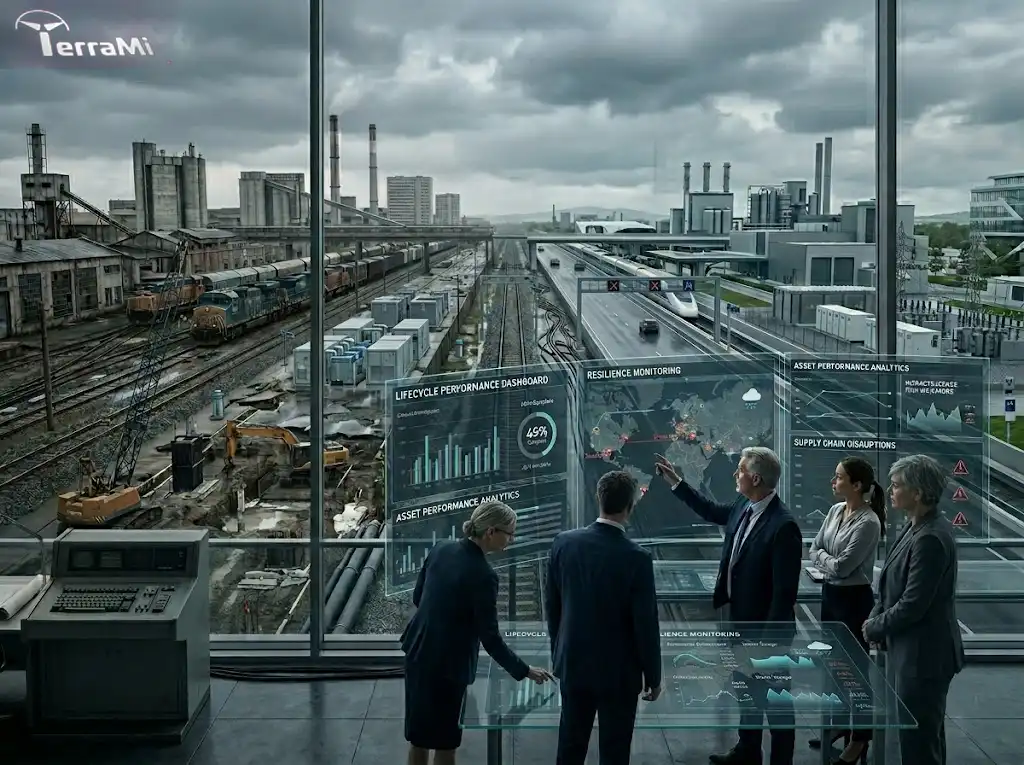
Organizations responding successfully to this transition are increasingly adopting measurable operating frameworks and data-led governance approaches, moving beyond reporting toward performance visibility and execution discipline ESG Metrics in Infrastructure Projects.
This shift is not temporary.
The challenge facing infrastructure organizations today is not whether they can build assets efficiently. It is whether those assets can continue delivering value under conditions that continuously change.
That is why traditional infrastructure models are no longer sustainable.
The organizations that outperform over the next decade will not necessarily build more. They will build systems capable of learning, adapting, and operating under uncertainty.
Why Traditional Infrastructure Models Are Losing Their Strategic Advantage
Traditional infrastructure delivery was designed for optimization.
Modern infrastructure requires adaptation.
Historically, project success depended on variables such as:
- Capital efficiency
- Schedule adherence
- Scope control
- Procurement optimization
- Compliance completion
Those indicators remain necessary—but increasingly insufficient.
Infrastructure now operates inside interconnected environments where disruptions rarely stay isolated.
A procurement issue becomes a schedule issue.
A weather event becomes a financing issue.
A workforce shortage becomes an operational continuity issue.
A reporting gap becomes a governance issue.
When infrastructure systems remain organized in disconnected layers, organizations lose visibility into how risk compounds across the lifecycle.
The result is not simply inefficiency.
It is strategic fragility.
Traditional Infrastructure Models Depend on Static Assumptions
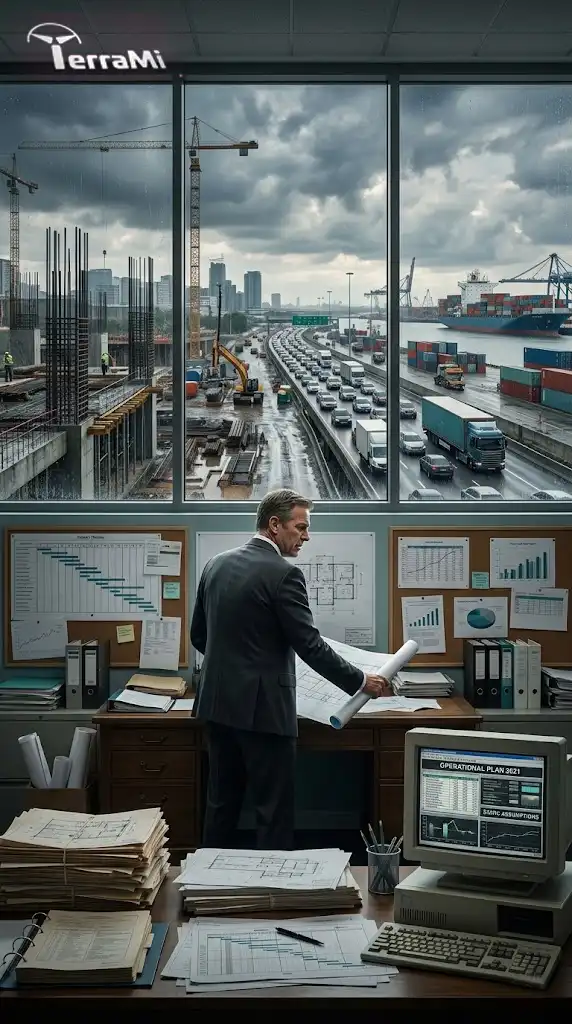
One of the structural limitations of traditional infrastructure models is their dependence on static planning logic.
Projects are commonly divided into sequential stages:
Planning → Design → Construction → Operation
While operationally convenient, this structure often creates delayed feedback loops.
Decisions made during planning frequently remain unchanged despite evolving conditions during execution.
This creates four recurring problems:
Limited Operational Visibility
Data often exists across isolated platforms with inconsistent ownership and delayed reporting.
Teams receive information after conditions have already changed.
Reactive Risk Management
Risk frameworks frequently focus on documenting issues rather than continuously identifying emerging operational signals.
Weak Lifecycle Integration
Assets may perform adequately at commissioning while underperforming across decades of operation.
Decision Latency
By the time executive teams receive performance data, opportunities for intervention may already be reduced.
Infrastructure uncertainty is accelerating faster than legacy governance models can absorb.
Sustainable Infrastructure Is No Longer an Environmental Conversation
A common misunderstanding is that sustainable infrastructure is primarily about environmental compliance.
That interpretation no longer captures the operational reality.
Sustainable infrastructure increasingly represents a management capability.
The question is no longer:
“How sustainable is the asset?”
The better question is:
“How resilient is the operating model behind the asset?”
A modern sustainable infrastructure strategy integrates:
- Operational performance
- Resource efficiency
- Asset adaptability
- Data visibility
- Long-term financial durability
- Infrastructure resilience
This changes how leaders evaluate success.
Infrastructure that performs for 18 months but deteriorates over 30 years cannot realistically be considered successful delivery.
Durability is becoming as important as deployment.
Operational ESG Is Becoming a Structural Layer of Infrastructure Decisions
Much of the early discussion around ESG focused on disclosure.
Infrastructure execution requires something different.
Operational ESG moves ESG from reporting into decision systems.
This means connecting:
Governance to Execution
Strategic objectives must translate into measurable field conditions.
Environmental Data to Operations
Performance indicators should influence daily operational decisions rather than annual reporting cycles.
Social Performance to Workforce Stability
Labor conditions, contractor coordination, and workforce readiness increasingly affect delivery outcomes.
Risk Monitoring to Capital Allocation
Investment decisions become stronger when operational signals are visible in real time.
Organizations that operationalize ESG gain something more valuable than compliance.
They gain decision quality.
Infrastructure Resilience Requires Infrastructure Intelligence
Resilience is frequently misunderstood as recovery.
Infrastructure resilience actually begins before disruption occurs.
The highest-performing infrastructure systems increasingly share common characteristics:
Continuous Data Collection
Performance signals remain visible across asset lifecycles.
Predictive Decision Frameworks
Teams evaluate emerging conditions before failures occur.
Cross-Functional Visibility
Finance, operations, delivery, and governance share common operational context.
Adaptive Execution Models
Planning evolves alongside changing field conditions.
This transition can be described as moving from infrastructure delivery to infrastructure intelligence.
Infrastructure intelligence is the capability to transform operational information into measurable action.
Organizations that develop this capability reduce uncertainty without reducing ambition.
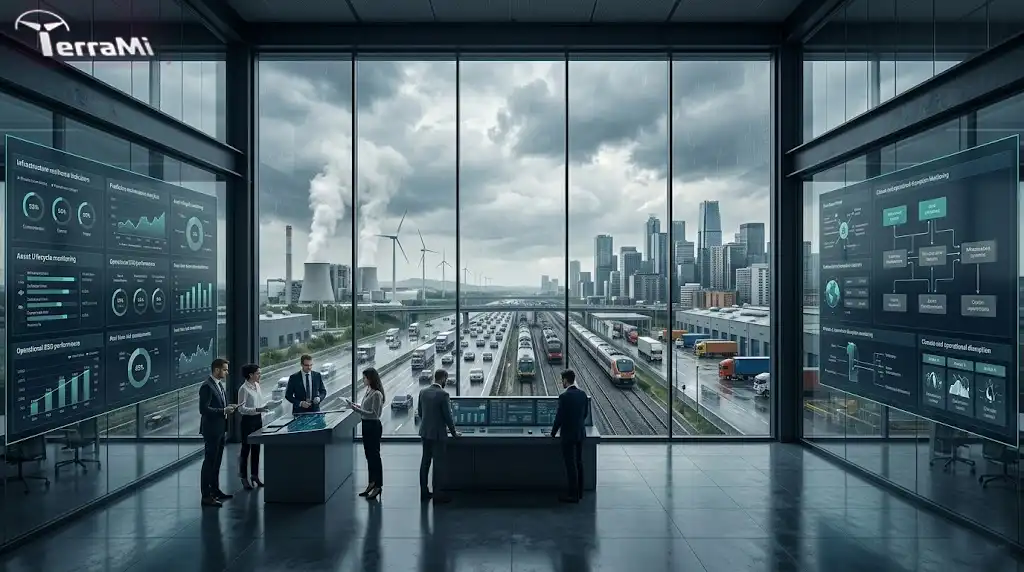
The Cost of Maintaining Legacy Infrastructure Thinking
Maintaining outdated infrastructure models creates hidden costs that rarely appear in initial project budgets.
Those costs emerge later as:
- Asset underperformance
- Operational interruptions
- Delayed interventions
- Capital inefficiencies
- Reduced stakeholder confidence
- Higher lifecycle expenses
- Governance complexity
The issue is not that legacy approaches completely fail.
The issue is that they scale poorly under modern conditions.
As infrastructure systems become more interconnected, traditional decision cycles become increasingly expensive.
Future competitiveness will depend less on building larger assets and more on operating smarter systems.
Building the Next Generation of Sustainable Infrastructure
Infrastructure transformation does not begin with technology.
It begins with changing operating assumptions.
Leading organizations increasingly ask different questions:
Instead of:
“How do we finish faster?”
They ask:
“How do we remain effective longer?”
Instead of:
“How do we collect more data?”
They ask:
“How do we improve decisions?”
Instead of:
“How do we reduce isolated risks?”
They ask:
“How do we strengthen system resilience?”
The next generation of sustainable infrastructure will likely be defined by four capabilities:
- Integrated operational data
- Lifecycle-based decision frameworks
- Infrastructure resilience metrics
- Adaptive governance systems
Technology supports these outcomes.
But strategic alignment enables them.
The Future Belongs to Infrastructure That Can Adapt
Infrastructure has entered a period where predictability can no longer be treated as a default condition.
Projects, assets, and investment decisions increasingly operate under persistent uncertainty.
Organizations that continue relying exclusively on traditional infrastructure models may still deliver projects.
But delivery alone will not define leadership.
Leadership will belong to organizations capable of converting uncertainty into operational visibility and operational visibility into sustained performance.
Sustainable infrastructure is no longer an aspirational objective.
Organizations that want to move beyond reporting and create measurable execution capability increasingly require operating models that connect governance, performance, and infrastructure intelligence. This shift is not about adding another management layer—it is about building infrastructure systems capable of adapting under real-world conditions. Explore how Operational ESG can support this transition through measurable infrastructure performance and long-term decision visibility.
It is becoming the operating requirement for long-term value creation.
At TerraMi, we view this transition as more than digital transformation or ESG maturity.
It is the evolution from infrastructure delivery toward infrastructure intelligence.