
Barriers to Circular Implementation in Infrastructure: Why Good Intentions Are Not Enough
Introduction
Over the past decade, organizations worldwide have increasingly recognized the importance of circular economy principles in infrastructure development. However, circular infrastructure barriers continue to prevent many projects from moving beyond sustainability commitments toward practical implementation. Despite growing awareness, infrastructure systems still operate largely through linear models that limit material reuse, lifecycle optimization, and resource efficiency.
Yet despite this growing consensus, the practical reality remains remarkably different.
Most infrastructure assets continue to be conceived, designed, procured, constructed, operated, and eventually demolished according to fundamentally linear principles. Materials still follow a predominantly one-way journey from extraction to disposal. Valuable components are frequently lost at the end of asset life, procurement systems continue to prioritize lowest upfront cost over long-term value, and project teams often lack the information necessary to recover or reuse materials effectively.
This disconnect raises an important question. If virtually everyone now agrees that circular infrastructure represents a more sustainable future, why has implementation remained so limited?
The answer is not that organizations lack ambition. Nor is it simply a matter of insufficient technology, inadequate funding, or weak environmental awareness. The deeper challenge is structural.
Today’s infrastructure industry was designed around operational models that prioritize linear delivery, fragmented decision-making, and short-term project optimization. Circularity, by contrast, depends on continuous information flows, lifecycle collaboration, material intelligence, adaptive governance, and coordinated decision-making across multiple stakeholders. In many organizations, these capabilities remain disconnected from one another.
As discussed in TerraMi’s previous Insight, Driving Infrastructure Toward Circular Economy Readiness, readiness should not be confused with implementation. Organizations may recognize the importance of circularity, establish sustainability commitments, and launch pilot initiatives while still operating within systems that were never designed to support circular outcomes.
Likewise, our earlier discussion in The Foundation of Sustainable Infrastructure Systems emphasized that sustainability emerges from interconnected systems rather than isolated interventions. Circular implementation represents one of the clearest demonstrations of this principle. Success depends less on individual technologies than on the ability of governance, engineering, procurement, finance, operations, and digital information systems to function as an integrated whole.
The transition to circular infrastructure is therefore not primarily a technological challenge.
It is a systems transformation challenge.
Understanding the barriers that prevent this transformation is essential—not because organizations lack commitment, but because overcoming these obstacles requires fundamentally rethinking how infrastructure projects are planned, delivered, managed, and continuously improved throughout their lifecycle.
The Circular Economy Has Won the Debate—But Not the Industry
Few concepts have achieved such rapid global acceptance within sustainability discourse as the circular economy. Once regarded as an emerging environmental philosophy, circularity now appears in national infrastructure strategies, ESG frameworks, corporate sustainability reports, procurement guidelines, engineering standards, and long-term investment policies. Across the public and private sectors, the direction of travel is increasingly clear: future infrastructure must minimize waste, preserve material value, and operate within planetary resource limits.
From a strategic perspective, the debate is largely over.
The evidence supporting circular approaches has become increasingly compelling. Infrastructure projects consume enormous quantities of raw materials, generate significant construction and demolition waste, and influence resource demand for decades after completion. Improving material recovery, extending asset life, designing for adaptability, and reducing dependence on virgin resources are now widely recognized as practical strategies for enhancing both environmental performance and economic resilience.
In principle, few organizations openly oppose these objectives.
However, widespread agreement has not translated into widespread implementation.
Many infrastructure projects continue to treat circularity as an additional sustainability initiative rather than as a fundamental operating principle. Circular considerations are often introduced late in project development, after critical design decisions have already been made. Procurement frameworks still reward conventional purchasing practices, project schedules continue to prioritize immediate delivery pressures, and information about future material recovery remains fragmented or unavailable.
This gap between strategic aspiration and operational reality reveals an important insight.
The greatest barriers to circular implementation rarely originate from a lack of knowledge about what should be done. Instead, they emerge from the institutional structures, governance models, financial incentives, and decision-making processes that determine how infrastructure projects are actually delivered.
Recognizing this distinction shifts the conversation in a meaningful way. Rather than asking why organizations are not embracing circularity, a more productive question is whether the systems within which they operate are capable of delivering circular outcomes at all.
That question forms the foundation for the remainder of this article.
Why Infrastructure Systems Resist Circular Change
One of the most persistent misconceptions surrounding circular infrastructure is the belief that implementation depends primarily on adopting new technologies or introducing more ambitious sustainability policies. While both are important, they rarely address the underlying reasons why circular initiatives struggle to move beyond isolated pilot projects.
Infrastructure systems are remarkably effective at producing the outcomes they were originally designed to achieve. For decades, those outcomes have emphasized predictable project delivery, cost control, schedule certainty, regulatory compliance, and operational reliability. These priorities have enabled societies to construct roads, bridges, ports, railways, energy systems, and water infrastructure at unprecedented scales.
The challenge is that these same systems were never designed to maximize material retention, facilitate asset adaptability, preserve resource value across multiple lifecycles, or coordinate decisions beyond individual project boundaries.
Circularity therefore asks infrastructure organizations to achieve objectives that their existing operating models were not built to support.
This distinction is fundamental.
Organizations often attempt to introduce circular practices without redesigning the governance structures, procurement models, information systems, and performance metrics that continue reinforcing linear behavior. As a result, circular initiatives frequently remain dependent on exceptional leadership, temporary funding, or individual champions rather than becoming embedded within routine project delivery.
In many respects, infrastructure behaves exactly as complex systems theory would predict. Individual actors may support circular principles, yet the collective system continues producing linear outcomes because the incentives, information flows, contractual relationships, and decision architectures remain largely unchanged.
This explains why organizations that genuinely support sustainability can still generate projects with significant material waste, limited reuse, fragmented data, and inefficient resource utilization. The problem is rarely one of intent. It is one of system design.
Rather than viewing the following barriers as isolated obstacles, they should be understood as interconnected characteristics of a delivery ecosystem that continues to prioritize short-term project completion over long-term resource stewardship.
Only by recognizing these structural dynamics can infrastructure organizations begin shifting from incremental improvements toward genuinely circular operating models.
Barrier 1 — Fragmented Project Delivery
Infrastructure projects are rarely delivered by a single organization.
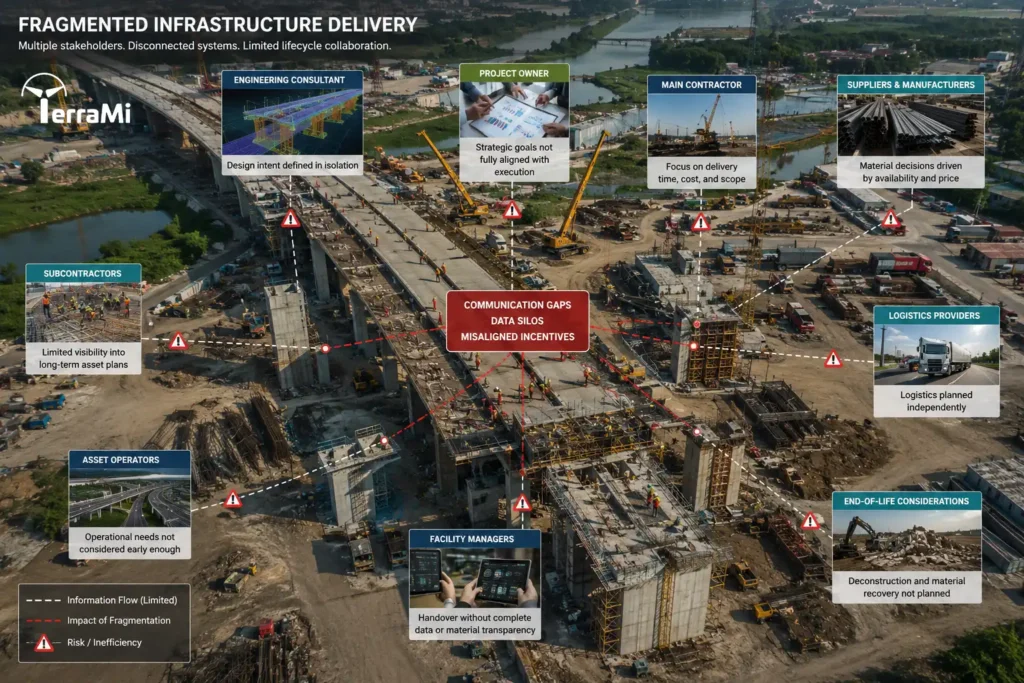
Instead, they involve intricate networks of owners, consultants, architects, engineers, contractors, subcontractors, suppliers, operators, regulators, financiers, and technology providers. Each participant contributes valuable expertise while pursuing objectives shaped by contractual obligations, commercial pressures, and project-specific responsibilities.
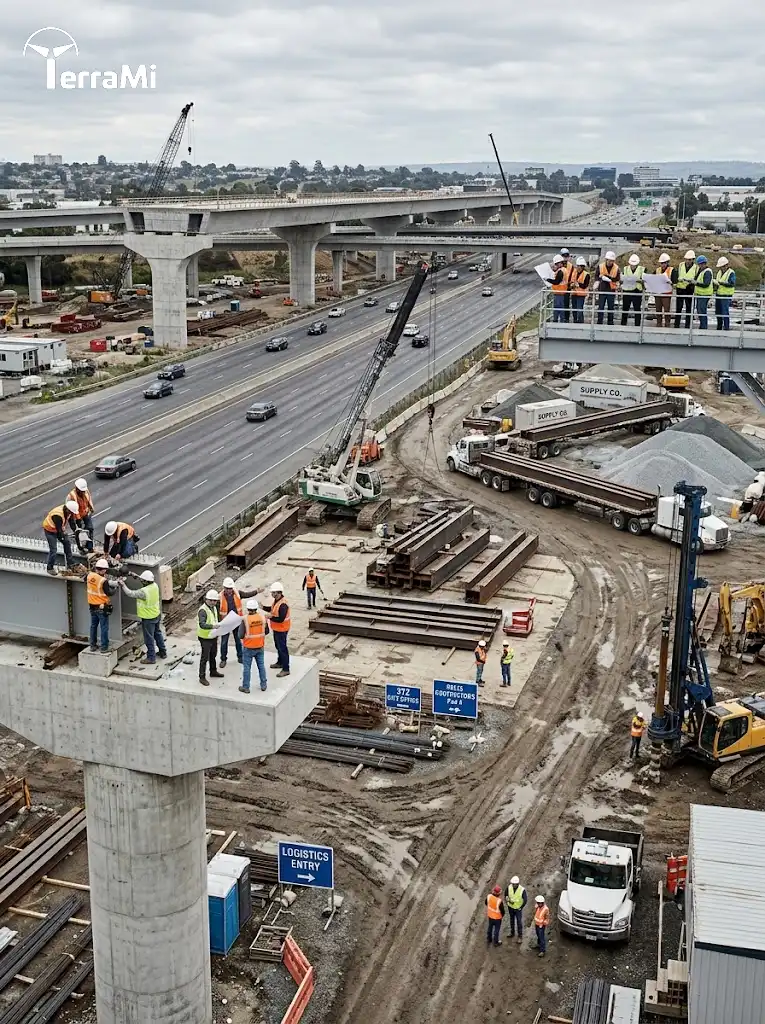
This specialization has enabled extraordinary engineering achievements. However, it also creates one of the greatest barriers to circular implementation. Most project participants optimize their own scope of work rather than the lifecycle performance of the infrastructure asset as a whole. Design consultants may prioritize engineering efficiency. Procurement teams focus on acquisition costs.
Construction contractors emphasize schedule performance. Operators concentrate on maintenance reliability. Asset owners evaluate long-term operational outcomes. Each perspective is rational within its own context. Yet circularity depends on decisions that frequently extend beyond the authority or incentives of any individual stakeholder.
Consider a bridge designed with reusable structural components. The engineering solution may technically enable future disassembly and material recovery. However, if procurement specifications fail to recognize reusable materials, contractors lack recovery expertise, digital records are incomplete, or future operators cannot access component histories decades later, much of the intended circular value disappears. The technology itself was never the limiting factor. The coordination system was.
Fragmentation also reduces the visibility required for informed decision-making. Material information becomes dispersed across design documents, procurement databases, construction records, maintenance systems, and asset management platforms that often operate independently from one another.
Without integrated information, opportunities for component reuse, refurbishment, remanufacturing, or adaptive repurposing become increasingly difficult to identify. The result is predictable.
Assets that still contain considerable material value are frequently treated as waste because the knowledge required to recover that value has been fragmented throughout the project lifecycle. Circular infrastructure therefore requires a transition from fragmented project optimization toward integrated lifecycle collaboration. This is not merely an organizational improvement. It represents a fundamental redesign of how infrastructure knowledge is created, shared, and preserved over decades.
Barrier 2 — Procurement Designed for Linear Consumption
Few organizational functions exert greater influence over infrastructure outcomes than procurement.
Procurement determines which materials enter a project, how suppliers are evaluated, which performance criteria receive priority, and ultimately what forms of value become economically attractive throughout the delivery process.
Despite its strategic importance, procurement practices in many infrastructure organizations remain rooted in assumptions developed for linear production systems.
Historically, procurement has rewarded predictable supply, standardized specifications, lowest initial cost, and immediate project delivery. These priorities were entirely appropriate within industrial models that viewed raw materials as abundant, inexpensive, and continuously available. Today’s resource landscape is fundamentally different.
Material price volatility, geopolitical uncertainty, supply chain disruptions, critical mineral dependencies, climate-related risks, and increasing ESG expectations have transformed procurement into a strategic resilience function rather than a purely transactional activity.
Yet many procurement frameworks continue measuring success primarily through short-term purchasing efficiency. This creates a structural contradiction.
Circular infrastructure often requires procurement decisions that initially appear more complex. Teams may need to evaluate reclaimed materials, specify reusable components, engage suppliers capable of reverse logistics, or consider lifecycle service agreements rather than one-time purchases.
These approaches frequently generate greater long-term value, but they may not perform well under procurement systems that emphasize immediate capital expenditure or lowest bid selection.
Consequently, project teams receive conflicting signals. Strategic sustainability policies encourage circular outcomes. Procurement incentives continue rewarding linear decisions. Until these competing objectives become aligned, implementation will remain inconsistent regardless of how ambitious organizational sustainability commitments may appear. The transition toward circular procurement therefore requires more than adding environmental clauses to tender documents.
It requires redefining what constitutes value within infrastructure investment.
Material Flow Optimization in Infrastructure Projects
Material flow optimization extends beyond logistics. It enables infrastructure organizations to understand where materials originate, how they move through complex delivery systems, where value is lost, and how intelligent planning can improve efficiency, resilience, and circular performance throughout the asset lifecycle.
Continue reading: Material Flow Optimization in Infrastructure Projects
Barrier 3 — Missing Material Intelligence
Circular infrastructure cannot function without knowing what materials exist, where they are located, what condition they are in, how they have performed over time, and whether they retain value for future use.
Surprisingly, this basic information remains unavailable—or inaccessible—for a significant proportion of infrastructure assets worldwide.
Many organizations possess extensive engineering documentation, maintenance records, procurement databases, inspection reports, and operational datasets. However, these information sources are rarely integrated into a coherent understanding of material value throughout an asset’s lifecycle.
Knowing that a bridge contains structural steel is not the same as knowing whether those components can be safely reused after decommissioning. Knowing that concrete was poured during construction does not reveal its composition, embodied carbon, durability history, contamination risk, or suitability for future applications. This distinction marks the difference between material data and material intelligence.
As explored in TerraMi’s earlier article, Material Intelligence for Resource-Based Regeneration, intelligence emerges when information becomes actionable. It connects engineering characteristics with lifecycle performance, digital traceability, environmental impacts, regulatory requirements, and future decision-making. Without this capability, circular strategies become largely speculative. Project teams cannot confidently identify reusable assets.
Designers cannot incorporate recovered materials into new infrastructure with sufficient assurance. Owners cannot estimate the future value embedded within existing assets. Investors cannot accurately evaluate resource resilience. Procurement teams cannot distinguish between materials that merely satisfy technical specifications and those that actively strengthen long-term circular performance. The consequence is significant.
Infrastructure continues consuming new resources while existing assets quietly store enormous quantities of recoverable value that remain effectively invisible to decision-makers. This hidden resource economy represents one of the greatest untapped opportunities in the transition toward circular infrastructure. Unlocking it requires more than digital databases. It requires intelligent systems capable of transforming fragmented material information into strategic decision support across the entire infrastructure lifecycle.
Barrier 4 — Financial Models That Ignore Lifecycle Value
Infrastructure investment has traditionally been evaluated through financial frameworks designed to optimize capital expenditure, construction efficiency, and predictable returns within relatively short planning horizons. While these models have supported decades of infrastructure expansion, they often struggle to recognize the forms of value that circular systems are intended to create.
Circular infrastructure generates benefits that accumulate over time.
Materials retain economic value beyond their first application. Components can be refurbished instead of replaced. Assets designed for adaptability remain useful under changing operational demands. Digital traceability reduces uncertainty surrounding maintenance and future recovery. Resource efficiency lowers exposure to volatile material markets while extending the productive life of existing infrastructure.
Many of these advantages emerge gradually rather than immediately.
Unfortunately, conventional financial evaluation frequently emphasizes initial project cost while undervaluing long-term resilience, future resource availability, avoided waste management expenses, reduced carbon liabilities, and retained material assets.
This creates an unintended bias toward linear investment decisions.
For example, designing a transport facility with modular, recoverable structural systems may require additional engineering effort during early project phases. Under a purely capital-cost perspective, this appears as an increased project expense. However, when evaluated across the asset’s entire lifecycle, the same decision may significantly reduce future demolition costs, preserve recoverable materials, improve adaptability, and lower environmental liabilities.
The investment has not become more expensive.
The accounting framework has simply failed to recognize where value is created.
This issue extends beyond individual projects.
Infrastructure owners increasingly operate in environments characterized by material price volatility, supply chain uncertainty, climate adaptation requirements, and stricter ESG reporting obligations. Financial models that overlook lifecycle resource value may unintentionally increase long-term exposure to these systemic risks.
Circular implementation therefore requires financial evaluation methods capable of recognizing infrastructure not merely as a depreciating physical asset, but as a continuously evolving repository of material, environmental, and operational value.
Barrier 5 — Regulation Still Rewards Linear Performance
Public policy has played a central role in advancing sustainability within the infrastructure sector. Environmental standards, carbon reduction targets, waste management regulations, and ESG disclosure requirements have all encouraged organizations to reconsider traditional development models.
Yet regulation often evolves more slowly than engineering practice.
Many regulatory frameworks continue to assess infrastructure according to indicators that originated within linear economic systems. Compliance may focus on waste disposal, emissions during construction, procurement procedures, or technical performance without adequately addressing material preservation, adaptive reuse, design for disassembly, or long-term resource recovery.
As a result, organizations frequently encounter an uncomfortable reality. A project can satisfy every regulatory requirement while still losing substantial quantities of recoverable material value throughout its lifecycle. This is not necessarily a failure of regulation.
Rather, it reflects the historical context in which many standards were developed. Most existing regulations were designed to minimize negative environmental impacts within linear systems, not to optimize positive resource circulation across multiple infrastructure lifecycles.
The distinction is significant. Reducing waste is not equivalent to preserving resource value. Managing demolition responsibly is not the same as designing infrastructure that avoids unnecessary demolition altogether. Similarly, recycling valuable materials after asset retirement represents progress, but it often occurs only after much of the original economic and functional value has already been lost.
Forward-looking regulatory systems are beginning to recognize these differences by encouraging lifecycle assessment, circular procurement, digital material passports, and whole-life carbon evaluation. However, implementation remains uneven across jurisdictions and infrastructure sectors. Until regulatory incentives consistently reward circular outcomes alongside traditional compliance metrics, organizations will continue balancing conflicting expectations between policy ambitions and operational realities.
Barrier 6 — Cultural Resistance Inside Organizations
Technology can be purchased. Policies can be revised. Contracts can be rewritten. Organizational culture is considerably more difficult to transform.
Infrastructure organizations have developed operational routines over decades of successful project delivery. These routines shape how risks are interpreted, how decisions are made, how performance is measured, and ultimately how innovation is either encouraged or constrained.
Within many organizations, linear thinking has become deeply institutionalized—not because employees oppose sustainability, but because familiar processes continue producing reliable short-term outcomes. Project managers are rewarded for delivering on schedule. Procurement teams are evaluated through purchasing efficiency. Engineering departments prioritize technical certainty.
Operations personnel minimize operational disruption. Finance departments control expenditure. Each function performs effectively according to its own objectives. Yet circular implementation frequently requires these same teams to optimize collectively rather than independently. That shift can feel uncomfortable.
Designers may hesitate to specify reclaimed materials that appear unfamiliar. Procurement professionals may avoid suppliers lacking extensive historical records. Project leaders may perceive circular practices as introducing additional complexity under already demanding delivery schedules.
Executives may support ambitious sustainability commitments while middle management struggles to reconcile those ambitions with existing performance metrics. These responses should not automatically be interpreted as resistance to change. More often, they represent rational reactions to organizational systems that continue rewarding linear success.
Creating a circular culture therefore depends less on persuading individuals and more on redesigning the incentives, leadership expectations, professional training, collaboration mechanisms, and performance indicators that shape everyday decision-making. When organizations align these elements, cultural transformation becomes a consequence of systemic change rather than an isolated change-management initiative.
Barrier 7 — Data Without Decision Intelligence
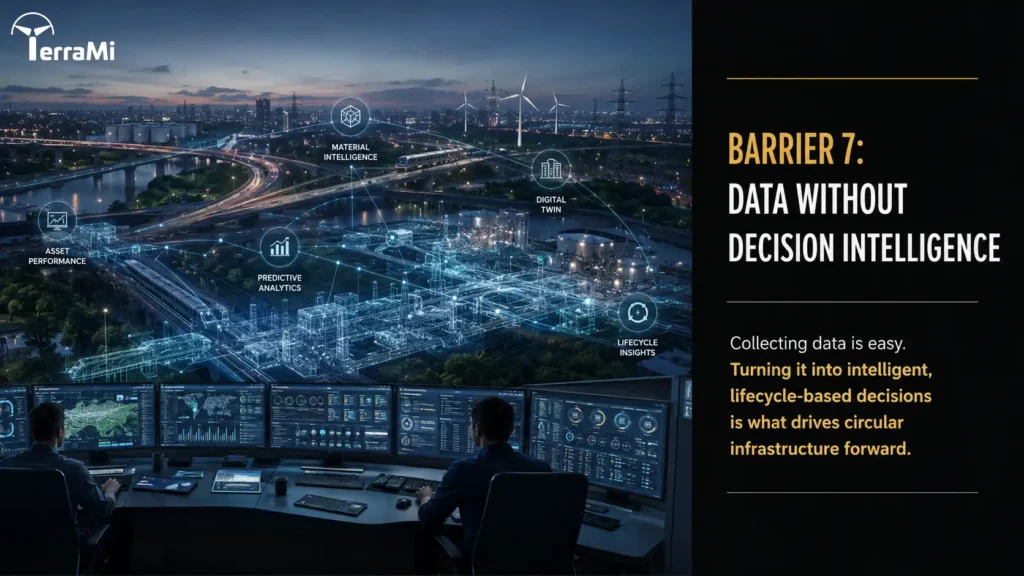
Infrastructure organizations have never possessed more data than they do today. Digital engineering platforms generate detailed design models. Construction sites produce continuous operational information. Sensors monitor structural performance. Asset management systems collect maintenance histories.
Inspection technologies generate high-resolution condition assessments. Procurement systems record extensive supplier information. The quantity of available data continues expanding rapidly. Yet data abundance alone does not produce circular infrastructure.
Many organizations continue operating with fragmented digital environments where information exists but remains disconnected from the decisions that determine material recovery, lifecycle planning, adaptive reuse, procurement strategies, and infrastructure resilience.
This creates what may be described as a decision intelligence gap. Decision-makers often have access to large volumes of information without possessing integrated insights capable of guiding complex lifecycle choices.
A digital model may accurately represent physical geometry while providing little understanding of future recoverability. Maintenance databases may document asset condition without estimating remaining material value. Procurement systems may record purchased components while failing to establish digital traceability across decades of operation.
As infrastructure becomes increasingly digital, the competitive advantage will not belong to organizations that simply collect more information. It will belong to those capable of transforming information into coordinated, predictive, and lifecycle-oriented decision intelligence.
Organizations looking to understand their current level of digital and circular readiness can begin with TerraMi’s AI Pre-Assessment, which provides an initial evaluation of organizational capabilities and identifies opportunities for improvement before embarking on broader transformation initiatives.This distinction represents one of the defining transitions shaping the next generation of infrastructure management.
It also establishes a natural bridge toward TerraMi’s upcoming exploration of digital infrastructure, digital twins, predictive asset management, and infrastructure intelligence as foundational capabilities for circular and resilient infrastructure systems.
From Isolated Barriers to Connected Systems
Examining these barriers individually is useful for understanding where implementation challenges emerge. However, treating them as separate problems risks overlooking the deeper pattern that connects them.
Fragmented delivery creates disconnected information. Disconnected information weakens procurement decisions. Linear procurement reinforces financial assumptions focused on short-term cost. Financial priorities influence regulatory interpretation and organizational incentives.
Organizational culture shapes how data is used. Weak decision intelligence limits the effectiveness of every other improvement. Each barrier reinforces the others. This interconnectedness explains why organizations that address only one challenge often experience disappointing results. Investing in digital technologies without changing procurement delivers limited progress. Introducing circular procurement without reliable material intelligence creates uncertainty. Revising sustainability policies without aligning financial incentives rarely changes everyday project decisions.
Circular implementation therefore cannot be approached as a collection of independent improvement projects. It requires coordinated transformation across governance, engineering, procurement, finance, digital systems, operations, and organizational leadership. In other words, the challenge is not simply implementing circular practices.
The challenge is redesigning the infrastructure system itself.
ESG as a Structural Driver in Infrastructure Projects
ESG delivers meaningful impact only when sustainability objectives become embedded within governance, procurement, engineering, operations, and organizational decision-making. Treating ESG as a reporting exercise rather than a structural operating framework limits both resilience and long-term value creation.
Continue reading: ESG as a Structural Driver in Infrastructure Projects
TerraMi Perspective
The transition toward circular infrastructure is often discussed as a question of technology, innovation, or sustainability policy. While these factors are important, they do not fully explain why implementation remains limited across much of the infrastructure sector.
At TerraMi, we believe the real challenge lies deeper.
Circular infrastructure is not constrained by a lack of ambition—it is constrained by systems that continue to reward linear behavior. Procurement, governance, financial evaluation, engineering workflows, and digital information management were largely designed for a different era, when resource abundance and one-way material flows were accepted as the norm.
Overcoming these barriers therefore requires more than adopting new tools or introducing isolated sustainability initiatives. It requires redesigning the decision-making architecture that governs how infrastructure assets are planned, delivered, operated, and ultimately regenerated.
This is where digital intelligence becomes essential.
As infrastructure systems become increasingly complex, organizations will need more than data—they will need integrated decision intelligence capable of connecting material flows, lifecycle performance, procurement strategies, ESG objectives, and operational resilience into a unified framework.
From TerraMi’s perspective, the future of circular infrastructure will not be defined by individual technologies, but by organizations that successfully integrate engineering, governance, and intelligence into a single operating model. Those that achieve this integration will be better positioned to manage resource uncertainty, strengthen resilience, and create long-term value from the infrastructure assets they own and operate.
Frequently Asked Questions (FAQ)
1. What are the biggest barriers to circular infrastructure implementation?
The most significant barriers include fragmented project delivery, procurement systems designed for linear consumption, limited material intelligence, financial models focused on upfront costs, regulatory frameworks that reward linear performance, organizational resistance to change, and insufficient decision intelligence.
2. Why is circular infrastructure difficult to implement?
Circular infrastructure requires collaboration across the entire asset lifecycle. Many infrastructure organizations still operate with disconnected systems, making it difficult to coordinate engineering, procurement, operations, and material recovery.
3. How does material intelligence support circular infrastructure?
Material intelligence transforms engineering and asset data into actionable insights. It enables organizations to identify reusable materials, improve lifecycle planning, support circular procurement, and make better-informed infrastructure decisions.
4. What is the difference between recycling and circular infrastructure?
Recycling focuses on recovering materials after they become waste. Circular infrastructure seeks to preserve the value of materials and assets throughout their entire lifecycle through better design, maintenance, reuse, refurbishment, and intelligent resource management.
5. Why is procurement important for circular infrastructure?
Procurement influences material selection, supplier relationships, lifecycle costs, and resource efficiency. Circular procurement encourages long-term value creation rather than simply selecting the lowest initial cost.
6. How can organizations begin their circular infrastructure journey?
Organizations should first evaluate their current capabilities across governance, procurement, digital systems, material management, and lifecycle planning. Establishing a clear understanding of current maturity helps identify the highest-impact opportunities for circular transformation before implementing new technologies or policies.
Related Resource: TerraMi’s AI Pre-Assessment provides an initial evaluation of organizational readiness for circular, ESG, and digital infrastructure transformation.