
The Future of Infrastructure Delivery: Why Sustainable Infrastructure Delivery Will Define the Next Generation of Global Projects
For decades, the infrastructure industry measured success through one dominant metric: speed. The faster a highway, tunnel, airport, transmission corridor, or energy facility could move from concept to commissioning, the more “successful” the project was considered. Yet the accelerating pressures of climate volatility, ESG regulation, resource scarcity, and operational complexity are fundamentally reshaping this paradigm. Today, Sustainable Infrastructure Delivery is emerging as the defining framework for long-term project viability, investor confidence, and infrastructure resilience.
The industry is entering a period where rapid delivery alone no longer guarantees strategic value. Infrastructure assets are now expected to perform under increasingly unpredictable environmental, regulatory, and economic conditions over multi-decade lifecycles. In this environment, projects optimized exclusively for schedule compression frequently create hidden liabilities that surface years later through excessive operational costs, carbon exposure, deferred maintenance burdens, and weakened climate adaptability.
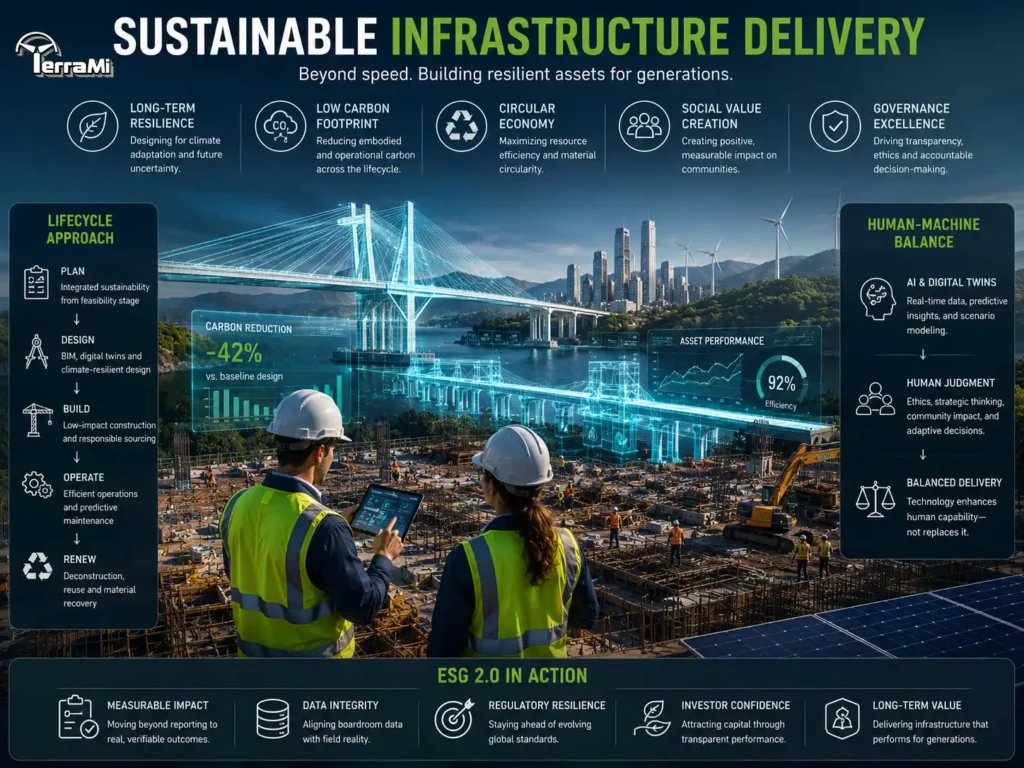
As global infrastructure systems become more interconnected and technologically dependent, Sustainable Infrastructure Delivery is no longer a secondary ESG initiative operating in parallel with construction execution. It is becoming the central operating philosophy that governs how projects are designed, procured, built, monitored, and maintained.
The future of infrastructure belongs to organizations capable of balancing execution velocity with lifecycle intelligence, digital transparency, environmental accountability, and field-level operational realism.
The Collapse of the “Build Faster at Any Cost” Model in Sustainable Infrastructure Delivery
Traditional project delivery models were built around short-term KPIs:
- accelerated schedules,
- minimized upfront capital expenditure,
- and rapid commissioning milestones.
However, these models often ignored the downstream consequences of infrastructure decisions made under procurement pressure and schedule compression.
In many large-scale projects, fast-tracking creates a chain reaction of operational compromises:
- lower-quality material substitutions,
- fragmented contractor coordination,
- inadequate climate adaptation analysis,
- excessive embodied carbon,
- and insufficient lifecycle performance modeling.
The result is infrastructure that may appear efficient during delivery but becomes economically and environmentally inefficient during operation.
This challenge is becoming increasingly visible across transportation, utilities, and urban development sectors. According to RICS Global Professional Standards, lifecycle thinking and whole-life carbon analysis are rapidly becoming central requirements for infrastructure governance frameworks worldwide.
The underlying issue is not speed itself. Infrastructure projects will always operate under intense schedule pressure. The problem emerges when schedule acceleration overrides long-term resilience planning.
A tunnel completed six months earlier loses strategic value if it requires major rehabilitation after fifteen years due to climate exposure that should have been addressed during the design stage. Likewise, a power infrastructure project optimized for initial CAPEX reduction may ultimately produce substantially higher operational emissions and maintenance liabilities across its lifecycle.
This is where Sustainable Infrastructure Delivery fundamentally diverges from legacy project management philosophies. The objective is no longer simply to “finish faster.” The objective is to optimize asset performance across a 30-to-50-year operational horizon.
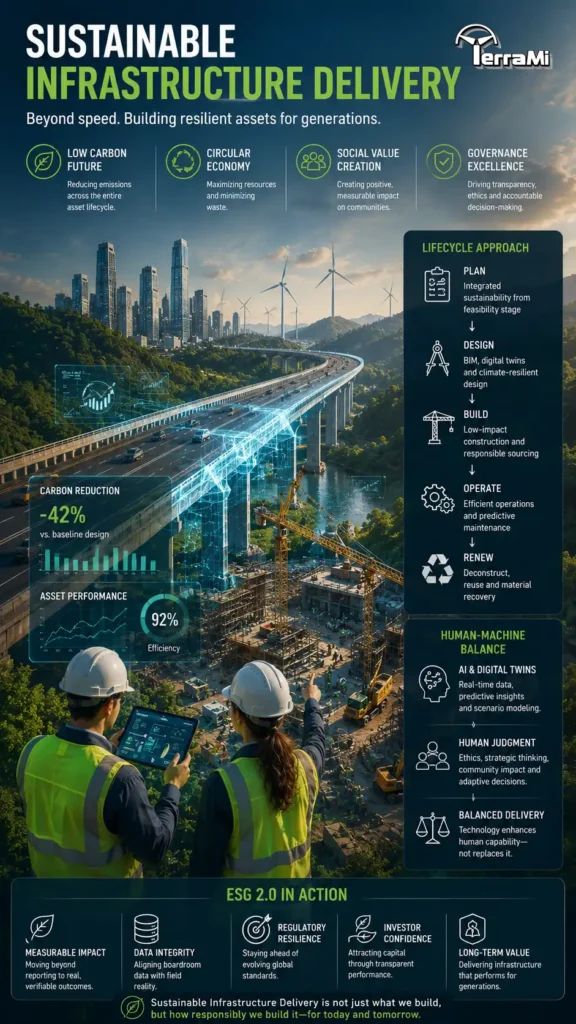
Why Sustainable Infrastructure Delivery Has Become a Strategic Competitive Advantage
The conversation around sustainability has evolved far beyond regulatory compliance. In today’s infrastructure economy, sustainability increasingly functions as a strategic differentiator influencing:
- investor behavior,
- procurement competitiveness,
- insurance exposure,
- financing conditions,
- and long-term asset valuation.
Organizations capable of integrating Sustainable Infrastructure Delivery principles at the feasibility and planning stages are significantly better positioned to navigate future regulatory and operational disruption.
At TerraMi, sustainability is approached not as a branding exercise, but as an operational intelligence framework that strengthens project resilience and execution quality.
Lifecycle Cost Optimization Beyond Initial CAPEX
Historically, infrastructure procurement focused heavily on reducing upfront capital costs. However, modern asset management increasingly prioritizes Total Cost of Ownership (TCO) and lifecycle operational efficiency.
This shift is transforming how infrastructure decisions are evaluated:
- energy efficiency now directly affects long-term profitability,
- circular material strategies reduce replacement exposure,
- predictive maintenance systems improve operational continuity,
- and resilient designs reduce climate-related disruption costs.
Organizations that fail to adopt lifecycle-based planning often underestimate future liabilities associated with:
- rising energy costs,
- carbon pricing mechanisms,
- water stress,
- extreme weather exposure,
- and accelerated material degradation.
The emergence of circular economy principles within infrastructure delivery is particularly important. As highlighted by UN Environment Programme – Sustainable Buildings and Construction, material reuse and embodied carbon reduction are becoming central components of global decarbonization strategies.
This transition changes the definition of “efficient infrastructure.” Efficiency can no longer be measured exclusively through construction timelines. It must include operational durability, environmental performance, and adaptability under changing future conditions.
Sustainable Infrastructure Delivery and the Rise of ESG 2.0
The infrastructure industry is now moving beyond first-generation ESG reporting into what many organizations describe as ESG 2.0: a more integrated, data-driven, and accountability-focused model of sustainability governance.
In ESG 1.0, many organizations focused primarily on high-level reporting metrics and compliance narratives. While reporting remains important, investors and regulators increasingly expect measurable operational alignment between corporate sustainability commitments and field execution realities.
This transition introduces a major challenge:
the widening disconnect between executive dashboards and on-site project conditions.
Boardrooms may define ambitious decarbonization targets, workforce safety goals, and ESG KPIs. Yet infrastructure projects often operate under very different realities:
- workforce shortages,
- procurement volatility,
- contractor fragmentation,
- regulatory inconsistency,
- and chronic schedule compression.
Without strong governance integration, sustainability targets frequently deteriorate during execution phases.
This is why Sustainable Infrastructure Delivery increasingly depends on “field reality verification” rather than purely centralized reporting systems.
The future of ESG performance will depend less on polished dashboards and more on whether infrastructure organizations can establish transparent synchronization between:
- digital reporting systems,
- operational decision-making,
- and actual site conditions.
This distinction is becoming increasingly important to institutional investors and infrastructure financing partners. According to Infrastructure Intelligence – ESG and Sustainability Trends, infrastructure stakeholders are placing greater emphasis on operational transparency and long-term resilience metrics rather than superficial ESG positioning.
The Human-Machine Balance in Sustainable Infrastructure Delivery
One of the defining characteristics of next-generation infrastructure systems is the growing integration of AI, predictive analytics, and Digital Twin technologies into project delivery workflows.
These technologies are transforming infrastructure management capabilities by enabling:
- real-time asset monitoring,
- predictive maintenance forecasting,
- material stress simulation,
- energy optimization,
- and operational risk modeling.
Digital Twins, in particular, are reshaping how infrastructure assets are evaluated throughout their lifecycle. By integrating sensor networks with live operational data, infrastructure operators can identify vulnerabilities before they evolve into catastrophic failures.
However, despite the extraordinary potential of automation and AI-driven analytics, technology alone cannot deliver sustainable infrastructure outcomes.
The future of Sustainable Infrastructure Delivery depends on maintaining a disciplined balance between technological precision and human strategic judgment.
Why Human Oversight Remains Irreplaceable
Infrastructure projects are not purely technical systems. They are socio-economic systems shaped by political pressure, labor conditions, community impact, environmental uncertainty, and regulatory evolution.
Algorithms can optimize material distribution models.
They cannot independently resolve ethical trade-offs involving:
- workforce welfare,
- indigenous land impact,
- public accountability,
- or long-term community resilience.
Similarly, predictive systems can identify schedule risks, but they cannot fully interpret the political and operational implications of field-level disruptions.
This creates a critical governance challenge for modern infrastructure leaders:
ensuring that digital optimization does not replace strategic accountability.
The most successful infrastructure organizations will not be those with the most automation. They will be the organizations capable of integrating:
- human expertise,
- operational realism,
- digital intelligence,
- and sustainability governance
into a unified decision-making framework.
Climate Resilience Is Becoming Central to Sustainable Infrastructure Delivery
Climate adaptation is no longer a future planning scenario. It is now an active operational variable affecting infrastructure reliability across every major sector.
Extreme heat, flooding, wildfire exposure, water scarcity, and severe weather volatility are already disrupting infrastructure performance worldwide. Assets designed under outdated environmental assumptions are becoming increasingly vulnerable.
As a result, Sustainable Infrastructure Delivery must now incorporate:
- climate resilience modeling,
- adaptive engineering standards,
- and long-term environmental stress forecasting
from the earliest planning stages.
This includes:
- flood-resistant transportation corridors,
- energy systems capable of handling temperature extremes,
- resilient water infrastructure,
- and materials engineered for longer operational durability under environmental stress.
Organizations that continue treating climate adaptation as a secondary design consideration risk creating stranded infrastructure assets that become economically unsustainable long before the end of their intended lifecycle.
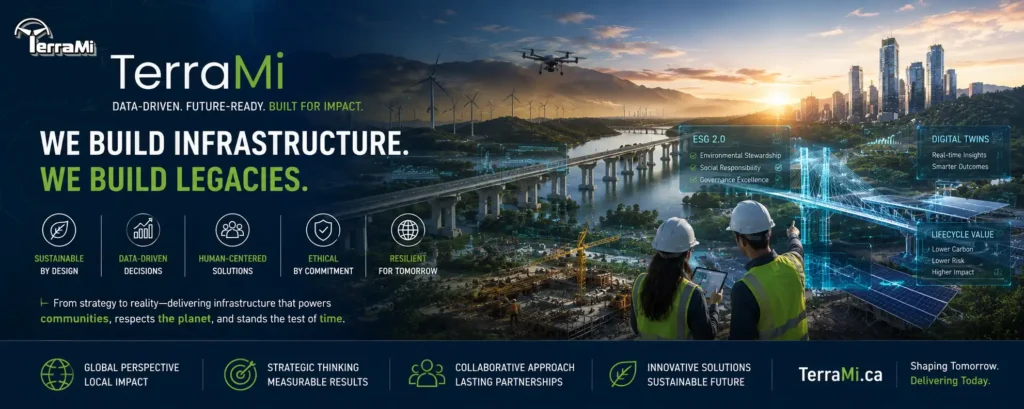
A New Definition of Excellence in Infrastructure Delivery
The infrastructure sector is entering a decisive transition period. The era in which rapid delivery alone defined project excellence is ending. Modern infrastructure must now satisfy a far broader set of expectations involving sustainability, resilience, operational transparency, digital accountability, and long-term lifecycle performance.
Sustainable Infrastructure Delivery represents more than an environmental initiative. It is the operational framework through which future-ready infrastructure will be conceived, governed, and executed.
The organizations that lead the next generation of infrastructure development will be those capable of connecting strategic vision with field reality — ensuring that ESG commitments, engineering decisions, digital systems, and on-site execution operate as a unified ecosystem rather than disconnected silos.
At TerraMi, we believe the future of infrastructure delivery depends on aligning sustainability strategy with operational execution at every stage of the asset lifecycle. From governance integration and lifecycle intelligence to digital-field synchronization and resilience planning, the next era of infrastructure will be defined not by how quickly projects are completed, but by how effectively they continue serving future generations under increasingly complex global conditions.