
Why Circular Economy in Construction Must Go Beyond Recycling
Introduction
Few concepts have gained as much attention in infrastructure and sustainability discussions as the circular economy. Governments reference it in policy documents. Investors increasingly include it within ESG assessments. Engineering firms highlight it in sustainability reports. Construction companies promote it in project announcements.
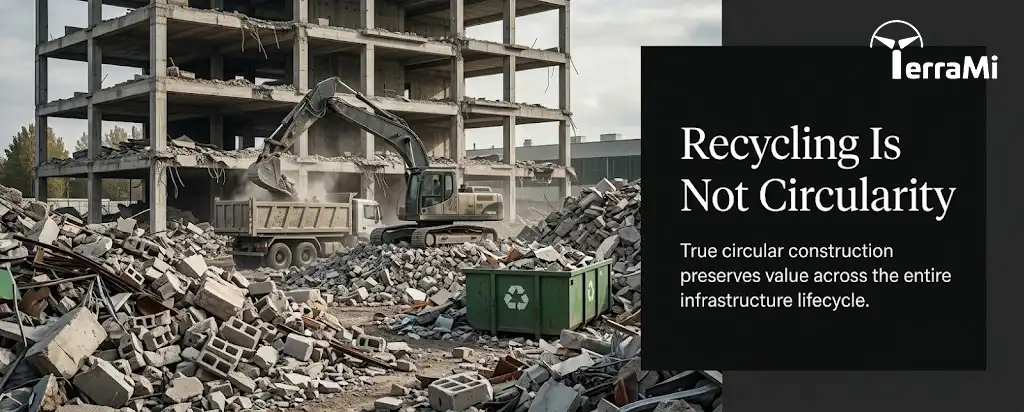
Yet despite its popularity, circular economy may be one of the most misunderstood concepts in modern infrastructure development.
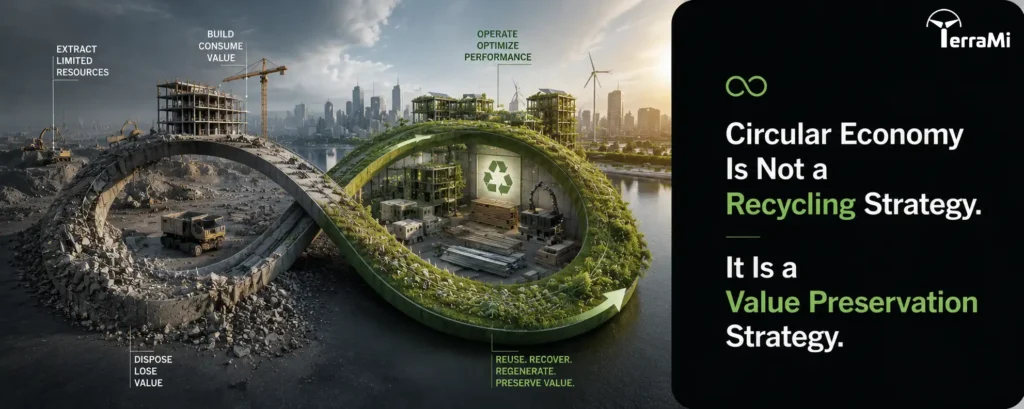
Many organizations claim to be pursuing circularity while continuing to operate largely within linear systems. Materials are still extracted, consumed, and discarded. Projects still prioritize short-term delivery over lifecycle value. Demolition often remains the default option when adaptation or recovery may be possible. The result is a growing gap between the language of circularity and the reality of implementation.
As discussed in our previous article, From Linear to Circular: The First Step in Infrastructure Transformation, the transition toward circular infrastructure begins with a fundamental shift in perspective. Circularity is not simply about managing waste more effectively. It is about redesigning how value flows through infrastructure systems across multiple lifecycles.
This distinction matters because the construction industry remains one of the world’s most resource-intensive sectors. Research from the United Nations Environment Programme continues to show that construction consumes enormous quantities of virgin materials while generating substantial waste streams, making the industry’s transition away from linear models increasingly important.
The challenge is that much of the public conversation about circular economy still focuses on the wrong things. Before discussing implementation, it is necessary to address the misconceptions.
How Circular Economy Became a Buzzword
The rise of circular economy is understandable. Over the last decade, organizations have faced growing pressure from a complex matrix of market and regulatory drivers:
| Category | Drivers of Circular Adoption |
| Regulatory & Compliance | ESG expectations Climate commitments Net-zero targets |
| Market & Supply Chain | Resource scarcity concerns Supply chain disruptions Investor scrutiny |
Under these conditions, circularity emerged as an attractive concept because it appears to offer solutions to multiple challenges simultaneously. Unlike traditional sustainability initiatives that often focus on reducing negative impacts, circular economy proposes a more systemic transformation. It seeks to preserve material value, reduce dependence on virgin resource extraction, and create more resilient economic systems.
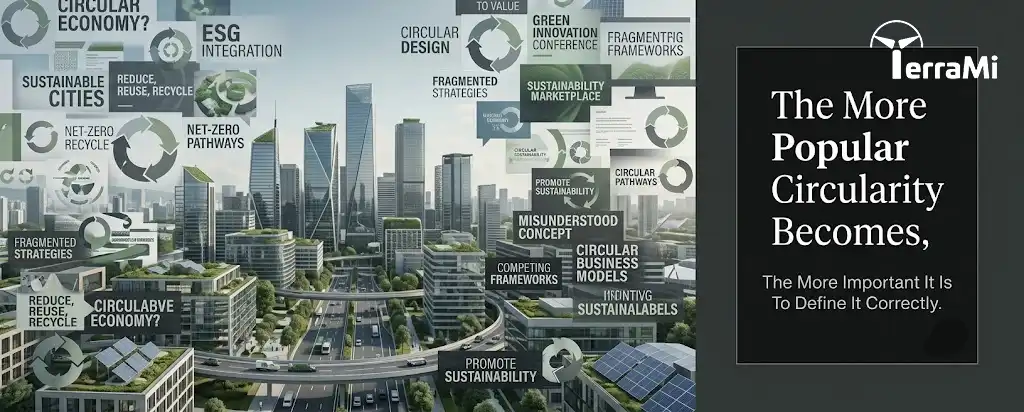
The problem is that rapid popularity often creates conceptual dilution. As more organizations adopted the language of circularity, the term gradually became attached to activities that are only partially circular—or sometimes not circular at all. Today, many construction projects are described as circular simply because they recycle waste materials or incorporate recycled content. While these actions may be beneficial, they represent only a small fraction of what circular economy actually involves.
The consequence is a growing disconnect between circular economy as a strategic framework and circular economy as a marketing label.
The Three Biggest Misconceptions About Circular Construction
Misconception 1: Recycling Equals Circular Economy
This is by far the most common misunderstanding. When most people hear the term “circular economy,” they immediately think about recycling. Recycling is important. However, circularity and recycling are not synonymous.
A genuinely circular system seeks to prevent value loss before recycling becomes necessary. The resource management priority shifts from the least effective to the most effective strategy according to the established value retention hierarchy:
| Priority | Strategy | Description |
| Highest Priority | 1. Reduce 2. Reuse | Minimizing material demand at the source and direct component reuse. |
| Medium Priority | 3. Refurbish 4. Remanufacture 5. Repurpose | Extending mechanical and structural life through mechanical upgrading. |
| Lowest Priority | 6. Recycle | Processing materials back into raw states, often resulting in downcycling. |
In other words, recycling often represents one of the final options rather than the primary objective. This distinction is particularly important in construction. A concrete structure crushed into road aggregate may technically be recycled. However, much of its original value has already been lost.
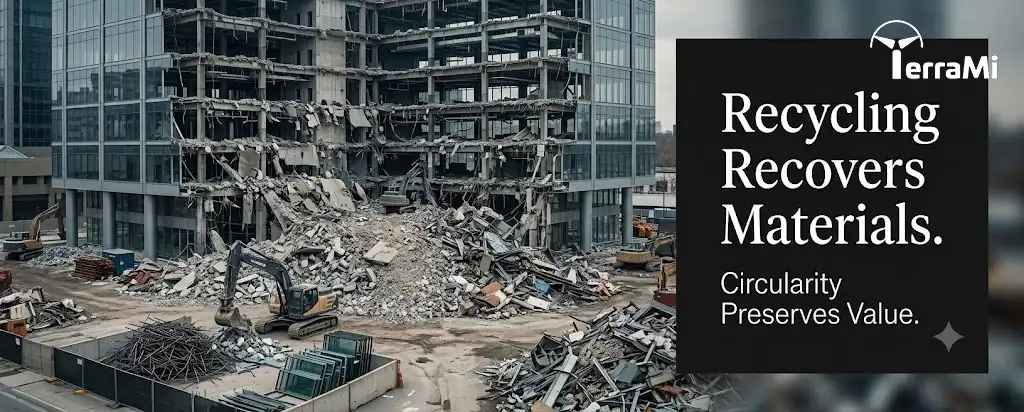
Research examining circularity in construction repeatedly notes that industry discussions often overemphasize recycling while giving insufficient attention to reduction, reuse, design strategies, and value retention. The critical question therefore is not: Can this material be recycled? The more important question is: How can this material retain its highest possible value for the longest possible period?
Misconception 2: Circular Economy Is Primarily an Environmental Initiative
Environmental benefits are important. But reducing circular economy to an environmental strategy significantly understates its importance. As outlined by systemic frameworks from the Ellen MacArthur Foundation, circularity increasingly intersects with critical operational metrics:
- Resource security: Mitigating the volatility of virgin commodity markets.
- Supply chain resilience: Creating localized loops to counter geopolitical friction.
- Infrastructure resilience: Designing assets that can adapt to shifting physical demands.
- Economic competitiveness: Retaining capital expenditure within the asset lifecycle.
- National strategic planning: Securing localized sovereignty over critical industrial minerals.
Recent years have exposed vulnerabilities within global supply chains for construction materials, industrial inputs, and critical minerals. As a result, policymakers are beginning to view circular systems not merely as sustainability tools but as mechanisms for reducing dependence on external resource flows.
The future relevance of circular construction may ultimately depend as much on economics and resilience as it does on environmental performance.
Misconception 3: Circularity Begins at End-of-Life
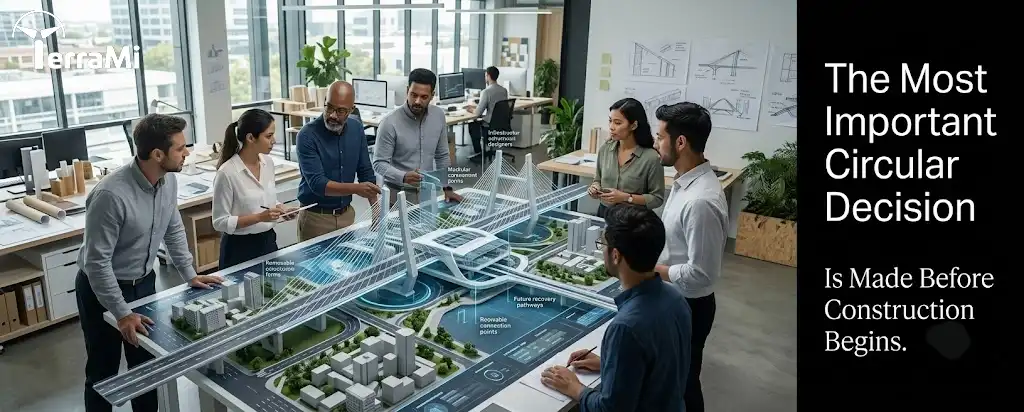
Many organizations begin discussing circularity only when assets approach demolition. By then, most opportunities have already been lost. True circularity begins during design.
Industry research consistently emphasizes that decisions made during design largely determine the future potential for reuse, recovery, adaptation, and deconstruction. Design for disassembly, adaptability, and future material recovery must be considered at the beginning of the asset lifecycle rather than at the end.
This principle fundamentally changes how projects are conceived. Instead of asking: How will this asset be demolished? Circular thinking asks: How will this asset evolve, adapt, and eventually become a resource for future infrastructure systems?
Why Construction Is Different from Consumer Products
Many circular economy concepts originated in manufacturing and consumer goods sectors. Construction is fundamentally different due to an entirely separate scale of operational longevity:
| Asset Type | Typical Lifecycle Horizon |
| Consumer Electronics (Smartphones) | 2 – 5 Years |
| Automotive Assets (Vehicles) | 10 – 15 Years |
| Infrastructure Assets (Buildings, Bridges) | 30, 50, 75, to 100+ Years |
This creates unique operational challenges:
- The individuals designing a building today will likely not be involved when that building reaches the end of its operational life.
- The organizations managing future reuse opportunities may not even exist yet.
As noted in current research on material passports, buildings often outlive the careers of the professionals who designed them, creating major challenges for preserving information needed for future reuse and recovery. This long lifecycle explains why many circular economy strategies that appear straightforward in manufacturing become significantly more complex in construction.
Information must survive decades. Ownership may change multiple times. Technologies evolve. Regulations shift. Markets change. Circular construction therefore requires a much longer planning horizon than most organizations are accustomed to.
The Real Question Most Organizations Are Not Asking
Much of the current discussion asks: How can we make construction more circular? This is a useful question. But it may not be the most important one. A more revealing question is:
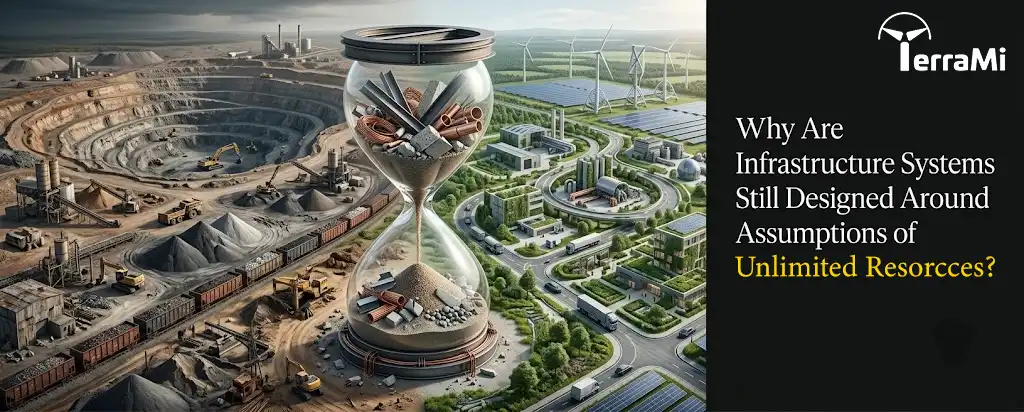
Why are our infrastructure systems still designed around assumptions of unlimited resources, predictable supply chains, and inexpensive material replacement?
This question connects circularity to the broader themes explored throughout TerraMi’s recent infrastructure series. The challenge is not merely waste. The challenge is the persistence of linear thinking. Until organizations begin questioning the assumptions that created linear systems in the first place, circular economy risks becoming another sustainability slogan rather than a transformative infrastructure strategy.
What Circular Construction Actually Looks Like
One reason circular economy remains poorly understood is that discussions often focus on principles rather than implementation. Most professionals agree that reducing waste is desirable. Most organizations support sustainability objectives. Many projects already incorporate some form of recycling.
Yet truly circular construction requires a much broader transformation. The difference lies in moving from managing waste to managing value. Rather than asking what happens to materials after a project is completed, circular construction asks how infrastructure assets can preserve, recover, and regenerate value throughout their entire lifecycle.
This shift affects decisions made during planning, design, procurement, construction, operation, refurbishment, and eventual deconstruction. Circularity is therefore not a single initiative. It is a system-wide design philosophy.
Designing for Disassembly
Traditional construction assumes permanence. Components are assembled with little consideration for future separation, recovery, or reuse. Circular construction challenges this assumption.
Design for Disassembly (DfD) encourages engineers and designers to create assets that can be systematically dismantled while preserving the value of materials and components. Instead of destroying value during demolition, disassembly seeks to preserve it through deliberate technical applications:
- Mechanical connections utilized instead of permanent chemical bonding.
- Modular structural systems that allow isolated adjustments without systemic failure.
- Standardized components ensuring cross-compatibility with future projects.
- Accessible service infrastructure allowing quick maintenance access.
- Reversible construction methods engineered into core structural layers.
The implications extend far beyond waste reduction. Design for Disassembly transforms future infrastructure from a demolition challenge into a resource opportunity. Research from the construction sector increasingly identifies deconstructability as one of the most important enablers of future circularity because it directly influences material recovery potential decades later.
Infrastructure as Material Storage
One of the most powerful concepts emerging within circular construction is the idea that infrastructure should be viewed as a long-term material repository. Historically, buildings and infrastructure assets have been treated as final destinations for materials. Circular thinking introduces a different perspective: infrastructure assets become temporary configurations of valuable resources.
- Steel remains structural steel.
- Concrete remains a recoverable aggregate material stream.
- Mechanical equipment retains future utility.
- Structural components preserve embedded carbon investment.
This perspective fundamentally changes planning assumptions. A bridge is no longer simply a bridge; it becomes a future source of structural materials. A building is no longer merely occupied space; it becomes a long-term inventory of recoverable assets.
This concept directly extends the argument introduced in our foundational insight piece: Infrastructure is not a material sink. It is a material bank. The organizations that begin managing infrastructure as stored value rather than consumed value may gain significant advantages in future resource-constrained environments.
Material Passports: The Missing Information Layer
A major obstacle to circular construction is information loss. Many infrastructure owners have incomplete records regarding critical material criteria:
| Information Layer | Missing Data Points in Linear Infrastructure |
| Composition & Specs | Material chemical composition, component engineering specifications. |
| Circularity Potential | Direct recovery potential, reuse suitability metrics. |
| Environmental Context | Embodied carbon logs, environmental performance baselines. |
When assets reach refurbishment or deconstruction stages decades later, critical information is often unavailable. Material passports seek to solve this problem.
A material passport functions as a digital record that documents the characteristics, location, composition, and future recovery potential of materials and components within an asset. Think of it as a permanent identity system for infrastructure materials. The concept may become increasingly important as organizations seek to preserve information across asset lifecycles that may extend fifty years or more. Emerging research suggests that material passports can significantly improve transparency and facilitate future reuse, recovery, and circular asset management practices.
Strategic Insight: Information May Become More Valuable Than Materials
Throughout history, infrastructure projects have focused primarily on acquiring materials. The next phase of circular construction may focus equally on preserving information about those materials. Without reliable information, valuable resources often become waste. With accurate information, the same resources can become future assets. In a circular economy, material intelligence may become as important as material ownership.
Adaptive Reuse Versus Demolition
Another area where circular construction differs from traditional approaches is asset adaptation. Linear systems often follow a predictable, finite sequence, whereas circular systems introduce adaptive interventions to maximize utility:
Adaptive reuse preserves embedded value and locks in embodied carbon. The environmental significance is substantial: large portions of an asset’s lifetime carbon footprint may already be locked into materials and construction processes before operations even begin. Demolition destroys much of this embedded investment; adaptation preserves it.
This explains why adaptive reuse is increasingly viewed as both a sustainability strategy and a resilience strategy. The most circular building is often not a new building—it is an existing building successfully adapted to serve future needs.
Resource Security and Strategic Resilience
Discussions about circular economy frequently focus on environmental outcomes. An equally important dimension is emerging: resource security. Construction depends heavily on raw commodities, all of which face severe structural pressures from macro-environmental forces:
| Critical Construction Commodity | Primary Macro-Environmental Pressures |
| Structural Compounds | Steel, Cement |
| Industrial Metals | Copper, Aluminum |
| Advanced Inputs | Rare earth elements, Industrial minerals |
Historically, infrastructure planning often assumed stable access to materials. That assumption is becoming less reliable. Circular construction can strengthen resilience by reducing dependence on continuous extraction and external resource flows. Material recovery, reuse, refurbishment, and lifecycle extension effectively create domestic resource capacity. This transforms circularity from an environmental initiative into a strategic capability.
Strategic Insight: The Future Resource War May Be Economic, Not Military
Competition for critical resources is increasingly shaping global infrastructure strategies. While future tensions may not resemble traditional resource conflicts of the past, economic competition for strategic materials is likely to intensify. Countries capable of recovering, reusing, and retaining material value within their infrastructure systems may gain significant advantages. Circular construction therefore contributes not only to sustainability objectives but also to economic resilience, resource independence, and long-term national competitiveness.
Why Digital Twins May Accelerate Circularity
Many circular economy discussions focus on physical materials. However, digital infrastructure may become equally important. One of the greatest barriers to circularity is visibility. Organizations frequently lack accurate information about asset conditions, material inventories, maintenance histories, recovery opportunities, and lifecycle performance.
Digital Twin technologies offer a potential solution. By creating dynamic digital representations of physical infrastructure assets, organizations can maintain continuous visibility across the lifecycle. This visibility supports targeted execution:
- Better maintenance decisions based on real-time structural performance.
- Improved asset utilization across varying operational conditions.
- Lifecycle optimization to reduce ongoing operational capital expenditures.
- Recovery planning mapped decades before structural deconstruction.
- Material tracking through connected information nodes.
In other words, digital twins can provide the information architecture required to support circular decision-making. Circularity and digitalization are therefore becoming increasingly interconnected. This trend may ultimately reshape how infrastructure owners manage assets throughout their operational lives.
Circular Construction Is Ultimately About Value Preservation
A common misconception is that circular construction is primarily concerned with waste reduction. Waste reduction is important. But it is not the ultimate objective. The deeper objective is value preservation.
Materials contain value. Components contain value. Infrastructure contains value. Information contains value. Circular construction seeks to retain that value for as long as possible while minimizing the need for new resource inputs.
When viewed through this lens, circularity becomes far more than an environmental initiative. It becomes a framework for managing infrastructure in a world characterized by uncertainty, resource constraints, and increasing demands for resilience.
Why Most “Circular” Projects Are Not Truly Circular
One of the most uncomfortable realities within the construction industry is that many projects described as “circular” remain fundamentally linear. A project may recycle construction waste, use recycled materials, publish sustainability metrics, and reference circular economy principles—and still operate within a largely linear framework.
The reason is simple: circularity is not defined by isolated actions. It is defined by system design. A project cannot be considered truly circular if materials continue to flow predominantly in one direction:
The presence of recycling does not automatically change the underlying model. Many organizations focus on highly visible initiatives because they are easier to measure and communicate. However, the greatest opportunities often exist upstream in design, procurement, asset management, and lifecycle planning. The challenge is not a lack of good intentions; the challenge is that circular transformation requires changing the system itself rather than improving one component of it.
The Governance Challenge
As explored in TerraMi’s previous analysis, Why Infrastructure Resilience Fails Without Governance, infrastructure transformation ultimately depends on institutional structure. Circular construction is no exception. Organizations frequently focus on technical solutions like new materials, digital platforms, recovery technologies, and circular procurement tools. Yet implementation often stalls because governance systems remain optimized for linear outcomes.
Core operational ownership barriers must be solved by leadership rather than technology:
- Material Sovereignty: Who owns recovered materials at the end of an asset loop?
- Financial Incentives: Who benefits from long-term lifecycle savings?
- Accountability Frameworks: Who is responsible for future structural recovery?
- Metric Standardization: How is circular performance quantified accurately?
- Capital Allocation: How are long-term benefits incorporated into near-term investment decisions?
Without governance structures capable of addressing these issues, circularity remains confined to pilot projects and isolated initiatives. The most successful circular infrastructure programs are rarely distinguished by superior technology alone; they are distinguished by leadership, institutional alignment, and long-term decision-making.
Measuring Circular Performance
One reason circular economy is often misunderstood is that organizations struggle to measure it. Traditional project metrics focus heavily on near-term constraints:
Circularity introduces entirely separate operational indicators that track long-term performance:
- Material Recovery Rate: How much material can be recovered for future use?
- Reuse Potential: What proportion of components can be reused without significant reprocessing?
- Lifecycle Extension: How much additional value can be generated through adaptation and refurbishment?
- Embodied Carbon Retention: How much carbon-intensive material production is avoided through reuse?
- Resource Productivity: How efficiently are resources generating value over time?
These indicators shift attention away from project completion and toward long-term asset performance. Success is no longer measured solely by what is built; it is increasingly measured by how effectively value is preserved.
The Next Evolution: Circular Infrastructure Intelligence
A more profound transformation may already be emerging. Historically, infrastructure management has focused on physical assets. Circular economy expands this focus to include materials. The next step may be managing infrastructure as an intelligent resource system—a concept described as Circular Infrastructure Intelligence.
In such an integrated ecosystem, multiple independent fields converge into a unified operating model:
Under this model:
- Materials are continuously tracked.
- Asset conditions are continuously monitored.
- Resource flows are continuously analyzed.
- Recovery opportunities are continuously identified.
The objective is not simply to build infrastructure; the objective is to optimize value throughout multiple lifecycles.
Strategic Insight: The Future Infrastructure Asset May Never Reach “End-of-Life”
Linear thinking assumes that infrastructure assets eventually become obsolete. Circular thinking challenges this assumption. Future infrastructure systems may increasingly evolve through continuous adaptation, refurbishment, reconfiguration, and recovery. In such systems, “end-of-life” becomes less important than “next-life.” The transition may seem subtle. In reality, it represents one of the most significant shifts in infrastructure thinking since the industrial era.
Why Artificial Intelligence Matters
Artificial Intelligence is often discussed in relation to automation and efficiency. Its potential contribution to circularity may be even more important. Future AI-enabled systems provide analytical processing to help organizations manage millions of interconnected decisions across structural lifecycles:
- Predicting structural and material degradation timelines.
- Optimizing complex asset maintenance schedules before failures occur.
- Identifying exact regional cross-project component reuse opportunities.
- Forecasting long-term macroeconomic resource demand trends.
- Improving sorting and recovery planning accuracy during disassembly.
- Reducing avoidable systemic operational and lifecycle waste.
The scale of modern infrastructure makes manual optimization increasingly difficult. AI may provide the analytical capability required to drive structural resource networks. The future circular economy is therefore unlikely to be driven solely by physical recovery systems; it will depend equally on information systems capable of understanding and optimizing complex resource networks.
Beyond Sustainability: A Different Way of Thinking
Perhaps the greatest mistake in discussions about circular economy is treating it solely as a sustainability initiative. Sustainability is certainly part of the story. But circularity ultimately represents something broader: it reflects a transition from a world built on assumptions of abundance to a world increasingly shaped by constraints.
For decades, infrastructure systems were designed around expectations of stable resource availability, predictable supply chains, affordable replacement costs, and linear economic growth. Those assumptions are becoming less reliable.
Circular thinking offers an alternative framework. Rather than continuously consuming resources, it seeks to preserve, regenerate, and recover value. Rather than focusing on individual projects, it focuses on long-term systems. Rather than optimizing for immediate outcomes, it optimizes for future adaptability. This distinction explains why circular economy is becoming increasingly relevant not only for sustainability professionals but also for engineers, investors, policymakers, and infrastructure leaders.
TerraMi Perspective
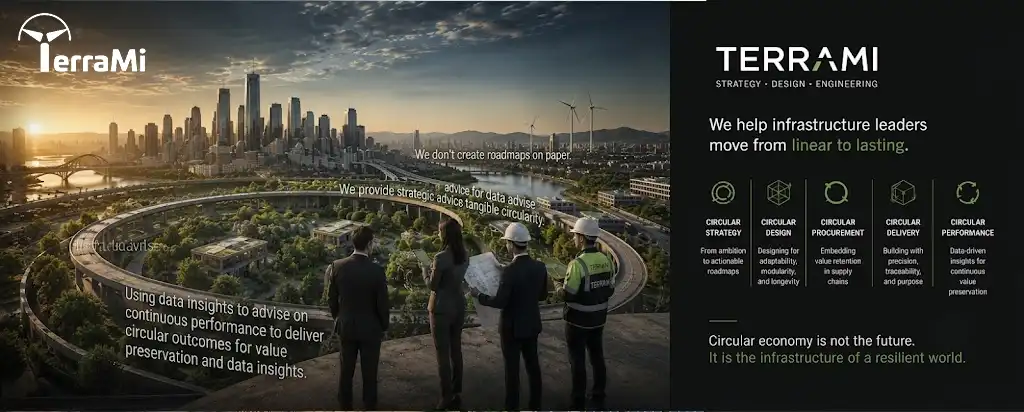
Many organizations continue to view circularity as a waste-management strategy implemented after project delivery. In reality, circularity begins much earlier. It begins with design decisions. It continues through procurement choices. It depends on governance structures. It is strengthened by digital intelligence. And it ultimately succeeds when infrastructure is viewed not as a disposable asset, but as a long-term reservoir of value.
The organizations that embrace this shift may discover that circularity delivers benefits extending far beyond sustainability reporting. They may improve resilience, strengthen resource security, reduce exposure to future uncertainties, and position themselves to operate more effectively within a world where materials, energy, and environmental capacity can no longer be treated as unlimited.
The future of construction will not simply be greener. It will be more intelligent, more adaptive, and increasingly circular.
FAQ
What is circular economy in construction?
Circular economy in construction is an approach that seeks to preserve material value, extend asset lifecycles, reduce resource consumption, and minimize waste through design, reuse, adaptation, and recovery strategies.
Is recycling the same as circular construction?
No. Recycling is only one component of circularity. Circular construction prioritizes reducing waste, reusing materials, extending asset life, and preserving value before recycling becomes necessary.
Why are material passports important?
Material passports help preserve information about materials and components throughout an asset’s lifecycle, making future recovery, reuse, and circular asset management more effective.
How does circular construction improve resilience?
Circular systems reduce dependence on virgin resource extraction, strengthen supply chain flexibility, improve resource security, and support long-term infrastructure adaptability.
What role does AI play in circular construction?
AI can help organizations optimize maintenance, predict degradation, identify recovery opportunities, manage material inventories, and improve lifecycle decision-making.
Is circular economy only about sustainability?
No. Circular economy also supports resource security, resilience, governance, operational efficiency, and long-term economic competitiveness.