
How Material Intelligence Can Transform Infrastructure Projects
Why Infrastructure Still Operates with Limited Material Intelligence
Introduction
For decades, infrastructure projects have been managed through a relatively simple assumption: if materials arrive on site when needed, the supply chain is functioning effectively.
Project managers traditionally focus on budgets, schedules, labor productivity, procurement milestones, and construction progress. Materials are often treated as inputs to be purchased, delivered, consumed, and eventually discarded. As long as shortages do not halt construction activities, the underlying material system receives little strategic attention.
However, this assumption is becoming increasingly problematic.
Infrastructure systems are entering an era defined by resource constraints, supply chain volatility, geopolitical uncertainty, climate disruptions, and increasing pressure to improve sustainability performance. Under these conditions, organizations can no longer afford to view materials merely as consumable resources. Materials represent economic value, operational resilience, environmental performance, and increasingly, strategic security.
The challenge is that most infrastructure organizations possess sophisticated systems for tracking financial flows but relatively limited capabilities for understanding material flows.
An organization may know precisely where every dollar is allocated, yet remain unable to answer fundamental questions about the physical resources supporting its infrastructure assets.
- Where did critical materials originate?
- How much material was actually used?
- How much was lost through inefficiencies?
- Which materials remain recoverable at the end of asset life?
- What future value exists within existing infrastructure systems?
These questions sit at the heart of Material Flow Optimization in Infrastructure Projects.
The ability to understand, monitor, and optimize the movement of materials across an asset’s lifecycle is rapidly emerging as a critical capability for infrastructure organizations seeking long-term resilience and efficiency.
Why Material Visibility Matters
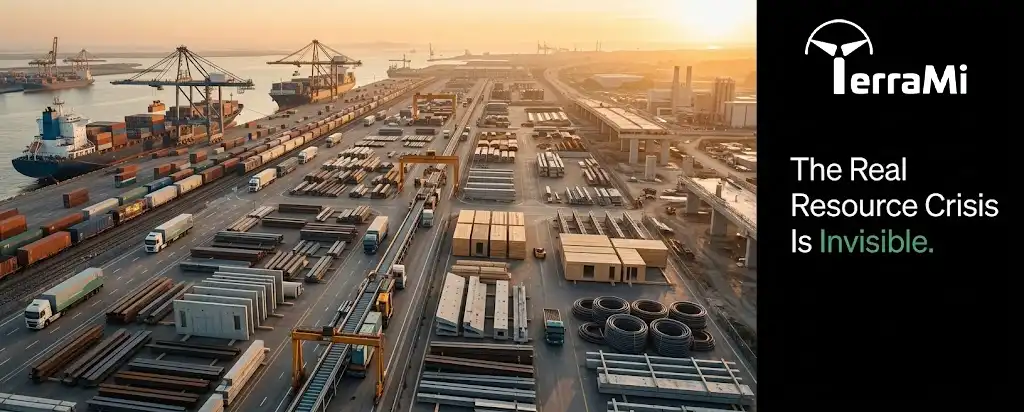
Most infrastructure projects generate enormous volumes of material data without generating meaningful material intelligence. Consider a major transportation corridor, water treatment facility, renewable energy installation, or urban development project. Thousands of tons of steel, concrete, aggregates, pipes, cables, structural components, and manufactured products move through complex supply chains before becoming part of a completed asset.
Yet throughout this process, decision-makers often lack real-time visibility into how materials flow through the project ecosystem. Materials may be ordered through multiple suppliers, transported through numerous logistics networks, temporarily stored at different locations, installed by various contractors, and eventually modified, replaced, or removed over decades of operation.
As projects increase in scale and complexity, the lack of material visibility creates a range of operational challenges:
- Excess procurement
- Material shortages
- Duplicate orders
- Construction delays
- Increased waste generation
- Poor inventory management
- Reduced asset recoverability
In many cases, organizations discover material inefficiencies only after costs have already been incurred. This reactive approach reflects a broader problem. Infrastructure has historically been designed around asset delivery rather than material intelligence. As a result, many projects successfully deliver physical assets while simultaneously losing significant opportunities to optimize material performance.
The Hidden Cost of Material Inefficiency
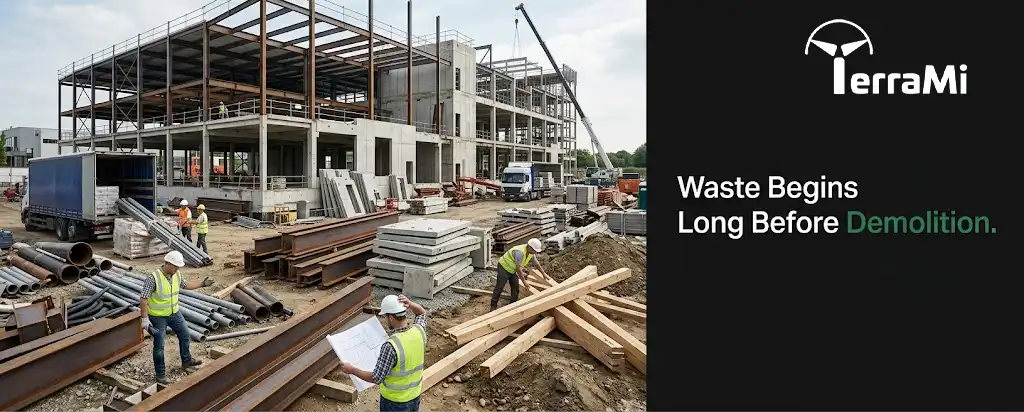
Material inefficiency is often discussed as an environmental issue. In reality, it is equally an economic and operational challenge. When materials are purchased but not utilized effectively, value is destroyed long before waste reaches a landfill.
Material losses occur in many forms:
- Over-ordering due to poor forecasting
- Damage during transportation
- Improper storage conditions
- Design changes during construction
- Rework caused by quality issues
- Premature replacement of components
- Failure to recover valuable materials during asset renewal
Each of these inefficiencies increases project costs while simultaneously consuming additional resources. What makes these losses particularly significant is that they often remain invisible within traditional project reporting structures. Financial reports may capture procurement expenses, but they rarely reveal how much material value was unnecessarily lost throughout the project lifecycle. Consequently, organizations may underestimate the true economic impact of inefficient material management.
The issue becomes even more significant when considered at national and regional scales. As infrastructure systems expand globally, inefficiencies multiply across thousands of projects, resulting in substantial resource consumption and increasing pressure on supply chains.
Material Flow and Resource Security
A growing number of governments and infrastructure organizations are beginning to view materials through a strategic lens. Historically, infrastructure planning focused primarily on cost, performance, and schedule. Today, another consideration is emerging:
Resource Security
The assumption that critical materials will always remain affordable and readily available is becoming increasingly uncertain. Infrastructure development depends upon access to:
- Steel
- Cement
- Copper
- Aluminum
- Aggregates
- Rare earth materials
- Energy-intensive manufactured products
These resources are influenced by global market dynamics, geopolitical tensions, trade restrictions, climate impacts, and supply chain disruptions. The implications are significant. An infrastructure system that consumes materials inefficiently increases its exposure to future resource risks.
Conversely, an infrastructure system that understands and optimizes material flows can reduce dependence on continuous extraction and improve long-term resilience. This perspective represents an important shift. Material Flow Optimization is no longer simply an operational improvement initiative. It is becoming part of a broader strategy for resource resilience and infrastructure security
From Material Consumption to Material Stewardship
One of the most important conceptual shifts occurring within modern infrastructure management is the transition from material consumption to material stewardship. Traditional infrastructure models largely assume a linear sequence:
Extract → Manufacture → Build → Operate → Dispose
Under this model, materials are treated primarily as consumable inputs. Circular infrastructure thinking introduces a fundamentally different perspective.
Materials are not merely resources to be consumed. They are assets whose value should be preserved for as long as possible. This distinction may appear subtle, but its implications are profound.
Organizations that adopt a stewardship mindset begin asking different questions:
- How can material value be preserved?
- How can assets be designed for adaptation?
- How can future recovery be improved?
- How can waste be minimized before it occurs?
- How can infrastructure support long-term resource resilience?
These questions move the discussion beyond procurement efficiency and toward strategic lifecycle management. They also establish the foundation for the technologies and methodologies that will be explored in the next section.
Material Flow Optimization in Infrastructure Projects
Building Material Intelligence Through Digital Infrastructure
“Bridging the gap between tracking financial capital and understanding physical resources requires a fundamental shift toward operational transparency. If material visibility is the bedrock of lifecycle optimization, the immediate question is practical: how do modern infrastructure organizations actually achieve it?”
The next question is obvious:
If material visibility is the foundation of optimization, how do infrastructure organizations actually achieve it?
The answer lies in the growing convergence of digital technologies, lifecycle thinking, and circular infrastructure principles. Around the world, leading organizations are beginning to move beyond simple material management toward something much more powerful:
Material Intelligence
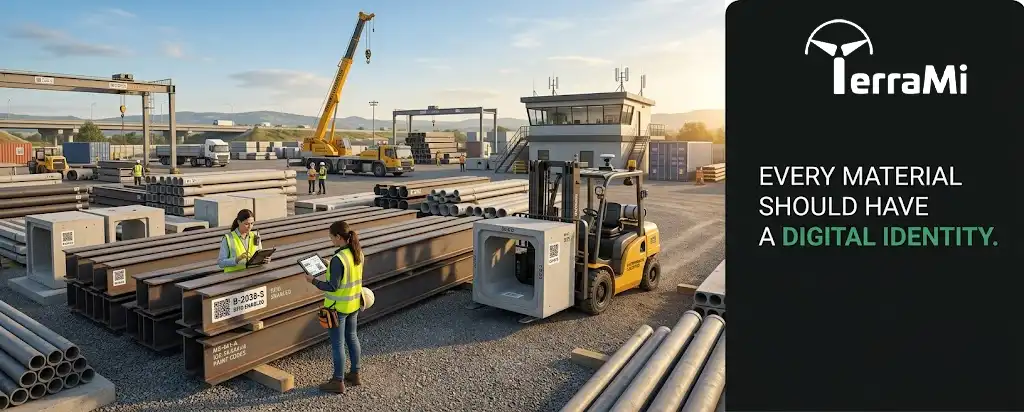
Rather than merely tracking materials as inventory, they are building systems capable of understanding material origin, condition, location, performance, and future recovery potential throughout the entire asset lifecycle. This shift is becoming a critical component of infrastructure modernization.
The Evolution from Material Tracking to Material Intelligence
Many organizations already track materials to some degree. Procurement systems record purchases. Warehouse systems monitor inventory. Construction schedules track deliveries. Asset management systems record installed components. However, these systems frequently operate in isolation. Information becomes fragmented across multiple platforms, contractors, suppliers, and project phases.
As a result, decision-makers may know where materials are today but remain unable to understand their complete lifecycle journey. Material intelligence requires a more integrated approach.
Instead of asking:
“How much material do we currently have?”
Organizations begin asking:
- Where did this material originate?
- What environmental impacts are associated with it?
- How much value remains embedded within it?
- Can it be reused in future projects?
- How can it be recovered at the end of service life?
These questions transform materials from consumable resources into strategic infrastructure assets.
Material Passports: Creating a Digital Identity for Materials
One of the most promising developments in circular infrastructure is the emergence of Material Passports.
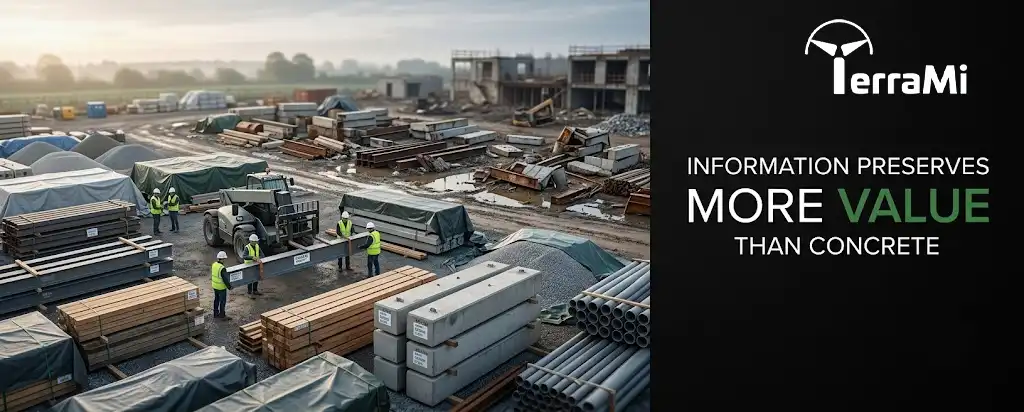
A Material Passport functions as a digital record containing detailed information about a material, product, or infrastructure component.
Depending on implementation, a passport may include:
- Material composition
- Manufacturing source
- Environmental characteristics
- Carbon footprint data
- Technical specifications
- Maintenance history
- Reuse potential
- Recovery value
- End-of-life guidance
The concept is deceptively simple.
If future asset managers know exactly what materials exist within an infrastructure asset, they can make more informed decisions regarding maintenance, refurbishment, adaptation, and recovery.
Without this information, valuable materials often become indistinguishable from waste during renovation or demolition activities. Material Passports therefore create the informational foundation necessary for circular infrastructure systems.
Waste often begins as missing information.
When infrastructure systems lose visibility into material composition, location, and future value, recovery becomes difficult and disposal becomes the default option.
BIM as a Foundation for Material Visibility
The increasing adoption of Building Information Modeling (BIM) has created new opportunities for material flow optimization. Although BIM is often associated with design coordination and clash detection, its long-term value extends much further. A well-structured BIM environment can serve as a centralized repository for material information throughout the asset lifecycle.
Rather than viewing infrastructure solely as geometry and engineering drawings, BIM allows organizations to connect physical assets with rich datasets describing their characteristics and performance. For material management, this means infrastructure owners can begin documenting:
- Material quantities
- Component specifications
- Supplier information
- Installation dates
- Maintenance requirements
- Replacement cycles
The result is improved transparency across the project lifecycle. More importantly, BIM creates the data foundation necessary for future circular economy initiatives. Without reliable digital records, material recovery strategies become significantly more difficult to implement.
The Emerging Role of Digital Twins
While BIM provides structured information about infrastructure assets, Digital Twins introduce an additional dimension:
Continuous Intelligence
A Digital Twin combines physical infrastructure with real-time operational data, creating a dynamic representation of asset performance. From a material flow perspective, Digital Twins offer significant potential. Instead of simply documenting materials at the time of construction, Digital Twins can help organizations understand how materials perform over decades of operation.
For example:
- Which components are deteriorating fastest?
- Which materials require replacement sooner than expected?
- Which assets can safely remain in service longer?
- Which components are suitable for refurbishment rather than replacement?
These insights support more efficient resource utilization while extending asset life and reducing unnecessary material consumption. In essence, Digital Twins help infrastructure organizations preserve value rather than continuously replacing it. This concept aligns directly with the core principles of circular infrastructure.
Smart Material Tracking Systems
Advances in digital technology are also transforming how materials are monitored across supply chains. Modern systems increasingly incorporate:
- RFID tagging
- QR code identification
- IoT-enabled sensors
- GPS tracking
- Cloud-based logistics platforms
- AI-assisted inventory analytics
These technologies provide greater visibility into the movement of materials from extraction and manufacturing through transportation, installation, operation, and eventual recovery. For large infrastructure projects, this visibility can generate substantial benefits.
Organizations gain the ability to:
- Reduce material losses
- Improve procurement accuracy
- Minimize project delays
- Strengthen supply chain resilience
- Improve inventory utilization
The result is not merely operational efficiency. It is improved decision-making across the entire infrastructure ecosystem.
Global Momentum Toward Material Intelligence
Although implementation remains uneven, momentum is clearly increasing. Governments, infrastructure owners, engineering firms, and technology providers are investing in systems designed to improve material transparency and resource efficiency.
Several trends are driving this shift:
Increasing Resource Constraints
Growing demand for construction materials is placing pressure on global supply chains.
Climate and ESG Expectations
Organizations face increasing pressure to demonstrate responsible resource management and measurable sustainability performance.
Circular Economy Policies
Many jurisdictions are introducing regulations and incentives encouraging material recovery and lifecycle optimization.
Infrastructure Modernization
Digital transformation initiatives are creating opportunities to integrate material intelligence into broader infrastructure management strategies.
Collectively, these drivers are accelerating the transition from traditional material management toward more sophisticated material intelligence systems.
Material Intelligence as a Competitive Advantage
Historically, infrastructure organizations competed through engineering expertise, project execution capabilities, and financial strength. Increasingly, another capability is becoming important:
The ability to understand and optimize material value.
Organizations capable of tracking material flows, preserving embedded value, and reducing resource inefficiencies may gain significant advantages:
- Lower lifecycle costs
- Improved operational resilience
- Better ESG performance
- Enhanced resource security
- Stronger regulatory compliance
- Greater adaptability to future market conditions
In an increasingly uncertain world, visibility itself becomes a strategic asset. The organizations that understand their materials best may ultimately be better positioned to manage future resource constraints and infrastructure challenges.
From Material Efficiency to Infrastructure Intelligence
Throughout this article, we have explored a critical but often overlooked reality:
Infrastructure systems are fundamentally material systems. Every bridge, transit network, water treatment facility, energy system, and building depends upon vast flows of physical resources moving through complex supply chains and operational environments. Yet for decades, infrastructure management has focused primarily on cost, schedule, and asset performance while paying comparatively little attention to the intelligence surrounding material flows.
This is beginning to change.
As resource constraints intensify and infrastructure systems become increasingly complex, organizations are recognizing that material visibility is not simply an operational concern—it is becoming a strategic capability.
Beyond Sustainability: Why Material Flow Optimization Matters
Material Flow Optimization is frequently discussed within sustainability frameworks. While sustainability remains important, limiting the discussion to environmental performance significantly understates its strategic value. Optimized material flows influence multiple dimensions of infrastructure performance:
Operational Efficiency
Reduced waste, improved inventory management, and more accurate procurement decisions.
Financial Performance
Lower lifecycle costs and improved utilization of embedded material value.
Resource Security
Reduced exposure to supply chain disruptions and material shortages.
Climate Resilience
Improved adaptability during periods of environmental stress and infrastructure disruption.
Infrastructure Intelligence
Enhanced ability to make data-driven decisions across the asset lifecycle.
This broader perspective reframes Material Flow Optimization as a foundational component of future infrastructure management rather than a niche sustainability initiative.
The future of infrastructure will be determined not only by how assets perform, but by how effectively organizations understand and preserve the materials within them.
Material Flow Optimization and Resource Security
One of the most important emerging themes in infrastructure planning is resource security. Historically, many infrastructure systems were developed under assumptions of relatively stable resource availability. Materials could be extracted, transported, purchased, and replaced with predictable levels of risk.
Increasingly, those assumptions are becoming less reliable. Infrastructure organizations now face growing uncertainty arising from:
- Supply chain disruptions
- Geopolitical tensions
- Critical mineral competition
- Climate-related disruptions
- Energy market volatility
- Transportation bottlenecks
Under these conditions, inefficient material use creates strategic vulnerabilities. Organizations that continuously depend upon virgin material extraction may become increasingly exposed to external risks. Conversely, organizations capable of tracking, recovering, and preserving material value improve their ability to withstand future disruptions. This is one reason why Material Flow Optimization is becoming closely connected to national infrastructure resilience strategies.
The Connection Between Circular Infrastructure and Resilience
The relationship between circularity and resilience is often underestimated. Many discussions present circular economy initiatives primarily as environmental programs. In reality, circular infrastructure can also improve resilience. Infrastructure systems that preserve material value and support recovery capabilities are often better positioned to adapt during periods of uncertainty.
For example:
- Reusable materials reduce dependence on new extraction.
- Recoverable components create future resource reserves.
- Adaptable assets extend useful life.
- Improved material intelligence accelerates maintenance and renewal activities.
In this sense, circularity and resilience are not separate objectives. They increasingly reinforce one another. The organizations most capable of preserving material value may also become the organizations most capable of managing future disruptions.

Material Flow Optimization as a Bridge to Infrastructure Intelligence
An important theme has quietly emerged throughout the TerraMi editorial roadmap. The journey from sustainability to infrastructure intelligence is not a collection of unrelated topics. It is a connected progression.
Consider the path explored so far:
Sustainable Infrastructure
Understanding long-term environmental and operational impacts.
↓
Circular Infrastructure
Preserving material value across asset lifecycles.
↓
Material Flow Optimization
Creating visibility into material systems.
↓
Digital Infrastructure
Building data-rich environments.
↓
Digital Twins
Connecting physical assets with real-time intelligence.
↓
Infrastructure Intelligence
Supporting predictive and adaptive decision-making. Material Flow Optimization sits at the center of this evolution. Without understanding material flows, organizations struggle to build meaningful digital representations of infrastructure systems. Material visibility therefore becomes a prerequisite for future infrastructure intelligence.
Emerging Global Examples
Across the world, signs of this transition are already visible. Infrastructure organizations are experimenting with:
- Material Passport programs
- Digital product records
- Circular procurement strategies
- BIM-enabled material databases
- Smart logistics systems
- AI-assisted resource optimization
- Digital Twin platforms
Although implementation remains uneven, the overall direction is clear. Infrastructure management is gradually evolving from asset-centric thinking toward system-centric thinking.
In the coming decade, organizations may increasingly evaluate infrastructure assets not only according to their physical performance, but also according to their ability to preserve and regenerate material value.
TerraMi Perspective
For much of the industrial era, infrastructure development was guided by a simple assumption:
Resources would remain available, affordable, and replaceable.
This assumption shaped how assets were designed, constructed, operated, and eventually discarded. Today, that assumption is becoming increasingly difficult to sustain. Infrastructure organizations face growing uncertainty arising from climate volatility, geopolitical pressures, supply chain disruptions, and increasing competition for critical resources. Under these conditions, material efficiency is no longer sufficient.
Organizations must develop the ability to understand, preserve, and optimize material value throughout the infrastructure lifecycle. Material Flow Optimization therefore represents more than a construction practice. It represents a shift in mindset.
The future of infrastructure will not be defined solely by how efficiently organizations build assets. It will increasingly be defined by how intelligently they manage the resources embedded within them.
At TerraMi, we believe the next generation of infrastructure systems will be characterized by three interconnected capabilities:
- Resource Intelligence
- Digital Intelligence
- Infrastructure Resilience
Organizations that successfully integrate these capabilities will be better positioned to navigate uncertainty, preserve value, and create infrastructure systems capable of supporting future generations.
Conclusion
Material Flow Optimization in Infrastructure Projects is often viewed as a technical exercise focused on reducing waste and improving efficiency. However, its implications are far broader.
The ability to understand material flows creates opportunities to improve sustainability performance, strengthen resource security, enhance resilience, and support the transition toward infrastructure intelligence. As infrastructure systems become increasingly interconnected and resource pressures intensify, material visibility will become a strategic necessity rather than an operational luxury. The organizations that succeed in the coming decades may not simply be those that build the most infrastructure.
They may be the organizations that understand the value flowing through it.
Frequently Asked Questions (FAQs)
What is Material Flow Optimization in Infrastructure Projects?
Material Flow Optimization in Infrastructure Projects is the process of improving how materials are sourced, transported, tracked, utilized, recovered, and managed throughout the infrastructure lifecycle. Its objective is to reduce waste, improve efficiency, preserve material value, and strengthen resource resilience.
Why is Material Visibility Important in Infrastructure Management?
Material visibility enables organizations to understand where materials originate, how they move through projects, how efficiently they are used, and what value remains available for future recovery. Without visibility, optimization and informed decision-making become significantly more difficult.
How Does Material Flow Optimization Support Circular Infrastructure?
Circular infrastructure depends on preserving material value for as long as possible. Material Flow Optimization helps organizations identify opportunities for reuse, refurbishment, adaptation, and recovery, reducing reliance on virgin resource extraction.
What Are Material Passports?
Material Passports are digital records that store information about materials and infrastructure components, including composition, specifications, maintenance history, and recovery potential. They support future reuse and improve lifecycle decision-making.
What Is the Relationship Between Digital Twins and Material Flow Optimization?
Digital Twins provide real-time insights into infrastructure assets and their performance. When integrated with material data, they help organizations monitor material conditions, predict maintenance needs, optimize resource utilization, and preserve asset value throughout the lifecycle.
How Does Material Flow Optimization Improve Infrastructure Resilience?
By reducing dependence on continuous resource extraction and improving visibility into material systems, Material Flow Optimization strengthens resource security, enhances supply chain resilience, and improves an organization’s ability to respond to future disruptions.