
From Extraction to Intelligence: The Rise of Circular Economy as a New Discipline
TerraMi Special Series II
The Resource Future of Infrastructure
As infrastructure systems enter an era shaped by geopolitical instability, critical mineral competition, climate pressures, and increasingly fragile supply chains, engineering priorities are evolving beyond efficiency alone. This three-part TerraMi Special Series explores how resource security is becoming one of the defining challenges of twenty-first-century infrastructure.
Part I
The Coming Resource Century: Why Resource Security Is Becoming a Global Priority ✓
Part II
From Extraction to Intelligence: The Rise of Circular Economy as a New Discipline
Part III
Why Developing Nations Cannot Afford Linear Growth
You are reading Part II of this special series.
Introduction
The global conversation surrounding the Circular Economy is changing.
For many years, circular economy initiatives were primarily associated with recycling programmes, waste reduction policies, and environmental sustainability. Governments promoted circularity to reduce landfill waste, industries adopted recycling targets to improve environmental performance, and organizations viewed circular practices as an extension of corporate sustainability initiatives.
While these objectives remain important, they no longer capture the full significance of the circular transition.
Today, the Circular Economy is increasingly being recognized as an emerging discipline that integrates engineering, economics, digital technologies, material science, industrial ecology, and strategic resource management. Rather than focusing solely on reducing environmental impacts, it seeks to optimize how resources are designed, utilized, recovered, and continuously circulated throughout multiple infrastructure lifecycles.
This evolution reflects a broader transformation taking place across infrastructure systems worldwide. As discussed in the first article of this series, growing concerns over Resource Security, geopolitical uncertainty, critical mineral dependency, and increasingly fragile supply chains are forcing organizations to reconsider the traditional linear model of resource consumption.
The familiar “take-make-dispose” approach that supported industrial development for more than a century is becoming progressively less resilient in an economy where strategic resources are increasingly constrained.
Instead, infrastructure is entering an era where materials are expected to remain productive long after their initial use. Every bridge, building, railway, utility corridor, and industrial facility is gradually being viewed not only as physical infrastructure but also as a future repository of valuable resources.
This shift introduces a fundamentally different way of thinking.
Rather than asking how efficiently infrastructure can consume resources, organizations are beginning to ask how intelligently those resources can be preserved, tracked, recovered, and reintegrated into future infrastructure systems.
The distinction is significant. Efficiency focuses on using fewer resources. Intelligence focuses on ensuring resources never lose their long-term value. That transition marks the emergence of a new discipline. The Circular Economy is no longer simply an environmental framework. It is rapidly becoming the science of intelligent resource systems.
Why the Linear Economy Is Reaching Its Limits
The industrial economy was built upon an assumption of abundance.
Raw materials could be extracted, transformed into products, used throughout their operational life, and ultimately discarded with relatively little consideration for future recovery. For decades, this linear model supported unprecedented economic growth, urban expansion, and infrastructure development.
Its success, however, depended upon conditions that are becoming increasingly uncertain.
Population growth continues to increase demand for infrastructure. Urbanization requires enormous quantities of construction materials. Electrification depends upon rapidly expanding supplies of critical minerals. Climate adaptation demands resilient infrastructure capable of withstanding increasingly unpredictable environmental conditions.
At the same time, geopolitical instability, resource concentration, environmental degradation, and volatile global supply chains are reducing the reliability of traditional resource systems.
These trends expose a fundamental weakness within the linear economy.It treats materials as temporary inputs rather than long-term strategic assets. Consequently, enormous quantities of economic value disappear at the end of every infrastructure lifecycle through demolition waste, inefficient material recovery, and limited reuse of valuable components.
From an engineering perspective, this represents more than an environmental issue. It represents a systems design problem. Infrastructure continues to be optimized for construction rather than for multiple generations of resource productivity.
The Circular Economy challenges this assumption by treating every material as an asset whose value should be preserved, measured, and continuously regenerated rather than permanently consumed.
Circular Economy Is Becoming an Engineering Discipline
The Circular Economy has traditionally been discussed through the lenses of sustainability, environmental protection, and waste management. While these perspectives remain important, they no longer reflect the breadth of its influence on modern infrastructure.
A more fundamental transformation is taking place.
The Circular Economy is evolving into an engineering discipline that applies systems thinking to the entire lifecycle of infrastructure assets. Rather than concentrating solely on how projects are constructed, it examines how materials flow through infrastructure systems, how value is retained over multiple lifecycles, and how engineering decisions influence future resource availability.
This represents a significant departure from conventional infrastructure practice. Historically, engineering has focused on optimizing structural performance, minimizing costs, and meeting operational requirements throughout an asset’s intended service life. End-of-life recovery was often treated as a demolition challenge rather than a design objective.
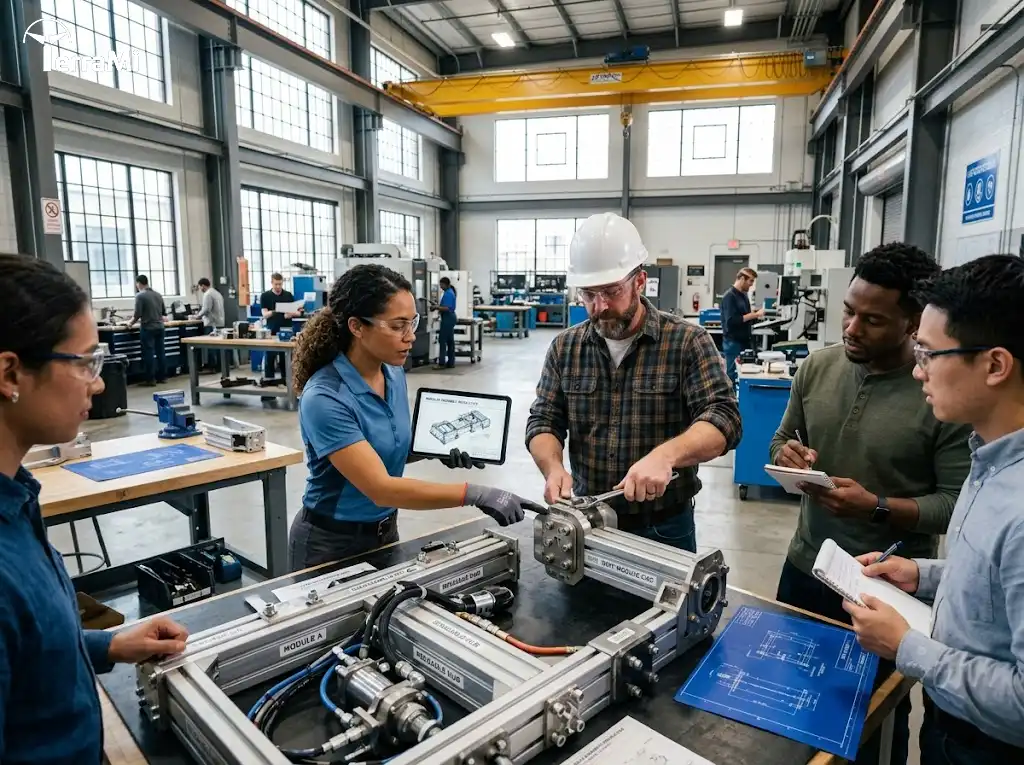
Circular engineering reverses this perspective.
Infrastructure assets are designed not only to perform efficiently today but also to preserve material value for future generations. Durability, adaptability, modularity, recoverability, and disassembly become engineering parameters alongside strength, safety, and operational performance.
This evolution reflects a broader shift from asset optimization toward resource optimization. Engineers are increasingly responsible not only for delivering infrastructure projects but also for ensuring that the materials embedded within those assets remain valuable long after their original purpose has been fulfilled.
Organizations that embrace this philosophy are beginning to redefine infrastructure as a continuously evolving resource system rather than a sequence of isolated construction projects.
Material Intelligence Is Transforming Decision-Making
Engineering has always relied upon data.
Structural calculations, geotechnical investigations, environmental assessments, and financial models have long supported infrastructure decision-making. However, one category of information has historically received far less strategic attention: Material intelligence.
Material intelligence refers to the systematic understanding of where materials originate, how they move through infrastructure systems, how they retain value over time, and how they can be recovered, reused, or regenerated throughout multiple asset lifecycles.
Rather than viewing materials as passive construction inputs, engineers increasingly recognize them as strategic assets whose characteristics influence resilience, economic performance, carbon reduction, and future resource availability.
This shift creates new opportunities for infrastructure planning.
Instead of selecting materials based solely on initial cost and technical specifications, organizations can evaluate long-term recoverability, embedded carbon, maintenance requirements, adaptability, and residual economic value.
Consequently, infrastructure decisions become increasingly informed by lifecycle intelligence rather than short-term optimization.
This approach also strengthens collaboration across engineering, procurement, asset management, sustainability, and finance. When all stakeholders operate from a shared understanding of material value, organizations are better positioned to improve resilience, reduce unnecessary resource consumption, and make more informed lifecycle decisions. This integrated perspective reflects the systems-based principles promoted by the Ellen MacArthur Foundation, which emphasizes designing resource flows to retain value throughout multiple lifecycles.
The transition from conventional material management toward material intelligence represents one of the defining characteristics of the next generation of infrastructure systems.
Material Passports Are Creating Transparency Across Infrastructure Lifecycles
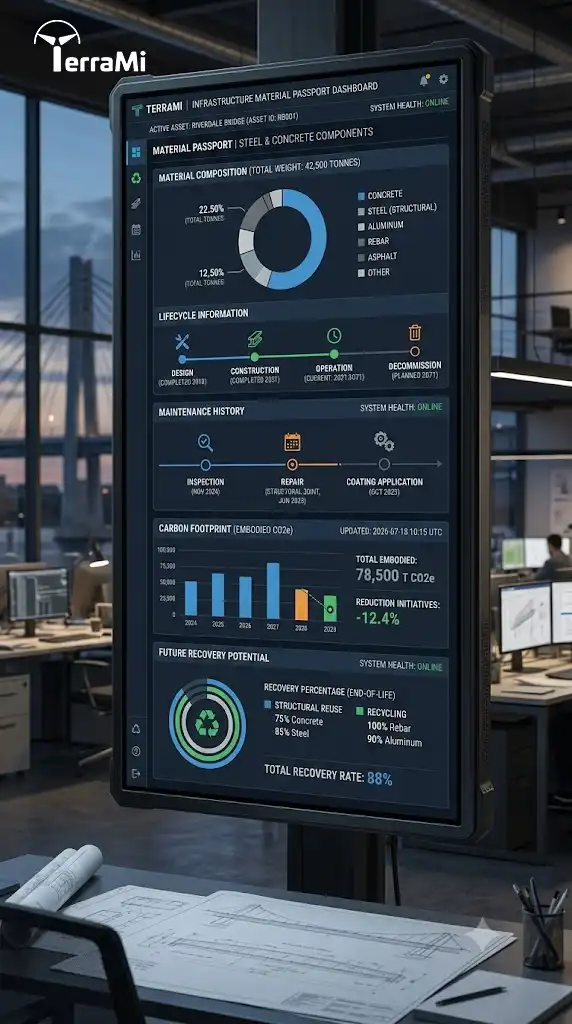
One of the most important developments supporting the Circular Economy is the emergence of Material Passports. Material Passports provide structured digital records describing the characteristics, composition, origin, environmental performance, maintenance history, and recovery potential of materials and products incorporated into infrastructure assets.
Instead of losing valuable information once construction is completed, infrastructure owners maintain a continuously evolving record of material knowledge throughout the asset lifecycle. This information significantly improves future decision-making.
Engineers responsible for refurbishment projects can identify reusable components before demolition begins. Asset managers gain greater visibility into maintenance requirements. Contractors can recover higher-value materials. Investors obtain improved insight into long-term resource performance.
Ultimately, Material Passports reduce uncertainty. Rather than treating existing infrastructure as unknown demolition waste, organizations begin viewing it as a documented inventory of future construction resources.
This represents an important cultural change. Infrastructure is no longer considered the final destination of construction materials. It becomes a temporary phase within a continuous material lifecycle.
For organizations seeking to improve circular infrastructure practices, Material Passports provide one of the most practical mechanisms for translating circular principles into measurable engineering outcomes.
Urban Mining Is Redefining Resource Availability
For centuries, societies have relied primarily upon extracting virgin resources from natural environments. The Circular Economy introduces an alternative perspective. Cities themselves are becoming resource reservoirs.
Buildings, bridges, transportation systems, industrial facilities, utility networks, and obsolete infrastructure collectively contain enormous quantities of steel, aluminium, copper, aggregates, timber, plastics, and increasingly valuable critical minerals.
This concept—commonly known as urban mining—expands the definition of resource extraction. Instead of looking exclusively beneath the ground, infrastructure organizations increasingly look within the built environment.
Urban mining offers several strategic advantages.
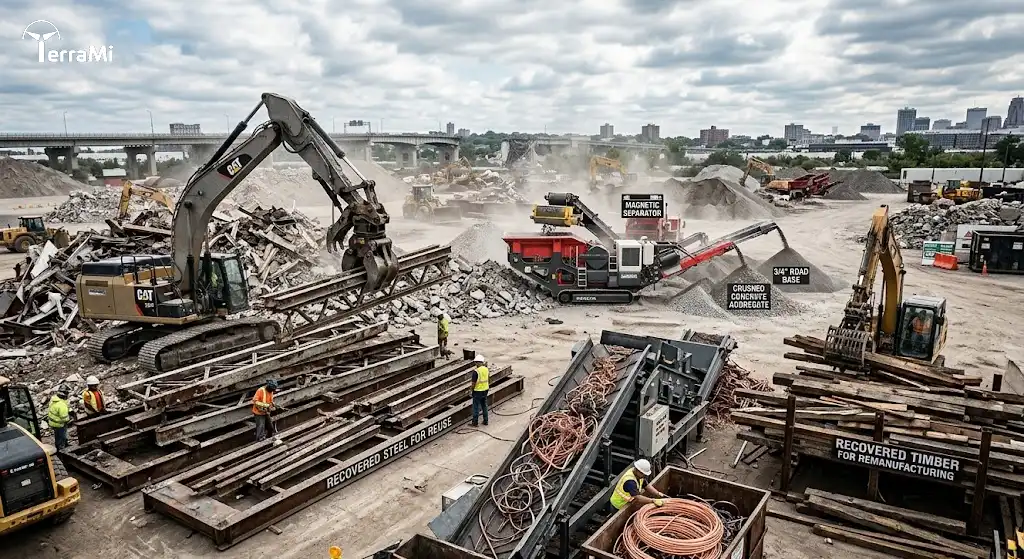
Recovering materials from existing assets reduces dependence on imported raw materials, shortens transportation distances, lowers embodied carbon emissions, and improves resilience against volatile global supply chains. At the same time, it enables infrastructure owners to preserve significant economic value that would otherwise be lost through conventional demolition practices.
Urban mining therefore complements traditional resource development rather than replacing it.
As global demand for construction materials continues to increase, future infrastructure will depend upon a balanced combination of responsible extraction, intelligent recovery, and circular material management.
Digital Technologies Are Accelerating Circular Infrastructure
The growing maturity of the Circular Economy would not be possible without digital transformation.
Managing millions of materials across decades of infrastructure development exceeds the capabilities of conventional documentation systems. Digital technologies now enable organizations to collect, analyse, and continuously update resource information throughout an asset’s lifecycle.
Building Information Modelling (BIM), Digital Twins, Geographic Information Systems (GIS), Internet of Things (IoT) platforms, artificial intelligence, blockchain-enabled traceability, and cloud-based asset management systems collectively provide unprecedented visibility into infrastructure resources. Together, these technologies enable organizations to monitor material flows, improve lifecycle decision-making, and strengthen infrastructure resilience through data-driven insights. This digital transformation is increasingly recognized as a critical enabler of future infrastructure systems by the World Economic Forum.
Rather than relying upon fragmented datasets, organizations can develop integrated digital environments that support engineering, procurement, maintenance, refurbishment, and material recovery using consistent information.
This transformation strengthens decision-making across every stage of infrastructure delivery.
Digital technologies allow engineers to anticipate future material demand, identify recoverable resources before demolition, evaluate lifecycle performance, optimize maintenance strategies, and improve resource productivity through evidence-based planning.
As digital capabilities continue to advance, infrastructure intelligence will increasingly depend upon the quality of resource intelligence embedded within these systems.
Organizations that successfully combine engineering expertise with digital resource management will be significantly better positioned to navigate future uncertainty.
Circularity Is Becoming a Strategic Competitive Advantage
Competitive advantage within infrastructure is changing. Historically, organizations differentiated themselves through engineering capability, financial strength, construction efficiency, and operational excellence.
These strengths remain essential. However, future leadership will increasingly depend upon an organization’s ability to understand and manage material value across multiple infrastructure lifecycles.
Organizations capable of preserving resources, recovering high-value materials, integrating digital intelligence, and designing infrastructure for future adaptability will reduce long-term costs while strengthening resilience against market volatility and resource constraints. Circularity therefore becomes more than a sustainability initiative.
It becomes a strategic capability. The organizations that adopt circular principles today are not simply reducing waste. They are building the knowledge, systems, and resource intelligence necessary to compete within an increasingly resource-constrained global economy.
This shift marks one of the most significant transitions in modern infrastructure. The question is no longer whether organizations can afford to adopt circular thinking. It is whether they can afford not to.
Conclusion
The transition toward a Circular Economy is no longer driven solely by environmental ambition. It is increasingly shaped by engineering realities, resource constraints, geopolitical uncertainty, and the growing need for resilient infrastructure systems.
Throughout this article, we have explored how circularity is evolving beyond recycling and waste management into a comprehensive discipline that integrates engineering, material science, digital technologies, industrial ecology, and strategic resource management. This evolution fundamentally changes how infrastructure is designed, operated, maintained, and ultimately renewed.
Rather than treating materials as temporary construction inputs, the Circular Economy recognizes them as strategic assets whose value should be preserved across multiple infrastructure lifecycles. Concepts such as material intelligence, digital traceability, urban mining, and lifecycle optimization are no longer experimental ideas; they are becoming practical tools that improve resilience while strengthening long-term economic performance.
Perhaps the most important shift is philosophical. The future of infrastructure will not be defined simply by how efficiently resources are consumed, but by how intelligently they are managed.
Organizations that embrace circular thinking today are positioning themselves to navigate future uncertainty with greater confidence. They will be better equipped to reduce dependence on volatile supply chains, preserve valuable materials, improve investment performance, and support national resource security without compromising engineering excellence.
The Circular Economy is therefore no longer an alternative approach to infrastructure. It is becoming the next stage of infrastructure development.
TerraMi Perspective
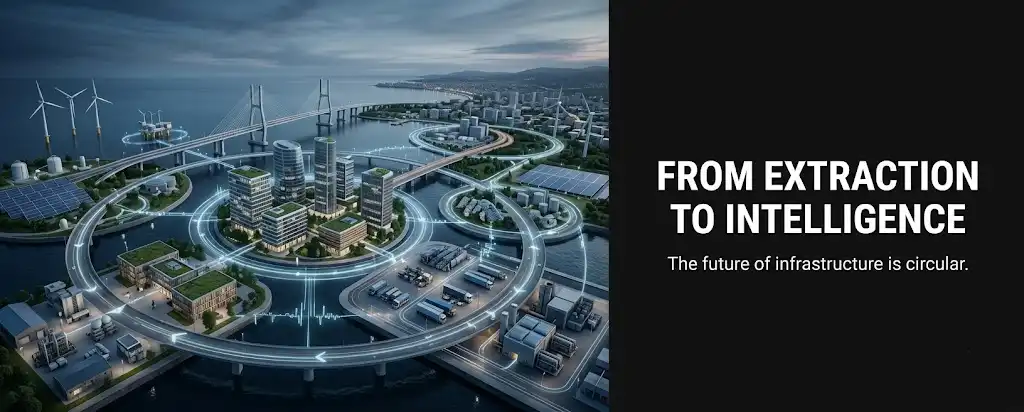
The future of infrastructure will not be determined by how much we build, but by how intelligently we preserve the value of what we build.
For generations, engineering success has been measured by delivering projects that are safe, efficient, and economically viable. While these objectives remain essential, the next generation of infrastructure requires a broader perspective—one that recognizes materials as long-term strategic assets rather than short-term construction inputs.
At TerraMi, we believe the Circular Economy represents far more than a sustainability initiative. It is an emerging engineering discipline that combines material intelligence, digital innovation, lifecycle thinking, and systems engineering to improve both resilience and long-term resource productivity.
As organizations begin adopting circular infrastructure principles, success increasingly depends on turning strategic concepts into practical implementation. Whether the objective is improving material traceability, developing circular procurement strategies, strengthening ESG performance, or preparing digital infrastructure systems for the future, meaningful progress requires both technical expertise and organizational readiness.
If your organization is exploring how circular economy principles can strengthen infrastructure resilience and long-term value creation, visit our Contact Us page to discuss how TerraMi can support your sustainability, circular infrastructure, and digital transformation initiatives.
Assess Your AI Readiness
The transition toward intelligent infrastructure also depends on an organization’s ability to leverage digital technologies effectively. Understanding your current level of AI readiness is an important first step before implementing AI-enabled resource intelligence, digital twins, predictive analytics, or advanced infrastructure management solutions.
TerraMi’s AI Pre-Assessment provides a structured starting point for organizations seeking to evaluate their preparedness for AI-driven infrastructure transformation.
Continue the TerraMi Special Series
TerraMi Special Series II — The Resource Future of Infrastructure
This second article explored how the Circular Economy is evolving from an environmental concept into a strategic engineering discipline. By integrating material intelligence, digital technologies, and lifecycle thinking, infrastructure organizations can reduce resource dependency while creating more resilient and adaptable systems.
In the final article, we will examine why this transformation is especially significant for developing nations and how emerging economies have a unique opportunity to avoid the limitations of traditional linear development.
Next Article
Part III — Why Developing Nations Cannot Afford Linear Growth
Frequently Asked Questions (FAQ)
What makes the Circular Economy different from traditional recycling?
Traditional recycling focuses primarily on recovering waste after products reach the end of their useful life. The Circular Economy begins much earlier by designing products, infrastructure, and material systems for durability, adaptability, reuse, refurbishment, and recovery throughout multiple lifecycles.
Why is the Circular Economy becoming important for infrastructure?
Infrastructure consumes enormous quantities of materials and typically remains in service for decades. Circular approaches improve resource productivity, reduce dependence on virgin materials, strengthen supply chain resilience, and preserve long-term economic value.
What are Material Passports?
Material Passports are digital records containing information about the composition, origin, performance, maintenance history, and recovery potential of materials incorporated into buildings and infrastructure assets. They improve transparency throughout an asset’s lifecycle and support future reuse.
What is urban mining?
Urban mining refers to recovering valuable materials from existing buildings, bridges, transportation systems, and other infrastructure rather than relying exclusively on newly extracted natural resources.
How do digital technologies support the Circular Economy?
Technologies such as BIM, Digital Twins, IoT, AI, GIS, and cloud-based asset management systems improve visibility into material flows, enabling organizations to optimize maintenance, refurbishment, resource recovery, and long-term infrastructure planning.