
Why Circular Construction Adoption Remains Slow: The Hidden Barriers Holding Infrastructure Back
Introduction
The construction industry has embraced the language of circularity with remarkable speed. Governments increasingly reference circular economy principles within infrastructure strategies. Engineering firms publish ambitious sustainability roadmaps. Material suppliers introduce products containing recycled content, while project owners announce commitments to reducing waste and lowering embodied carbon.
On paper, the transition appears well underway. The reality, however, tells a different story.
Across much of the global infrastructure sector, traditional linear practices continue to dominate project delivery. Valuable construction materials are still discarded after demolition. Components that could be reused remain difficult to recover. Design decisions frequently prioritize immediate cost over long-term resource efficiency. Even projects marketed as sustainable often rely on fundamentally linear material flows.
This disconnect raises an important question:
If the benefits of circular construction are widely recognized, why has industry-wide adoption remained so slow?
The answer extends far beyond recycling technologies or waste management practices. Circular construction is not merely an environmental initiative—it represents a fundamental transformation in how infrastructure assets are designed, procured, constructed, operated, maintained, and ultimately repurposed.
Such a transformation challenges decades of established engineering practices, contractual structures, supply chain relationships, regulatory frameworks, and organizational cultures. These deeply embedded systems cannot be replaced simply by introducing new materials or publishing sustainability policies.
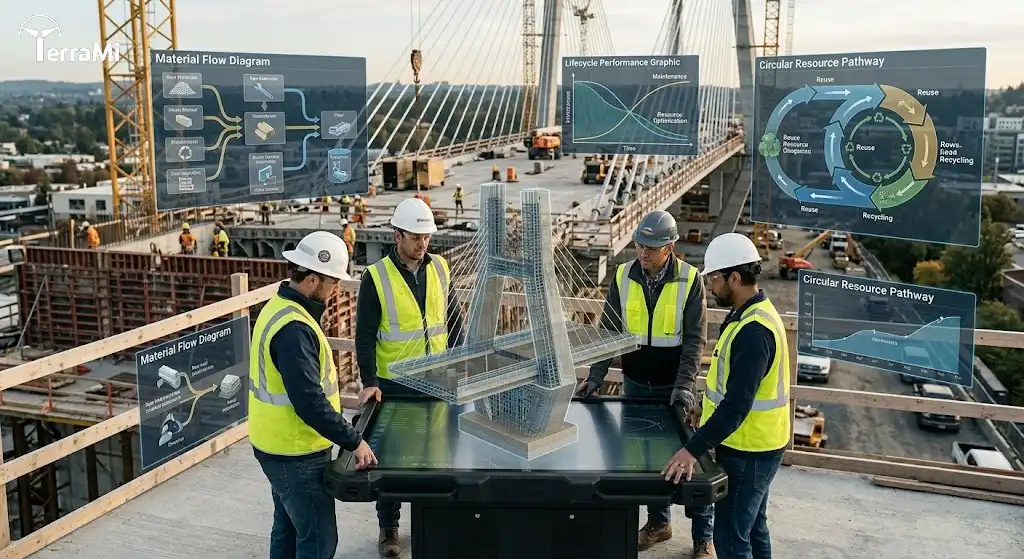
As discussed in TerraMi’s previous article, Material Flow Optimization in Infrastructure Projects, improving visibility into material movement represents an essential step toward greater resource efficiency. However, visibility alone does not create circularity. Organizations may understand where materials originate and where they are consumed while still operating within entirely linear business models.
Circular infrastructure requires something more comprehensive. It requires systems capable of preserving the value of materials across multiple asset life cycles rather than optimizing a single construction project.
This distinction is often overlooked.
Many organizations attempt to implement isolated circular initiatives—using recycled aggregates, reducing packaging waste, or increasing recycling rates—without addressing the structural barriers that continue to reinforce linear decision-making. As a result, isolated successes rarely scale into organization-wide transformation.
The industry’s greatest challenge, therefore, is not a lack of sustainability ambition. It is the persistence of interconnected barriers that prevent circular principles from becoming standard engineering practice.
Circular Construction Is a Systems Challenge—Not a Recycling Strategy
One of the most common misconceptions surrounding circular construction is that it focuses primarily on waste reduction.
Waste reduction is certainly important, but it represents only one outcome of a much broader systems approach.
A truly circular infrastructure system seeks to maximize the lifetime value of materials, components, and assets throughout multiple generations of use. Instead of viewing buildings, bridges, roads, or utility networks as temporary collections of construction products, circular thinking treats them as long-term material repositories capable of supporting future infrastructure development.
This shift fundamentally changes engineering priorities. Traditional project delivery asks questions such as:
- Can this project be delivered on time?
- Can costs be minimized?
- Does the design satisfy technical specifications?
- Are construction risks adequately controlled?
Circular project delivery introduces additional strategic questions:
- Can major components be disassembled without destruction?
- Can structural elements be reused decades from now?
- Can future owners identify every material contained within the asset?
- Can maintenance extend useful life rather than trigger replacement?
- Can today’s infrastructure become tomorrow’s resource instead of tomorrow’s waste?
These questions cannot be answered solely during construction.
They influence decisions made throughout the entire infrastructure lifecycle—from concept design and procurement to operation, refurbishment, decommissioning, and material recovery.
Consequently, circular construction should not be understood as an isolated sustainability initiative. It represents a comprehensive redesign of infrastructure systems. This systems perspective explains why implementation has proven far more difficult than many early advocates anticipated. Changing individual materials is relatively straightforward. Changing entire engineering ecosystems is considerably more complex.
Why Good Ideas Often Fail During Implementation
The construction industry is not resistant to innovation because engineers oppose sustainability. Rather, implementation frequently fails because existing project ecosystems reward short-term optimization while circularity depends upon long-term value creation.
Most infrastructure projects involve dozens—sometimes hundreds—of independent stakeholders, including owners, consultants, contractors, subcontractors, suppliers, operators, regulators, insurers, and financial institutions.
Each stakeholder typically operates according to different objectives.
- Contractors focus on delivery schedules.
- Owners prioritize lifecycle performance.
- Procurement teams seek competitive pricing.
- Regulators enforce compliance.
- Financial institutions evaluate investment risk.
- Operators emphasize long-term maintainability.
Although every participant may publicly support sustainability, few contractual arrangements encourage collaborative optimization across the entire asset lifecycle. Instead, each organization optimizes only the decisions directly affecting its own responsibilities.
The result is predictable. Projects become highly efficient within individual organizational boundaries while remaining inefficient at the system level. This phenomenon explains why many circular initiatives struggle to move beyond pilot programs. Success requires coordination across organizations that often lack shared incentives, shared information, or shared accountability.
In other words, the barriers slowing circular construction are rarely isolated. They are interconnected.
- A procurement decision influences design flexibility.
- Design choices determine future maintenance options.
- Maintenance practices affect asset longevity.
- Asset information determines whether components can later be reused.
- Regulatory requirements influence every stage of this process.
When one element fails, the effectiveness of the entire circular system begins to deteriorate. Understanding these relationships is essential before proposing solutions. Without recognizing the systemic nature of the challenge, organizations risk treating symptoms while leaving the underlying causes untouched.
The Four Categories of Barriers
Although individual projects face unique circumstances, most implementation challenges can be grouped into four interconnected categories:
- Technical barriers that limit visibility, traceability, and engineering confidence.
- Economic barriers that discourage long-term investment despite lifecycle benefits.
- Regulatory barriers created by outdated standards, procurement rules, and legal uncertainty.
- Organizational barriers arising from fragmented governance, cultural resistance, and disconnected decision-making.
Each category reinforces the others. Technical limitations increase financial uncertainty, financial uncertainty discourages regulatory reform, regulatory complexity reinforces organizational inertia, and organizational fragmentation slows technological adoption. This interconnected structure explains why progress has often been incremental despite significant advances in sustainable engineering technologies. Understanding these barriers individually—and more importantly, understanding how they interact—provides the foundation for accelerating the transition toward genuinely circular infrastructure systems.
Technical Barriers: Why Circular Construction Begins with Information
Perhaps the greatest misconception surrounding circular construction is the assumption that the primary obstacle is material availability. In reality, the construction industry already possesses enormous quantities of recoverable materials embedded within existing buildings, bridges, tunnels, industrial facilities, transportation networks, and public infrastructure. Every year, billions of dollars’ worth of steel, concrete, aluminum, timber, asphalt, glass, and mechanical equipment reach the end of their original service lives.
The challenge is rarely that these resources do not exist; rather, it is that the industry often has little reliable information about them. Unlike products manufactured within tightly controlled industrial environments, infrastructure assets are typically constructed over many years by numerous contractors, suppliers, subcontractors, and design teams. Documentation may become fragmented, outdated, or entirely unavailable, renovations alter original designs, maintenance records are scattered across multiple systems, and ownership changes introduce additional data loss.
When an asset eventually requires rehabilitation or demolition decades later, project teams frequently know less about the materials inside the structure than they know about newly manufactured products arriving from suppliers. This lack of information fundamentally undermines circularity because materials cannot be confidently reused if engineers cannot verify their origin, composition, structural integrity, maintenance history, or remaining service life. These challenges closely align with the principles discussed in Material Flow Optimization in Infrastructure Projects. Consequently, many potentially reusable components are treated as waste—not because they have lost value, but because their value cannot be demonstrated with sufficient confidence.
Circular construction therefore begins with something less visible than recycled materials. It begins with trusted information.

The Hidden Cost of Missing Material Intelligence
In conventional project delivery, information about materials is primarily collected to support construction activities. Once a project is completed, however, much of that information gradually loses visibility. Decades later, organizations attempting to refurbish or decommission infrastructure often encounter fundamental questions that should have straightforward answers:
- Which supplier manufactured this structural component?
- What grade of steel was used?
- Has the element experienced significant fatigue loading?
- Were repairs previously undertaken?
- Does hazardous material exist within this assembly?
- Can the component safely be reused elsewhere?
Surprisingly often, the answer is uncertain. As a result, engineering teams adopt conservative assumptions, and rather than investing time and resources to verify existing components, replacing them with newly manufactured materials becomes the lower-risk option.
This conservative approach is understandable because engineering decisions must prioritize public safety, regulatory compliance, and liability management. However, it also reinforces the linear economy. Without trustworthy lifecycle information, infrastructure effectively becomes a collection of unknown materials rather than a managed portfolio of recoverable assets.
This is where the concept of Material Intelligence becomes increasingly important. Material Intelligence extends far beyond inventory management by creating continuously updated digital knowledge that describes where materials exist, how they have been used, their environmental characteristics, maintenance history, condition assessments, and future recovery potential. Instead of asking, What materials are entering this project?, organizations begin asking, What resources already exist within our infrastructure portfolio? That shift fundamentally changes decision-making.
Why Material Passports Matter
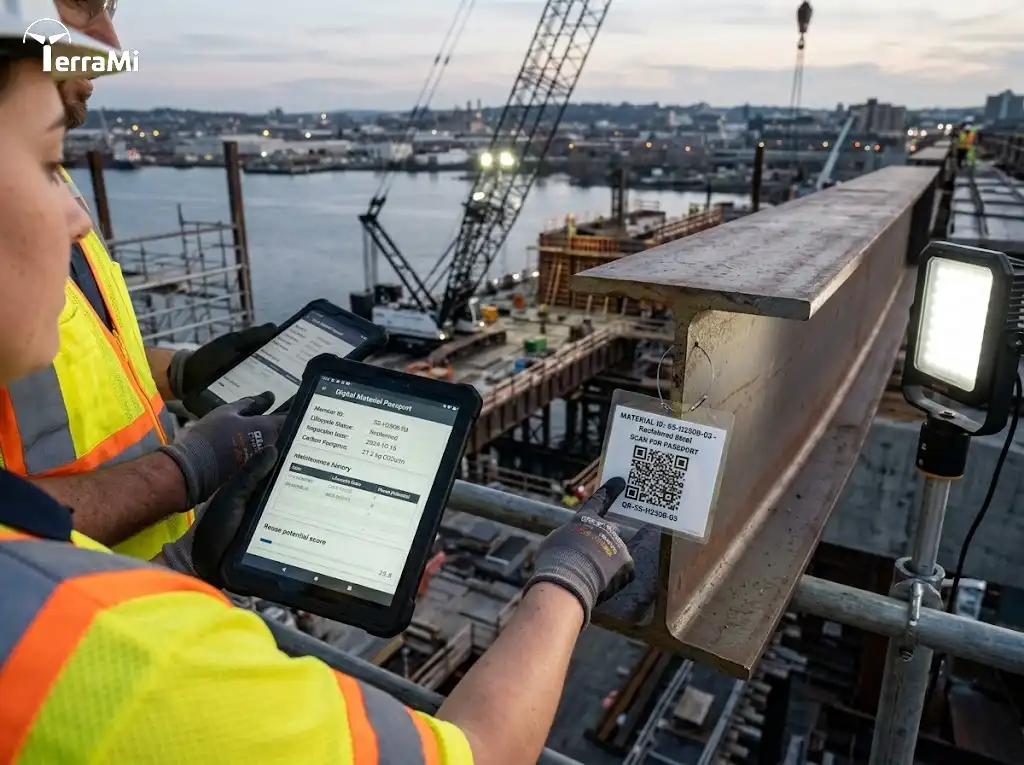
One of the most promising developments supporting circular construction is the emergence of Material Passports. A material passport functions as a long-term digital identity for construction materials and components throughout their entire lifecycle.
Rather than documenting only installation information, a passport preserves critical knowledge such as:
- Material composition
- Manufacturer information
- Environmental performance
- Structural characteristics
- Installation date
- Inspection history
- Repair records
- Remaining service life
- Reuse potential
- Recycling pathways
This information becomes increasingly valuable as infrastructure ages. Instead of treating demolition as the end of an asset’s story, organizations gain the ability to recover valuable components with significantly greater confidence, transforming demolition from a waste-generating activity into a process of selective resource recovery.
Despite their considerable promise, however, widespread adoption of material passports remains limited. Creating accurate passports requires standardized data collection, interoperable digital systems, consistent maintenance practices, and close collaboration across supply chains. Many organizations still lack the digital infrastructure necessary to support these requirements, which is why material passports remain far more common in pilot projects than across national infrastructure portfolios.
The Digital Twin Gap
Another major technical obstacle is the uneven adoption of digital engineering technologies. Digital Twins have attracted considerable attention across the infrastructure sector because they enable organizations to connect physical assets with continuously updated digital representations. When implemented effectively, they integrate information from engineering models, sensors, inspections, maintenance activities, operational performance, and environmental conditions into a unified decision-support environment.
Within the context of circular construction, this capability becomes particularly valuable. A Digital Twin can help organizations answer questions such as:
- Which bridge components are approaching replacement?
- Which structural elements remain suitable for continued service?
- Which materials possess sufficient residual value for reuse?
- Which assets should be refurbished instead of replaced?
- How will maintenance decisions influence future resource recovery?
Without these digital capabilities, such assessments often rely on isolated inspections and incomplete historical records, causing decision-making to remain reactive rather than predictive.
Implementing Digital Twins, however, remains a significant challenge. Many infrastructure owners continue to operate legacy assets that were designed decades before modern digital engineering practices emerged. Information is distributed across incompatible software platforms, paper documentation is still common, sensor coverage varies dramatically between assets, and standardized data governance is often absent. The result is a fragmented digital landscape in which valuable engineering information exists but cannot easily be connected or analyzed.
The problem, therefore, is not simply a lack of data—it is a lack of integration.
Fragmented Data, Fragmented Decisions
Infrastructure organizations frequently possess enormous quantities of information distributed across multiple systems, including engineering drawings, inspection reports, procurement records, maintenance schedules, GIS databases, BIM models, asset management systems, environmental assessments, financial systems, and procurement platforms. Each dataset provides valuable insight, yet few communicate effectively with one another.
This fragmentation creates one of the most underestimated barriers to circular implementation. Decision-makers cannot optimize resource recovery if information remains distributed across disconnected systems. For example, a bridge rehabilitation project may require engineers to combine structural inspection data, procurement history, material specifications, maintenance records, carbon assessments, and future replacement schedules. When these datasets remain isolated within separate organizational silos, comprehensive decision-making becomes slow, expensive, and uncertain, making replacement appear simpler than recovery.
The issue is not technological capability—it is information architecture. Circular construction depends upon integrated infrastructure intelligence rather than isolated databases.
Economic Barriers: When Short-Term Costs Override Long-Term Value
Even when the necessary technical capabilities exist, financial structures frequently discourage circular decision-making. This apparent contradiction reflects one of the defining characteristics of infrastructure economics: many circular strategies generate substantial lifecycle value while requiring higher initial investment. Traditional project evaluation methods often struggle to recognize that long-term value, causing economically rational circular solutions to appear financially unattractive during procurement.
The Problem with Lowest-Cost Procurement
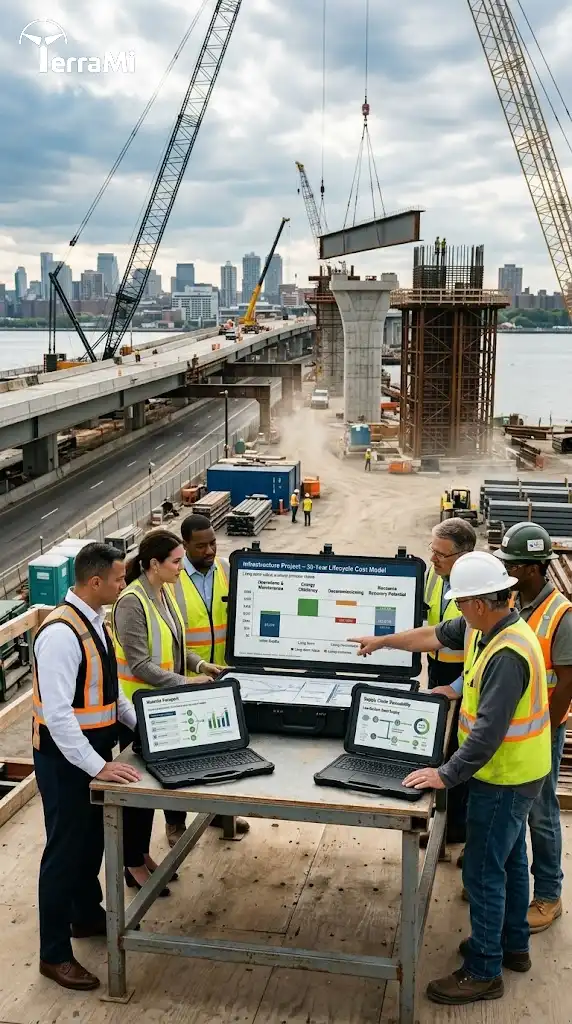
Public and private infrastructure projects alike continue to rely heavily on procurement models that emphasize immediate construction costs. Competitive bidding undoubtedly improves transparency and market efficiency. However, when project evaluation focuses primarily on the lowest upfront price, long-term resource efficiency receives comparatively little attention.
For example, designing a bridge for future disassembly may require:
- More detailed engineering
- Higher-quality connectors
- Enhanced documentation
- Digital material tracking
- Additional lifecycle planning
These investments inevitably increase initial project costs. However, they can dramatically reduce future demolition expenses, material losses, carbon emissions, and replacement costs decades later. The financial benefits are real; they simply materialize beyond the time horizon considered by many procurement decisions. This mismatch creates a persistent implementation barrier, allowing organizations to optimize individual project budgets while unintentionally increasing the total lifetime cost of infrastructure.
Circular Value Often Appears Too Late
Infrastructure assets frequently remain in service for fifty, seventy-five, or even one hundred years. As a result, many of the greatest benefits of circular construction emerge long after the original project team has completed delivery. The contractor responsible for today’s construction may never experience the financial value generated through easier refurbishment decades later, while engineering consultants rarely benefit directly from reduced demolition costs that materialize several generations into the future.
This disconnect between investment and reward weakens incentives across the entire project ecosystem. Those who invest in circular innovation are often not the organizations that ultimately capture its long-term value. Until procurement models more effectively align lifecycle benefits with project incentives, the transition toward circular construction is likely to remain gradual.
The Business Case Is Broader Than Cost Savings
Another limitation lies in how organizations define return on investment. Circular construction is frequently evaluated solely through direct financial savings, even though its value extends far beyond immediate cost reductions.
A comprehensive business case may include:
- Reduced exposure to volatile raw material markets
- Lower embodied carbon emissions
- Improved ESG performance
- Greater supply chain resilience
- Reduced dependence on critical materials
- Higher asset adaptability
- Increased infrastructure longevity
- Better regulatory preparedness
- Enhanced organizational reputation
- Improved access to sustainable financing
When these broader strategic benefits are incorporated into investment decisions, circular construction often becomes significantly more attractive. Unfortunately, many evaluation frameworks continue to prioritize short-term capital expenditure while undervaluing resilience, resource security, and long-term operational flexibility. That imbalance remains one of the most significant obstacles preventing circular construction from becoming mainstream infrastructure practice.
Regulatory Barriers: When Rules Designed for the Linear Economy Limit Circular Innovation
Technical capability alone cannot transform an industry. Even when organizations possess the engineering expertise, digital infrastructure, and financial motivation to implement circular construction, they must still operate within regulatory systems that were largely developed for a different economic model.
For decades, construction regulations have been optimized to support a linear process:
- Extract resources
- Manufacture products
- Construct assets
- Operate infrastructure
- Demolish at end of life
- Dispose of waste
This model has produced safe and reliable infrastructure around the world. However, it was never designed to maximize material recovery across multiple generations of infrastructure development. As a result, many regulations unintentionally discourage circular practices—not because policymakers oppose sustainability, but because existing frameworks prioritize certainty, standardization, and risk reduction.
Changing these frameworks requires balancing two legitimate objectives: maintaining public safety while enabling innovation. Achieving that balance is considerably more challenging than simply introducing new environmental policies.
Existing Standards Favor New Materials
Engineering standards depend upon confidence. Design codes specify material properties, testing procedures, manufacturing tolerances, durability expectations, and structural performance with remarkable precision. Newly manufactured materials generally satisfy these requirements because they originate from standardized industrial production, whereas recovered materials often do not.
Even when reclaimed steel, concrete components, structural timber, or mechanical equipment remain technically suitable for continued use, demonstrating that suitability may require additional inspections, laboratory testing, engineering analysis, and certification. These additional requirements increase uncertainty, leading project teams to conclude that purchasing new materials represents the lower-risk option.
The issue, therefore, is not that reused materials are inherently inferior. Rather, the regulatory burden associated with demonstrating equivalent performance often outweighs their economic and environmental advantages. Until engineering standards evolve to better accommodate verified material reuse, many organizations will continue to favor replacement over recovery.
Procurement Regulations Continue to Reward Linear Delivery
Public procurement policies have traditionally emphasized transparency, fairness, and cost competitiveness. These principles remain essential. However, procurement frameworks often evaluate projects using criteria that inadequately recognize the long-term value created by circular construction.
Tender documents frequently prioritize:
- Lowest construction cost
- Delivery schedule
- Technical compliance
- Immediate operational performance
- Contractor qualifications
By contrast, far less attention is typically given to:
- Design for disassembly
- Material recoverability
- Future adaptability
- Resource traceability
- Lifecycle carbon performance
- Long-term asset flexibility
This creates a structural imbalance. Organizations responding to procurement requirements naturally optimize for the evaluation criteria that determine contract awards. If circular performance contributes little to procurement success, investment in circular innovation becomes difficult to justify. As a result, many organizations remain supportive of circular economy principles while continuing to deliver projects through procurement systems that were fundamentally designed for linear infrastructure.
Liability and Risk Remain Significant Obstacles
Engineering is fundamentally a profession built upon accountability. Every design decision carries legal, financial, and ethical responsibility, and this reality significantly influences attitudes toward material reuse.
Consider a structural engineer evaluating reclaimed steel beams recovered from a demolished industrial facility. Before approving their reuse, the engineer must answer several critical questions:
- Can previous loading history be verified?
- Has corrosion affected structural performance?
- Were undocumented modifications previously undertaken?
- Do inspection records provide sufficient confidence?
- Who accepts liability if future performance differs from expectations?
Even when technical evidence suggests that reuse is feasible, uncertainty surrounding future responsibility often discourages adoption. In many jurisdictions, legal frameworks governing reused construction materials remain less mature than those applicable to newly manufactured products. As a result, organizations frequently conclude that minimizing liability presents less risk than pursuing circularity.
This conservative approach is understandable. Infrastructure failures carry enormous human, environmental, and financial consequences. Nevertheless, reducing liability uncertainty will be essential if material reuse is to become routine rather than exceptional.
Circular Construction Requires Regulatory Evolution, Not Regulatory Relaxation
Calls for reducing regulation often oversimplify the challenge. Circular construction does not require weaker standards—it requires smarter ones.
Future regulatory systems will likely need to support:
- Standardized material passports
- Digital traceability requirements
- Performance-based certification
- Lifecycle documentation
- Reuse verification protocols
- Digital asset records
- Circular procurement criteria
- Harmonized engineering standards
Such reforms would strengthen—not weaken—engineering confidence. Rather than lowering safety expectations, they would provide engineers with better information for making informed decisions about existing materials and infrastructure assets. In this sense, regulation becomes an enabler of circularity rather than an obstacle to it.
Organizational Barriers: The Human Side of Infrastructure Transformation
Technology can be purchased, software can be deployed, and policies can be rewritten. Organizational transformation, however, is considerably more difficult. Many circular construction initiatives encounter their greatest resistance not because of engineering limitations, but because they operate within organizational structures that were optimized for a fundamentally different model of infrastructure delivery.
Circular construction requires close collaboration among disciplines that have historically operated independently, including design teams, procurement specialists, construction managers, asset operators, maintenance engineers, ESG professionals, financial analysts, digital transformation teams, and supply chain partners. Each group brings valuable expertise to the process, yet each also operates according to different objectives, performance metrics, and decision timelines. Without effective coordination, circular ambitions frequently dissolve into isolated departmental initiatives rather than becoming organization-wide capabilities.
Infrastructure Remains Highly Fragmented
Unlike many manufacturing industries, infrastructure projects rarely operate within a single organizational boundary. Instead, responsibility shifts repeatedly throughout the asset lifecycle: owners commission consultants, consultants develop designs, contractors construct the asset, specialist subcontractors install components, operators manage day-to-day performance, maintenance organizations conduct repairs, and future owners eventually inherit the infrastructure decades later.
Each transition introduces opportunities for information loss, while every organizational boundary creates another potential break in material knowledge, asset history, and engineering documentation. Circular construction depends upon continuity, yet traditional project delivery often produces discontinuity. This fundamental difference explains why implementing circular construction requires far more than technical innovation—it requires governance capable of preserving information across organizational transitions that may span several decades.
Culture Often Changes More Slowly Than Technology
The engineering profession appropriately values proven methods. Infrastructure assets are expected to remain safe and reliable for generations, so engineers naturally approach new methodologies with caution. This conservative culture has contributed significantly to public safety, but it can also slow the adoption of beneficial innovations.
Organizations frequently encounter questions such as:
- Has this approach been proven?
- Who else is doing this?
- Will regulators approve it?
- What happens if it fails?
These questions are entirely legitimate. However, when every organization waits for another to demonstrate success first, industry-wide progress becomes extremely gradual. Pilot projects remain isolated, knowledge spreads slowly, and innovation struggles to scale. Changing organizational culture therefore requires more than awareness campaigns; it demands leadership willing to embed circular thinking into strategic planning, investment decisions, engineering processes, procurement practices, and organizational performance metrics. Only then can circularity evolve from an environmental initiative into a core operational capability.
Skills Are Becoming as Important as Technology
The transition toward circular infrastructure also demands a new generation of professional competencies. Future infrastructure organizations will increasingly require expertise that spans multiple disciplines rather than traditional functional boundaries.
Engineers must understand lifecycle assessment alongside structural performance. Procurement professionals need to evaluate long-term resource value rather than focusing solely on initial purchase price. Asset managers must integrate environmental data with maintenance planning, while digital specialists are expected to connect BIM, Digital Twins, GIS, IoT platforms, and enterprise asset management systems into coherent information ecosystems. At the executive level, leaders must be able to interpret sustainability indicators alongside financial performance to support better strategic decisions.
These capabilities extend well beyond the scope of traditional engineering education. They represent a new model of interdisciplinary infrastructure management, and organizations that invest in developing them are likely to accelerate circular implementation far more effectively than those that focus exclusively on acquiring new technologies.
The Circular Lock-In Cycle
Although technical, economic, regulatory, and organizational barriers can be examined individually, they rarely operate independently. Instead, they reinforce one another through a self-perpetuating cycle. A lack of digital information increases engineering uncertainty, engineering uncertainty discourages investment, limited investment slows technological adoption, and slower technological adoption weakens the evidence available to regulators. In turn, regulatory uncertainty reinforces conservative procurement practices, conservative procurement discourages organizational innovation, organizational inertia limits data sharing, and limited data availability further increases technical uncertainty—bringing the cycle back to where it began.
This feedback loop explains why many organizations successfully complete individual circular pilot projects without achieving widespread transformation. Isolated improvements address only one part of the system, while the remaining barriers continue reinforcing linear practices.
Breaking this cycle therefore requires coordinated action across multiple dimensions simultaneously. Digital transformation without procurement reform delivers limited impact, policy reform without reliable engineering data creates uncertainty, and material innovation without organizational change struggles to scale. Circular construction succeeds only when these elements evolve together.
This systems perspective represents an important shift in how the industry approaches implementation. The objective is not simply to remove isolated obstacles—it is to redesign the infrastructure ecosystem so that circular decisions become the easiest, safest, and most economically rational choices available.
Breaking the Cycle: Infrastructure Intelligence as the Missing Layer
Throughout this article, we have examined four interconnected categories of barriers that continue to slow the adoption of circular construction. Technical barriers limit visibility, economic barriers discourage long-term investment, regulatory barriers reinforce conservative decision-making, and organizational barriers fragment responsibility across the asset lifecycle. Each barrier is significant on its own. Together, however, they reveal a more fundamental challenge: the infrastructure sector is attempting to build a circular economy on top of information systems that were originally designed for a linear economy.
This distinction is critical. For decades, infrastructure projects have primarily managed assets, contracts, schedules, budgets, and risks, while materials have largely been viewed as project inputs rather than strategic resources capable of retaining value across multiple infrastructure lifecycles.
Circular construction fundamentally changes this perspective. Materials become long-term assets, infrastructure becomes a resource bank, buildings become repositories of future economic value, bridges become inventories of recoverable components, and roads become continuously evolving systems rather than disposable engineering projects. Making this transition requires more than sustainability policies—it requires an entirely new level of Infrastructure Intelligence.

Infrastructure Intelligence integrates ehttps://terrami.ca/ai-pre-assessment/ngineering data, digital asset records, material traceability, lifecycle analysis, operational performance, ESG metrics, procurement information, and predictive analytics into a unified decision-making framework. Rather than asking isolated questions such as “How much waste did this project generate?”, organizations begin asking broader strategic questions:
- Which assets contain the highest future material value?
- Which components should be refurbished instead of replaced?
- Which maintenance strategy maximizes resource efficiency?
- How will today’s design decisions influence material recovery fifty years from now?
- Which investments simultaneously improve resilience, ESG performance, and circularity?
These questions represent a fundamental shift from project optimization toward infrastructure ecosystem optimization. That shift is where circular construction begins to move from aspiration to operational reality.
Circular Construction and Digital Transformation Are Converging
Historically, sustainability initiatives and digital transformation programs have often evolved independently. ESG teams measured environmental performance, engineering teams developed BIM models, asset managers implemented maintenance systems, digital departments invested in data platforms, and procurement teams focused on supplier relationships. Each initiative generated valuable outcomes, yet many organizations struggled to connect these efforts into a coherent operating model.
That separation is becoming increasingly unsustainable. Digital technologies are no longer simply improving engineering efficiency; they are becoming the operational foundation of circular infrastructure. Building Information Modeling (BIM) improves design coordination, Digital Twins provide continuous asset visibility, IoT sensors monitor infrastructure condition in real time, Material Passports preserve lifecycle knowledge, Artificial Intelligence identifies patterns across vast engineering datasets, and predictive analytics optimize maintenance decisions before failures occur.
When these capabilities operate together, organizations gain something far more valuable than a collection of isolated digital tools. They gain the ability to make infrastructure decisions based on continuously evolving intelligence rather than static documentation. As a result, circularity, resilience, operational efficiency, and ESG performance become interconnected outcomes of the same information ecosystem. This convergence represents one of the defining transformations reshaping infrastructure management worldwide.
Looking Beyond Circularity
The future of infrastructure will likely not be defined by individual sustainability initiatives. Instead, competitive advantage will increasingly depend on how effectively organizations integrate environmental, engineering, operational, and digital intelligence into everyday decision-making.
Circular construction is therefore not the destination; it is one essential capability within a much broader transformation. Organizations that continue treating sustainability as a standalone compliance function may struggle to adapt, whereas those that embed circularity into engineering strategy, asset management, digital transformation, and long-term investment planning are likely to become substantially more resilient in an increasingly resource-constrained world.
As climate uncertainty, geopolitical instability, supply chain disruption, and shortages of critical materials continue to reshape infrastructure investment, the ability to understand and manage material value throughout the asset lifecycle will become an operational necessity rather than a competitive advantage. Ultimately, the organizations that succeed will not necessarily be those adopting the newest technologies, but those that use information most intelligently.
TerraMi Perspective
At TerraMi, we believe that the slow adoption of circular construction is not primarily a technology problem, nor is it simply a policy problem. At its core, it is an information problem.
Infrastructure projects generate extraordinary volumes of engineering, environmental, operational, and asset data throughout their lifecycles. Yet in many organizations, this information remains fragmented across departments, software platforms, contractors, and asset owners. When information becomes fragmented, decision-making becomes fragmented—and when decision-making becomes fragmented, achieving circularity becomes significantly more difficult.
This is why we view Infrastructure Intelligence as the next evolution of sustainable infrastructure management. Rather than treating ESG, Digital Twins, BIM, asset management, material traceability, and lifecycle analysis as separate initiatives, organizations should integrate them into a unified decision-support ecosystem capable of guiding infrastructure decisions over decades rather than individual projects.
Ultimately, circular construction is not simply about recovering materials—it is about preserving knowledge. Every future infrastructure decision depends on the quality of information that survives from today’s projects. Organizations that invest in information resilience today will be significantly better prepared to achieve resource resilience tomorrow.
Conclusion
The global construction industry has already demonstrated that circular construction is technically possible. Numerous pilot projects have shown that materials can be recovered, components reused, waste reduced, and environmental impacts significantly lowered. The remaining challenge is no longer proving that circular construction works—it is scaling its implementation.
Achieving that goal requires recognizing that the barriers slowing circular construction are interconnected rather than isolated. Technical capability must be supported by reliable information, economic incentives must reward lifecycle value, regulatory frameworks must evolve alongside engineering practice, and organizations must establish governance structures capable of preserving knowledge throughout decades of infrastructure operation.
Most importantly, the industry must begin viewing information as critical infrastructure in its own right. Without trusted information, circular decisions remain uncertain. With trusted information, however, circular construction becomes not only environmentally responsible, but also economically rational, operationally resilient, and strategically advantageous.
The future of infrastructure will not be built solely from concrete, steel, and asphalt. It will also be built from intelligence.
Frequently Asked Questions (FAQ)
What is circular construction?
Circular construction is an approach to designing, building, operating, and eventually deconstructing infrastructure so that materials and components retain their value for as long as possible through reuse, refurbishment, remanufacturing, and recycling rather than disposal.
Why is circular construction difficult to implement?
Implementation is slowed by a combination of technical limitations, economic incentives, regulatory uncertainty, fragmented supply chains, organizational culture, and insufficient lifecycle information. These barriers reinforce one another, making systemic change more challenging than isolated sustainability initiatives.
How do Digital Twins support circular construction?
Digital Twins create continuously updated digital representations of physical infrastructure assets. They improve asset visibility, support predictive maintenance, preserve lifecycle information, and help organizations identify opportunities for refurbishment, reuse, and more efficient resource management.
What are Material Passports?
Material Passports are digital records that document the characteristics, origin, composition, maintenance history, and reuse potential of construction materials and components. They enable future owners to recover and reuse valuable resources with greater confidence.
Why is Infrastructure Intelligence important for circular construction?
Infrastructure Intelligence integrates engineering, operational, environmental, financial, and digital information into a unified decision-making framework. This enables organizations to optimize assets across their entire lifecycle rather than focusing solely on individual construction projects.