
Data-Driven Decision Making in Engineering Projects
Data-driven decision making in engineering is becoming less about having access to more information and more about knowing which information should influence a decision, when it should influence it, and how confidently it can be trusted.
For decades, engineering projects have generated enormous quantities of data. Drawings, specifications, schedules, inspection reports, cost records, material information, equipment readings, change orders, field observations, environmental measurements and maintenance histories all contribute to the project record. Yet the existence of this information does not automatically make an organization data-driven.
A project can be surrounded by data and still operate reactively.
That distinction matters because infrastructure decisions increasingly have to be made under conditions that are more dynamic than the assumptions on which many traditional project-management processes were built. Design conditions change. Material availability shifts. Costs move. Construction progress deviates from plan. Assets behave differently from models. Weather affects schedules and performance. Operational conditions evolve long after the project team has moved on.
The engineering challenge is no longer simply to document what happened.
It is to recognize what the available evidence is telling us before the consequences become expensive or irreversible.
1. Why Engineering Decisions Still Tend to Be Reactive
The traditional engineering workflow is highly structured for a good reason.
Engineers establish requirements, develop designs, define specifications, estimate costs, create schedules, execute work, inspect results and document performance. Each stage produces information that is supposed to support the next stage.
The problem emerges when information becomes trapped inside those stages.
A design decision may depend on assumptions established months earlier. A construction team may discover field conditions that were not represented adequately in the original model. A project manager may receive schedule information after a delay has already developed. An asset owner may inherit thousands of records at handover but have limited ability to connect them to operational decisions years later.
In each case, the organization has information.
What it lacks is decision-ready information.
This is one reason infrastructure digitalization should not be reduced to the adoption of software platforms. Digitalization becomes meaningful when it changes the relationship between information and action.
The distinction can be illustrated simply:
| Traditional approach | Data-driven approach |
|---|---|
| Record what happened | Understand what is happening |
| Review information periodically | Monitor relevant conditions continuously |
| Respond to deviations | Detect emerging deviations |
| Depend heavily on historical experience | Combine experience with current evidence |
| Optimize individual activities | Evaluate system-level relationships |
| Correct problems after detection | Identify signals before failure or disruption |
The transition does not mean that engineering judgment becomes less important. Quite the opposite.
A mature data environment gives engineers better evidence with which to exercise that judgment.
2. The Real Problem Is Not a Lack of Data
Infrastructure projects rarely suffer from an absolute shortage of data.
They suffer from fragmentation.
Engineering information can exist across BIM environments, spreadsheets, enterprise systems, project-management platforms, inspection databases, procurement records, sensor networks, maintenance systems and individual files. Different teams may use different naming conventions, formats, levels of detail and update cycles.
This creates a deceptively difficult problem.
Imagine that a project team wants to determine whether a recurring delay is associated with material availability, design changes, contractor productivity or weather conditions.
The relevant information may exist.
But it may be distributed across several systems that were never designed to communicate with one another.
The result is a familiar pattern: people spend significant time collecting, reconciling and interpreting information before they can even begin making the decision.
This is where engineering data becomes strategically important.
Data only creates decision value when it has enough context, quality, consistency and timeliness to support a specific engineering question.
A quantity of data is not the same thing as information quality.
And information quality is not the same thing as decision quality.
That chain is often overlooked in digital transformation programs.
3. From Project Records to an Engineering Information System
The shift toward data-driven engineering requires a different view of information.
Instead of treating project data as a by-product of engineering work, organizations can begin treating information as part of the infrastructure’s operating architecture.
This idea is already reflected in established information-management practices. ISO 19650, for example, frames information management around the organization, exchange, recording, versioning and use of information across the lifecycle of built assets. Its scope extends beyond design into construction, operation, maintenance and other lifecycle stages.
That lifecycle perspective is important.
A bridge inspection record should not exist only as a historical document. Its value increases when it can be connected to the bridge’s design assumptions, material characteristics, previous interventions, environmental exposure, loading conditions and current performance. Digital Twin Infrastructure takes this principle further by connecting physical assets with continuously updated digital information that can support monitoring, analysis and decision-making.
The same principle applies to a water network, railway corridor, airport, energy facility or major construction project.
The objective is not to create one enormous database containing everything.
It is to establish a reliable information environment in which the right data can reach the right decision at the right time.
That is a much more demanding objective than simply digitizing documents.

4. What Changes When Data Becomes Predictive?
The most important step beyond conventional digitalization is the move from descriptive information to predictive insight.
Descriptive systems tell engineers what has happened.
Diagnostic systems help explain why it happened.
Predictive systems attempt to identify what is likely to happen next.
That distinction changes the timing of engineering decisions.
Consider a conventional maintenance process. An asset is inspected periodically. A defect is identified. Engineers assess its severity. A maintenance intervention is scheduled. The organization responds to an observed condition.
A predictive approach asks a different question:
Can available evidence indicate that the asset is moving toward an undesirable condition before that condition becomes visible through conventional inspection?
This is where predictive analytics in engineering can become valuable.
Historical performance data, sensor readings, inspection results, environmental conditions, operating patterns and engineering models can be examined together to identify relationships or deviations that would be difficult to recognize through isolated records.
The objective is not to replace inspection or engineering assessment with an algorithm.
It is to increase the amount of useful evidence available before the decision is made.
That distinction becomes especially important in infrastructure, where failure is often not a single event but the final stage of a gradual process.
A change in vibration, temperature, moisture, deformation, energy consumption or operating behaviour may not represent failure by itself. But when those signals are interpreted alongside historical and contextual data, they may reveal an emerging pattern.
The engineering value lies in detecting that pattern early enough to act.
5. Prediction Is Only Valuable When It Changes a Decision
There is a common mistake in discussions about predictive technology: assuming that better prediction automatically produces better outcomes.
It does not.
A predictive model can identify an increasing probability of equipment failure, schedule disruption or performance degradation. But if the organization has no defined response, no accountable decision-maker, no budgetary flexibility or no operational mechanism for acting on that signal, the prediction remains an interesting data point.
This is why the real progression is not:
Data → AI → prediction
It is:
Data → interpretation → prediction → decision → action
Each step matters.
The quality of the initial data matters because unreliable inputs can produce unreliable outputs. The analytical method matters because different engineering problems require different approaches. Human interpretation matters because context can change the meaning of a signal. Governance matters because someone must be accountable for acting on the information.
This is also why information management and engineering analytics should not be treated as separate disciplines.
ISO 19650-4:2022, for example, specifically addresses information exchange and includes criteria for decision-making intended to ensure the quality of project and asset information. It applies across infrastructure assets of different sizes and levels of complexity.
The larger lesson is straightforward:
Predictive engineering begins long before the predictive model.
It begins with the way an organization creates, structures, governs and connects its information.
6. The Architecture Behind Data-Driven Engineering
A predictive engineering environment does not begin with an analytics dashboard.
It begins with an information architecture.
For engineering teams, that architecture needs to connect several layers of information that have traditionally been managed separately: project records, engineering models, field observations, asset-condition data, schedules, costs, environmental conditions and, increasingly, real-time sensor data.
The objective is not necessarily to place all of these datasets into a single system. What matters is that they can be related when a decision requires them.
For example, a project manager investigating a schedule deviation may need to connect procurement data with construction progress, design changes and weather conditions. An asset manager assessing deterioration may need to connect inspection history with material properties, environmental exposure and maintenance interventions.
The useful question is not:
How much data do we have?
It is:
Can we connect the data required to explain a decision?
That shift changes the design of digital engineering systems.
A useful architecture can be thought of as four connected layers.
Data capture
The first layer is where information is generated.
This includes engineering models, inspections, surveys, project-management systems, sensors, equipment records, procurement systems and field applications. Data capture needs to happen as close as possible to the source, with enough context to preserve its engineering meaning.
A sensor reading without an asset identifier, timestamp or operating context has limited value.
The same applies to an inspection record that cannot be reliably connected to the component it describes.
Data integration
The second layer connects information from different sources.
This is often where organizations encounter the greatest practical difficulty. Different systems may use different identifiers, formats, naming conventions and update cycles. Historical records may also contain gaps or inconsistencies.
Integration is therefore not simply a technical exercise. It requires decisions about information ownership, data standards, quality controls and common definitions.
Without those foundations, analytics can produce an impressive visualization of fundamentally inconsistent information.
Analytics and modelling
The third layer transforms information into insight.
This may involve statistical analysis, engineering models, anomaly detection, machine learning, forecasting or other forms of predictive analytics.
The appropriate method depends on the engineering problem.
Not every problem requires artificial intelligence. In some cases, a well-defined engineering threshold or statistical model may provide a more transparent and reliable decision signal than a complex machine-learning system.
The objective should be fitness for purpose, not technological sophistication.
Decision interface
The fourth layer is where analysis becomes useful to engineers and decision-makers.
This could be a dashboard, alert, engineering report, digital twin interface, maintenance recommendation or project-control workflow.
The interface should answer a decision question rather than simply display data.
A dashboard showing twenty performance indicators may look sophisticated. A system that clearly identifies which asset requires attention, why it requires attention and what evidence supports that conclusion is far more useful.
7. Data Quality Becomes an Engineering Issue
Once organizations begin using data to predict outcomes, data quality stops being an administrative concern.
It becomes an engineering risk.
A model trained on incomplete inspection records may underestimate deterioration. A forecasting system built on inconsistent project schedules may generate misleading completion estimates. A sensor that drifts out of calibration can create apparent changes in asset behaviour that do not actually exist.
This creates an important principle for data-driven engineering:
The reliability of a decision cannot be separated from the reliability of the evidence behind it.
Data quality has several dimensions. Accuracy is only one.
Engineers also need to consider completeness, consistency, timeliness, traceability, provenance and context.
A perfectly accurate measurement that arrives six months too late may be useless for a time-sensitive decision.
Likewise, a current measurement without a reliable history may be insufficient to establish whether a change is abnormal.
This is why engineering organizations moving toward predictive decision-making need to establish data governance alongside analytics capabilities.
Someone needs to know where the data originated, who is responsible for it, how it is updated, what its limitations are and whether it is suitable for the decision being considered.
That is not bureaucratic overhead.
It is part of engineering assurance.
8. The Shift from Dashboards to Decision Systems
The engineering dashboard has become one of the most visible symbols of digital transformation.
But dashboards can create a false sense of progress.
A dashboard can make fragmented information look organized without actually improving the decision process behind it.
The more useful evolution is from dashboarding to decision support.
A dashboard might tell an engineering manager that productivity is 8% below the planned level.
A decision-support system should help answer the questions that follow:
- What is causing the deviation?
- Is the deviation temporary or persistent?
- Which activities are contributing most to it?
- What is the likely impact on the overall schedule?
- What interventions are available?
- What happens if no action is taken?
This is where predictive engineering begins to move beyond visualization.
The value of analytics is not the chart itself. It is the ability to reduce uncertainty around an impending decision.
TERRAMI INSIGHT
The value of engineering data is not determined by how much an organization collects. It is determined by how much uncertainty that data can remove before a decision has to be made.
This is why the transition from reactive to predictive engineering is fundamentally a decision-making transition. More sensors, larger datasets and more sophisticated models can increase information volume without improving engineering outcomes. The real test is whether the organization can turn evidence into earlier, clearer and more defensible action.
9. Predictive Engineering Requires a Different Operating Model
Technology can support predictive decisions, but technology alone cannot create them.
An organization may have sensors, cloud infrastructure, BIM models, analytics software and machine-learning capabilities and still make decisions exactly as it did twenty years ago.
The reason is organizational.
Traditional engineering environments often separate design, construction, operations, maintenance, procurement and asset management into distinct functions. Each group has its own objectives, systems and information priorities.
Predictive decision-making requires stronger connections between them.
An anomaly detected during operation may be related to a design characteristic.
A recurring maintenance problem may be associated with an installation decision made during construction.
A procurement decision may affect future maintenance exposure.
A design choice may determine how easily an asset can later be inspected, repaired or monitored.
When these relationships remain invisible, organizations optimize individual stages while missing lifecycle consequences.
This is one of the deeper implications of infrastructure digitalization.
The goal is not merely to digitize existing workflows. It is to make relationships between decisions visible across the infrastructure lifecycle.
That requires shared information structures, clear ownership and a willingness to treat data as an organizational asset rather than the property of a single department.
10. From Predictive Signals to Prescriptive Decisions
There is another distinction worth making.
Predictive analytics estimates what may happen.
Prescriptive decision-making goes one step further by helping determine what should be done.
Consider an infrastructure asset with an increasing probability of component failure.
A predictive system may identify the rising risk.
A more advanced decision environment could combine that risk with:
- maintenance availability
- replacement cost
- asset criticality
- service disruption
- safety implications
- material availability
- crew capacity
- environmental conditions
- alternative intervention strategies
The result is not simply a warning.
It becomes a decision context.
This distinction will become increasingly important as infrastructure organizations face competing pressures around cost, resilience, carbon performance, resource availability and service continuity.
The best engineering decision may not always be the technically optimal intervention in isolation.
It may be the intervention that produces the best outcome across the system’s operational, financial, environmental and lifecycle constraints.
That is where predictive engineering can evolve into a broader form of infrastructure intelligence.
11. Where Data-Driven Decision Making Changes Engineering Practice
The strongest case for data-driven decision making in engineering is not that it makes organizations more digital.
It is that it can change when and why an engineering decision is made.
The difference becomes clearer when we look at the major stages of infrastructure delivery and operation.
Project Planning
During planning, engineering teams work with assumptions about cost, schedule, demand, site conditions, resource availability and future operating requirements.
Those assumptions are necessary, but they are rarely static.
Data-driven planning allows organizations to continuously test those assumptions against new evidence. Historical project performance, market conditions, site information, environmental data and resource availability can be incorporated into scenario analysis before commitments become difficult to reverse.
The benefit is not perfect prediction.
It is better visibility into uncertainty.
Instead of asking whether a project will remain on schedule under one assumed scenario, teams can examine how different conditions could affect the outcome and which variables deserve the closest attention.
That moves planning from a fixed baseline toward a living decision model.

12. Construction: Detecting Problems Before They Become Delays
Construction is one of the clearest environments for predictive decision-making because project conditions change continuously.
A schedule can be technically correct when it is issued and already becoming inaccurate days later.
Weather, labour availability, equipment utilization, design changes, procurement delays, site access and productivity all influence project performance. When these factors are monitored independently, their combined effect can be difficult to recognize until the schedule has already deteriorated.
A data-driven environment can bring these signals together.
For example, declining productivity may not be caused by workforce performance alone. It could coincide with a sequence of late material deliveries, repeated design clarifications or restricted site access.
When those datasets are connected, an engineering team can investigate the relationship rather than simply observing the resulting delay.
This is an important distinction.
Predictive analytics does not eliminate uncertainty. It can make the sources of uncertainty visible earlier.
That earlier visibility creates options.
A procurement intervention made before a critical material shortage is fundamentally different from emergency procurement after the shortage has already disrupted construction.
13. Asset Management: From Scheduled Maintenance to Condition Intelligence
The same principle becomes even more significant after an infrastructure asset enters operation.
Traditional maintenance strategies often rely on fixed inspection intervals, manufacturer recommendations or historical failure patterns.
These methods remain useful. But they can be inefficient when asset condition changes faster or slower than the predefined schedule assumes.
Predictive maintenance introduces another layer of evidence.
Condition-monitoring data, inspection records, operating conditions, historical interventions and environmental exposure can be combined to estimate how an asset is behaving and whether its condition is changing in an unusual way.
This is particularly relevant for assets where failure has significant consequences.
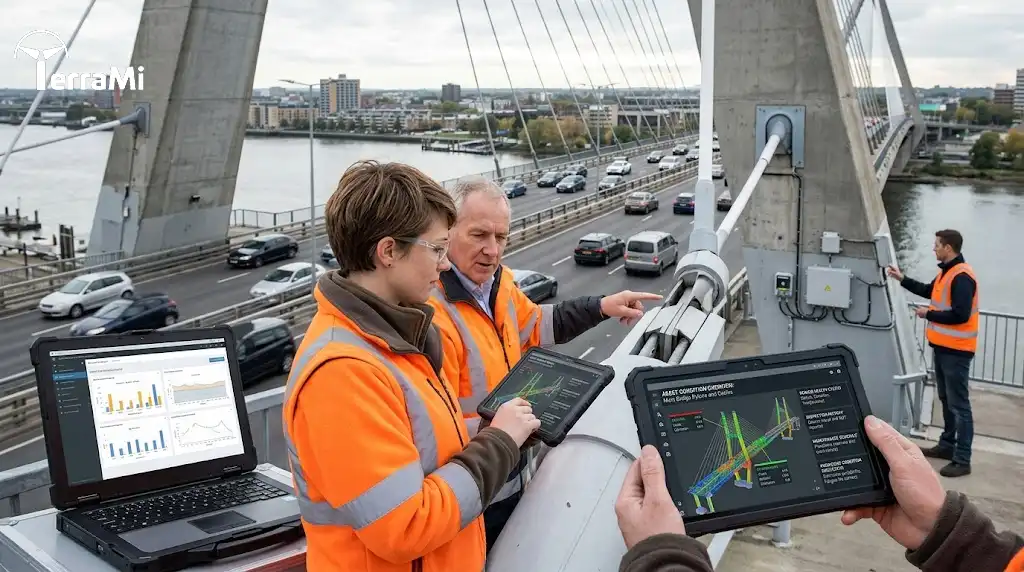
A bridge component, pumping system, power asset or railway system does not necessarily move directly from “healthy” to “failed.” Deterioration can develop over time, producing signals that may be detectable before conventional failure thresholds are reached.
The opportunity is to intervene during that window.
This can extend asset life, reduce emergency interventions and improve the allocation of maintenance resources.
TerraMi has previously explored this relationship between digital intelligence, predictive maintenance and lifecycle performance in its discussion of Asset Management Decarbonization, where predictive maintenance is connected to longer asset life and reduced carbon-intensive replacement cycles.
14. Risk Management: Moving Beyond Static Risk Registers
Risk registers have an important place in engineering management.
But many risk processes are periodic. Risks are identified, assessed, assigned an owner and reviewed at defined intervals.
Infrastructure systems increasingly require something more dynamic.
When new evidence becomes available continuously, risk should not remain frozen between review meetings.
A data-driven risk environment can incorporate changes in asset condition, project performance, weather, supply chains, operational conditions and external constraints into ongoing assessment.
This does not mean that every new data point should trigger a change in risk classification.
It means that the organization can establish signals that deserve attention.
That distinction is important because too many alerts can be just as problematic as too few.
A useful predictive system therefore needs thresholds, context and prioritization.
An engineer does not need to know that 500 variables changed this morning.
They need to know which changes could materially affect safety, cost, schedule, performance or asset life.
This is where analytics becomes an engineering discipline rather than simply a technology function.
15. The Environmental Dimension of Engineering Data
The value of engineering data also extends beyond traditional cost, schedule and technical performance.
Infrastructure projects increasingly need to understand their environmental performance while decisions are still being made.
Energy consumption, material quantities, waste, emissions, water use and resource flows can all become part of the decision environment.
This creates an important connection between engineering information and ESG performance.
If environmental data is collected only for annual reporting, its ability to influence engineering decisions is limited.
If the same information is available during procurement, construction, operations and maintenance, it can influence choices while those choices are still actionable.
For example, material data can inform procurement decisions.
Energy data can influence equipment selection or operating strategies.
Waste data can reveal opportunities for material recovery.
Asset-condition data can support decisions about repair versus replacement.
This is why engineering data and ESG data should increasingly be viewed as connected information streams rather than separate reporting systems.
TerraMi’s work on operational ESG makes a similar point: decision-relevant data becomes more valuable when it is integrated into asset-management and operational systems instead of being collected solely for disclosure.
16. The Human Role Does Not Disappear
One of the most persistent misconceptions about predictive engineering is that better analytics will eventually remove the need for engineering judgment.
That is unlikely—and it would not necessarily be desirable.
Engineering decisions involve constraints that cannot always be inferred from historical data.
A model may identify a statistically unusual condition.
An engineer still has to determine whether the condition represents a genuine engineering concern.
A predictive system may recommend intervention.
A project team still has to consider constructability, safety, access, cost, stakeholder requirements and operational constraints.
A forecast may indicate an increasing probability of delay.
A project manager still has to decide whether changing sequence, allocating additional resources or accepting the risk is the appropriate response.
The relationship should be understood as augmentation rather than replacement.
The system processes large volumes of information and identifies patterns.
The engineer interprets those patterns within the physical and organizational context of the project.
That combination is more powerful than either one operating alone.
17. The New Engineering Advantage Is Decision Speed With Evidence
For decades, engineering excellence was often associated with technical expertise, experience and the ability to solve difficult problems.
Those qualities remain essential.
But infrastructure systems are becoming too interconnected and dynamic for experience alone to provide sufficient visibility.
The emerging advantage is not simply having more experienced engineers or more sophisticated software.
It is the ability to combine engineering judgment with timely evidence.
An organization that can detect a developing problem two weeks earlier has more choices than one that discovers the same problem when it becomes unavoidable.
An asset owner that understands deterioration before a major intervention becomes necessary has more options than one responding to failure.
A project team that recognizes a pattern behind recurring delays can address the cause rather than repeatedly treating the symptom.
This is the practical meaning of moving from reactive to predictive engineering.
It is not about predicting the future perfectly.
It is about creating more room to act before the future becomes a constraint.
18. Why Data-Driven Engineering Is Harder Than Installing the Technology
The technical case for data-driven decision making in engineering is becoming easier to understand. The organizational case is harder.
Many infrastructure organizations already have access to cloud platforms, BIM environments, sensors, project-management systems and analytics tools. Yet the existence of these technologies does not necessarily produce better decisions.
The obstacle is often the operating model surrounding the technology.
A predictive system can only be useful when people trust its information, understand its limitations and have a defined process for acting on its recommendations.
This creates a fundamental implementation challenge:
Organizations cannot become predictive simply by acquiring predictive technology.
They have to change how information moves through the organization and how decisions are made from it.
19. Data Silos Are More Than a Technology Problem
Engineering data silos are often described as a software-integration problem.
Sometimes they are.
But the deeper problem is usually organizational ownership.
Design teams may control one information environment. Construction teams may operate another. Asset managers may inherit information in a different format. Procurement may maintain its own records, while environmental and ESG teams collect another layer of data.
Each system may work perfectly well within its own function.
The difficulty appears when a decision crosses organizational boundaries.
Consider an asset manager deciding whether to repair or replace a deteriorating component.
The technical condition may be available from inspection records.
The original material specification may exist in project documentation.
The maintenance history may sit in another system.
The replacement cost may be held by procurement.
The carbon implications may be calculated separately.
The operational consequences may be known by another team.
No individual dataset answers the decision.
The value emerges only when these pieces of information can be brought together.
This is why data integration should be understood as a decision architecture problem, not simply an IT integration project.
20. Trust Is a Prerequisite for Predictive Analytics
Engineers are unlikely to rely on a predictive recommendation simply because an algorithm produces a probability score.
They need to understand whether the underlying information is reliable.
This is especially important when the decision involves safety, significant capital expenditure, asset availability or public infrastructure.
Trust has several dimensions.
Engineers need confidence in the data.
They need confidence that the analytical method is appropriate.
They need to understand the conditions under which the model may become unreliable.
And they need sufficient transparency to challenge an output when engineering evidence points in another direction.
This does not mean every model needs to expose every mathematical detail to every user.
It means that the decision environment needs an appropriate level of explainability and traceability.
A useful predictive system should make it possible to ask:
- What information produced this signal?
- How current is the information?
- What assumptions are involved?
- How reliable is the prediction?
- What conditions could make it less reliable?
- What engineering evidence supports or contradicts it?
Without these questions, predictive analytics can become another black box inside an already complex infrastructure system.
21. Legacy Systems Cannot Be Ignored
Infrastructure assets often outlive the technology used to manage them.
An organization may operate an asset designed decades ago while relying on information systems that have themselves been replaced several times.
This creates layers of historical information.
Some records may be structured.
Others may exist in PDFs, spreadsheets, drawings, inspection reports or archived databases.
Replacing every legacy system is rarely realistic.
A better approach is often to establish a gradual information architecture around the existing environment.
That can mean prioritizing the datasets that have the greatest decision value, creating common identifiers, improving metadata, establishing interfaces between systems and progressively bringing critical historical information into a usable structure.
The key is to avoid a common digital-transformation trap: attempting to solve every information problem before delivering any decision value.
A more practical question is:
Which engineering decisions would benefit most from better information today?
That question provides a basis for prioritizing investment.
22. Skills Must Evolve Alongside Technology
The rise of predictive engineering also changes the skills required within engineering organizations.
This does not mean that every engineer needs to become a data scientist.
It does mean that engineers increasingly need to be comfortable working with data, understanding analytical outputs and questioning the assumptions behind models.
At the same time, data specialists need a stronger understanding of engineering context.
A technically sophisticated model can still be useless if it misunderstands how an asset operates, how construction activities interact or which variables actually matter to a decision.
The strongest teams will therefore be interdisciplinary.
Engineers bring domain knowledge.
Data specialists bring analytical capability.
Digital specialists build the information environment.
Asset and project managers connect analysis to operational decisions.
Governance teams establish accountability and controls.
The result is not a replacement of engineering expertise.
It is a broader form of engineering capability.
23. Start With Decisions, Not Data
One of the most effective ways to avoid unnecessary complexity is to reverse the conventional digital-transformation question.
Instead of asking:
What data should we collect?
Start with:
Which decisions are currently difficult, slow, expensive or reactive?
The answer can reveal where better information would have the greatest value.
A project organization might identify recurring schedule disruptions as a priority.
An asset owner might focus on unplanned equipment failures.
A transportation authority might prioritize deterioration forecasting.
An energy operator might focus on equipment efficiency and remaining useful life.
Once the decision is defined, the organization can work backwards:
Decision → required evidence → data sources → integration → analytics → action
This is a much more disciplined approach than collecting data first and searching for applications later.
It also provides a clearer business case for digital investment.
24. The First Predictive System Does Not Need to Be Complex
There is a tendency to associate predictive engineering with large-scale artificial intelligence programs.
That can make the transition appear more difficult than it needs to be.
A first application could be relatively simple.
For example, an organization might combine historical inspection records with condition indicators to identify assets that deserve earlier inspection.
Another project might combine schedule data with procurement information to identify activities exposed to material-delivery risk.
A maintenance team might use equipment operating data to identify abnormal patterns that warrant engineering review.
These applications can establish the underlying practices required for more sophisticated predictive systems:
- consistent data definitions
- reliable identifiers
- data-quality controls
- clear decision ownership
- defined response procedures
- feedback from engineering users
The sophistication of the model is less important than whether the organization can close the loop between evidence and action.
25. The Feedback Loop Is Where Intelligence Emerges
A mature data-driven engineering system should not stop once a recommendation has been made.
The outcome of the decision should become new information.
Suppose a predictive system identifies an asset as having elevated deterioration risk and recommends an inspection.
The inspection produces a result.
That result can then be compared with the original prediction.
Was the risk correctly identified?
Was the condition more severe or less severe than expected?
Did the intervention reduce the risk?
Did the asset behave differently after the intervention?
These outcomes improve future decisions.
The same principle applies to construction.
If a model predicts a schedule disruption and the project team changes the sequence of work, the resulting outcome becomes evidence about whether the intervention was effective.
This creates a continuous learning cycle:
Observe → analyse → predict → decide → act → measure → learn
That is fundamentally different from a static reporting environment.
It turns engineering data into an evolving organizational memory.
26. What This Means for Infrastructure Leaders
For infrastructure leaders, the transition to data-driven engineering should not be framed primarily as a technology program.
It is a decision-quality program.
The strategic questions are broader:
Can the organization identify its most consequential decisions?
Can the information required for those decisions be accessed reliably?
Can information from different lifecycle stages be connected?
Can engineers distinguish useful signals from noise?
Can predictive recommendations be challenged and validated?
Can the organization act quickly enough when new evidence changes the risk?
And, critically, can the results of those decisions feed back into the information environment?
These questions reveal whether an organization is actually becoming more intelligent—or simply becoming more digital.
The distinction will matter increasingly as infrastructure systems become more interconnected and the consequences of delayed decisions become more expensive.
27. From Data-Rich Infrastructure to Decision-Ready Infrastructure
The next phase of infrastructure digitalization will not be defined by how many sensors an organization deploys or how many dashboards it operates.

It will be defined by whether information improves the timing and quality of decisions.
That is a more demanding standard.
A data-rich infrastructure can contain millions of records without becoming meaningfully more intelligent.
A decision-ready infrastructure connects relevant information to the decisions that matter.
It recognizes emerging conditions.
It makes uncertainty more visible.
It gives engineers stronger evidence.
It allows organizations to test assumptions continuously rather than waiting for failure or deviation to confirm them.
And it creates a feedback loop in which every intervention can improve the quality of future decisions.
This is the real promise of predictive engineering.
Not the replacement of engineering judgment.
Not the pursuit of technology for its own sake.
But a shift from discovering problems after they become visible to recognizing the signals that precede them.
28. The Future of Engineering Is Not Data-Rich. It Is Decision-Ready.
The infrastructure sector has spent years digitizing information. The next challenge is more consequential: making that information useful at the moment an engineering decision has to be made.
Data-driven decision making in engineering is not about replacing professional judgment with algorithms. It is about giving that judgment better evidence, earlier signals and a clearer understanding of uncertainty.
The shift from reactive to predictive engineering will depend on several capabilities working together: reliable engineering data, connected information systems, appropriate analytics, strong governance and people who understand both the technology and the physical systems they manage.
The organizations that make this transition successfully will not necessarily be those with the largest datasets or the most sophisticated artificial intelligence.
They will be the organizations that can answer a more practical question:
Can we recognize what is changing early enough to make a better decision?
That is the real measure of engineering intelligence.
And as infrastructure becomes more interconnected, resource-constrained and exposed to uncertainty, the ability to answer that question will become less of a digital advantage and more of a core engineering capability.

TerraMi Perspective
From Data Collection to Decision Intelligence
Infrastructure has never lacked information. What it has often lacked is the ability to connect information to decisions across the asset lifecycle.
The next stage of infrastructure digitalization should therefore move beyond dashboards, isolated datasets and retrospective reporting. The objective should be to create decision-ready infrastructure—systems in which engineering, operational, environmental and asset information can be connected to the decisions that matter.
For TerraMi, this is where digital infrastructure becomes strategically important.
A predictive model is valuable only when it helps an organization see a developing condition, understand its implications and act while meaningful options still exist.
That requires more than technology. It requires information that can be trusted, governance that creates accountability and engineering workflows designed around continuous learning.
The future of infrastructure intelligence will not be defined by how much data an organization owns.
It will be defined by how effectively that organization turns evidence into action.
Frequently Asked Questions
What is data-driven decision making in engineering?
Data-driven decision making in engineering is the use of reliable project, asset, operational and environmental data to support engineering decisions. It combines professional judgment with evidence, analytics and, where appropriate, predictive models to improve the timing and quality of decisions.
How does predictive analytics support engineering projects?
Predictive analytics can identify patterns and emerging conditions that may indicate future schedule delays, equipment problems, asset deterioration or other risks. Its value comes from giving engineering teams more time and evidence to evaluate possible interventions before a problem becomes more difficult or expensive to address.
Does data-driven engineering replace engineering judgment?
No. Data-driven engineering is better understood as an augmentation of engineering judgment. Analytics can identify patterns and signals, but engineers still need to interpret those signals within physical, operational, safety, financial and project-specific contexts.
Why is data quality important for predictive engineering?
Predictive outputs depend on the quality and context of the information used to generate them. Incomplete, outdated, inconsistent or poorly governed engineering data can produce misleading conclusions and reduce confidence in predictive systems.
What is the difference between a dashboard and a predictive decision system?
A dashboard primarily presents information. A predictive decision system goes further by identifying relevant patterns, estimating potential future conditions and helping decision-makers understand what may require attention and why.
How can infrastructure organizations begin using predictive analytics?
They should begin with a high-value engineering decision rather than with a technology purchase. Identify a decision that is currently slow, reactive, costly or uncertain, determine what evidence is required, connect the relevant data sources and establish a feedback loop between predictions, actions and outcomes.