
Infrastructure Risk Assessment: Why Planning for One Future Is No Longer Enough
Infrastructure risk assessment has traditionally been built around a deceptively simple idea: understand what can go wrong, estimate how likely it is to happen, calculate the consequences, and design accordingly.
That logic still matters. What is changing is the environment in which the assessment takes place.
Infrastructure is expected to operate for decades, while the conditions surrounding it are becoming less stable. Climate hazards are changing in frequency and intensity. Population and land-use patterns shift. Technologies alter demand and operating conditions. Infrastructure systems become more interconnected, meaning a failure in one network can disrupt others. Even the economic assumptions behind a major investment can change during its lifetime.
A road, power network, flood defence system, water facility, or transit corridor is therefore not being designed for a single known future. It is being committed to a range of possible futures.
That distinction changes what risk assessment needs to accomplish.
Recent research is moving toward fully probabilistic and multi-dimensional approaches that connect hazard, exposure, vulnerability, and consequences rather than treating risk as a fixed number. A 2026 study of European surface transport infrastructure, for example, used a fully probabilistic assessment to examine coastal flood risk under different global warming levels.
The question for infrastructure planners is no longer simply “What is the risk?”
It is increasingly:
“How does risk change across plausible futures, and which decisions remain sensible as those futures unfold?”
The Problem With Treating Risk as Static
A conventional risk assessment often begins with historical evidence.
Historical flood levels, past failures, recorded temperatures, previous maintenance problems, traffic patterns, cost records, and other observations provide a foundation for estimating future conditions.
That foundation remains valuable. The problem appears when historical behaviour is treated as a reliable representation of the entire future operating environment.
Climate change makes that assumption increasingly difficult to defend.
A system that performed adequately under historical conditions may face a different risk profile as hazards change. The same asset can move from relatively low risk to significant risk without any physical change to the asset itself.
The change may come from outside the asset:
- a higher frequency of extreme rainfall;
- rising sea levels;
- increasing heat stress;
- changing wildfire conditions;
- shifting population exposure;
- new dependencies on digital systems;
- or the failure of another infrastructure network on which the asset depends.
Recent work on climate risk is also drawing greater attention to interdependencies. A September 2026 research highlight in Nature Climate Change described modelling that combines climate projections, stochastic hazard simulations, and network analysis to examine cascading failures across interconnected power and water systems. The research suggests that climate change can increase systemic risk not only through stronger hazards, but through changes in the frequency and spatial coherence of disruptions across connected systems.
This matters because infrastructure rarely operates alone.
A bridge depends on access roads. A water treatment facility depends on electricity. A hospital depends on transportation, communications, water, and power. A port depends on both physical access and digital systems.
A risk assessment that examines each asset in isolation can miss the risk created by these connections.
This is one reason infrastructure resilience increasingly requires a systems perspective rather than an asset-by-asset view.
From Probability to Decision-Making
Recognizing uncertainty does not mean that infrastructure planning becomes impossible.
It means the question changes.
Instead of asking planners to predict exactly what will happen, probabilistic approaches allow them to examine a range of possible outcomes and their likelihoods. This can reveal where uncertainty matters most and where a decision is particularly sensitive to changing assumptions.
Recent infrastructure research is applying this thinking to areas well beyond climate hazards. For example, a 2025 study developed a probabilistic framework combining Bayesian methods and Monte Carlo simulation to examine cost and schedule uncertainty in major infrastructure projects.
In construction risk assessment, researchers are also developing Dynamic Bayesian Network approaches capable of representing risk factors that evolve over time rather than remaining fixed throughout a project.
These approaches point to an important shift:
Risk assessment is becoming less about producing one definitive estimate and more about understanding the range, dependencies, and evolution of possible outcomes.
That distinction is particularly important when decisions have long consequences.
A planning team may not know exactly how severe a future climate hazard will be in 2050. But it can still ask:
- What happens if the hazard is lower than expected?
- What happens if it is substantially higher?
- Which components become critical first?
- Which interventions reduce risk across several scenarios?
- Which investments could lock the organization into an expensive path?
- What information should be monitored before the next major decision?
Those questions turn risk assessment from a reporting exercise into a decision-support process.
TERRAMI EDITORIAL CALLOUT
The Real Value of Risk Assessment Is Not Predicting One Future
A useful infrastructure risk assessment does more than assign a probability to failure. It helps decision-makers understand how risk changes, where uncertainty matters, and which choices preserve flexibility as conditions evolve.
The goal is not to eliminate uncertainty. It is to make better decisions in spite of it.
Why Probabilistic Thinking Alone Is Not Enough
There is an important distinction between better modelling and better planning.
A sophisticated probabilistic model can estimate a wide range of outcomes. But an organization still has to decide what to do with that information.
This is where the idea of adaptive planning becomes important.
An infrastructure strategy can be designed around a sequence of decisions rather than a single irreversible commitment. Some measures may be implemented immediately. Others can be reserved for conditions in which monitoring shows that a threshold has been reached.
This approach is increasingly visible in climate adaptation research.
A 2025 study of coastal transport infrastructure, for example, combined climate projections, fragility information, and satellite observations to develop adaptation pathways. Rather than defining one permanent response, the approach identified potential future decision points and sequences of adaptation measures as conditions change.
That is a fundamentally different way of thinking about infrastructure planning.
Instead of:
Assess → Design → Build → Operate
the longer-term process can become:
Assess → Decide → Monitor → Reassess → Adapt
The second model accepts that some assumptions will change.
It also creates a place for new information.
If climate observations improve, if an asset performs differently than expected, if population patterns change, or if a new technology becomes viable, the planning process can incorporate that information rather than treating the original decision as permanent.
This does not mean every infrastructure project should be endlessly redesigned. It means that irreversibility itself should be treated as a risk.
A decision that closes off future options may deserve more scrutiny than one that preserves them.
Risk Assessment Must Look Beyond the Asset
The next challenge is scale.
A single asset may appear resilient when examined independently but vulnerable when its role within a larger infrastructure system is considered.
This is particularly important for critical infrastructure, where disruption can propagate across sectors.
Recent research on European airports illustrates another direction in this field: multi-risk assessment. Instead of looking at one hazard in isolation, researchers have developed approaches that combine multiple climate hazards with physical, economic, and social dimensions of vulnerability. The study identified different risk archetypes among European airports to support more targeted adaptation decisions.
This suggests that the future of infrastructure risk assessment is likely to become increasingly:
multi-hazard, probabilistic, interconnected, and decision-oriented.
For planners, that means the useful output is not necessarily the most complicated model.
It is the model that helps answer the decisions that actually need to be made.
From Scenarios to Stress Tests
Once uncertainty is recognized, the next temptation is to create a larger forecast.
More climate scenarios. More datasets. More model runs. More detailed projections.
But adding complexity to a forecast does not necessarily make the resulting decision better.
The more useful question is whether the analysis can stress-test a decision across materially different futures.
Scenario analysis is valuable precisely because scenarios are not forecasts. They are structured ways of asking what could happen if important assumptions move in different directions. This distinction matters in infrastructure because many of the variables shaping long-term performance are outside the control of the project owner.
Climate conditions may evolve differently from current projections. Demand may grow faster or slower than expected. Technology may change the economics of an asset. Regulations may shift. A new infrastructure connection may create dependencies that did not exist when the original investment was approved.
A scenario-based assessment makes these uncertainties visible before they become operational problems.
The OECD’s work on climate-resilient infrastructure describes scenario planning as a way to accommodate a range of potential future conditions and notes that adaptive planning can use predefined trigger points to move between alternative investment or policy pathways.
The purpose is not to identify the scenario that will eventually prove correct.
It is to find out how well today’s decision performs if the future turns out differently from what was expected.
That is a much more useful question for a long-lived asset.
The Difference Between Prediction and Preparedness
Forecasting remains important.
Engineers need forecasts to estimate demand, rainfall, temperature, traffic, energy consumption, deterioration, maintenance requirements, and many other variables. The problem begins when a forecast is treated as a commitment rather than an evolving source of information.
A forecast says:
This is what we currently expect.
A resilient planning process asks:
What will we do if reality moves away from that expectation?
This distinction becomes especially important as new information arrives.
A 2026 study on adaptive water-supply planning, for example, proposes incorporating Bayesian learning into adaptive decision rules so that the assessment of climate uncertainty can be updated as new observations become available. The underlying idea is important beyond water systems: uncertainty does not have to remain fixed throughout the life of an infrastructure decision. The information available to decision-makers can improve over time.
This creates a different relationship between forecasting and planning.
Forecasting provides an estimate of what may happen.
Monitoring tells us what is actually happening.
Risk assessment compares the two.
Planning determines when the difference is large enough to justify a new decision.
That last step is often missing from conventional infrastructure planning.
Finding the Decisions That Need Flexibility
Not every infrastructure decision requires the same response to uncertainty.
Some decisions are relatively reversible. Others create commitments that are extremely expensive or impossible to undo.
That difference should influence risk assessment.
A planning team considering a modular capacity expansion, for example, may have the option to add capacity later if demand increases. A team selecting the location of a major piece of infrastructure may have far less flexibility once land has been acquired and surrounding development has occurred.
This introduces the concept of decision flexibility into risk analysis.
The question becomes not only:
Which option has the lowest expected risk?
but also:
Which option performs acceptably across the widest range of plausible conditions while preserving future choices?
This is one of the foundations of adaptive pathways.
Instead of selecting one fixed long-term intervention, planners can identify a sequence of possible actions, together with the conditions that would justify moving from one action to another.
A 2025 study on coastal transport infrastructure demonstrates this approach at asset level. Researchers combined climate projections, fragility information and satellite observations to identify when different adaptation measures might become necessary. The analysis showed how combinations of interventions could delay protection “tipping points” far beyond the study period.
This is an important change in planning logic.
The question is no longer simply what should we build today?
It becomes:
What should we do today, what should we monitor, and what should we be prepared to do next?
When the Model Should Trigger a New Decision
Adaptive planning only works if the organization knows what to watch.
This is where trigger points become important.
A trigger is a predefined condition that signals that an existing strategy may no longer be adequate. It could relate to physical performance, hazard frequency, demand, asset condition, financial exposure, or another measurable indicator.
For example, a coastal infrastructure strategy might define a sea-level threshold beyond which the existing protection standard is no longer sufficient.
A transportation authority might monitor pavement deterioration, flood-related closures, or changing traffic patterns.
A water utility might track demand, reservoir conditions, groundwater levels, or the frequency of supply restrictions.
The specific indicators vary. The principle does not:
A risk assessment becomes much more useful when it tells an organization what evidence should cause it to reconsider a decision.
This is also where monitoring becomes part of infrastructure planning rather than an activity that happens after planning is finished.
The 2025 research on climate-model uncertainty and adaptation pathways in Scotland found that different representations of climate uncertainty can lead to different adaptation pathways and emphasized the importance of incorporating that uncertainty into decision-making.
That finding has a practical implication.
If different plausible futures can produce different preferred actions, then the planning process needs to identify which future developments would justify changing course.
Without that step, scenario analysis can remain an interesting analytical exercise rather than a management tool.
Avoiding the Cost of Being Wrong
There is another reason to move beyond static risk assessment: the cost of being wrong is not always symmetrical.
Underestimating risk can lead to physical damage, service disruption, emergency expenditure, regulatory exposure, or loss of public confidence.
But overestimating risk can also have consequences.
An organization may overinvest in protection that is not needed for decades, select unnecessarily expensive technologies, or lock capital into an inflexible design while better options are developing.
The objective is not simply to choose the most conservative scenario.
It is to identify decisions that remain defensible across a reasonable range of futures.
This is the logic behind robust decision-making and related approaches to decision-making under deep uncertainty. Transportation planning guidance from the Inter-American Development Bank, for example, identifies scenario planning, adaptive pathways and robust decision-making as approaches for situations where future climate risks cannot be confidently quantified.
The distinction is subtle but important.
A risk-minimizing strategy asks:
Which decision produces the lowest estimated risk?
A robust strategy asks:
Which decision performs acceptably across many plausible futures?
An adaptive strategy goes one step further:
Which decision performs acceptably now while keeping future options open?
For infrastructure with long lifetimes and high capital costs, that third question can be the most useful one.
From Forecasting to Predictive Infrastructure Decisions
Forecasting becomes more valuable when it changes a decision. By combining monitoring, predictive analysis, and predefined decision points, infrastructure owners can respond to emerging conditions before they become failures. The shift is from predicting exactly what will happen to preparing for what the data is beginning to reveal.
The Data Problem Behind Better Risk Models
Better risk assessment depends on better information.
That sounds obvious, but infrastructure organizations often have data distributed across engineering teams, asset management systems, inspection records, operational platforms, environmental monitoring, financial systems, and external datasets.
Some information is updated continuously.
Some is updated annually.
Some may exist only in project documents created years earlier.
And some critical variables cannot be measured directly at all.
This creates a practical limitation: a sophisticated model cannot compensate indefinitely for weak or fragmented inputs.
The challenge is not simply collecting more data. It is determining which information materially changes the decision.
That distinction can prevent organizations from building increasingly complicated analytical systems that produce little additional decision value.
A useful risk assessment should help identify:
- which variables have the greatest influence on the outcome;
- which assumptions create the most uncertainty;
- which missing data would materially change the decision;
- which indicators should be monitored over time;
- and where better information would justify delaying, accelerating, or changing an investment.
This is where risk assessment begins to connect with infrastructure intelligence.
The objective is not to build the most elaborate model possible.
It is to create a decision process in which new evidence can change what the organization does.
That is a much higher standard.
When Uncertainty Becomes a Planning Asset
Uncertainty is often treated as something that makes planning harder.
It can also reveal where planning needs to become more flexible.
A project with highly predictable conditions may justify a relatively fixed design strategy.
A project exposed to deep uncertainty may benefit from staged investment, modularity, monitoring, contingency measures, or explicit adaptation pathways.
The difference is not simply technical. It is strategic.
The 2025 research on climate-resilient development pathways in Cork, Ireland, illustrates this broader direction by combining adaptation, mitigation, and sustainable-development objectives into alternative pathways over time. The framework explicitly considers interactions between measures and the possibility of shifting between pathways as conditions evolve.
This points toward a broader definition of infrastructure resilience.
A resilient infrastructure system is not necessarily one that can withstand every conceivable future without changing.
It may be one that can change course without losing its ability to deliver essential services.
That means flexibility itself becomes a form of resilience.
And risk assessment becomes the mechanism for determining where that flexibility is most valuable.
Turning Risk Assessment Into Investment Decisions
A risk model has limited value if its conclusions remain inside a report.
The real test comes when an organization has to decide where to invest, what to defer, which asset to retrofit, what level of protection to adopt, or whether a proposed project should proceed at all.
This is where infrastructure risk assessment becomes part of capital planning.
The OECD’s current work on sustainable infrastructure makes this connection explicit: climate resilience needs to be integrated across the infrastructure investment cycle, from planning and project assessment through financing, design, operation, and maintenance. Its 2026 work on sustainable infrastructure investment also emphasizes stronger project preparation and assessment as a basis for better-informed investment choices.
The implication is straightforward.
Risk should not appear as a separate technical appendix after the investment decision has effectively been made.
It should influence the decision itself.
That means a risk assessment should help answer practical questions such as:
- Which risks are material enough to change the project scope?
- Which risks justify additional capital expenditure?
- Which risks can be managed through operations or maintenance?
- Where is staged investment preferable to a single large intervention?
- Which assumptions need to be monitored after the project enters operation?
- When should the organization revisit the original decision?
A useful assessment therefore connects risk, cost, performance, and timing.
The result is not simply a risk register. It is a framework for deciding what should happen next.
Risk Should Change the Way Capital Is Prioritized
Infrastructure organizations rarely have unlimited capital.
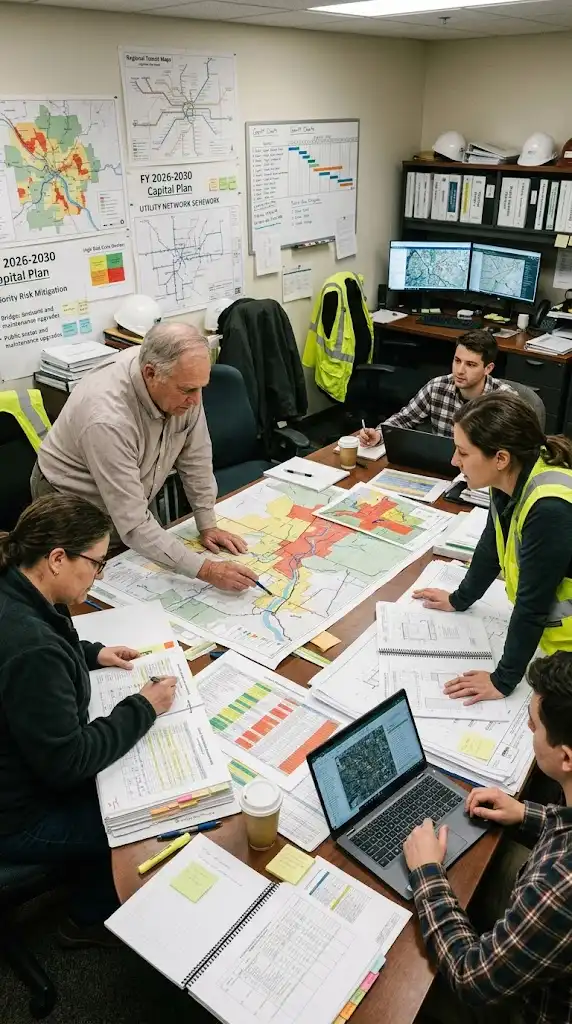
A municipality, utility, transportation authority, developer, or institutional investor may face dozens of assets requiring attention at the same time. Some will have visible deterioration. Others may appear healthy but have increasing exposure to future hazards.
This creates a difficult allocation problem.
If investment is prioritized only according to current condition, organizations can overlook assets whose future risk is increasing faster than their present condition suggests.
Conversely, if every potential future risk receives the same level of attention, limited resources can be spread too thinly.
Risk-informed investment requires a more discriminating approach.
An organization might rank interventions according to a combination of:
Probability × Consequence × Exposure × Vulnerability × Time
The exact methodology will vary by asset class and organization. The important point is that risk should be connected to consequences and decision timing rather than treated as a standalone score.
This also makes it possible to distinguish between assets that need immediate intervention and assets that require better monitoring before a major investment is justified.
That distinction matters financially.
Climate-resilient infrastructure investment is not simply about spending more. It is about directing capital toward decisions that reduce material exposure while preserving the ability to respond as conditions change.
The OECD has similarly emphasized that resilience needs to become part of mainstream infrastructure finance and investment rather than remain an exceptional consideration.
From Risk Maps to Infrastructure Intelligence
The growing availability of operational and environmental data is changing what can be done after the initial risk assessment.
Sensors can provide information about asset condition.
Weather systems can provide increasingly detailed observations and forecasts.
Remote sensing can reveal changes across large areas.
Operational systems can show how infrastructure is actually being used.
Asset management platforms can combine inspection history, maintenance records, and performance data.
The challenge is turning these separate information streams into something decision-makers can use.
This is where infrastructure intelligence becomes relevant.
Infrastructure intelligence is not simply having more data or adding artificial intelligence to an existing system. Its value lies in connecting information that was previously considered separately and using it to improve decisions across the asset lifecycle.
For risk assessment, that can create a continuous feedback loop:
Model → Monitor → Compare → Update → Decide
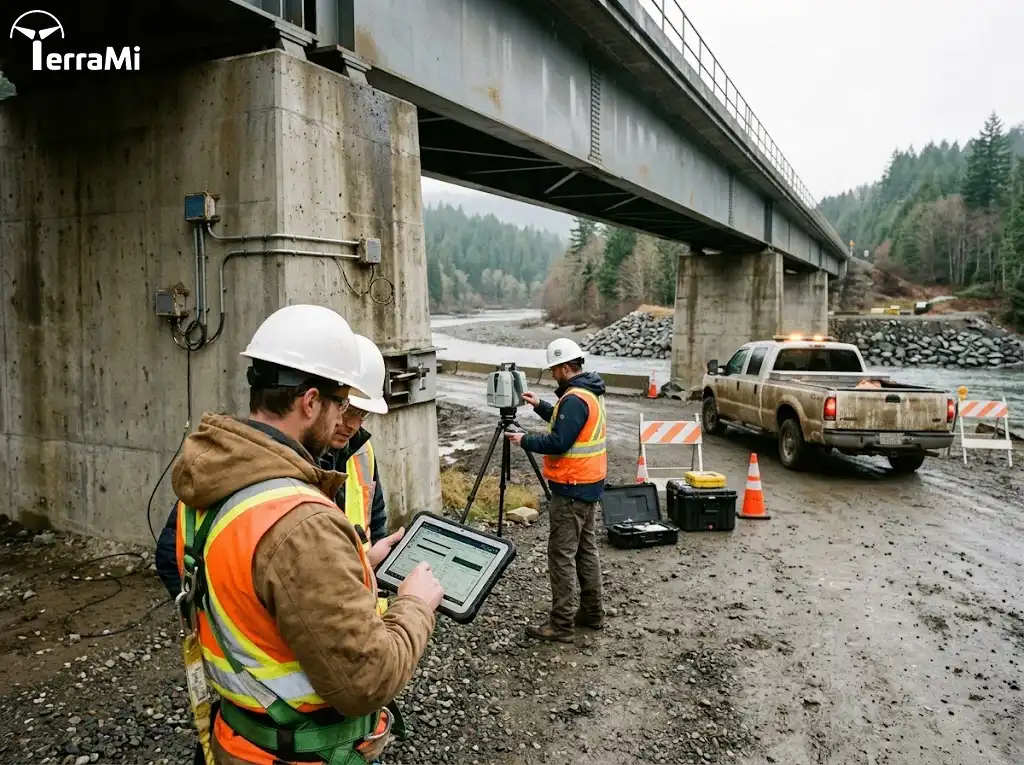
The original risk model establishes a baseline.
Operational and environmental data then provide evidence about how reality is evolving.
When actual conditions begin to diverge from the assumptions used in planning, the organization has an opportunity to reassess before the divergence becomes a failure.
This is particularly important for infrastructure with long operating lives.
A risk assessment conducted during project planning should not be treated as permanently valid. As the asset ages and external conditions change, the evidence behind the assessment should change with it.
That is why resilience is increasingly becoming an ongoing management discipline, rather than a one-time design attribute.
The OECD similarly identifies continuous performance measurement and adjustment of operation and maintenance as part of building climate-resilient infrastructure because climate risks evolve throughout an asset’s lifetime.
TERRAMI EDITORIAL CALLOUT
A Risk Model Should Not Become a Frozen Decision
The most useful risk assessment is designed to evolve.
As conditions, evidence, asset performance, and assumptions change, the organization should be able to revisit its decisions before risk becomes disruption. The goal is not to build a perfect forecast. It is to create a better decision cycle.
The Investment Decision Needs a Time Dimension
One of the most overlooked variables in infrastructure risk is when an intervention should happen.
A measure can be technically effective but economically premature.
Another can be inexpensive today but create much higher costs if delayed.
A third may only become necessary when a measurable threshold is reached.
This is why adaptive planning is useful.
Instead of asking whether an organization should invest in resilience, decision-makers can ask:
What should be done now, what can wait, and what evidence would tell us that waiting is no longer appropriate?
That framing makes uncertainty manageable.
Suppose an infrastructure owner faces increasing flood exposure.
One strategy might be to construct the maximum level of protection immediately.
Another might involve a smaller intervention now, continuous monitoring, and a predefined upgrade when flood frequency or water levels cross a specified threshold.
The preferred strategy will depend on costs, consequences, uncertainty, financing conditions, and the consequences of being wrong.
But the important point is that the assessment now has a time architecture.
The OECD’s framework for climate-resilient infrastructure makes a similar connection between risk assessment, planning, financing, implementation, and ongoing monitoring. It also identifies adaptive and flexible planning as a response to uncertainty, including the use of predefined trigger points to move between alternative investment pathways.
This is a more realistic model for infrastructure with a 30-, 50-, or 100-year horizon.
The decision is not made once.
It is made, monitored, and revisited.
Risk Assessment as a Governance Discipline
There is also a governance dimension that can be easy to miss.
A risk model does not make decisions. People and institutions do.
Someone has to determine which risks are material, who owns them, what level of uncertainty is acceptable, how much capital should be committed, and when a decision should be reconsidered.
That makes risk assessment partly a governance question.
For major infrastructure systems, responsibilities may be distributed among asset owners, operators, engineers, regulators, investors, municipalities, governments, and communities.
If the information remains fragmented between these groups, even a sophisticated risk assessment may have limited influence.
A stronger approach establishes clear connections between:
risk information → accountable decision-maker → investment choice → monitoring → review
This also makes assumptions more visible.
If an investment depends on a particular climate projection, demand forecast, maintenance assumption, or financing condition, that dependency can be documented rather than hidden inside a model.
The benefit is not only technical.
It improves institutional memory.
When personnel change or projects move from planning to operation, the organization retains a record of why a decision was made and what conditions would justify changing it.
That is an important part of long-term infrastructure resilience.
TerraMi Perspective: From Risk Analysis to Adaptive Infrastructure Decisions
The most important shift in infrastructure risk assessment may not be technological.
It may be conceptual.
For decades, infrastructure planning has often been structured around the assumption that enough information can eventually produce a sufficiently reliable prediction. The better the forecast, the better the decision.
That assumption is becoming harder to sustain.
Infrastructure now operates within systems shaped by climate volatility, technological change, demographic shifts, interconnected networks, evolving regulation, and uncertain economic conditions.
Better models remain essential. Better data remains essential. But neither eliminates uncertainty.
The more useful objective is to make infrastructure decisions that remain defensible when assumptions change.
That requires a different relationship between assessment and planning.
Risk assessment should reveal where uncertainty matters.
Scenario analysis should show how decisions perform under different conditions.
Monitoring should provide evidence about which trajectory is actually emerging.
Adaptive pathways should establish what can change and when.
Governance should determine who has the authority to act.
And infrastructure intelligence should connect these elements over the asset’s operating life.
This does not mean abandoning long-term planning.
It means making long-term planning more intelligent about what cannot be known today.
A resilient infrastructure strategy is not one that claims to know exactly what the future will look like.
It is one that is prepared to recognize when the future is becoming different from the assumptions on which today’s decisions were based.
For infrastructure owners, planners, investors, and policymakers, that may be the more useful definition of resilience:
not predicting the future perfectly, but preserving the capacity to make good decisions as the future unfolds.
What Better Risk Assessment Changes
The evolution of infrastructure risk assessment is not really about replacing one model with another.
It is about changing what happens after the model produces its result.
A static assessment may tell an organization where risk is concentrated today.
A probabilistic assessment can show how that risk may vary.
Scenario analysis can reveal how a decision performs across different futures.
Adaptive planning can identify when a different course of action should be triggered.
Infrastructure intelligence can keep the assessment connected to changing evidence.
And governance can turn that information into action.
Together, these elements create a more useful planning cycle:
Assess → Model → Stress-Test → Decide → Monitor → Adapt
That cycle is better suited to infrastructure systems whose operating environments cannot be assumed to remain stable.
The practical challenge now is not whether organizations can model uncertainty. Increasingly, they can.
The challenge is whether they are prepared to make decisions differently because uncertainty has been made visible.
TerraMi helps infrastructure organizations think beyond individual assets and short-term project decisions. By connecting resilience, risk, data, systems thinking, and long-term planning, organizations can build decision processes that are better prepared for changing conditions.
Explore how TerraMi can support more informed infrastructure planning and resilience.