
Smart Cities Begin With Connections, Not Devices
Smart cities are often introduced through their most visible technologies: sensors embedded in roads, connected buildings, intelligent traffic signals, electric mobility, automated lighting, public Wi-Fi, surveillance systems, or dashboards displaying streams of urban data. These technologies matter, but they do not by themselves make a city smart.
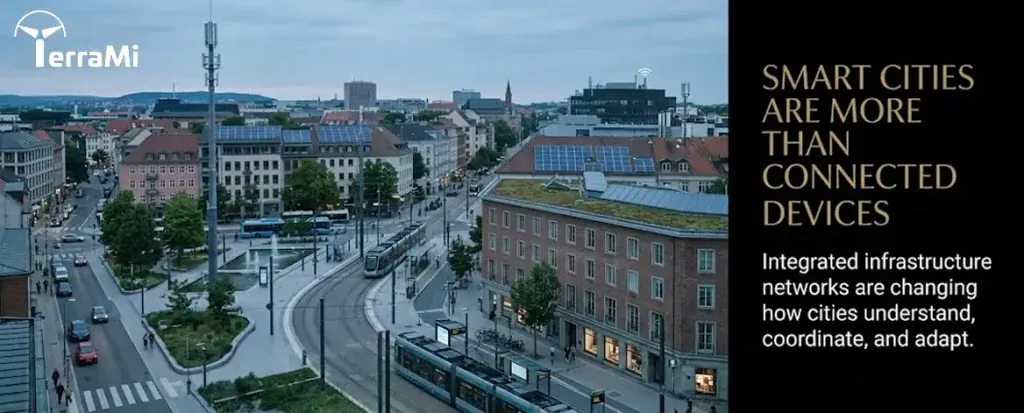
A city can have thousands of connected devices and still operate as a collection of disconnected systems.
The deeper shift is from treating infrastructure as a set of individual assets to understanding it as a network of systems that continuously influence one another. A transport network affects energy demand. Energy availability affects buildings and mobility. Water infrastructure depends on energy for pumping and treatment. Telecommunications support the operation of almost every modern infrastructure service. Buildings generate data that can influence energy management, mobility patterns, and emergency response. A disruption in one system can propagate into others.
This interdependence has always existed. What is changing is the speed, scale, and visibility of those relationships.
Digital technologies make it possible to observe more of these interactions and respond to them more quickly. But that capability only becomes valuable when the underlying systems can communicate, when institutions can share information, and when decisions are made with an understanding of the wider urban network.
That is where the idea of the smart city becomes much more interesting than the technology itself.
From Smart Assets to Smart Systems
The first generation of smart infrastructure often focused on individual assets.
A traffic signal could adjust its timing based on traffic conditions. A building could regulate heating and cooling according to occupancy. A water network could use sensors to identify abnormal pressure. A streetlight could dim when there was little activity. Each application could produce a measurable improvement.
The limitation was not the technology. It was the boundary around the technology.
When each system is optimized independently, improvements in one area do not necessarily produce the best outcome for the city as a whole. In some cases, they can create new constraints elsewhere. A transport intervention can change electricity demand. A building electrification programme can affect grid capacity. Expanding data-intensive digital services can increase dependence on telecommunications and energy infrastructure. Climate events can expose dependencies that were previously invisible during normal operations.
This is why infrastructure intelligence needs to operate at more than one level.
At the asset level, the question is whether a particular component is operating efficiently.
At the system level, the question is how a network of related assets performs together.
At the urban ecosystem level, the question becomes much broader: how do multiple infrastructure systems interact, and what happens when conditions change?

A genuinely smart city needs to address all three.
The World Bank’s work on smart cities similarly places data, digital infrastructure, institutional enablers, and people and digital skills beneath the digital services that support city functions. The implication is important: technology is not an independent layer placed on top of a city. It depends on physical infrastructure, institutions, capabilities, and the quality of the information flowing between them.
The Infrastructure Network Is the Real Smart-City Platform
The phrase “smart city platform” can create the impression that a city needs one enormous digital system connecting everything together. In practice, that is neither realistic nor necessarily desirable.
Cities contain many platforms, agencies, operators, standards, legacy systems, private service providers, and infrastructure owners. The objective is not to erase this complexity. It is to make the complexity more interoperable.
This distinction matters.
A transport authority may have its own operational systems. An electricity provider has another. Water utilities, building operators, emergency services, telecommunications companies, and municipal departments may each maintain different data environments. They do not need to abandon these systems and move onto one universal platform.
They need appropriate ways to exchange information when there is a legitimate reason to do so.
The World Bank has described this model as a city functioning more like a “meta-platform,” where different platforms and systems can connect and work with one another rather than being forced into a single system.
That requires interoperability.
And interoperability is much more than making two databases technically capable of exchanging files.
For information to become useful across infrastructure boundaries, systems need to agree on how information is structured, what terms mean, who can access it, under what conditions it can be used, and who remains accountable for it. The OECD identifies technical, semantic, organisational, and legal dimensions of interoperability, alongside governance arrangements that allow different organisations to work toward shared outcomes.
This is where smart-city programmes often encounter a less visible challenge.
Connecting devices is relatively straightforward compared with connecting institutions.
Why Infrastructure Integration Is Hard
Urban infrastructure has rarely been designed as one system.
Different sectors developed at different times, under different regulations, with different investment cycles and different operational priorities. A road network may be managed by one public authority, electricity infrastructure by another organization, water by a separate utility, and telecommunications infrastructure by private companies.
Their physical networks may intersect every day while their planning and data environments remain separate.
This creates what could be called an integration gap.
The city functions as an interconnected system, but its institutions often do not.
Data fragmentation is one expression of this problem. A city may possess enormous quantities of information while still struggling to answer basic cross-sector questions. Data can be stored in incompatible formats, controlled by different organizations, updated at different intervals, or collected for purposes that do not align.
The problem is not simply that data are missing. Often, the problem is that useful data cannot easily become shared knowledge.
The OECD has emphasized this challenge in its work on smart-city data governance, noting that data can remain trapped in silos and that interoperability depends on standards, governance, cooperation, data quality, and appropriate rules for sharing.
That distinction changes how infrastructure leaders should think about digital investment.
Buying another sensor does not necessarily reduce fragmentation.
Building another dashboard does not necessarily create integration.
Collecting more data does not necessarily improve decision-making.
The value appears when information from different sources can be interpreted together and used to support a better decision.

When One Infrastructure System Affects Another
Consider a severe heat event in a large urban region.
At first glance, extreme heat appears to be an environmental problem. In reality, it can become an infrastructure systems problem.
Electricity demand may increase as buildings rely more heavily on cooling. Higher electricity demand can place pressure on generation, transmission, and distribution capacity. Public transport infrastructure may face operational constraints. Roads and rail systems can be affected by heat-related deterioration or equipment limits. Water demand may change at the same time. Vulnerable populations may require additional emergency services. Telecommunications networks become even more important as authorities communicate warnings and coordinate responses.
None of these systems exists independently.
The same principle applies to flooding, major storms, wildfire smoke, power failures, cyber incidents, or sudden population movements. The initial disruption may be concentrated in one part of the urban system, but its consequences can travel through other networks.
A smart city should not merely detect the first failure.
It should help decision-makers understand the dependencies and cascading effects that follow.
This is a different level of infrastructure intelligence.
Instead of asking, “Is this asset functioning?”, the question becomes, “What does this condition mean for the systems that depend on it?”
That shift is particularly important as cities face more uncertain environmental and operational conditions. Integrated infrastructure networks can provide a stronger basis for identifying dependencies, prioritizing interventions, and coordinating responses. But integration also creates a new responsibility: the more interconnected a city becomes, the more carefully those connections need to be governed.
Data Is the Connecting Layer — But Not the Whole Solution
Data sits at the centre of this emerging infrastructure model.
Sensors, connected equipment, operational systems, geographic information, mobility data, weather observations, building systems, maintenance records, and public-service information can provide different views of the same urban environment.
When these sources remain isolated, each organization sees only part of the picture.
When they can be combined appropriately, a more complete picture begins to emerge.
This is already visible in emerging urban data initiatives. The World Bank’s Smart Parcel Atlas for Resilient Cities, for example, combines satellite imagery and other spatial data to produce intelligence around buildings, infrastructure, settlement growth, and risk. The purpose is not simply to create a better map; it is to turn fragmented spatial information into insights that can support investment and resilient urban development.
The distinction between data collection and decision intelligence is critical.
A smart city should not measure everything simply because measurement is possible. It should identify which information is needed to understand system performance, manage risk, allocate resources, and improve outcomes.
That means asking difficult questions before deploying technology:
What decision will this data improve?
Who needs the information?
How quickly does it need to be available?
What other systems depend on it?
Who is responsible for its quality?
What happens if the data are wrong?
Who is permitted to use it?
How should privacy, security, and public trust be protected?
These questions move smart-city planning away from technology procurement and toward infrastructure governance.
And that is where the next generation of smart cities will be decided.
Designing Cities Around Infrastructure Interdependence
The implications extend beyond data exchange. If urban infrastructure is becoming more interconnected, the way cities are planned, designed, financed, and operated must change with it.
Traditional infrastructure planning often follows sector boundaries. Transport planners focus on mobility. Energy planners focus on supply and distribution. Water utilities focus on treatment and networks. Building authorities focus on individual structures and land use. Telecommunications providers focus on connectivity.
Each perspective is necessary. None is sufficient on its own.
The challenge is to create planning processes that can see the relationships between them.
This is where systems thinking becomes increasingly important in urban infrastructure.
A new transit corridor, for example, is not simply a transport investment. It can influence land values, development patterns, electricity demand, pedestrian movement, emissions, public-space requirements, and access to essential services. A district-scale energy system can affect building design, electric mobility, grid demand, and resilience during outages. A new data centre can create significant demands on electricity, water, telecommunications, and cooling infrastructure.
The infrastructure project may belong to one sector, but its consequences do not.
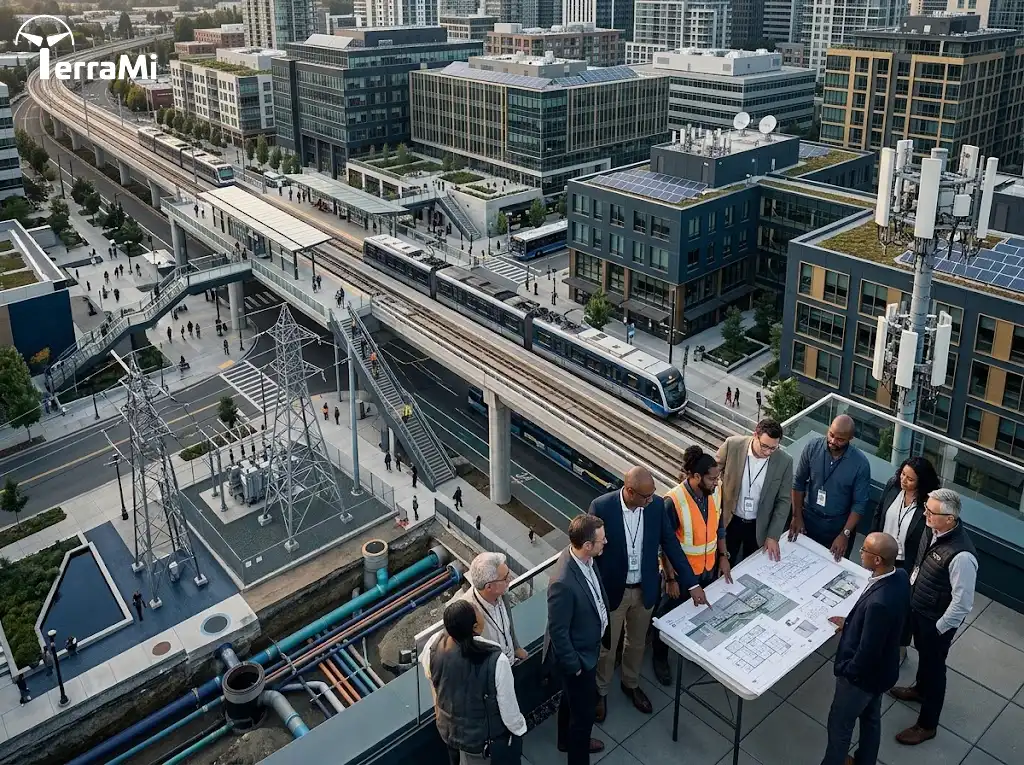
Smart-city planning needs to account for those consequences before they become operational problems.
This does not mean that every infrastructure decision needs an enormous modelling exercise. It means that planners and engineers need to identify the most important dependencies early enough to influence design.
The question is no longer only whether an individual project works.
It is whether the project strengthens or weakens the wider infrastructure network in which it operates.
The Physical City Still Comes First
There is a tendency to describe smart cities primarily through their digital layer. Yet the physical infrastructure remains the foundation.
Sensors cannot compensate for an unreliable water network. A sophisticated mobility platform cannot eliminate inadequate transport capacity. Digital energy management cannot replace resilient power infrastructure. A city cannot become more intelligent simply by adding software to infrastructure that was poorly planned, maintained, or coordinated.
The digital and physical layers need to evolve together.
This is especially important because digital infrastructure itself has become physical infrastructure in all but name. Data centres require power and cooling. Telecommunications depend on fibre, wireless networks, towers, exchanges, and power systems. Connected mobility depends on physical transport networks as well as digital services. Cloud-based urban applications depend on a chain of facilities and communications infrastructure that users rarely see.
The boundary between “digital infrastructure” and “traditional infrastructure” is consequently becoming less useful.
A connected transport system depends on roads, vehicles, sensors, communications, energy, software, and operational control. A smart building depends on its physical structure, mechanical and electrical systems, connectivity, controls, and data. A modern utility depends on physical networks and digital systems that monitor and manage them.
These are not separate worlds.
They are layers of the same infrastructure ecosystem.
That has an important consequence for investment decisions. Digital infrastructure should not be treated simply as an optional enhancement added after a physical project has been designed. In many cases, connectivity, sensing, data architecture, cybersecurity, and interoperability need to be considered as part of the infrastructure’s original design.
The same principle applies in reverse: digital systems need to understand the physical conditions and constraints of the assets they monitor.
Integration Changes How Resilience Is Understood
Interconnected infrastructure can improve resilience, but interconnection can also create new vulnerabilities.
This is one of the central tensions in the smart-city model.
A connected system can detect a disruption earlier, reroute services, provide better information to operators, and coordinate a response across organizations. But if critical services become dependent on the same communications, cloud, energy, or control infrastructure, a failure in that shared layer can have consequences across multiple sectors.
Greater connectivity does not automatically produce greater resilience. It produces greater interdependence.
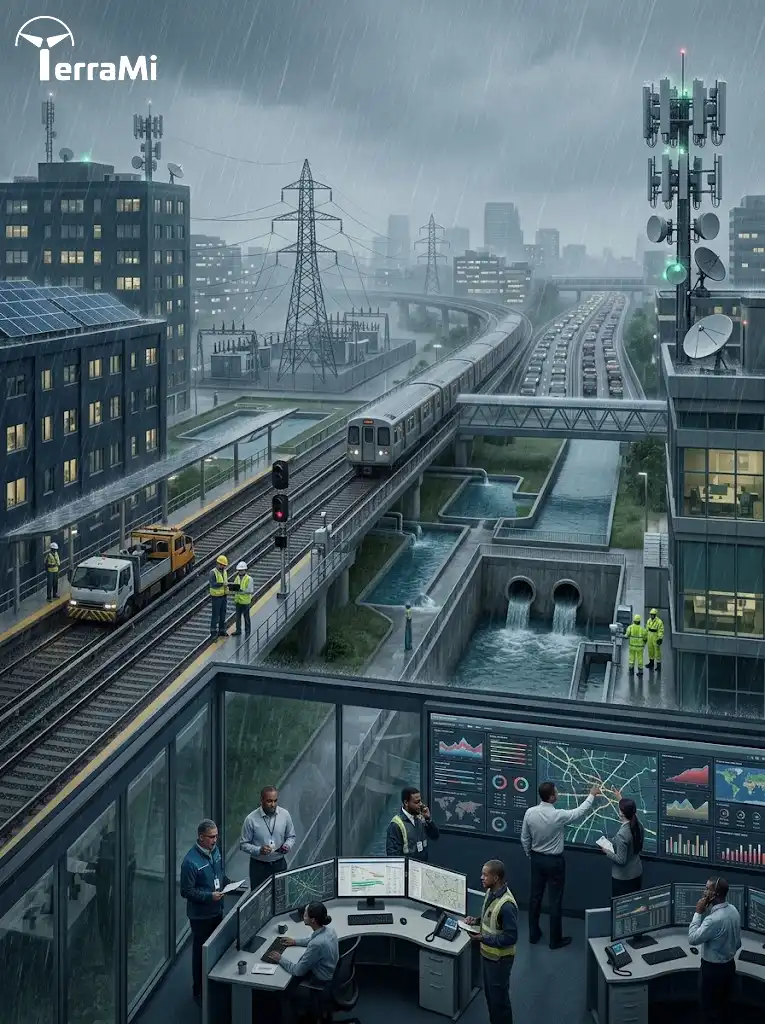
Whether that interdependence becomes an advantage or a weakness depends on how the system is designed.
Resilient smart-city infrastructure therefore needs redundancy, fallback mechanisms, cybersecurity, operational independence where necessary, and clear recovery procedures. Critical services should not become unable to function simply because a digital platform, communications network, or centralized control environment is unavailable.
This is a particularly important design principle as cities adopt increasingly automated systems.
The more infrastructure operations depend on digital coordination, the more important it becomes to understand what happens when that coordination fails.
A resilient system is not one that assumes technology will always work. It is one that has been designed with failure in mind.
That principle connects smart-city development directly to broader infrastructure resilience. The objective is not maximum connectivity at any cost. It is useful connectivity combined with controlled dependencies.
Governance Becomes Infrastructure
The technical architecture of a smart city can be impressive and still fail to deliver lasting value if governance is weak.
Someone has to decide which data can be shared. Someone has to define responsibilities. Someone has to resolve conflicts between organizations. Someone has to establish standards. Someone has to determine how systems should respond when their objectives differ.
These are governance questions, but they have direct consequences for infrastructure performance.
Consider a citywide mobility system that integrates public transport, traffic management, parking, micromobility, and emergency response. The technical possibility of connecting these services does not determine whether the integration will actually happen. Different organizations may have different mandates, budgets, procurement systems, privacy requirements, and operational priorities.
Without governance mechanisms that support collaboration, the technology can remain fragmented even when the technical architecture exists.
This is why smart-city maturity should not be measured only by the number of connected assets or the sophistication of a city’s digital platform.
A more meaningful assessment would consider whether the city can:
- exchange relevant information across institutional boundaries;
- establish common standards and definitions;
- coordinate decisions across infrastructure sectors;
- understand critical dependencies;
- protect sensitive systems and information;
- maintain accountability when multiple organizations share responsibility;
- and convert information into decisions that improve urban outcomes.
These capabilities are less visible than a new digital command centre, but they determine whether the command centre can actually improve the city.
The Role of Digital Twins and Real-Time Urban Intelligence
As infrastructure systems become more connected, digital twins can provide another layer of integration.
A digital twin is not simply a three-dimensional representation of a physical asset. In a mature infrastructure environment, it can become a dynamic representation that combines information about physical conditions, operational performance, environmental conditions, and system relationships.
At the urban scale, this creates the possibility of examining interactions that are difficult to understand through isolated infrastructure models.
A city could use integrated models to explore how changes in transport demand affect energy consumption, how extreme weather could influence multiple infrastructure networks, or how a new development might alter pressure on mobility, utilities, and public services.
The value is not the visual model itself.
The value lies in the ability to test relationships before decisions are made in the physical world.
This also points toward a broader change in infrastructure planning: from describing what exists toward understanding how the system behaves.
That distinction becomes important when cities face conditions that are difficult to predict. Historical data can explain how infrastructure performed under previous conditions. Integrated models can help explore how systems might behave under conditions that have not yet occurred.
This is one reason the convergence of data, digital twins, IoT, and AI is becoming strategically important. Each technology addresses a different part of the infrastructure intelligence problem.
Sensors provide observations.
Connected systems provide flows of information.
Digital twins provide models of assets and systems.
AI can help identify patterns, anomalies, relationships, and possible responses.
But none of these components is sufficient in isolation.
The real opportunity emerges when they operate within an infrastructure environment that has the standards, governance, physical capacity, and institutional coordination required to use them responsibly.
Smart Cities Need a Different Definition of Performance
The success of an integrated infrastructure network cannot be judged only by the performance of its individual components.
A transport system may reduce journey times while increasing energy demand elsewhere. A building may become more energy efficient while shifting demand to the electricity grid. A water utility may improve operational efficiency while remaining vulnerable to a regional power disruption.
Sector-specific performance indicators remain necessary, but they need to be complemented by measures that reveal system-level outcomes.
This means asking questions such as:
Does the infrastructure network recover quickly from disruption?
Can operators identify dependencies before they become failures?
Can different agencies coordinate during a major event?
Can infrastructure capacity adapt as demand changes?
Can investment in one sector improve performance in another?
Can the city maintain essential services when part of its digital infrastructure is unavailable?
These questions shift the definition of a smart city from technological sophistication toward system performance.
That shift also matters for sustainability.
Urban infrastructure accounts for a substantial share of global resource use and emissions, but improving sustainability is not simply a matter of making each asset more efficient. The way systems interact can create opportunities that are invisible when each sector is considered separately.
Waste heat from one process may become a resource for another. Energy demand can be coordinated across buildings and mobility. Water and energy systems can be planned together. Existing infrastructure can be used more efficiently through better information rather than through continuous physical expansion.
The circular economy logic that applies to individual infrastructure systems can, at the urban scale, become a question of how resources, energy, materials, information, and capacity circulate between interconnected systems.
A smart city, in this sense, is not merely a city that knows more about itself.
It is a city that can use what it knows to coordinate its infrastructure more intelligently.
Integration Is a Long-Term Infrastructure Capability
Cities do not become integrated overnight.
Much of today’s urban infrastructure will remain in service for decades. Legacy systems will coexist with new digital platforms. Different generations of technology will operate simultaneously. Some infrastructure will be highly connected while other assets remain difficult to monitor or integrate.
That reality makes interoperability and adaptability more important than technological novelty.
Infrastructure designed today needs to remain capable of interacting with systems that may not yet exist. Data standards will evolve. Sensors will be replaced. software platforms will change. New mobility models will emerge. Energy systems will become more distributed. Climate conditions will continue to change.
A smart-city strategy that depends on one technology stack or one generation of digital infrastructure risks becoming obsolete before the physical infrastructure reaches the end of its useful life.
The better approach is to build adaptable infrastructure architectures.
That means designing interfaces, data structures, governance arrangements, and physical systems that can accommodate change. It also means treating integration as an ongoing capability rather than a one-time project.
The most advanced city may not be the one with the largest number of sensors or the most impressive digital control room.
It may be the one that can make a change in one infrastructure system without losing sight of what that change means for the others.
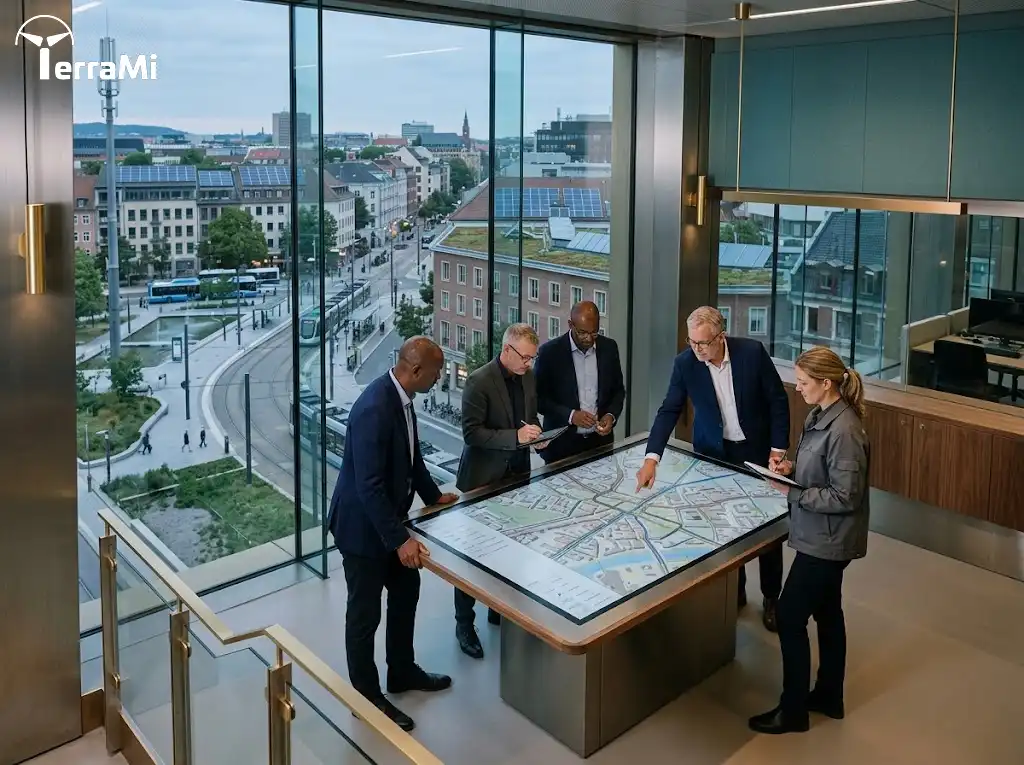
That is a much harder problem.
It is also much closer to what intelligent infrastructure will require.
Building the Integrated Infrastructure City
The transition toward integrated infrastructure networks will not happen through a single technology, project, or municipal programme. It requires a change in how infrastructure decisions are made over time.
The first step is to identify the systems that matter most.
Not every urban asset needs to be connected to every other asset. Trying to create universal connectivity can produce unnecessary complexity, increase cybersecurity exposure, and generate large volumes of information with little practical value.
A better approach begins with critical dependencies.
Which infrastructure systems are essential to one another? Which failures could create cascading consequences? Where would better information materially improve operational decisions? Which connections could improve resilience, resource efficiency, or public service delivery?
These questions provide a more useful starting point than simply asking where another sensor or digital platform could be deployed.
Once critical relationships are understood, cities can prioritize integration around the areas where it can produce the greatest value.
This might mean connecting transport and energy planning in areas with rapidly growing electric mobility. It could mean linking water, energy, and climate-risk information in regions exposed to drought or flooding. It could mean integrating building data with district energy systems. In another context, the priority might be telecommunications resilience because so many other infrastructure services depend on continuous connectivity.
There is no universal smart-city architecture.
The appropriate architecture depends on the physical characteristics of the city, its infrastructure maturity, institutional structure, risk profile, and long-term objectives.
From Projects to Infrastructure Ecosystems
One of the most significant changes is a move away from thinking about smart-city initiatives as isolated projects.
A city may launch a smart parking programme, a traffic-management platform, a digital building initiative, or an intelligent water network. Each project can have a legitimate business case.
But if the projects are developed independently, the city may end up with a collection of successful digital applications rather than an integrated infrastructure ecosystem.
The difference is strategic.
A project has a defined scope, budget, schedule, and completion point.
An infrastructure ecosystem has relationships that continue to evolve.
This means that cities need to think beyond project delivery and consider the long-term architecture of their infrastructure networks. New investments should be evaluated partly on their ability to connect with existing systems and support future integration.
Procurement becomes important here.
If infrastructure contracts specify only the immediate function of an asset, integration may become difficult later. Requirements around data formats, interfaces, interoperability, cybersecurity, ownership, access rights, and lifecycle management can determine whether a new system remains adaptable.
This is not a technical detail to be resolved after procurement.
It is an infrastructure design decision.
The same applies to engineering specifications. A physical asset may operate perfectly as an isolated system while creating significant integration challenges at the network level. Designing for interoperability needs to become part of the asset lifecycle, from planning and design through construction, operation, maintenance, renewal, and eventual replacement.
The Human Side of Smart Infrastructure
The more connected infrastructure becomes, the more important people become.
This may appear counterintuitive. Smart-city discussions often emphasize automation and artificial intelligence because these technologies can process information at speeds and scales beyond human capacity.
But infrastructure decisions still involve judgement.
An algorithm can identify an unusual energy pattern. It cannot, by itself, determine whether the pattern represents a malfunction, a temporary operational change, a legitimate emergency response, or a broader shift in demand that requires investment.
A predictive model can identify a potential failure. Someone still needs to determine the appropriate intervention.
A citywide platform can reveal a relationship between transport demand and energy consumption. Institutions still need to agree on what action should follow.
This makes organizational capability part of infrastructure intelligence.
Engineers, planners, operators, policymakers, technology specialists, and infrastructure owners need enough shared understanding to interpret information across disciplinary boundaries. They do not all need to become experts in every sector, but they need to understand how their decisions affect the systems around them.
The future infrastructure professional may increasingly need to think in terms of networks rather than isolated assets.
That is a substantial cultural change.
Trust Is Part of the Infrastructure
There is another dimension that cannot be separated from integration: public trust.
A smart city can collect information about mobility, buildings, energy use, public spaces, and patterns of urban activity. That capability can improve services, but it can also create legitimate concerns about privacy, surveillance, cybersecurity, data ownership, and how information is used.
Technical capability does not answer those concerns.
Governance must establish clear boundaries around data collection and use, especially when systems involve sensitive information or affect public services.
The issue is not simply whether data can legally be collected. Cities also need to consider whether the purpose is clear, whether the collection is proportionate, whether people understand how information is used, and whether safeguards are credible.
Trust becomes even more important as automated decision-making expands.
If an infrastructure system begins to influence traffic management, energy allocation, emergency response, or access to services, people need confidence that the system is operating within appropriate rules and that there is meaningful accountability when something goes wrong.
A city that is technologically connected but institutionally opaque is not necessarily smart.
It may simply be more automated.
Measuring What Integration Actually Delivers
The next challenge is measurement.
Smart-city programmes often produce easily reported numbers: devices installed, kilometres of fibre deployed, applications launched, buildings connected, data points collected, or users registered.
These indicators describe activity.
They do not necessarily demonstrate value.
The more important question is what changed because the infrastructure became more connected.
Did emergency response improve?
Did energy demand become easier to manage?
Did infrastructure downtime decrease?
Did maintenance become more predictive?
Did different agencies coordinate more effectively?
Did the city become more resilient to disruption?
Did investment decisions improve because dependencies became visible?
Did residents receive better services without unacceptable trade-offs in privacy or equity?
These are harder outcomes to measure, but they provide a much stronger basis for evaluating whether a smart-city strategy is working.
This also introduces an important distinction between digital maturity and infrastructure maturity.
A city can be highly digital and still have fragmented infrastructure governance. It can have advanced analytics while struggling with basic asset maintenance. It can collect enormous volumes of information without having the institutional capacity to act on it.
Digital maturity should support infrastructure maturity.
It should not become a substitute for it.
Equity Cannot Be Left Outside the Network
Integrated infrastructure also raises a question that technology alone cannot answer: who benefits?
Connected infrastructure can improve access to services, optimize resource use, and make cities more responsive. But benefits may not be distributed evenly.
Areas with better connectivity, newer buildings, stronger institutions, or greater investment capacity may adopt advanced systems more quickly. Communities with older infrastructure or limited digital access may receive fewer benefits even though they may have significant infrastructure needs.
This creates a risk of building a two-speed city: highly intelligent infrastructure in some areas and persistent infrastructure deficits in others.
A smart-city strategy therefore needs to consider infrastructure equity alongside technological capability.
The objective should not be to make every part of the city equally digital.
It should be to ensure that the benefits of better infrastructure coordination contribute to better urban outcomes across the city.
That requires attention to access, affordability, reliability, resilience, and the quality of essential services—not simply the sophistication of the digital interface through which those services are delivered.
The City as a Living Infrastructure System
The most useful way to think about the smart city may be as a living infrastructure system.
It changes continuously.
Population patterns shift. Climate conditions evolve. Mobility behaviour changes. New technologies emerge. Infrastructure ages. Energy systems are transformed. Economic activity moves between locations. New risks appear while old ones become more severe.
A static infrastructure plan cannot fully account for this level of change.
An integrated infrastructure ecosystem can respond more effectively because it has greater visibility into how the system is behaving and how its components influence one another.
But responsiveness should not be confused with constant intervention.
Sometimes the intelligent decision is to do nothing.
Sometimes the right response is maintenance rather than replacement, coordination rather than expansion, or better use of existing capacity rather than construction of another asset.
This is one of the strongest arguments for systems-based infrastructure intelligence: it can help cities move from reacting to isolated problems toward understanding the conditions that create them.
The objective is not a city where every infrastructure system is continuously adjusting itself.
The objective is a city where infrastructure decisions are informed by a clearer understanding of the whole system.
Beyond the Smart City
The term “smart city” may eventually become less important than the capability it describes.
As digital systems become embedded in infrastructure, connectivity will stop being a special feature of selected projects. It will become a normal characteristic of infrastructure planning and operation.
The more important question will then be whether cities can manage this connectivity intelligently.
That means understanding dependencies. Designing for interoperability. Protecting critical systems. Sharing information responsibly. Building institutional capacity. Maintaining human accountability. Planning for failure. And evaluating infrastructure according to system-level outcomes rather than isolated technological achievements.
This is a more demanding definition of intelligence.
It does not ask whether a city has enough sensors, enough data, or enough automation.
It asks whether the city’s infrastructure can sense, understand, coordinate, and adapt without losing sight of the people and physical systems it exists to serve.
That is the direction in which smart cities are likely to evolve: not as collections of increasingly sophisticated technologies, but as increasingly connected infrastructure ecosystems.
And once infrastructure begins to operate as an ecosystem, the boundaries between transport, energy, water, buildings, communications, and digital systems become less meaningful than the relationships between them.
The future of urban infrastructure will be shaped not only by how intelligent individual systems become, but by how intelligently the systems work together.
TerraMi Perspective
The next generation of urban infrastructure will not be defined simply by how much technology cities deploy. It will be defined by how well their infrastructure systems work together.
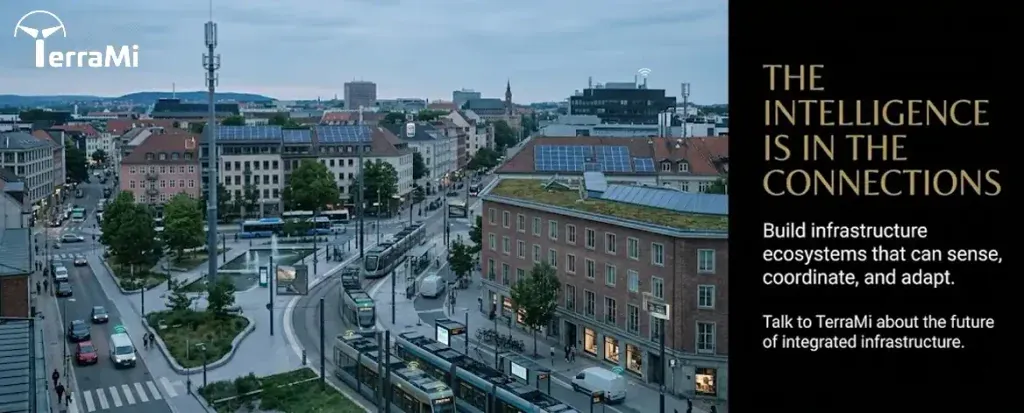
That distinction matters.
A city can invest heavily in sensors, platforms, automation, and artificial intelligence while continuing to plan transport, energy, water, buildings, and communications through disconnected institutional and operational structures. In that environment, digital capability can grow without creating corresponding infrastructure intelligence.
The more useful direction is to treat the city as a system of interconnected infrastructure systems.
That requires more than technical interoperability. It requires shared priorities, clear governance, appropriate data standards, resilient physical and digital foundations, and organizations capable of making decisions across traditional sector boundaries. International work on smart-city governance increasingly points in this direction: interoperability depends not only on technology, but also on institutional, organizational, semantic, legal, and governance arrangements.
For infrastructure leaders, this changes the strategic question.
Instead of asking, “How can we make this infrastructure asset smarter?”, the more important question may be:
“How can this asset contribute to a smarter infrastructure system?”
That is a different way of thinking about investment, engineering, operations, resilience, and long-term planning.
It also creates an important bridge toward the next stage of infrastructure intelligence, where AI, IoT, digital twins, and other technologies increasingly converge. Their value will depend less on the sophistication of each individual technology and more on the quality of the infrastructure ecosystem in which they operate.
A connected city is not automatically an intelligent city.
The intelligence emerges from the connections.
A Next Step for Infrastructure Leaders
For organizations assessing their own readiness for this shift, the starting point does not need to be another technology purchase.
It can begin with a simple assessment of where the organization stands today: how infrastructure data is used, where information remains fragmented, how decisions cross organizational boundaries, and whether current systems are ready to support greater integration.
Explore TerraMi’s AI Pre-Assessment to begin that conversation from your organization’s current position.
Q&A
What makes a city a smart city?
A smart city uses digital technologies, data, and connected infrastructure to improve how urban systems operate and how decisions are made. But technology alone is not enough. A genuinely smart city also needs interoperability, effective governance, resilient infrastructure, institutional coordination, and a clear focus on public outcomes.
What are integrated infrastructure networks?
Integrated infrastructure networks are interconnected systems in which different infrastructure sectors—such as transport, energy, water, buildings, telecommunications, and digital infrastructure—can exchange relevant information and coordinate their operations or planning.
The goal is not necessarily to place every system on one platform. It is to enable appropriate interaction between systems where their performance, risks, or decisions are interdependent.
Why is interoperability important in smart cities?
Interoperability allows different systems and organizations to exchange and use information in meaningful ways. It includes technical compatibility, but also shared data definitions, organizational processes, legal arrangements, standards, and governance. Without these foundations, connected systems can remain isolated despite having sophisticated technology.
Is a smart city mainly about IoT and sensors?
No. IoT devices and sensors can provide valuable information about infrastructure conditions and urban activity, but they are only one component of a smart-city ecosystem.
The larger challenge is turning information into coordinated decisions. A city can deploy large numbers of connected devices without solving institutional fragmentation, poor data quality, weak interoperability, or inadequate infrastructure planning.
How do smart cities improve infrastructure resilience?
Integrated systems can improve resilience by providing greater visibility into infrastructure conditions and dependencies, allowing organizations to detect disruptions earlier and coordinate responses across sectors.
However, greater connectivity can also create new dependencies. Smart infrastructure therefore needs redundancy, cybersecurity, fallback capabilities, and clear recovery procedures so that a failure in one digital or physical layer does not unnecessarily cascade across critical services.
What role do digital twins play in integrated infrastructure?
Digital twins can provide dynamic representations of infrastructure assets or systems by combining information about physical conditions, operations, and environmental or contextual factors.
At larger scales, they can help planners and operators explore relationships between infrastructure systems, test scenarios, identify dependencies, and evaluate potential interventions before making changes in the physical environment.
What is the biggest barrier to integrated smart-city infrastructure?
The biggest barrier is rarely a lack of technology alone. Fragmented governance, incompatible systems, inconsistent data standards, organizational boundaries, legacy infrastructure, procurement practices, cybersecurity concerns, and unclear responsibility can all limit integration.
This is why smart-city development increasingly needs to be treated as an organizational and infrastructure-planning challenge, not simply a technology programme. OECD analysis similarly emphasizes governance, interoperability, standards, coordination, and data management as central conditions for effective smart-city development.
Does a smart city need one central data platform?
Not necessarily. A city can operate with multiple platforms and decentralized systems as long as appropriate standards, interfaces, governance arrangements, and data-sharing mechanisms allow them to work together.
The objective is not maximum centralization. It is useful and controlled integration.
How can cities avoid creating technology silos?
Cities can address this by considering interoperability from the beginning of infrastructure and technology projects. Open interfaces, common standards, reusable data structures, clear ownership and access rules, cybersecurity requirements, and lifecycle planning can reduce the risk of creating systems that work only within one project or vendor environment.
Interoperability should be treated as an ongoing capability rather than a one-time technical integration exercise.
What should infrastructure leaders measure in a smart city?
They should measure outcomes, not only technology deployment.
Useful measures can include infrastructure reliability, response and recovery times, energy and resource efficiency, cross-sector coordination, service accessibility, data quality, operational visibility, and the ability to manage disruptions.
The number of sensors installed or data points collected can indicate activity, but it does not by itself demonstrate that infrastructure performance has improved.